
French Drain vs. Retaining Wall Drainage: Which Do You Need?
November 4th, 2026French drain vs retaining wall: 5 Practical Clues for Homeowners
Quick Answer: If you are comparing French drain vs retaining wall solutions, start with where the water is collecting. A yard French drain generally collects and carries water through a soggy landscape area, while retaining wall drainage manages water that builds up on the uphill side of a retaining wall. If water is sitting directly behind the wall, a drain placed elsewhere in the yard may not address that pressure or seepage path. The right answer depends on the water source, slope, soil, wall location, discharge destination, and an on-site inspection.
For homeowners around Garner, Raleigh, and the Triangle, this distinction matters because yard runoff, hillside drainage, retaining walls, crawl spaces, and basements often overlap. A wet lawn may be a landscape drainage problem. A damp crawl space may point to foundation or interior moisture concerns. Water behind retaining wall areas may require attention at the wall itself, not just a pipe somewhere in the yard.
Drainage & Waterproofing Solutions, LLC approaches these decisions by looking at the water source first. The goal is not to sell every homeowner the same system. The goal is to understand where water starts, how it moves, where it collects, and where it can safely discharge without creating a new problem.
French drain vs retaining wall: 5 practical clues that guide the choice
The choice usually comes down to five practical clues. These are more useful than the name of the system because the same yard can have more than one water problem.
- Water source: where the water starts.
- Collection point: where water visibly sits or seeps.
- Slope: how the ground moves water during rain.
- Wall-to-house relationship: whether the wall, yard, and foundation influence each other.
- Discharge route: where collected water can safely go.
A yard French drain may make sense when water is moving through or across the lawn, collecting in a low area, or traveling toward the home. Retaining wall drainage may be the better discussion when water is collecting in the backfill area behind a wall, staining the wall, seeping through joints, or saturating soil directly uphill of the wall.
The U.S. Department of Energy’s Building America Solution Center explains that site measures such as gutters, downspouts, grading, swales, drains, footing drains, and sump systems can help reduce standing water and localized flooding around homes during rainy conditions. That Building America site-drainage guidance supports looking at the whole site instead of assuming one pipe solves every wet spot.
Clue 1: the water source
The first question is where the water starts. Roof runoff, driveway runoff, a hillside, compacted soil, a neighboring grade, and a low lawn area can all create similar wet spots. A yard French drain may help when the water source is shallow subsurface water or runoff moving through the landscape. Retaining wall drainage becomes more important when the water source is feeding the uphill side of the wall.
Clue 2: the collection point
Where water collects often tells you which part of the property needs attention. Water spread across a lawn points to yard drainage. Water sitting directly behind a wall, seeping through joints, or staining the wall face points toward drainage behind retaining wall areas. Water at a basement wall-floor joint or inside a crawl space may require a separate waterproofing assessment.
Clue 3: the slope
Slope controls how water moves. If water visibly flows across the surface during rain, grading or a swale may belong in the plan. If water disappears into soil and reappears as saturated ground, a drainage system may be needed. If the slope pushes water into a wall, the wall area should be inspected before assuming a yard French drain somewhere else will solve it.
Clue 4: the wall’s relationship to the house
A retaining wall near the house can affect more than the wall itself. Water behind retaining wall areas may influence nearby soil, foundation conditions, basement moisture, or crawl-space dampness. That does not mean every wall problem is structural, but it does mean the wall, yard, and house should be evaluated together.
Clue 5: the discharge route
The outlet is not an afterthought. Whether the project involves a yard French drain, retaining wall drainage, grading, or waterproofing, the collected water needs a suitable discharge route. A poor outlet can create erosion, move the wet spot, or send water where it should not go.
| Possible solution | Main purpose | Best-fit clues | Main limitation |
|---|---|---|---|
| Yard French drain | Collect and convey water through a landscape area | Soggy lawn, recurring wet strip, runoff toward the house, or a low area away from the wall | It may not relieve water collecting directly behind a retaining wall |
| Retaining wall drainage | Manage water on the uphill side of a retaining wall | Wet soil behind the wall, seepage through wall joints, staining, or runoff concentrated above the wall | It must be coordinated with wall conditions, grading, and a suitable outlet |
| Grading or swale | Redirect surface runoff before it reaches the problem area | Water visibly flows across the ground during rain | It may not control subsurface water or saturated soil |
| Interior drain system | Collect water that has reached the basement or crawl-space perimeter | Water appears at the wall-floor joint, under a slab, or inside the crawl space | It does not correct every exterior water source |
| Foundation waterproofing or moisture control | Reduce moisture entry or manage interior moisture conditions | Damp walls, seepage, or crawl-space moisture after exterior conditions are considered | The correct approach depends on the water source and building condition |
What a yard French drain is built to do
A French drain installation is typically used to intercept and move water through a landscape area. In a residential yard, that can mean collecting water from a soggy strip, a recurring low spot, or an area where runoff and shallow subsurface water tend to gather after storms.
A yard French drain is not just “a pipe in gravel.” It should be planned around the way water enters the area, the depth and route of the trench, the collection material, the filter fabric or separation strategy where used, and the discharge point. If the outlet is poor, blocked, uphill, or aimed toward a neighbor, the system is incomplete even if the trench itself looks right.
A yard French drain may be part of the discussion when water is away from the retaining wall and moving through the yard toward a low point. It may also be considered when runoff travels toward a crawl space, basement wall, patio, or driveway area. It is not automatically the right answer when the problem is water trapped behind a wall.
In Garner and the surrounding Triangle, heavy rain can reveal flow paths that are hard to see on a dry day. Water may sheet across a lawn, follow a fence line, move along a driveway edge, or collect where landscaping has changed the original grade. That is why the inspection should include the high point, low point, roof drainage, hard surfaces, and the route water would take during a storm.
What retaining wall drainage is built to do
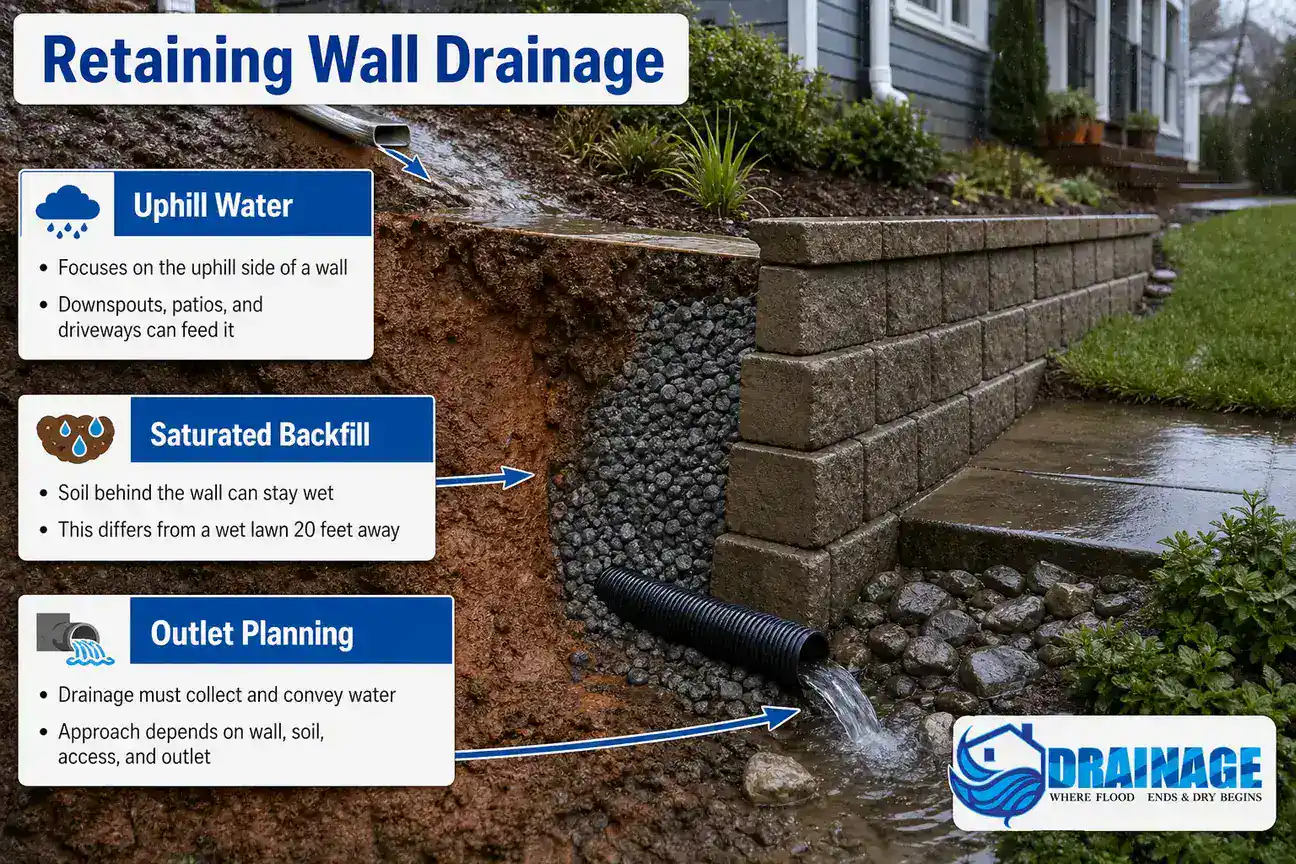
Retaining wall drainage is focused on water that reaches the uphill side of a wall. A retaining wall holds back soil; when the soil behind it stays saturated, drainage details and discharge planning become important. This is a different problem from a wet lawn 20 feet away.
Retaining wall drainage may involve collection and conveyance behind or near the wall, but the specific approach depends on the wall, site conditions, soil, access, and outlet. A contractor should not look only at the face of the wall. The uphill area matters: downspouts, patios, driveways, compacted soil, planted beds, and neighboring grades can all send water toward the wall.
Drainage work is also not the same as structural engineering. If a retaining wall shows significant movement, bulging, settlement, or concerning cracking, the homeowner should contact an appropriately qualified structural professional. Drainage & Waterproofing Solutions, LLC provides drainage, waterproofing, crawl space, and retaining wall services, but does not provide structural engineering or foundation structural repair.
When the issue is water behind retaining wall areas, the inspection should ask whether the wall is below a slope, beside a house, or downhill from a roof or paved surface. The answer affects whether the project is about a wall drainage detail, broader yard runoff, grading, or a combination of systems.
Drainage behind retaining wall: what inspectors look for
Homeowners often search for drainage behind retaining wall information after seeing stains, seepage, wet soil, or erosion around the wall. Those signs do not prove a specific failure, but they do show that water needs to be traced carefully.
During an on-site inspection, the contractor should look for the first place water appears, not just the most visible wet spot. Water that shows at the base of a wall may have started as roof runoff, driveway runoff, a slope above the wall, or saturated soil that drains slowly after repeated rain.
Key inspection questions include:
- Is the wall uphill or downhill from the house?
- Does the yard slope toward the wall, away from it, or along it?
- Is the soil wet directly behind the wall or mainly in the yard beyond it?
- Does water appear during rain only, or does it continue after the storm?
- Are downspouts, patios, driveways, or neighboring grades adding water to the area?
- Is there a visible outlet for existing wall drainage?
- Could an outlet cause erosion or send water toward another property?
- Has water entered the basement or crawl space?
Drainage behind retaining wall areas should be coordinated with the broader site. A new wall drain that discharges into a flat, soggy area can create another wet spot. A yard drain that bypasses the wall may leave the wall’s backfill saturated. The inspection has to connect cause, collection, conveyance, and outlet.
Why water behind retaining wall signs deserve attention
Water behind retaining wall areas is different from normal surface wetness in the yard because it is interacting with soil held by the wall. That does not mean a homeowner should assume structural failure. It means the drainage path should be evaluated before water is casually redirected or excavation begins.
Some common clues include damp soil immediately behind the wall, seepage through wall joints, water stains on the face of the wall, soil washing out near the base, or water collecting above the wall after every hard rain. These symptoms can overlap with grading problems, downspout discharge, or concentrated runoff from hard surfaces.
The decision is especially important when the wall is located between a slope and the house. In that situation, drainage choices can affect the yard, wall, foundation area, and crawl space or basement. A yard French drain may help intercept water before it reaches the house, but if the wall itself is where water collects, retaining wall drainage still needs to be part of the conversation.
Do not dig casually beside a retaining wall or foundation. Excavation can expose utilities, disturb soil, or make an already wet area less stable. Call NC 811 before digging, and contact the proper structural professional if you notice wall movement, settlement, or major cracking.
When a yard French drain makes more sense
A yard French drain is more likely to fit when the wet area is in the landscape rather than directly behind the wall. For example, water may travel across the lawn after storms, collect along a fence line, or move toward the foundation from a shallow swale that no longer drains well.
A yard French drain may also be discussed when the problem is recurring soggy ground near a walkway, driveway, or side yard. In those cases, the drain route should be planned to intercept water before it reaches the home and discharge it to a suitable location. The outlet is just as important as the trench.
A yard French drain is not a substitute for drainage behind retaining wall areas when water is accumulating directly at the wall. It also may not be the first choice when the main problem is surface runoff that could be redirected by grading or a swale. The inspection should sort out whether water is flowing over the ground, staying in saturated soil, or collecting against a wall.
Homeowners can do a few safe observations before requesting an estimate. Watch where water first appears during a normal rain. Look at downspout discharge points. Note whether water is moving across the surface or appearing later as saturated soil. Take photos from a safe place. Do not enter flooded areas near electrical outlets, panels, or equipment.
When retaining wall drainage is the stronger clue
Retaining wall drainage becomes the stronger clue when water is concentrated at the wall rather than spread across the yard. If the uphill side is wet, the wall face shows seepage, or water emerges through joints or at the base, the inspection should focus on the wall area and the water feeding it.
Retaining wall drainage also deserves attention when the wall sits below a broad slope, driveway, patio, or roof drainage area. Hard surfaces can send water quickly to one spot. Soil behind the wall can stay wet after the storm has passed. If that water has no practical path out, it can keep the area damp and contribute to erosion or staining.
This does not mean every retaining wall problem is solved by the same drain detail. The wall type, access, condition, height, surrounding grades, and discharge route matter. Local permit or approval requirements may also apply depending on the scope. The North Carolina Residential Code section addressing retaining walls is one reason homeowners should confirm requirements with their local building department instead of assuming a wall project is informal yard work.
For properties in Garner and nearby areas, a retaining wall may be part of a larger drainage picture. The yard may need a collection system, the wall may need drainage, and the house may need separate waterproofing or moisture-control evaluation if water has already reached the interior.
Grading, swales, and roof runoff can change the answer
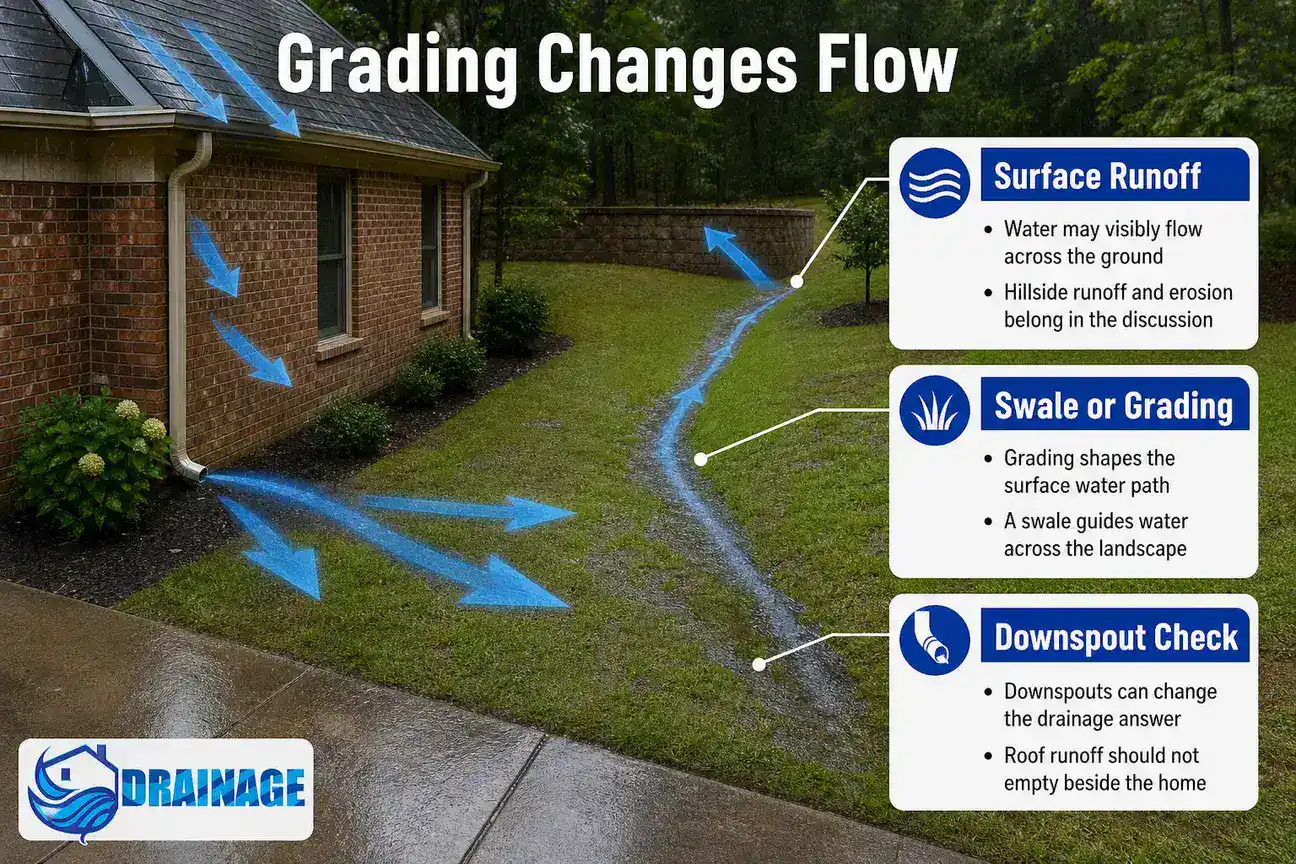
Sometimes the best first conversation is not a drain at all. If water visibly flows across the ground, grading or a swale may help direct surface runoff before it reaches the wall or home. That is why when yard grading is essential belongs in the discussion for hillside runoff and erosion.
Grading is about shaping the surface so water moves in a planned direction. A swale is a shallow, graded path that guides water across the landscape. These can be useful when the water is clearly moving over the surface. They are less likely to solve water trapped in soil behind a wall or water that has already entered the basement or crawl space.
Downspouts also need attention. A downspout that empties above a retaining wall can concentrate roof water right where it is least helpful. A downspout that discharges near a foundation can add to basement or crawl-space moisture concerns. Moving roof water is not just a matter of adding extensions; the discharge point still has to be acceptable and should not create erosion or affect another property.
The NC DEQ Erosion and Sediment Control Planning and Design Manual discusses runoff-control and runoff-conveyance measures such as diversions, grass-lined channels, riprap or paved channels, and slope drains in the context of minimizing erosion and sedimentation from land-disturbing activities. That NC DEQ erosion and sediment control guidance is a reminder that the outlet and erosion control are part of the drainage system, not an afterthought.
Where the water can discharge safely
A drainage system without a suitable discharge destination is unfinished. Whether the system is a yard French drain, retaining wall drainage, or a grading improvement, the collected water has to go somewhere that is practical, lawful, and unlikely to create a new problem.
Do not route drainage water onto a neighboring property. Do not connect yard or wall drainage to a sanitary sewer. Do not assume a street, ditch, storm drain, or public system is an approved discharge point just because it is nearby. Public systems, easements, right-of-way areas, and stormwater facilities can have local rules and approval requirements.
The discharge point should be evaluated for slope, erosion potential, access, ownership, and downstream effects. It may need outlet protection or another site-specific detail to reduce erosion. If the discharge area is flat, blocked, or already saturated, a new drain may simply move the problem from one place to another.
NC DEQ’s stormwater program information is a useful reminder that stormwater can involve public systems, regulated programs, and local requirements, not just water moving across one yard. Review the NC DEQ stormwater page and confirm property-specific requirements with the local authority before changing runoff patterns or discharging toward public drainage features.
Local rules differ. Raleigh homeowners, for example, can consult the city’s drainage assistance information for examples of how local stormwater concerns are handled, but requirements depend on the property and jurisdiction. The City of Raleigh stormwater drainage assistance page is a useful reminder that drainage issues can involve private property conditions, public systems, and downstream impacts.
For Garner-area homeowners, the practical takeaway is simple: the outlet must be part of the plan from the start. A contractor should be able to explain where the water will go, how it will get there, what could block it, and whether local approval should be confirmed before work begins.
When the house needs a separate waterproofing assessment
Outdoor drainage and retaining wall drainage can reduce water pressure or redirect water outside, but water already inside the home needs its own assessment. If the basement wall-floor joint is wet, water appears under a slab, or a crawl space stays damp, the project may involve more than a yard drain.
In that case, the inspection should include exterior drainage, foundation conditions, interior drainage options, sump equipment, humidity, and crawl-space details. Crawl space and basement waterproofing may be relevant when water has reached the interior. Foundation waterproofing may also be part of the discussion depending on the water source and wall conditions.
It is important not to jump to conclusions. Interior water does not automatically identify the correct repair. It may be connected to grading, downspouts, wall drainage, exterior waterproofing, an interior drain system, a sump pump, or a combination. It may also involve plumbing or other issues outside the scope of drainage work, in which case the right professional should be called.
Drainage & Waterproofing Solutions, LLC does not provide mold testing, mold remediation, plumbing, sewer repair, radon mitigation, structural engineering, or foundation structural repair. If symptoms point outside drainage and waterproofing work, the homeowner should involve the appropriate specialist.
Permit checks and project planning before work starts
Permit and approval questions depend on the property, scope, wall, jurisdiction, and discharge destination. A small yard drainage correction may be handled differently from a retaining wall project, significant grading, work near a property line, or a discharge toward a public stormwater system.
Homeowners should confirm local requirements before work begins when a project involves a retaining wall, substantial excavation, grading that changes runoff patterns, work near boundaries, pump equipment, electrical components, or connection to a public system. Do not assume that a contractor’s drainage plan automatically satisfies every local requirement.
For crawl-space waterproofing or moisture-control work, permit requirements can also depend on the scope and jurisdiction. If a project changes a conventional crawl space, adds electrical components, or involves other regulated work, homeowners should confirm requirements with their local building department before work begins.
Large land-disturbing projects may also trigger erosion and sediment-control requirements. NC DEQ’s erosion-control resources are written for broader regulatory purposes, not as a custom design for one home, but they reinforce the need to think about runoff, sediment, and downstream effects. Confirm the current requirements with the local building department or appropriate local authority.
Maintenance after a drain or wall system is installed
No drainage system should be treated as “set it and forget it.” Leaves, sediment, mulch, roots, crushed outlets, and grade changes can affect performance over time. A pipe may be present but not functioning well if it is blocked, disconnected, or discharging into a poor location.
For a yard French drain, maintenance usually means keeping visible inlets, grates, cleanouts, and outlets clear. Check after heavy rain to see whether water is moving where expected and whether the outlet area is eroding. Keep downspouts aimed toward their planned discharge points, not back toward the wall or foundation.
For retaining wall drainage, maintenance means watching the wall area and the outlet. Look for soil washing out, new wet spots, blocked weep areas where present, standing water above the wall, or erosion below the outlet. If the wall shows movement, settlement, or significant cracking, call the appropriate structural professional rather than assuming maintenance will solve it.
For interior drain systems installed by Drainage & Waterproofing Solutions, LLC, the company offers 6-month and yearly drainage system inspections. The service is $150 per appointment for internal drain system, sump pump, and dehumidifier inspection with filter change for systems the company installed. That maintenance inspection is separate from a free estimate for a new project.
Cost drivers without guessing at a price
It is natural to ask whether a yard French drain costs less than retaining wall drainage, but a reliable answer requires an on-site inspection. The cost drivers are different from property to property, and publishing a generic price can be misleading.
Common cost drivers include trench length, depth, access, soil conditions, rock or roots, wall location, pipe route, outlet distance, erosion-control needs, excavation limits, restoration, and whether the project involves interior waterproofing, sump equipment, crawl-space work, or retaining wall work. The discharge point can also affect the scope because a drain that cannot discharge properly is not a complete plan.
Drainage & Waterproofing Solutions, LLC provides free written estimates within a 60-mile radius of the Raleigh/Garner area. Outside that radius, a $200 trip/estimate charge applies. Each estimate includes an on-site inspection, a detailed written plan, and a written cost quote and estimated timeline.
If you are deciding between a yard French drain, retaining wall drainage, grading, or waterproofing work, you can request a free estimate or call (919) 508-7503. The estimate process is meant to identify the water source and the practical scope before work is proposed.
How to prepare for an on-site inspection
A good inspection is easier when the homeowner can describe what happens during and after rain. You do not need to diagnose the issue yourself. You only need to observe safely and share what you have seen.
Helpful notes include:
- Where water first appears during rain
- How long the area stays wet after the rain stops
- Whether water flows over the surface or appears later from saturated soil
- Whether the wet area is directly behind the retaining wall or elsewhere in the yard
- Where downspouts, patios, driveways, and slopes send water
- Whether the basement or crawl space has shown moisture
- Where existing drains, outlets, sump pumps, or cleanouts are located
- Whether the proposed outlet could affect a neighboring property
- Whether the wall shows movement, settlement, or significant cracking
- What local permit or stormwater questions may need to be confirmed
Photos and short videos taken from a safe location during rain can be useful. Avoid walking through floodwater near electrical equipment. Avoid digging to “test” a wall or foundation. Avoid opening or modifying buried drainage without knowing where utilities are located.
Putting the decision together
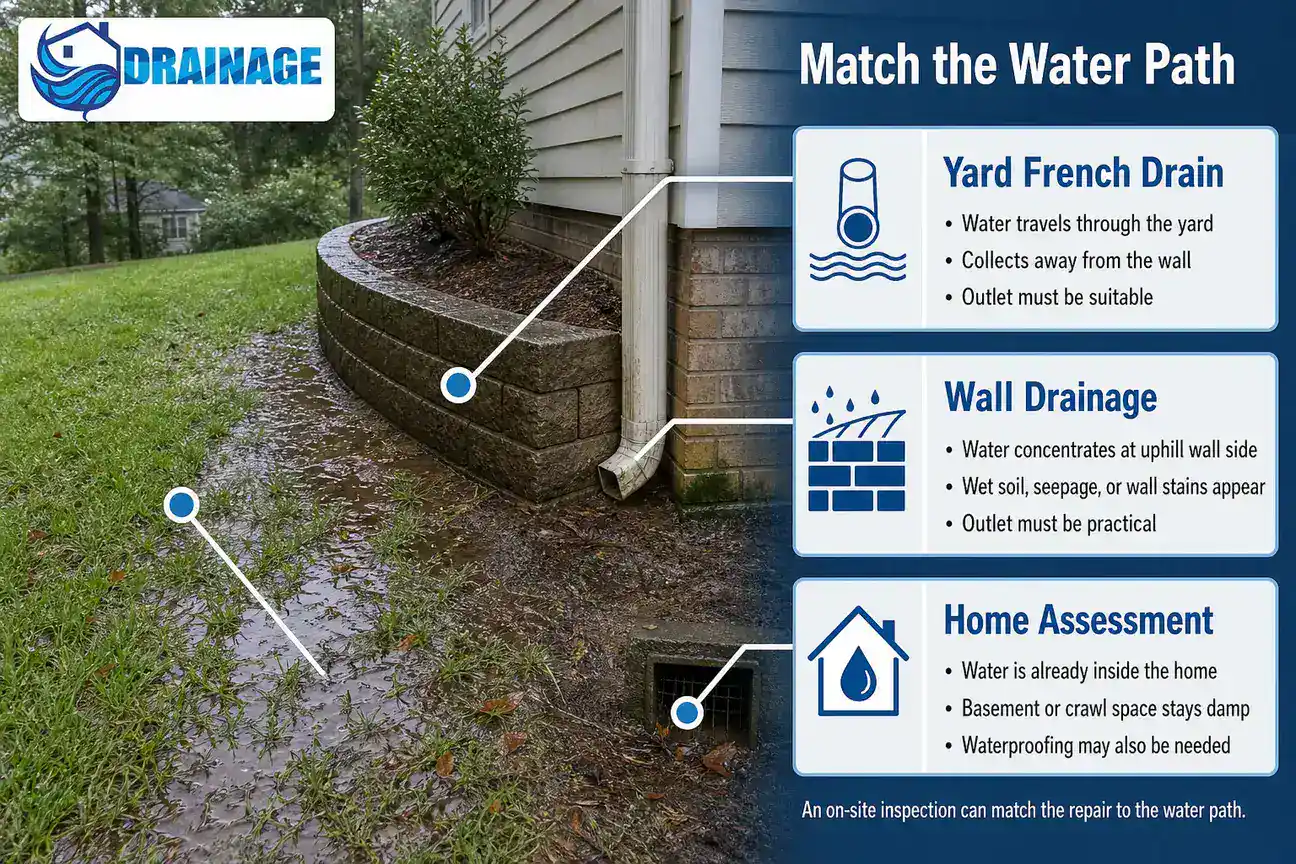
The simplest way to compare the options is to match the repair to the water path. If water is traveling through the yard and collecting away from the wall, a yard French drain or grading plan may be part of the answer. If water is concentrated directly at the uphill side of a wall, drainage behind retaining wall areas deserves a closer look. If water is already inside the home, waterproofing or an interior drainage assessment may be needed as well.
The final answer may be one system or a combination. A property may need grading to reduce surface runoff, retaining wall drainage to manage the wall area, and a separate waterproofing plan where water has reached the crawl space or basement. Another property may only need a targeted yard French drain and a better outlet.
That is why the French drain vs retaining wall decision should not be made from a single symptom. It should be made after tracing the water source, slope, soil conditions, wall location, and discharge destination. The system has to fit the property, not just the name of the problem.
This article is general homeowner information. The right drainage or waterproofing solution depends on an on-site inspection of your property.
Frequently Asked Questions
Is a French drain the same as retaining wall drainage?
No. A yard French drain generally collects and conveys water through a landscape area, while retaining wall drainage addresses water accumulating on the uphill side of a retaining wall. They can sometimes work together, but one is not automatically a substitute for the other.
Can a French drain solve water behind a retaining wall?
Not necessarily. If water is collecting directly behind the wall, the drainage approach must address that location and provide a suitable discharge route. A yard drain installed elsewhere may help with broader runoff but may not relieve the wall area.
Should water from a retaining wall drain go into a sanitary sewer?
No. Yard drainage and retaining wall drainage should not be connected to a sanitary sewer, and water should not be routed onto a neighboring property. The discharge destination should be evaluated for ownership, erosion, slope, local rules, and downstream effects.
Can grading replace a French drain?
Sometimes grading or a swale can redirect visible surface runoff before it reaches the problem area. Grading does not automatically solve subsurface saturation, water trapped behind a retaining wall, or moisture that has already reached a basement or crawl space.
What if water is already inside my basement or crawl space?
Water inside the home needs a separate assessment. The inspection may need to look at exterior drainage, foundation waterproofing, interior drainage, sump equipment, crawl-space conditions, and moisture control. The symptom alone does not identify the correct repair.
Do retaining wall drainage projects require permits in North Carolina?
Requirements depend on the wall, site, scope, jurisdiction, and whether the work affects grading, stormwater, property boundaries, or public systems. Homeowners should confirm requirements with the local building department before work begins.
What should I check after a drainage system is installed?
Keep inlets, grates, cleanouts, surface channels, and outlets clear. After heavy rain, check whether water is moving as intended and whether the outlet area is eroding. For internal drain systems installed by Drainage & Waterproofing Solutions, LLC, 6-month and yearly maintenance inspections are available.