
Should Downspouts Drain Into the Yard or a French Drain?

November 9th, 2026

Downspout drainage: Safe Yard Outlet or French Drain?

A downspout can drain into the yard when the ground gives water a safe, visible path away from the house. A French-drain connection may be the better fit when surface discharge causes ponding, erosion, or moisture near the foundation and there is a proper outlet. The right downspout drainage choice depends on grading and slope, soil behavior, roof runoff volume, outlet location, and whether water could flow back toward the foundation or across a property line. If the water source or discharge path is not clear, an on-site inspection is the practical next step.

Quick answer: Do not choose “yard” or “French drain” based only on where the downspout sits. Start with where the water goes after it leaves the pipe. The DOE Building America Solution Center guidance on site drainage, published in 2020 and updated in 2026, recommends that surface grade slope away from the house and that swales or drains be used where grading is not enough. For homeowners in Apex and the Triangle, that matters because a brief rain may look harmless while a longer or more intense storm shows the real flow path.

How downspout drainage choices compare in the yard
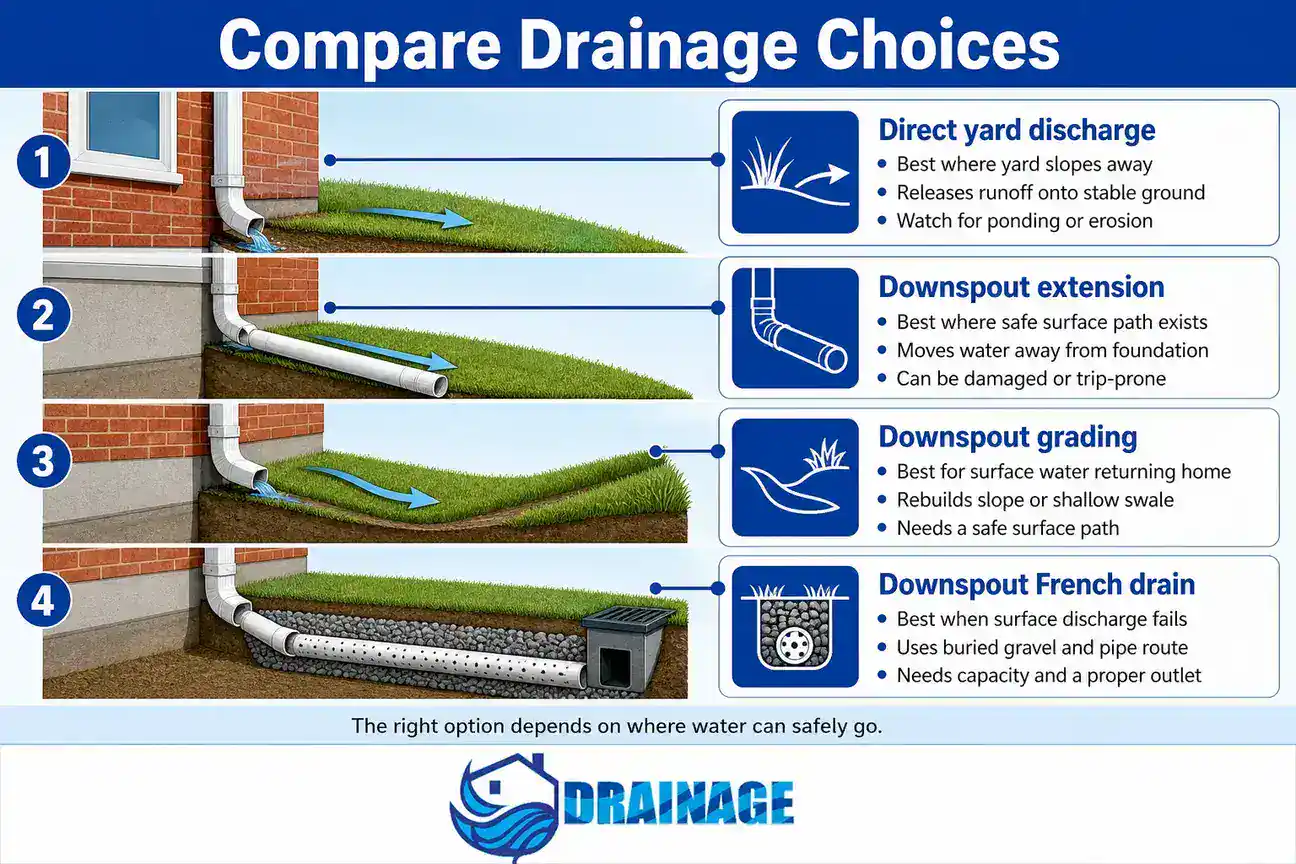
Infographic comparing direct discharge, extensions, grading, and French drains for downspouts.

Most homes need one of several practical approaches: direct surface discharge, a downspout extension, downspout grading, a downspout French drain, or a coordinated combination. The table below gives a practical starting point, not a final design.

OptionBest fitWhat it addressesMain limitationInspection concern
Direct yard dischargeA yard that clearly slopes away from the homeSimple roof runoff release onto stable groundCan cause ponding or erosion if the yard is flat or lowWhere the water travels after it leaves the outlet
Downspout extensionShort, visible redirection where a safe surface path existsMoves concentrated water away from the foundation areaCan be damaged, create a trip hazard, or still discharge into a low spotWhether the extension outlet stays stable during heavier rain
Downspout gradingSurface water flowing back toward the houseCorrects shallow runoff patterns and low areasDoes not solve every groundwater or foundation seepage issueWhether there is enough room to create positive drainage
Downspout French drainLimited surface outlet options or repeated ponding at discharge pointsCollects and carries water underground toward a planned outletMust be designed for the water volume, slope, filtration, and outletWhether the drain can accept roof runoff without backing up
Combination systemMultiple downspouts, poor grading, and moisture near the foundationCoordinates roof runoff drainage, yard drainage, and foundation protectionRequires careful diagnosis instead of one-size-fits-all installationWhich water source is causing the main problem

That comparison is why a buried drain is not automatically “better” than a surface outlet. A visible extension that drains to a stable slope may be easier to maintain than a buried system. On the other hand, a simple extension may not help if the yard is flat, the soil stays saturated, or water is already pushing toward a crawl space or basement.

When a yard outlet can work without a buried drain

A downspout can empty onto the lawn when the lawn acts like a real drainage path. That means water leaves the downspout, moves away from the house, spreads out without cutting a muddy channel, and does not collect near the foundation, crawl-space vents, basement steps, sidewalks, driveways, or a neighboring property.

In practice, the best first observation is simple: watch the outlet during rain from a safe location. Look for the first place water slows down, pools, or turns back. A yard outlet that looks fine in a brief shower may show problems during a longer rain, especially in low or compacted areas where water does not move away quickly.

Direct yard discharge is usually weaker when the downspout empties beside a foundation wall, into a mulch bed that washes out, onto a walkway, or into a swale that already stays wet. It is also a poor choice when the water can re-enter the house through a basement entrance, crawl-space opening, garage slab edge, or low foundation area.

Do not assume that “out into the yard” means “away from the house.” Around many homes, landscaping beds, patios, walkways, and settled backfill can quietly redirect water. A surface route only works when the grade, outlet, and final discharge point all support the same goal: moving water away from the structure without creating a new problem.

When a downspout extension is the practical first move

A downspout extension is often the simplest way to test whether roof water is part of the problem. Because it is above ground, a downspout extension is visible, easy to inspect, and easier to adjust than a buried line. It can also help separate a gutter outlet problem from a deeper yard or foundation drainage issue.

A downspout extension fits best when the ground beyond the outlet already slopes away and the extension can discharge onto stable soil, lawn, stone, or another safe surface. It is especially useful when a downspout currently dumps roof water into a planting bed or directly beside the foundation.

The limitation is that a downspout extension only moves the discharge point. It does not create slope where the yard is flat, it does not make saturated soil absorb more water, and it does not correct a gutter that is overflowing before the water reaches the downspout. A downspout extension can also interfere with mowing, create a tripping point, or be knocked loose.

There is no universal extension length that fits every property. The right discharge point depends on the grade, soil, roof area feeding the downspout, and where water travels after it leaves the extension. If the downspout extension simply moves water from one low area to another, the yard may need grading, a swale, a French-drain route, or a combined drainage plan.

Where roof runoff drainage should be deliberate

Roof runoff drainage is different from general yard drainage because it concentrates water from a large roof surface into a few small outlets. Even when the yard can handle normal rainfall, a downspout can create a focused flow that erodes soil, overloads a low area, or sends water toward a foundation.

Good roof runoff drainage starts before the ground system. Gutters should not overflow at the eaves, downspouts should not be blocked, and buried lines should have a working outlet. If water is spilling over the gutter in a sheet, connecting the downspout to a buried line may not address the real source.

Homeowners can make useful observations without taking anything apart. During a safe rain check, note whether water exits all downspouts, whether one outlet carries much more flow than others, and whether roof runoff drainage is causing erosion below one corner of the house. Take photos before, during, and after rain so the water path is easier to explain during an inspection.

For Apex homes and other properties around the Triangle, roof runoff drainage often has to work around patios, tight side yards, crawl-space access points, and neighboring lot lines. That does not mean every home needs a buried system. It means the discharge point needs to be planned, not guessed.

When downspout grading is enough to solve the surface problem

Downspout grading means shaping the nearby ground so water naturally moves away from the home after it leaves the downspout. It may involve correcting a low spot, rebuilding slope around a foundation area, or using a shallow swale to guide surface water. The goal is not to hide water underground. The goal is to give it a safe surface path.

Downspout grading is often appropriate when the main problem is surface water moving back toward the foundation. If you can see runoff traveling across the lawn or mulch toward the house, grading and slope deserve attention before assuming the only fix is a buried drain.

The DOE Building America Solution Center page on site drainage, published in 2020 and updated in 2026, states that when grade is level or directed toward the house and space is available, swales can capture, control, and filter stormwater runoff. The same guidance notes that where space is limited, drains may be used to collect and direct water through underground systems. That is a practical way to compare downspout grading with a buried drain: use the surface when the property gives you room and a safe route; consider underground collection when it does not.

Downspout grading does not solve every type of moisture problem. It may not correct groundwater pressure, water entering below a basement slab, a clogged interior drain system, a leaking plumbing line, or a foundation waterproofing issue. If water appears at the wall-floor joint, in a crawl space after storms, or around a basement perimeter, the inspection should look beyond the downspout outlet.

For a deeper look at the surface-drainage side of the decision, the resource on when yard grading is essential explains why slope and low spots matter around the home. If grading alone cannot provide a safe discharge route, the next comparison is usually a surface drain, French drain, or another drainage layout.

When a downspout French drain makes sense

A downspout French drain may make sense when water cannot safely remain on the surface. Common examples include repeated ponding at downspout outlets, several roof drainage points feeding one tight side yard, a low spot beside the foundation, or a yard where a downspout extension would block walkways and still discharge into saturated ground.

A downspout French drain also may be considered when downspout grading cannot create a reliable path. For example, the house may sit close to the property line, a patio may trap runoff, or the only visible surface route may send water toward a neighbor, driveway, or crawl-space access. In those cases, an underground route may help, but only if it has a proper outlet and is designed for the water it will carry.

A French drain is not just a buried pipe. The Building America guidance describes this type of drain as a perforated pipe surrounded by rock and wrapped with landscape fabric, with positive slope toward the outlet. In a real yard, the design also has to account for pipe size, depth, cleanouts, filter fabric, stone, inlet protection, overflow behavior, and the final discharge point.

For homeowners comparing a downspout French drain with a surface fix, the outlet is often the deciding issue. A buried line that ends in a low, saturated area can back up or keep the surrounding soil wet. A line that discharges toward a neighboring property or public area can create a different problem. The drain must lead somewhere appropriate.

If a French drain is the right direction, Drainage & Waterproofing Solutions, LLC can evaluate French drain installation as part of a broader yard-drainage plan. The recommendation still depends on an on-site inspection of the slope, water source, soil conditions, and outlet options.

Can every French drain accept roof runoff?
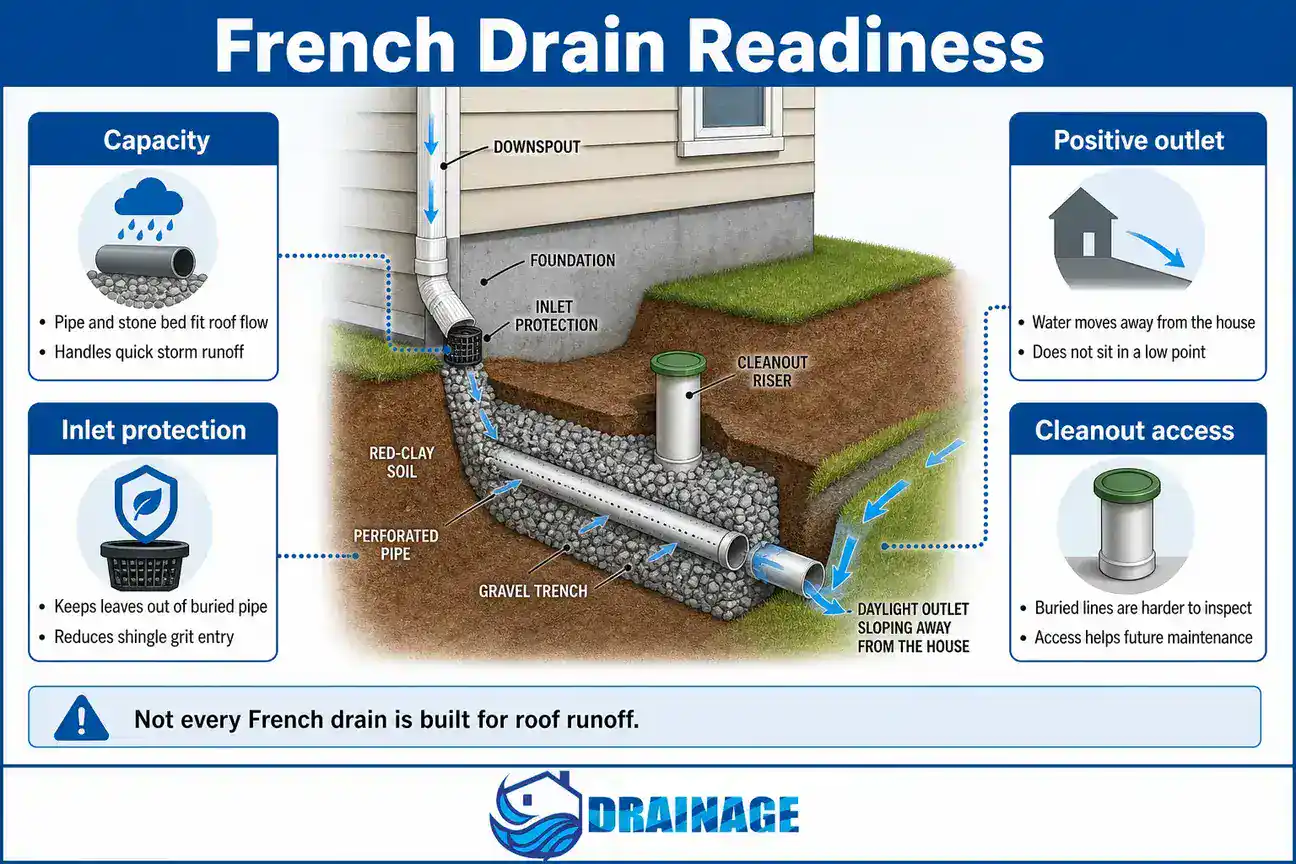
Cross-section infographic showing French drain capacity, outlet, inlet protection, and cleanout access.

No. A French drain that was designed to collect subsurface water may not be ready to accept concentrated roof runoff. Roof runoff drainage can arrive quickly during a storm, and a buried system has to handle both the volume and the way water enters the pipe.

A downspout French drain should be evaluated for several practical details:

This is where a simple “connect it to a French drain” answer can get homeowners into trouble. If the drain was built for one purpose and then loaded with roof runoff without checking slope and outlet capacity, the system may back up or move water to the wrong place. The safer approach is to identify the water source, then design the collection and outlet together.

What homeowners can check safely before choosing
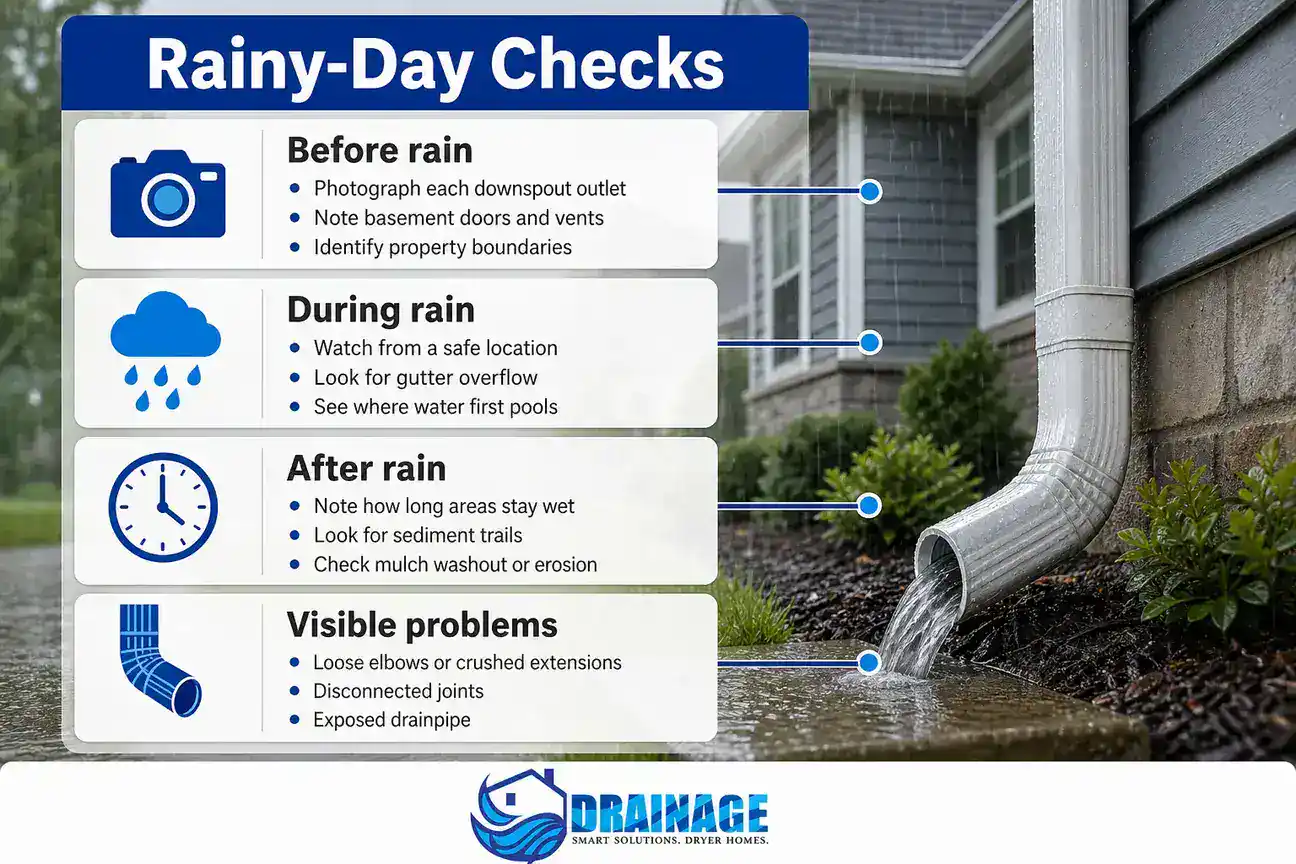
Rainy-day checklist for homeowners inspecting downspout outlets and drainage issues.

Before calling for an estimate, homeowners can collect observations that make the inspection more useful. These checks do not require digging or dismantling a buried system.

If you see significant cracks, settlement, or displacement, do not diagnose that from drainage symptoms alone. A structural engineer should evaluate structural concerns. If you suspect a supply-line, sewer, septic, or plumbing leak, a plumber is the right professional for that part of the problem.

Musty odors or visible growth should also be handled carefully. The EPA guidance on mold and moisture in the home focuses on correcting the moisture source and cleaning up appropriately; it does not support guessing mold species or health effects from appearance. Drainage & Waterproofing Solutions, LLC does not provide mold testing or mold remediation.

Local outlet and permission issues for Apex homeowners

Apex homeowners should treat the outlet as part of the drainage system, not an afterthought. The same is true across Raleigh, Garner, Cary, and the Triangle. Before connecting to a public system, changing flow through an easement, adding a drywell, or routing water near a property line, homeowners should confirm applicable city, county, HOA, and building-department requirements.

Private roof water should not be deliberately directed onto a neighbor’s property, into a sanitary sewer, or toward a public walkway where it can create a hazard. A drainage plan also should not rely on a low area that already stays saturated. Moving water out of sight is not the same thing as moving it to a suitable outlet.

Municipal programs are not the same as permission for a private drainage change. For example, the City of Raleigh drainage assistance page distinguishes public drainage assistance from private-property issues and lists landscaping and yard grading issues, roof and gutter problems, and stormwater runoff from neighboring private properties among items not eligible for that specific program. Apex homeowners should check Apex-specific requirements instead of applying Raleigh program details to their property.

Closed or sealed crawl-space work may involve different rules than a yard drain or downspout route. The NC Office of State Fire Marshal interpretation on closed crawl-space permits states that a permit is required for closed crawl-space work under the cited interpretation. Homeowners should confirm project-specific requirements with their local building department.

How an on-site inspection sorts out overlapping causes

An inspection is worth scheduling when water returns after a downspout extension, a crawl space or basement stays damp, the outlet is not obvious, or several symptoms overlap. It is also helpful when a buried drain backs up, when water appears only after heavier storms, or when you are comparing exterior drainage with basement waterproofing, crawl-space work, or an interior drain system.

A practical inspection looks at the water source first. Is the issue roof runoff drainage, surface runoff from the yard, groundwater pressure, a foundation waterproofing concern, or a plumbing-related issue? The answer changes the fix.

The inspection should also evaluate grading and slope, soil behavior around the home, existing drain lines, discharge options, low spots, crawl-space or basement entry points, and whether a proposed outlet could affect a neighbor or public area. Only after that diagnosis does it make sense to compare downspout grading, a downspout extension, a downspout French drain, or a combined plan.

For homes with basement or crawl-space moisture, exterior drainage may be only one part of the solution. Depending on the source, the discussion may include foundation waterproofing, crawl space and basement waterproofing, or drainage system improvements. No article can determine that from symptoms alone.

How Drainage & Waterproofing Solutions, LLC approaches the choice

Drainage & Waterproofing Solutions, LLC is a locally owned and family-operated drainage, waterproofing, and crawl-space contractor with more than 20 years of experience. The company serves Raleigh, Garner, Cary, Apex drainage and waterproofing homeowners, the Triangle, Fayetteville, Southern Pines, and surrounding central North Carolina service areas.

For a downspout concern, the goal is not to sell the same system for every yard. The first step is identifying the water source and the outlet. A downspout extension may be enough for one home. Another may need downspout grading, a French drain, foundation drainage work, or a combination that keeps roof runoff from returning to the foundation.

Drainage & Waterproofing Solutions, LLC provides free written estimates within a 60-mile radius of the Raleigh/Garner area. Outside that radius, a $200 trip/estimate charge applies. Each estimate includes an on-site inspection, a written plan, a written quote, and an estimated timeline. To discuss a yard-drainage concern, you can request a free estimate or call (919) 508-7503 during regular business hours.

For drain systems the company installed, 6-month and yearly drainage system inspections are available for $150 per appointment and include the internal drain system, sump pump, and dehumidifier inspection with filter change. That maintenance price applies to installed systems, not to a new estimate.

Final practical takeaway for choosing the outlet

The best downspout drainage plan starts with two questions: where is the water coming from, and where will it safely go? If the yard has positive slope, stable soil, and a safe outlet, surface discharge or a downspout extension may be practical. If water ponds, erodes soil, or returns toward the foundation, downspout grading or a downspout French drain may need to be evaluated.

A French drain is useful only when it is designed for the water source, the site conditions, and a proper outlet. Grading is useful only when surface slope can be corrected without creating a new problem. The right answer may be simple, or it may require a combination of roof runoff drainage, yard drainage, and waterproofing work.

This article is general homeowner information. The right drainage or waterproofing solution depends on an on-site inspection of your property.

Frequently Asked Questions

Is it okay for a downspout to empty directly onto the lawn?

It can be acceptable when the ground carries water away from the house without erosion, ponding, or runoff toward another property. The outlet should be observed during rain, and water should not move toward the foundation, crawl-space vents, basement entrances, sidewalks, driveways, or public areas.

Should downspouts go into a French drain?

Sometimes, but not automatically. A French drain may help when surface discharge cannot safely move water away, but the system needs appropriate capacity, positive outlet slope, cleanout access, and a design suited to the water source. A drain intended for subsurface water may not be adequate for concentrated roof runoff without evaluation.

Is grading better than a French drain for downspout drainage?

Grading is often the more direct response when surface water is flowing toward the house and there is enough room to create a safe route away. A French drain may be considered when space is limited or surface routing creates ponding or erosion. Some properties need both.

Can a downspout discharge onto a neighbor’s property?

Homeowners should not plan drainage that directs runoff onto a neighbor’s property. They should also verify local requirements before directing water toward public systems, rights-of-way, easements, shared drainage features, or low areas near a property line.

Why does water still reach the crawl space after a downspout extension is installed?

Possible causes include poor grading, saturated soil, a blocked or undersized buried line, groundwater, foundation drainage issues, or water entering through another location. The extension may have moved the outlet without solving the broader water source.

How can a homeowner tell whether roof runoff is causing the problem?

Observe the property during and after rainfall. Look for overflow at gutters, concentrated flow at downspouts, erosion below outlets, ponding near the foundation, and moisture that appears soon after rain. These observations can help an inspector, but they do not prove the complete cause by themselves.

When should a homeowner request an on-site drainage inspection?

Request an inspection when water repeatedly collects near the home, the basement or crawl space is damp, a drainage system backs up, the outlet is unclear, or you are comparing grading, French drains, interior drainage, waterproofing, or encapsulation.
Sources

Posted in Yard Drainage, French Drains

French Drain or Grading: Which Fix Fits Yard Water?

November 6th, 2026

French Drain or Grading: Which Fix Fits Yard Water

If you are choosing between a French drain or grading, start with the path water takes across your yard, not the product name. Grading, downspout routing, swales, and French drains solve different problems. In Cary and around the Triangle, the right choice depends on roof runoff, slope, soil, the discharge point, and whether water is moving toward the home, crawl space, or basement.

Quick Answer: Surface grading often fits water you can redirect above ground. Downspout routing comes first when roof runoff is dumping near the foundation. A swale can help broad sheet flow when there is room and slope. A French drain fits a confined wet line or low area when water must be collected and carried underground to a suitable outlet.

Quick yard drainage comparison for common wet-yard clues

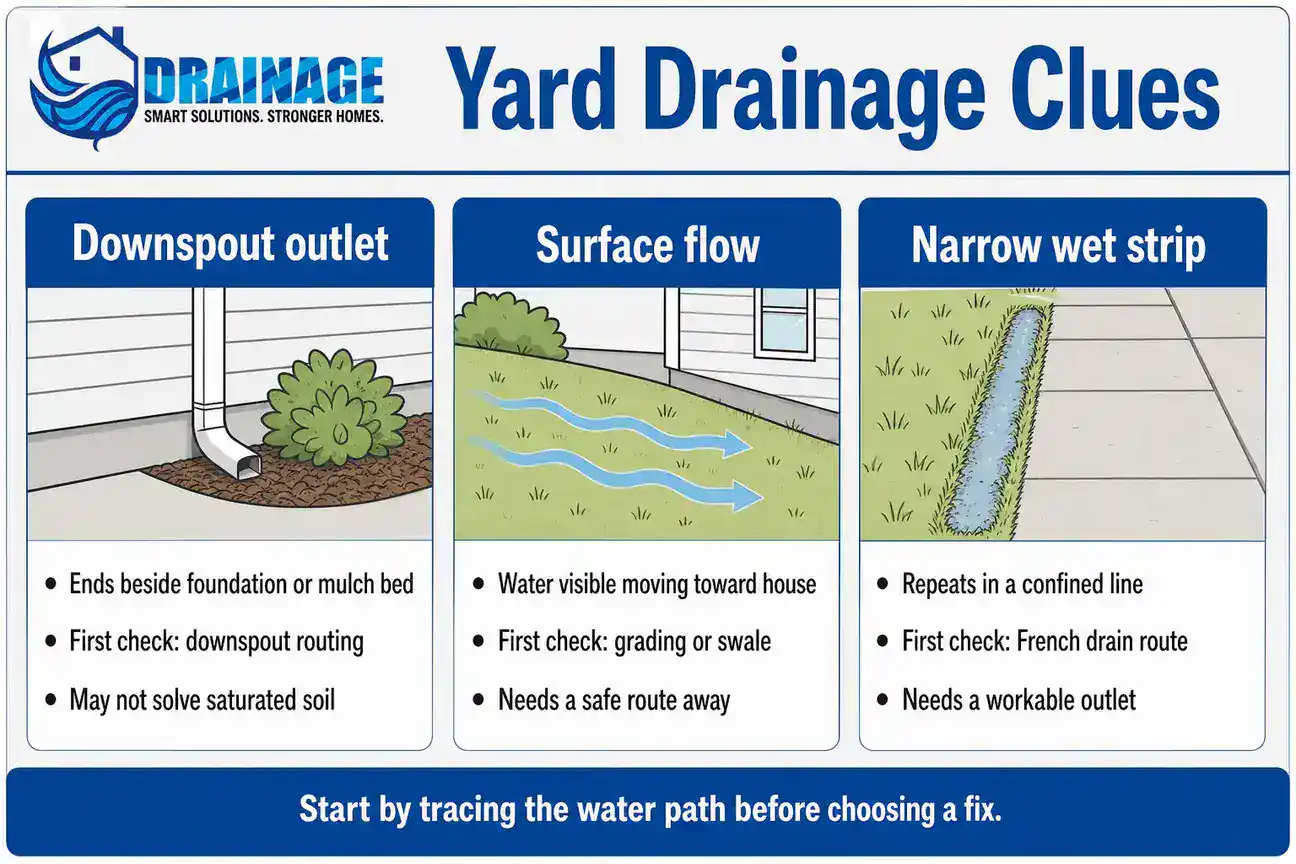
Infographic comparing downspout routing, grading or swales, and French drains for wet-yard clues.

This yard drainage comparison is a starting point, not a final design. Building America’s site drainage guidance treats gutters, downspouts, final grade, swales, drains, footing drains, and sump pumps as connected parts of reducing standing water and localized flooding around a home. That is a useful way to think about a soggy yard: the fix should match the water source and the route water can safely take away from the house.

Observed problemFirst option to investigateWhy it may fitMain limitation
Downspout ends beside the foundation or in a mulch bedDownspout routingMoves concentrated roof runoff away from the home before it spreadsMay not solve uphill runoff, saturated soil, or groundwater pressure
Ground slopes toward the house or holds shallow puddles near the wallSurface gradingChanges the surface path before water reaches the foundationRequires enough room, usable soil, and a safe discharge path
Broad runoff crosses the yard after stormsSwaleCaptures and redirects sheet flow across a wider areaNeeds yard width, workable grade, and a responsible outlet
Water follows a repeatable line or collects in a narrow low areaFrench drainCollects and routes water underground where surface routing is limitedStill needs a reliable outlet and should not receive water from every unresolved source
Water reaches the basement, crawl space, or foundation edgeExterior drainage plus waterproofing evaluationYard drainage may reduce outside water, but below-grade symptoms need separate diagnosisAn on-site inspection is needed to match the system to the structure and water source

How French drain or grading decisions should start

The most useful first question is not, “Which drainage product is better?” It is, “Where does the water begin, where does it travel, and where can it safely go?” A soggy patch downhill from the home may be mostly a lawn problem. A smaller wet strip that points toward a crawl space wall may matter more because it is feeding the foundation area.

Walk the yard during or shortly after a normal rain if it is safe to do so. Look at roof valleys, gutter outlets, driveway edges, patios, AC pads, walkways, and the lowest ground near the house. In Cary neighborhoods with mature landscaping, patios, fences, and neighboring lots close by, water often changes direction several times before it becomes a visible puddle.

Before comparing yard drainage options, trace these clues:

A homeowner can gather those clues, but the final plan should come from an on-site inspection. Soil, buried utilities, old drainage lines, foundation height, crawl space access, and the available outlet can change the recommendation.

How to narrow yard drainage options before an inspection

Good yard drainage options are not interchangeable. Each one handles a different part of the water pathway. If roof runoff is the main problem, a drain in the middle of the lawn may miss the source. If the entire yard slopes toward the house, a short downspout extension may help but not solve the larger surface-flow problem. If the surface grade cannot be reshaped, an underground collection line may become part of the plan.

Think of the choice in layers. First, control concentrated water from the roof. Second, shape the surface where reasonable. Third, intercept broad runoff before it reaches the house. Fourth, collect water underground only when that is the right match and there is a workable outlet. Finally, evaluate the foundation, basement, or crawl space if water has already reached the structure.

For homeowners comparing French drains with grading, that order matters. A French drain can collect water, but it should not be asked to make up for every unresolved slope, gutter, and discharge problem on the property. Grading can guide water, but it cannot create fall where the site has no room to drain responsibly.

Drainage & Waterproofing Solutions, LLC evaluates the site before recommending a system. A free written estimate is available within a 60-mile radius of the Raleigh/Garner area and includes an on-site inspection, a written plan, a written quote, and an estimated timeline. Outside that radius, a $200 trip/estimate charge applies.

When surface grading problems point to reshaping the yard

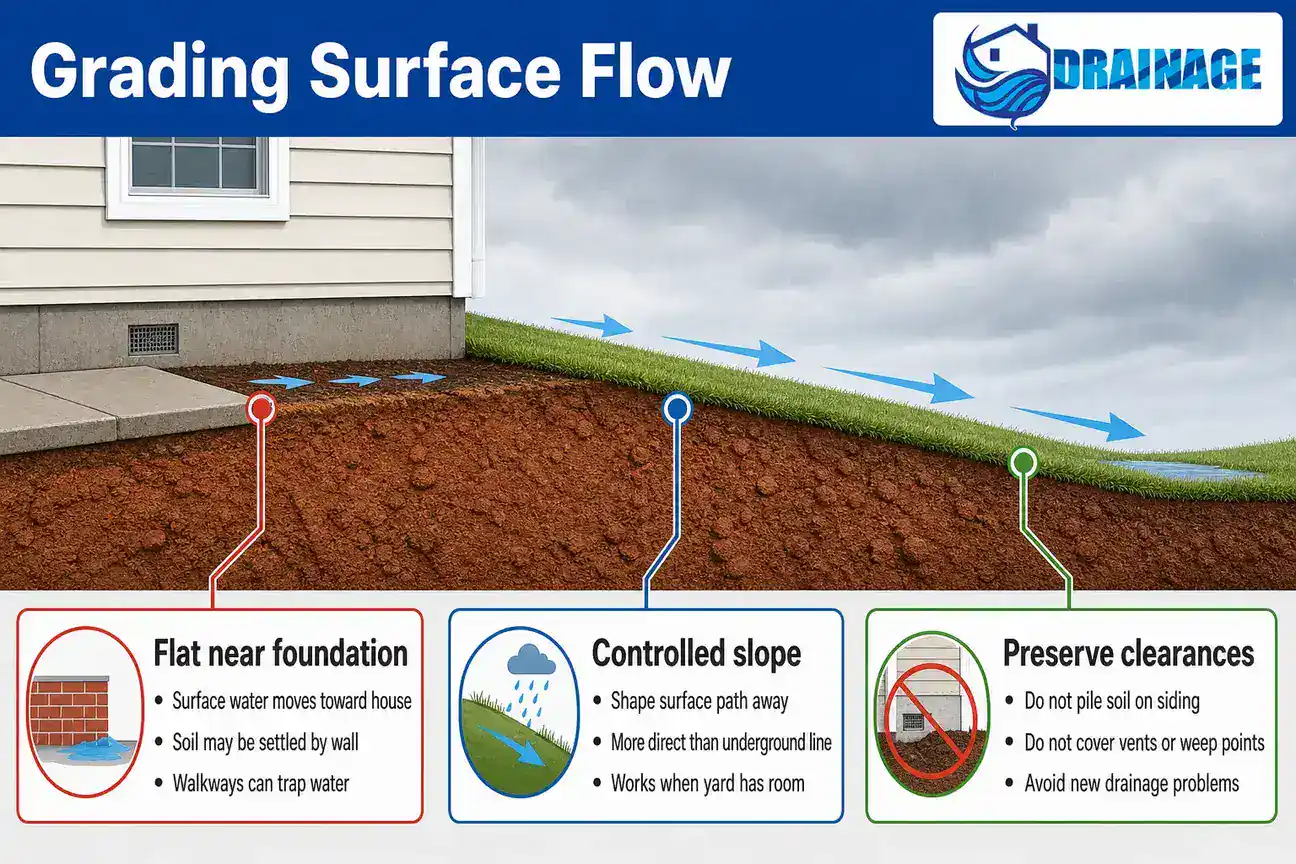
Cross-section diagram showing grading that directs surface water away from a home foundation.

Surface grading problems are often the first thing to investigate when water is visible above ground and moving toward the house. The ground may be flat near the foundation, settled beside a backfilled wall, crowned in the wrong direction, or trapped by a walkway or landscape bed. In those cases, changing the surface path may be more direct than adding an underground line.

Grading is not the same as piling soil against the siding or covering weep points, vents, brick ledges, or foundation details. The goal is to create a controlled slope that carries water away from the structure while preserving safe clearances and avoiding new drainage problems. When a yard has enough room, grading can redirect shallow sheet flow before it reaches the foundation edge.

Surface grading problems are especially common where landscaping has been added over time. Mulch beds may rise higher than the lawn. Edging may trap water beside the foundation. A patio, sidewalk, or driveway may act like a small dam. A low point may form where construction soil settled after the home was built.

Soil also matters. NC State Extension’s homeowner soil guidance is a reminder that soil texture, compaction, organic matter, and drainage conditions affect how water behaves around a home. It also gives a practical grading benchmark: where site conditions allow, create a 5 percent grade sloping away from the home for at least 10 feet. In the Triangle, many yards have clay-heavy or compacted soils that can shed water slowly, so that benchmark still has to be evaluated against the actual lot, foundation height, and discharge path.

Grading tends to fit when these conditions line up:

Surface grading problems become harder when the lot is tight, the foundation is low, the neighboring grade is higher, or the only obvious outlet points toward another property. In those cases, grading may still be part of the work, but it may need to be combined with a swale, area drain, French drain, or foundation waterproofing evaluation.

If grading seems like the likely answer, the next step is still a site-specific look at slope, soil, clearances, and discharge. Drainage & Waterproofing Solutions can compare grading with other drainage and waterproofing services when the wet area is connected to a crawl space, basement, or foundation edge.

When downspout water pooling should be handled first

Downspout water pooling can make a yard look like it needs a larger drainage system when the first problem is roof runoff. A single roof area can send a large amount of water to one small outlet during a heavy storm. If that outlet empties beside the foundation, into a low mulch bed, or onto clay-heavy soil, the water may spread into the lawn or push toward the crawl space.

Check each downspout before deciding on larger yard drainage options. Ask whether the outlet is clear, whether the extension has a positive slope, and whether the discharge point remains open during rain. A downspout that ends in a low spot is still a problem even if it is several feet from the house. Water needs a route that stays functional during storms.

Downspout water pooling often shows up as washed mulch, exposed roots, soil splatter on siding, erosion trenches, or a wet fan-shaped area at the outlet. It can also hide under decorative stone. If the water is routed underground, the outlet may be blocked, crushed, or set too low to drain well. An inspection looks at both the inlet and the discharge end.

Downspout routing may be enough when roof runoff is the main source and the yard has a safe place to accept the water. It may not be enough if the downspout discharge combines with an inward slope, a tight side yard, or runoff from a neighboring higher area. In that situation, routing may be the first layer, followed by grading, a swale, or an underground drain.

Do not route a downspout or any yard drain into a sanitary sewer, toward a neighbor’s foundation, or onto a property line where it causes erosion or ponding. Local stormwater and drainage requirements vary. The NC DEQ stormwater program is a state-level starting point, and homeowners should confirm local requirements with the applicable town, city, county, or stormwater department before connecting to public systems or changing discharge patterns.

When a swale is the better yard drainage comparison

A swale is a shallow, shaped surface channel that redirects water across a wider area. In a yard drainage comparison, a swale belongs between grading and an underground drain. It is still a surface solution, but it is more organized than simply changing the slope at one spot. It can help where broad runoff crosses the yard from higher ground before reaching the house.

A swale may fit when the yard has enough width, the slope can be controlled, and the discharge path is appropriate. It can also work with landscaping when designed carefully. But a swale is not automatically simpler than a French drain. It needs room, a route, stable soil, and a place for the water to go. A poorly placed swale can hold water too long or send it toward the wrong property.

Building America’s drainage guidance discusses swales alongside site grading, gutters, downspouts, drains, and sump systems. That matters because a swale should be selected as part of the site’s drainage pattern, not because it sounds less invasive than underground work. The same property may need surface grade corrected near the wall, roof water routed away, and a swale used farther out to intercept broad runoff.

In Cary and nearby Triangle communities, swales may be limited by fences, narrow side yards, patios, mature trees, and neighboring grades. If the available route is too narrow or flat, a swale may not move water reliably. If the soil stays saturated for days, the swale may need help from a drain or a different discharge strategy.

A swale tends to fit when:

Swales and grading are often paired. Grading may reshape the area close to the house, while the swale intercepts water farther uphill. That combination can reduce the load on a French drain or make an underground drain unnecessary. On other sites, the swale handles broad runoff while a French drain collects water from one confined low area.

When a French drain for yard water makes more sense

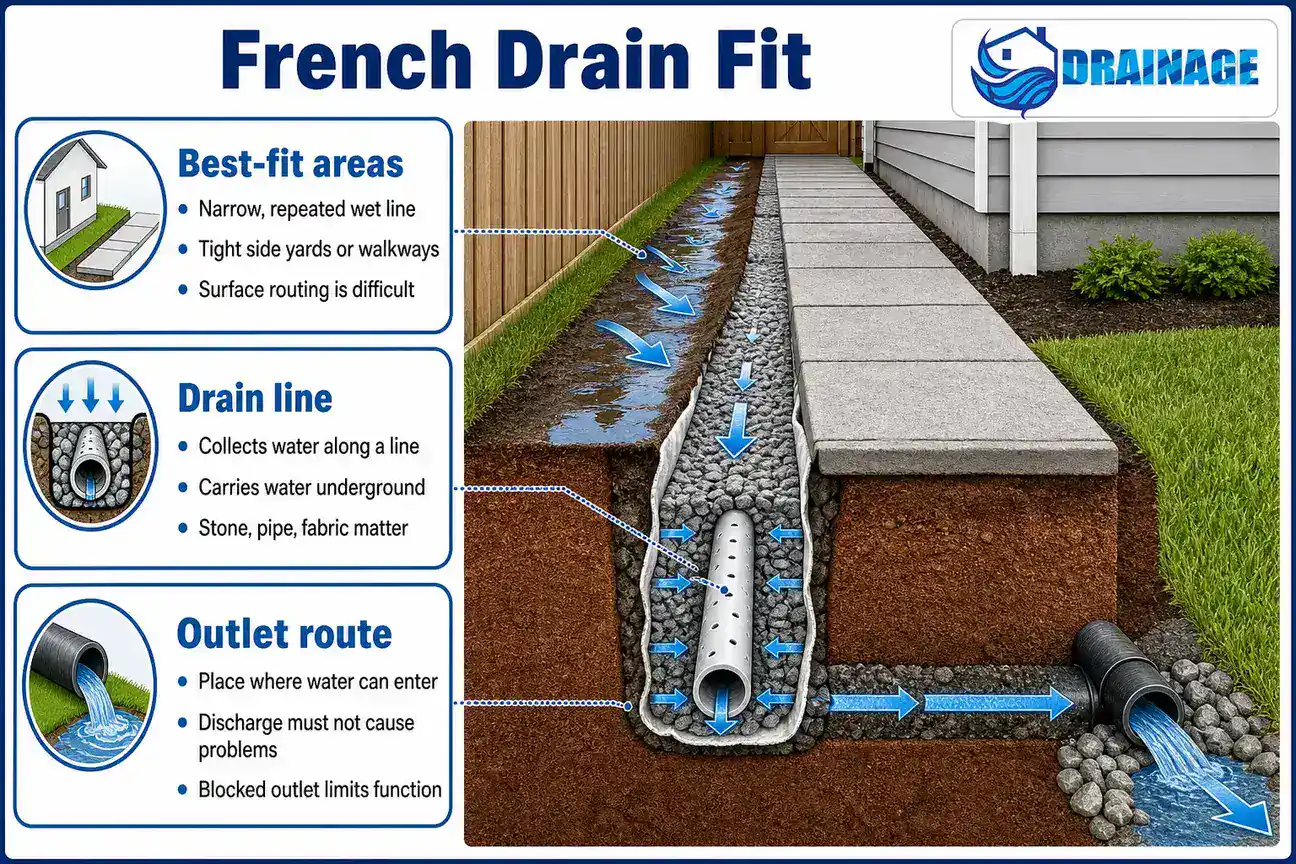
French drain cutaway showing gravel, perforated pipe, water entry, and a discharge route.

When homeowners ask about a French drain for yard drainage, the best-fit situations are usually narrow, repeated, and difficult to route on the surface. Instead of trying to reshape a broad area, the drain collects water along a line and carries it underground to a suitable discharge point. That can help in tight side yards, low strips near walkways, or areas where surface flow is blocked.

A French drain for yard drainage can mean different layouts depending on the property. The route, depth, stone, pipe, fabric, outlet, and surrounding grade all matter. The drain must be placed where water can enter it, and it must discharge where the water will not cause a new problem. If the outlet is blocked, too flat, or directed to the wrong place, the system may not perform as intended.

A French drain may fit when:

A French drain does not automatically solve every wet-yard problem. It will not fix a plumbing leak, a failed sump pump, a blocked gutter, an undersized outlet, or a site-wide slope that continues sending water into the same area. If water is entering below grade, exterior drainage may need to be paired with foundation waterproofing or crawl space and basement waterproofing after an inspection.

The best French drain for yard drainage situations have a clear collection line and a realistic outlet. The hardest situations are flat lots with no fall, low foundations, or discharge points that would affect a neighbor. In those cases, the answer may be a combined plan, not a stand-alone drain.

Drainage & Waterproofing Solutions, LLC provides French drain installation as part of residential drainage work. The recommendation still depends on an on-site inspection, because the same wet spot can have different causes from one property to the next.

Soil, slope, and discharge decide more than the wet spot

Two yards can have the same puddle and need different fixes. One may have a simple downspout problem. Another may have compacted soil and no safe surface outlet. A third may have water moving toward the foundation through a narrow side yard. The wet spot matters, but the slope, soil, and discharge point usually decide the system.

Soil affects whether water can soak in, run off, or stay trapped near the surface. Clay-heavy or compacted soils often drain more slowly than loose, well-structured soils. Sandier soils, such as some areas farther south and east of the Triangle, may behave differently, but they still require a site-specific look. No soil type automatically selects the fix.

Slope matters because water needs a path. If the yard has usable fall, surface grading or a swale may be practical. If the yard is flat or blocked by hardscape, a French drain or other collected drainage may be considered. If the only low point is beside the house, the plan has to solve the discharge problem before choosing the collection method.

Discharge is the constraint many homeowners overlook. A drain, swale, or downspout extension is incomplete until the water reaches a stable, practical, and appropriate outlet. Do not send collected water toward a neighbor, a neighboring crawl space, a public sidewalk, a sanitary sewer, or an area that erodes during storms. Where local rules, easements, public systems, or property lines are involved, confirm requirements with the local authority.

This is where a professional yard drainage comparison becomes more than a product choice. The inspection should look at the start of the water, the route across the yard, the foundation exposure, and the proposed endpoint. If the endpoint is wrong, the system is wrong.

When combined yard drainage options are the honest answer

Many wet-yard problems are not solved by choosing only one item from a list of yard drainage options. The roof, yard, soil, and foundation often work together. If several sources feed the same low area, a single measure may reduce water without fully addressing the cause.

Common combinations include:

A combined plan should not be treated as upselling. Sometimes it is the practical result of following the water path. For example, downspout water pooling may be obvious, but the downspout may be discharging into a side yard that already slopes toward the crawl space. Moving the downspout without changing the slope may simply move the puddle.

If the crawl space stays damp after exterior water is reduced, a separate evaluation may be needed. Drainage & Waterproofing Solutions, LLC offers crawl space encapsulation and related crawl space services, but encapsulation should not be used as a substitute for correcting active exterior water that is still being directed toward the home.

Likewise, if water appears where a basement wall meets the floor, yard drainage may be only part of the answer. Hydrostatic pressure, foundation drainage, interior drain systems, sump equipment, and moisture control may need to be evaluated. No article can determine that from symptoms alone.

Cost drivers without guessing at prices

Homeowners often ask whether grading is cheaper than a French drain. The honest answer is that price depends on the site and the scope, and this article should not guess at numbers. A small downspout correction is different from reshaping a side yard, cutting through hardscape, installing a long drain line, or pairing exterior drainage with basement work.

Cost drivers may include:

If you are comparing yard drainage options for a Cary home, Drainage & Waterproofing Solutions can provide an on-site inspection and written plan before pricing the work. You can request a free estimate or call (919) 508-7503. The free estimate applies within 60 miles of the Raleigh/Garner area and includes a written quote and estimated timeline.

Safety and permit boundaries homeowners should not skip

Do not enter a flooded basement or crawl space area if water may be near energized outlets, appliances, panels, extension cords, or electrical equipment. If the water may involve a plumbing, sewer, septic, or supply-line problem, contact the appropriate plumber or specialist. Drainage & Waterproofing Solutions does not provide plumbing, sewer, septic, radon, pest control, mold testing, or mold remediation services.

Call 811 before digging. Even shallow drainage work can encounter utilities, irrigation, communication lines, or other buried components. A homeowner should not start trenching for a drain or reworking a discharge path without understanding what is below grade.

If mold is present or suspected, follow EPA moisture and mold guidance: correct the moisture source and use appropriate cleanup practices. Avoid trying to identify mold type by appearance or making health conclusions from what you see. Moisture control is the starting point, but testing and remediation are separate services.

Closed or sealed crawl space work may require a permit in North Carolina. The NC OSFM interpretation on permits for closed crawl spaces is a reminder to confirm requirements with the local building department. This article is not code-compliance advice, and local requirements can vary.

Structural cracks, settlement, wall movement, or suspected structural problems should be evaluated by a structural engineer. Drainage work can address water sources and moisture pathways, but it is not a substitute for structural engineering or foundation structural repair.

How an on-site inspection compares the fixes

A useful inspection is not just a quick look at the puddle. It should connect the wet area to the roof, slope, soil, foundation, and discharge route. That is how the recommendation moves from “maybe a drain” to a written plan that fits the property.

For a soggy-yard call, an inspection may consider:

For Cary homeowners, it can also be helpful to work with a company familiar with local Triangle drainage patterns, crawl-space-heavy homes, and storm runoff around compacted residential lots. Drainage & Waterproofing Solutions serves Cary as part of its Triangle service area; you can learn more about Cary drainage and waterproofing if your property is the local focus.

The company is locally owned and family operated and has more than 20 years of experience in drainage, waterproofing, and crawl space work. The right system still depends on the inspection, the water source, soil, grading, structure, discharge point, and maintenance.

Choosing the practical fix for a soggy yard

The best yard drainage comparison is not a contest where grading always beats a drain or a drain always beats grading. Start with downspouts, then surface slope, then broad runoff, then confined collection, then foundation or crawl-space symptoms. Each clue narrows the choices.

If the problem is visible sheet flow and the yard has room, grading or a swale may be the practical first choice. If the problem is downspout water pooling, roof runoff should be addressed before assuming the yard needs a larger system. If the water follows a repeatable narrow line and there is limited room for surface routing, a French drain for yard drainage may be appropriate. If water has reached the basement or crawl space, exterior drainage may need to be paired with waterproofing or moisture-control work.

When you are deciding between a French drain or grading, remember that the correct answer may be a combination. A written plan should show where water starts, how it will be redirected or collected, and where it will discharge without creating a new problem.

This article is general homeowner information. The right drainage or waterproofing solution depends on an on-site inspection of your property.

Frequently Asked Questions

Is grading usually better than a French drain for a soggy yard?

Not always. Grading is usually considered first when water is moving across the surface and there is enough room to slope it away safely. A French drain may fit better when water collects along a confined low area or surface routing is limited. The right choice depends on the source, slope, soil, and outlet.

Can downspout extensions solve yard drainage by themselves?

They can when roof runoff is the main source and the discharge area drains safely. If the extension ends in a low spot, points toward the foundation, or combines with uphill runoff, downspout routing may need to be paired with grading, a swale, or an underground drain.

When should I consider a swale instead of an underground drain?

A swale may make sense when broad surface runoff crosses the yard and there is enough room to shape a shallow channel. It needs a workable slope and a responsible discharge path. Tight side yards, flat lots, or saturated soil may make an underground option more practical.

Will a French drain keep water out of my crawl space or basement?

A French drain may reduce water reaching the foundation area when it matches the water source and has a good outlet. It does not guarantee a dry crawl space or basement. If water has already entered below grade, the foundation, sump system, interior drainage, vapor barrier, and moisture conditions should be inspected.

Can I route yard drainage toward the street or a neighbor’s property?

Do not assume that any discharge point is acceptable. Avoid sending water toward a neighbor, neighboring foundation, sanitary sewer, sidewalk, or erosion-prone area. Local stormwater rules and easements can vary, so confirm requirements with the appropriate local department before changing discharge patterns.

How do I know if soil is part of the drainage problem?

Watch how long the wet area stays saturated after rain. Soil that remains wet for days, has heavy compaction, or sits in a low point may limit how well surface grading or a swale performs. Soil conditions should be considered along with slope, roof runoff, and the discharge route.

Should I get an inspection before choosing a yard drainage fix?

Yes. A homeowner can identify useful clues, but an on-site inspection connects the wet area to the roof, grade, soil, foundation, and outlet. That is especially important when water is moving toward a crawl space, basement, or neighboring property.


Sources

Posted in Yard Drainage, French Drains