
Do I Need a Sump Pump in My Basement?
August 10th, 2026Do I Need a Sump Pump in My Basement?
If water repeatedly enters the lowest part of your basement, collects along the floor, reaches an interior drainage system, or has no reliable gravity-fed path out of the home, a sump pump may be an appropriate part of the water-management system.
But not every damp basement needs one.
A sump pump is designed to remove water that has already been collected and direct it to an appropriate discharge location. It does not automatically correct poor grading, overflowing gutters, a plumbing leak, water collecting beside the foundation, or every other cause of basement moisture.
That is why the better question is not simply:
“Do I need a sump pump?”
It is:
“Where is the water coming from, how is it being collected, and does it need mechanical pumping to leave the property?”
Drainage & Waterproofing Solutions LLC provides basement drainage, waterproofing, sump-pump-related water management, and sump pump installation in Raleigh and surrounding Central North Carolina service areas.
If you are experiencing recurring basement water, contact Drainage & Waterproofing Solutions to have the water pathway and drainage conditions evaluated before choosing a system.
What Does a Sump Pump Actually Do?
A sump pump removes water that collects in a sump basin or pit at a low point in a basement or crawl-space drainage system.
A typical water-management sequence looks like this:
Water enters or is collected → drainage directs it toward the sump → water rises in the basin → the pump activates → water is discharged away from the structure.
The pump is only one part of the system.
For it to work effectively:
- Water has to reach the collection point.
- The pump has to activate when needed.
- The discharge line has to carry the water away.
- The discharge location must not simply send the water back toward the foundation.
A sump pump can be very important when those conditions are present, but installing one without understanding the larger drainage problem can leave a homeowner with an incomplete solution.
What Are the Signs I May Need a Sump Pump?
A sump pump becomes more relevant when a basement has a repeatable liquid-water problem, especially when the water reaches a low point or drainage system that cannot discharge effectively by gravity.
Signs worth evaluating include:
- Standing water after heavy rain
- Water entering at the wall-floor joint
- Recurring basement seepage
- Water collecting at the lowest part of the basement
- An interior drainage system that needs a mechanical discharge point
- An existing sump pit with no functioning pump
- A pump that runs frequently during storms
- Previous basement water problems
- Water returning after an older pump fails
- Saturated conditions beneath or around the foundation
These symptoms do not automatically prove that a new pump is the right answer.
They indicate that the water-management system needs to be evaluated.
Do I Need a Sump Pump If My Basement Has Never Flooded?
Not necessarily.
A house does not need a history of major flooding for a sump pump to be useful, but the absence of flooding also does not mean every home should have one installed.
A homeowner may have:
- Minor recurring seepage without a flood
- An interior drain that directs groundwater toward a sump location
- A high-water condition beneath the slab during wet weather
- An existing pump that prevents visible flooding
- No liquid-water problem at all
A basement that remains consistently dry with no identified drainage issue may not benefit from adding a pump simply as a precaution.
The system should match an actual water-management need.
When Is Sump Pump Installation in Raleigh Appropriate?
Sump pump installation Raleigh homeowners consider is most appropriate when water is being collected below grade and needs a reliable mechanical way to leave the basement or crawl space.
That situation may occur with an interior drainage system, basement low point, recurring foundation seepage, or another properly designed water-collection system.
Drainage & Waterproofing Solutions provides sump-pump-related services as part of its broader drainage and waterproofing work.
For Raleigh-area homeowners, the first step should be determining whether water needs to be collected, redirected, pumped, or prevented from reaching the structure in the first place.
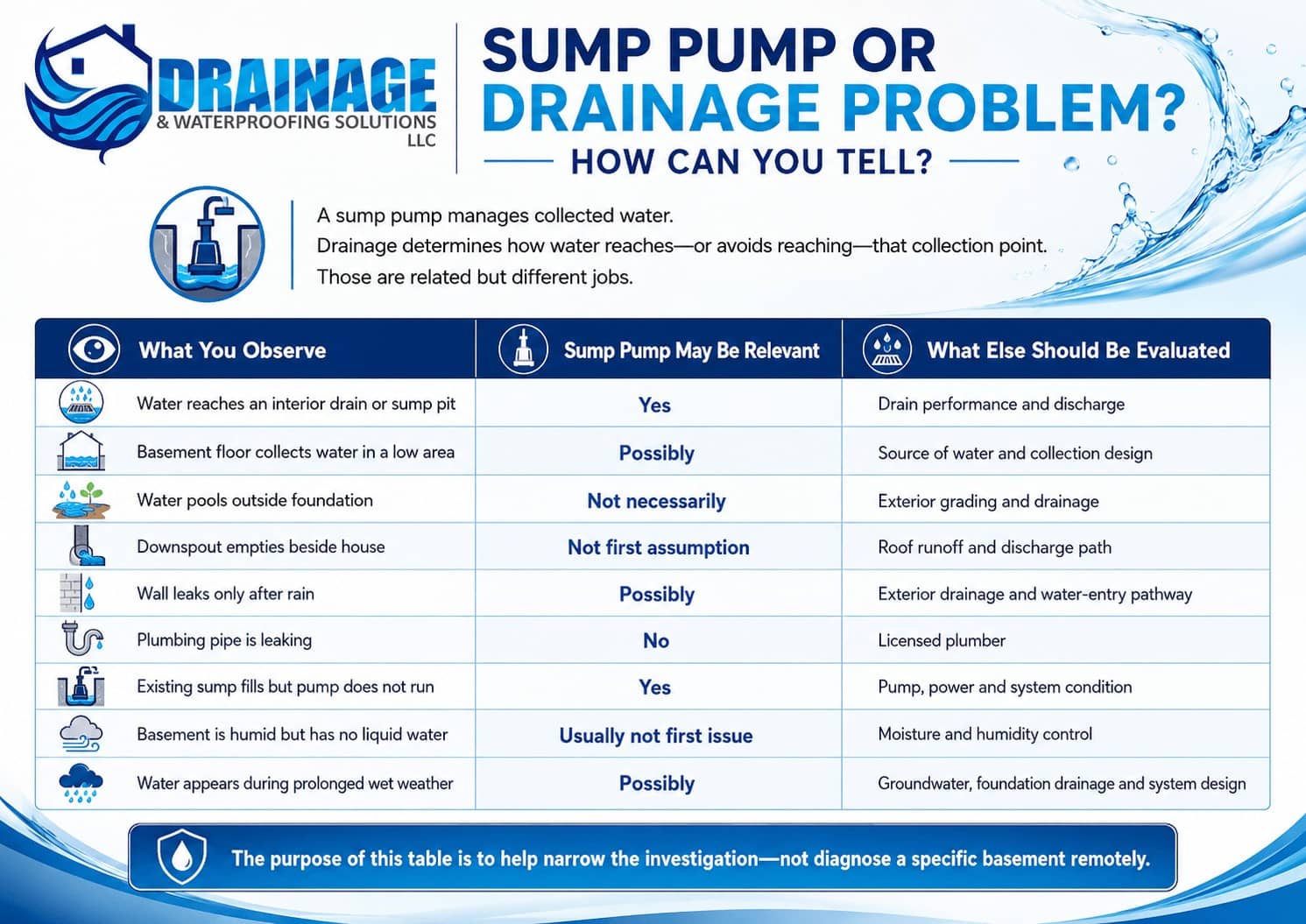
Sump Pump or Drainage Problem? How Can You Tell?
A sump pump manages collected water.
Drainage determines how water reaches—or avoids reaching—that collection point.
Those are related but different jobs.
| What You Observe | Sump Pump May Be Relevant | What Else Should Be Evaluated |
|---|---|---|
| Water reaches an interior drain or sump pit | Yes | Drain performance and discharge |
| Basement floor collects water in a low area | Possibly | Source of water and collection design |
| Water pools outside foundation | Not necessarily | Exterior grading and drainage |
| Downspout empties beside house | Not first assumption | Roof runoff and discharge path |
| Wall leaks only after rain | Possibly | Exterior drainage and water-entry pathway |
| Plumbing pipe is leaking | No | Licensed plumber |
| Existing sump fills but pump does not run | Yes | Pump, power and system condition |
| Basement is humid but has no liquid water | Usually not first issue | Moisture and humidity control |
| Water appears during prolonged wet weather | Possibly | Groundwater, foundation drainage and system design |
The purpose of this table is to help narrow the investigation—not diagnose a specific basement remotely.
Is a Sump Pump the Same as Basement Waterproofing?
No.
A sump pump is a water-removal component.
Basement waterproofing and moisture control are broader.
Depending on the home, basement moisture control can involve:
- Exterior drainage
- Interior drainage
- Foundation-water management
- Sump pumps
- Moisture control
- Drainage corrections
- Other measures based on the water pathway
A properly designed sump system can be an important part of basement waterproofing, but installing a pump does not automatically stop water from reaching the foundation.
The objective should be to manage the entire water pathway.
Can a Sump Pump Fix Water Pooling Around My Foundation?
Not by itself.
If rainwater is collecting outside next to the foundation, the exterior drainage problem deserves attention.
Possible contributors include:
- Ground sloping toward the house
- Downspouts releasing water close to the foundation
- Concentrated roof runoff
- Low landscaping areas
- Saturated soil
- Existing drainage limitations
- Water traveling downhill toward the property
A sump pump inside the basement may manage some water that reaches an interior system, but it does not correct the exterior condition causing water to accumulate outside.
Drainage & Waterproofing Solutions provides foundation waterproofing and drainage evaluation when the water problem extends beyond the sump pump itself.
Do I Need a Sump Pump If Water Only Appears After Heavy Rain?
Possibly.
Rain-dependent basement water suggests that drainage, soil saturation, runoff, foundation-water pathways, or several conditions together may be involved.
During the next safe rainfall event, observe:
- Where downspouts discharge
- Whether water pools beside the house
- Which direction the yard slopes
- Whether exterior drains are flowing
- Where basement water first appears
- Whether an existing sump fills
- How quickly the water recedes after the storm
Those observations can help determine whether the basement needs a sump pump, exterior drainage correction, waterproofing, repair to an existing system, or a combination.
Do I Need a Sump Pump If I Already Have a French Drain?
It depends on what type of drainage system you have and where the collected water goes.
An exterior French drain may be able to move water by gravity toward an appropriate outlet without using a pump.
An interior drainage system may collect water below the basement floor and direct it toward a sump basin, where a pump removes it from the structure.
The critical question is:
Can the collected water reach an appropriate discharge point by gravity, or does it need mechanical pumping?
That answer depends on elevation, system design, drainage destination, and site conditions.
A French drain and sump pump are not necessarily competing options. In some systems, they perform different parts of the same job.
Sump Pump vs. Gravity Drainage
Whenever practical, water-management planning should consider whether water can move through gravity drainage before assuming a pump is required.
Gravity Drainage
Gravity systems use elevation to move water from a higher point to a lower discharge point.
Potential advantages include:
- No pump motor required
- No reliance on electricity for basic flow
- Fewer mechanical components
But gravity drainage only works when the property provides an appropriate elevation difference and discharge location.
Pumped Drainage
A sump pump mechanically lifts collected water and sends it through a discharge line.
It becomes useful when water collects below the elevation of the available outlet or when the system otherwise requires mechanical removal.
Neither approach is universally better.
Site conditions determine which one is appropriate.
What If I Already Have a Sump Pump?
An existing pump should not necessarily be ignored until it stops working.
Pay attention to changes such as:
- Pump running more often than usual
- Pump not activating when water rises
- Unusual noises
- Water remaining in the basin
- Basement water appearing despite pump operation
- Discharge water returning toward the house
- Visible damage to the discharge line
- Pump cycling repeatedly over short intervals
A change in performance deserves evaluation before the next major water event.
Drainage & Waterproofing Solutions also provides drainage-system inspections when an existing drainage or water-management system needs professional evaluation.
How Do I Know If My Sump Pump Is Working?
If the sump system is accessible and can be observed safely, homeowners can watch what happens when water reaches the basin.
The exact testing procedure depends on the installed pump, so follow the manufacturer's instructions rather than improvising electrical or mechanical tests.
Useful observations include:
- Does the pump activate as water rises?
- Does the water level decrease?
- Does the pump stop appropriately?
- Is water leaving through the discharge line?
- Are there unusual sounds?
- Does water immediately return to the basin?
- Is the discharge point clear?
If you are uncertain how the system operates, have it inspected rather than disassembling the pump yourself.
What Happens If a Sump Pump Loses Power?
A standard electric sump pump normally depends on available electrical power.
That matters because storms capable of producing significant water can also be associated with electrical outages.
A backup system may therefore be worth evaluating for homes where continuous pumping is especially important.
Questions to consider include:
- How quickly does the basin fill?
- How dependent is the basement on pumping?
- Has the property lost power during heavy storms before?
- Is a backup pumping method appropriate?
- Would an alarm or monitoring system be useful?
Not every home requires the same backup configuration.
Is a Battery Backup Sump Pump Worth Considering?
For a home that depends heavily on mechanical pumping to manage recurring water, backup protection may be worth considering.
A battery-backup system can provide an additional pumping method if the primary electrical system becomes unavailable or the main pump encounters certain problems.
However, a backup should not be treated as a substitute for:
- Correct pump selection
- Proper drainage
- Appropriate discharge
- Routine inspection
- Correcting known system defects
Backup protection is redundancy—not a replacement for a properly designed primary system.
Where Should Sump Pump Water Go?
A sump pump needs an appropriate discharge location.
The line should not simply send collected water back toward the foundation, where it may return to the drainage system.
Discharge planning should account for:
- Property slope
- Foundation location
- Nearby structures
- Erosion
- Drainage pathways
- Applicable local requirements
- Public versus private drainage infrastructure
The City of Raleigh provides stormwater and water-pollution guidance that homeowners can review when considering drainage and discharge conditions.
Discharge design is part of the installation—not an afterthought.
Can a Sump Pump Discharge Into the Sanitary Sewer?
Do not assume that it can.
Local plumbing, sewer, and stormwater requirements can govern where water may be discharged.
For Raleigh properties, the discharge route should be reviewed as part of the project instead of connecting a pump to an existing pipe without confirming what that pipe serves.
A professional sump pump installation in Raleigh should account for both where water is collected and where it can appropriately be discharged.
What Size Sump Pump Do I Need?
There is no responsible universal pump size for every basement.
Selection depends on factors such as:
- How quickly water enters the basin
- Vertical lift
- Discharge distance
- Pipe configuration
- Drainage-system design
- Expected inflow
- Pump performance specifications
- Backup requirements
A larger pump is not automatically better.
The pump should be selected to match the system.
Reducing the decision to horsepower alone ignores the amount of water entering the system and the resistance the pump must overcome to reach its discharge point.
Does Every Basement Need a Sump Pit?
No.
A sump pump normally needs an appropriate basin or collection point, but that does not mean every basement should have one installed.
If a house has no identified water-management need, installing a basin and pump may provide little benefit.
If an interior drainage system needs to collect and mechanically remove water, a sump basin may be an important part of that design.
System selection should follow evaluation of:
- Foundation conditions
- Interior drainage
- Elevation
- Water source
- Water volume
- Discharge options
Can a Sump Pump Help a Crawl Space Too?
Yes.
A sump pump may be used as part of a crawl-space drainage system when liquid water collects beneath the home and needs mechanical removal.
However, the same diagnostic principle applies.
Standing water in a crawl space can involve:
- Exterior runoff
- Saturated soil
- Groundwater
- Foundation entry
- Existing drainage
- Plumbing
- Low areas beneath the home
The pump should be part of a larger water-management system rather than installed simply because the crawl space feels damp.
Drainage & Waterproofing Solutions also provides crawl-space and basement waterproofing when water beneath the home requires drainage and moisture-management work.
When Is a Sump Pump Not the Right First Solution?
A sump pump may not be the first answer when the problem can be corrected more directly at its source.
A Plumbing Leak
A failed plumbing line needs an appropriate plumbing professional.
An Overflowing Gutter
Correct the roof-drainage problem rather than simply pumping water after it reaches the basement.
Downspout Water Dumping Against the Foundation
Redirecting roof runoff appropriately may be more direct.
Poor Surface Grading
The exterior drainage pathway should be evaluated.
Humidity Without Liquid Water
A sump pump does not control airborne humidity.
Significant Structural Movement
A pump is not a structural repair. Appropriate foundation or structural evaluation may be necessary.
The best water-management plan does not start by asking which product can be installed.
It starts by identifying the source of the problem.
Do I Need a Sump Pump? Homeowner Decision Guide
| What Is Happening? | Sump Pump Evaluation? | Other Issue to Evaluate |
|---|---|---|
| Interior drainage reaches a low collection point | Yes | Overall drainage design |
| Basement repeatedly gets standing water | Yes | Water source and foundation drainage |
| Existing sump fills during storms | Yes | Pump performance and discharge |
| Water only pools outside | Maybe | Exterior drainage first |
| Basement is humid but dry | Usually not first step | Humidity/moisture control |
| Downspout dumps beside foundation | Maybe | Roof runoff first |
| Plumbing line leaks | No | Plumber |
| Water enters wall-floor joint | Yes | Interior/exterior water pathway |
| Existing pump cannot keep up | Yes | Pump capacity plus inflow source |
| Water appears after power outage | Yes | Primary and backup pumping strategy |
No table can determine what a specific basement needs, but this framework helps identify when professional sump-pump evaluation makes sense.
What Happens During a Professional Sump-Pump Evaluation?
A useful evaluation should look beyond the pump itself.
Relevant questions include:
- Where is the water coming from?
- When does the basement get wet?
- How is water currently collected?
- Is an interior drainage system present?
- Is there an existing sump basin?
- How quickly does water enter the basin?
- Where can the pump discharge?
- Does exterior drainage also need correction?
- Is the existing pump performing properly?
- Would backup protection be appropriate?
The purpose is to determine the right water-management system rather than simply installing or replacing a pump because water is present.
What Determines the Cost of Sump Pump Installation?
The cost of a sump-pump project depends on much more than the price of the pump.
Relevant factors may include:
- Whether a sump basin already exists
- Excavation
- Interior drainage requirements
- Pump specifications
- Discharge piping
- Vertical lift
- Discharge distance
- Electrical requirements
- Backup system
- Alarm or monitoring components
- Accessibility
- Existing water-management equipment
- Restoration
- Overall project complexity
That is why generic online pricing can be misleading.
Replacing a pump in an existing basin is fundamentally different from installing a new interior drainage system, sump basin, pump, discharge line, and backup equipment.
Homeowners researching sump pump installation Raleigh NC should compare the complete proposed scope—not simply the pump model or advertised price.
Should I Repair or Replace My Existing Sump Pump?
That depends on the condition of the pump and the larger system.
Replacement may make sense when the pump:
- Does not activate reliably
- Cannot move water adequately
- Has significant mechanical problems
- Has repeatedly failed
- No longer matches the drainage system's needs
But what appears to be a pump failure can sometimes involve:
- A restricted discharge
- Electrical problems
- Float-switch issues
- Excessive water entering the system
- A drainage problem upstream
- Water returning from the discharge location
The failure should be identified before assuming the motor itself is the only problem.
Should I Have a Backup Sump Pump?
A backup system is especially worth discussing when the home depends heavily on sump pumping to prevent water from collecting in the basement.
The decision can depend on:
- Frequency of pump operation
- History of power outages
- Rate of water inflow
- Consequences if the primary pump stops
- Existing backup equipment
- Desired level of redundancy
The backup system should complement—not compensate for—a poorly designed primary system.
When Should Raleigh Homeowners Call About Sump Pump Installation?
Consider professional evaluation when:
- Basement water repeatedly returns
- An existing sump pit fills
- Your pump no longer activates reliably
- You are installing an interior drainage system
- Water enters at the floor perimeter
- Your basement depends on a pump during storms
- A pump has failed previously
- You are uncertain where the discharge goes
- You need to determine whether gravity drainage is practical
- You are comparing sump pump installation Raleigh options but do not yet know which system is appropriate
Understanding the water pathway before the next major storm makes it easier to select a system based on the actual problem rather than reacting after another wet basement.
What Should I Do Before the Contractor Arrives?
If conditions are safe, gather information that helps explain how the basement behaves.
Take Photos During or After Rain
Photograph:
- Water entry
- The sump pit
- Standing water
- Foundation walls
- Wall-floor joints
- Exterior pooling
- Downspouts
- Existing drainage outlets
Note When the Pump Runs
Does it run:
- Only during major storms?
- Hours after rain stops?
- Frequently during normal weather?
- Almost never?
Locate the Discharge
If safely visible, identify where the existing sump discharge ends.
Record Changes
Mention:
- Landscaping work
- Grading changes
- Drainage repairs
- Pump replacements
- Power-outage water problems
- New seepage locations
You do not need to diagnose the problem yourself.
Good observations simply give the contractor more information.
Do I Need a Sump Pump in My Basement?
You may need a sump pump when liquid water collects below grade and requires mechanical removal because gravity drainage alone cannot adequately carry it to an appropriate discharge point.
You may not need one when:
- The basement has no liquid-water problem
- Exterior drainage alone is the primary issue
- Water can be managed through an appropriate gravity system
- The symptom is humidity rather than standing water
- A plumbing problem is causing the moisture
The right decision comes from evaluating the whole system:
water source → collection → drainage → sump → pump → discharge.
Skipping one of those steps can result in a pump that treats the symptom while leaving the actual water problem unresolved.
Request a Sump Pump and Basement Drainage Evaluation
If you are asking “Do I need a sump pump?”, the most useful next step is to determine exactly how water is reaching and leaving your basement.
Drainage & Waterproofing Solutions LLC provides drainage, waterproofing, sump-pump-related services, and sump pump installation in Raleigh and surrounding Central North Carolina communities.
The appropriate solution may involve a sump pump, repair or replacement of an existing system, drainage improvements, foundation waterproofing, or another water-management approach based on the conditions at the property.
Call (919) 508-7503 or contact Drainage & Waterproofing Solutions to discuss your basement water problem.
Frequently Asked Questions
Do I need a sump pump if my basement is dry?
Not necessarily. A consistently dry basement with no identified groundwater, seepage, or drainage problem may not benefit from installing a pump simply for the sake of having one. The decision should be based on whether water needs to be collected and mechanically removed from below grade.
Do I need a sump pump if my basement only leaks during heavy rain?
Possibly. Rain-related seepage can involve saturated soil, foundation drainage, exterior runoff, or an interior drainage system that needs a sump. The rainfall connection should first be evaluated so the pump is not used as a substitute for correcting an exterior drainage problem when another solution is more appropriate.
Can a sump pump stop basement flooding?
A properly designed sump system can remove water collected by an interior drainage system or sump basin and can be an important part of reducing basement water problems. It cannot prevent every type of flooding, plumbing failure, surface-water entry, or water problem. Its effectiveness depends on the entire collection and discharge system.
Is a sump pump the same as a French drain?
No. A French drain collects and redirects water through a gravel-and-pipe drainage system, while a sump pump mechanically removes collected water from a basin. Some systems use both: drainage collects the water and directs it toward a sump, then the pump moves it to the discharge location.
Where should a sump pump discharge?
The discharge location should move water away from the structure without simply sending it back toward the foundation. Property slope, erosion, neighboring properties, drainage infrastructure, and applicable local requirements should all be considered when planning the discharge route.
Do sump pumps work during a power outage?
A standard electric sump pump normally requires power. Homes that depend significantly on pumping during storms may benefit from evaluating an appropriate backup system. Backup configuration depends on the property's water inflow, existing equipment, electrical conditions, and the consequences of the primary pump being unavailable.
How much does sump pump installation in Raleigh cost?
There is no reliable universal price because the scope can range from replacing a pump in an existing basin to installing a new drainage system, sump pit, pump, discharge line, and backup equipment. Site conditions, excavation, pump requirements, access, drainage design, and restoration all influence the final project.
Who should install a basement sump pump?
When the pump is part of a basement drainage or waterproofing system, a qualified drainage and waterproofing contractor can evaluate the complete water pathway rather than treating the pump as an isolated appliance. Plumbing or electrical work outside that contractor's scope should be handled by the appropriate qualified trade.