How Do You Know If Your French Drain Is Clogged or Failing?

August 14th, 2026

How Do You Know If Your French Drain Is Clogged or Failing?

A French drain may be clogged or no longer working properly if water begins pooling in areas that previously drained, the soil stays saturated long after rain, water returns near the foundation, or the system's visible outlet stops discharging when you would normally expect flow.

Those symptoms are useful clues, but they do not prove that a clog is the cause.

A French drain can appear to "stop working" because of sediment buildup, an obstructed outlet, damaged pipe, changes in grading, unusually concentrated runoff, or a drainage problem occurring outside the area the system was designed to collect.

That is why troubleshooting should begin with the water pattern, not with the assumption that the pipe simply needs to be cleaned.

Drainage & Waterproofing Solutions LLC provides French drain services and drainage evaluation for homes throughout Raleigh, Garner, Wake County, and other verified Central North Carolina service areas.

If a drainage system that once worked is no longer controlling water effectively, contact Drainage & Waterproofing Solutions to have the condition evaluated.

What Are the Most Common Signs a French Drain Is Clogged?

The most useful warning sign is a change in drainage behavior.

If the system previously moved water effectively but the same areas now remain wet or flood after ordinary rainfall, something may have changed.

Possible warning signs include:

  • Water pooling near the French drain
  • Soggy ground returning in an area that used to drain
  • Water remaining for much longer after rain
  • Little or no discharge from a visible outlet
  • Water backing up near the foundation
  • Basement or crawl-space moisture returning after storms
  • Erosion developing around the drain route or outlet
  • Water appearing in a new location because the intended drainage path is not functioning
  • Mud or sediment collecting around accessible drainage components

No single symptom confirms a clog.

The system needs to be considered as a complete pathway: collection area → drain → pipe → outlet.

How Is a French Drain Supposed to Work?

A French drain collects excess water through a gravel-filled drainage trench and perforated pipe and redirects that water toward another location.

Water does not enter the system through one small surface opening. Instead, it can move through the surrounding stone and into the perforated drainage pipe along part of the drain's length.

Drainage & Waterproofing Solutions explains on its French drain service page that these systems collect and redirect water away from problem areas such as recurrent yard puddles and foundation-adjacent drainage zones.

This distinction is important when troubleshooting.

If an entire section of saturated soil used to drain effectively and now remains wet, the problem could involve the collection area, pipe, or outlet.

If water is appearing somewhere the original French drain was never intended to intercept, the existing system might still be functioning properly while a new or separate drainage problem has developed.

Can a French Drain Actually Become Clogged?

Yes.

Over time, fine sediment, soil particles, decomposing organic material, and other debris can reduce the amount of water that can move through portions of a French drain.

The client's current French Drain page specifically notes that sediment—including dirt and decaying leaf material—can eventually restrict a French drain.

But "clogged" can describe several different problems.

Sediment Within the Gravel Zone

Fine material can accumulate in spaces that were intended to allow water movement.

Sediment Inside the Pipe

Material entering the perforated pipe can reduce its usable cross-section.

A Blocked Outlet

The buried collection system may be functioning while the discharge end is blocked by soil, leaves, vegetation, debris, or another obstruction.

A Damaged Pipe

A pipe may become displaced, crushed, disconnected, or otherwise unable to carry water effectively.

A Restricted Collection Area

Changes above or around the drain can reduce how efficiently water reaches it.

These conditions can create similar symptoms, which is why looking at the whole system matters.

Why Is Water Pooling Even Though I Have a French Drain?

Water pooling near an existing French drain does not automatically mean the drain has failed.

Several explanations are possible:

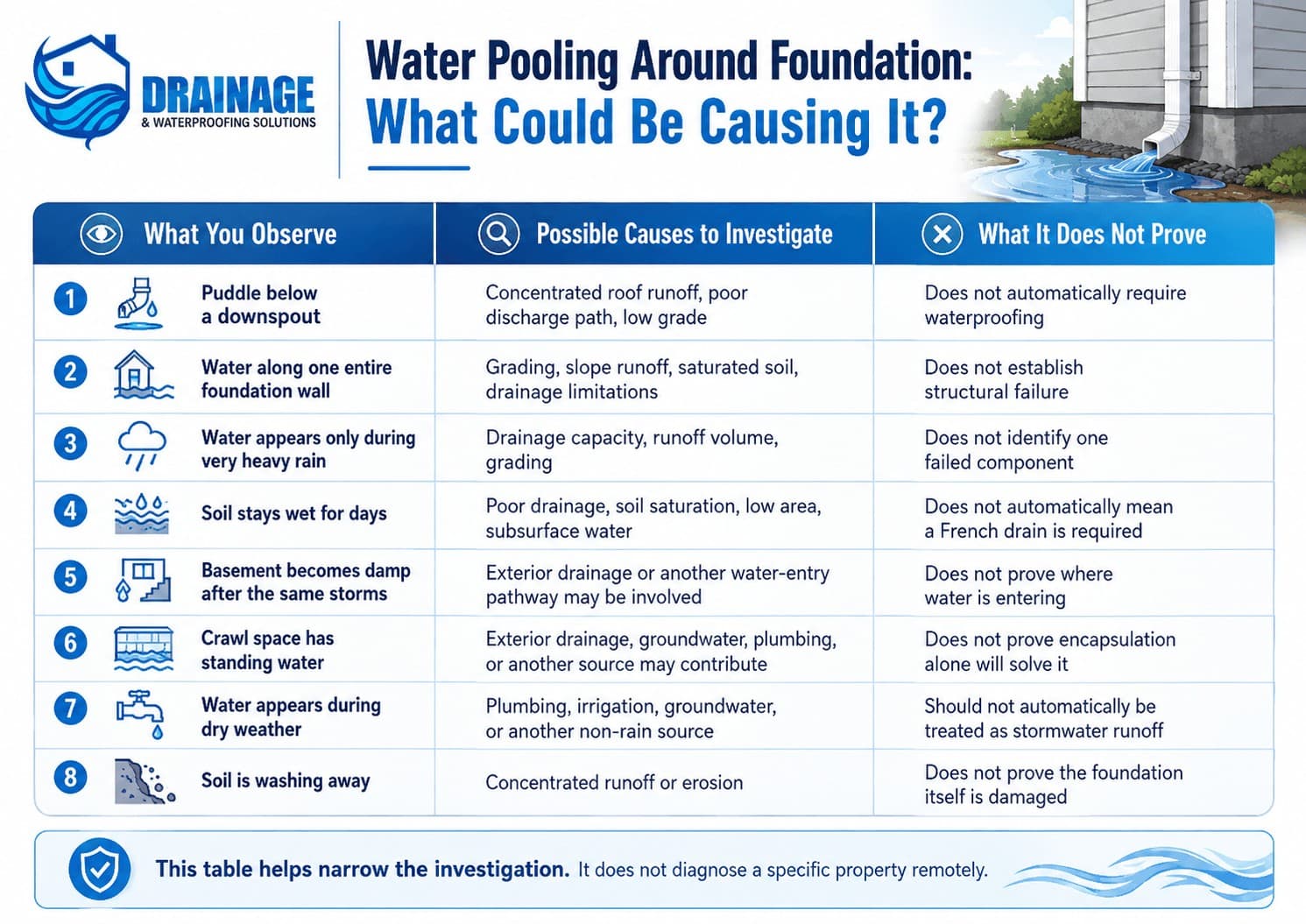
What You Notice Possible Explanation What It Does Not Prove
Water returns directly over the drain route Sediment, restriction, damaged pipe, or excessive water volume Does not prove the entire system needs replacement
Water pools far from the drain New drainage pathway, grading change, or runoff outside collection area Does not prove the French drain is clogged
Outlet no longer flows during storms Outlet blockage, upstream restriction, or little water reaching system Does not identify where the problem is
Yard stays soggy for days Restricted drainage, saturated soil, grading, or another water source Does not prove one specific failed component
Water appears beside foundation again Drain limitation, roof runoff, grading, groundwater, or another pathway Does not automatically mean foundation waterproofing is required
Water appears only during unusually intense rain System capacity or runoff pattern may be involved Does not necessarily indicate a permanent blockage

The recurring question should be:

Has the water behavior changed compared with how the property performed when the system was working normally?

That comparison can provide more useful information than the presence of a puddle alone.

Infographic showing possible reasons water may still pool even with a French drain, including sediment, grading changes, outlet blockage, saturated soil, runoff, and drainage limitations.

Should Water Be Coming Out of the French Drain Outlet?

If a French drain has an accessible gravity outlet and the system is actively collecting enough water during wet conditions, you may see discharge.

However, not every system has the same design, outlet visibility, or operating conditions.

The absence of visible flow does not automatically prove that the system is blocked.

Possible explanations include:

  • The soil has not become saturated enough for water to enter the drain
  • The outlet is hidden or difficult to locate
  • The system discharges somewhere you cannot observe directly
  • Water is leaving through another part of the drainage design
  • An obstruction exists
  • The drain is not collecting the water that is creating the visible problem

Do not dig randomly along an unknown drainage route simply because you cannot find the outlet.

If the route or discharge point is uncertain, professional evaluation may be more useful.

What Can Block a French Drain Outlet?

The discharge point is one of the simplest places to inspect when it is safely and clearly accessible.

Possible outlet restrictions can include:

  • Leaves
  • Soil
  • Mulch
  • Grass
  • Plant growth
  • Erosion deposits
  • Debris
  • Animal activity
  • Landscaping changes

The City of Raleigh advises private-property owners to keep branches, leaves, grass clippings, and other debris away from private stormwater pipes and drainage areas because these materials can contribute to obstructions.

A visible blockage at the outlet may explain poor flow.

However, clearing debris from the outlet does not prove the buried portion of the drain is functioning correctly.

Could Landscaping Changes Make a French Drain Seem Broken?

Yes.

Drainage depends on water being able to reach the system.

Landscaping changes can alter that pathway.

Examples include:

  • Adding soil
  • Installing raised planting beds
  • Changing mulch depth
  • Regrading part of the lawn
  • Installing a patio or walkway
  • Building a fence
  • Changing downspout discharge
  • Adding a shed or other impervious surface
  • Altering the slope above the drain
  • Heavy equipment compacting the soil

If runoff now travels around the French drain instead of toward it, the drain may continue functioning exactly as installed while water begins collecting elsewhere.

That is one reason drainage troubleshooting should include the surrounding landscape—not just the buried pipe.

Can Downspouts Overwhelm or Bypass a French Drain?

Roof runoff can significantly influence yard drainage.

A downspout concentrates water collected from part of the roof into a relatively small discharge area.

If a downspout has been changed, disconnected, shortened, or redirected since the French drain was installed, the new runoff pattern can make an otherwise functioning drainage system appear inadequate.

During a safe rainfall event, observe:

  • Where each nearby downspout releases water
  • Whether that water reaches the French drain
  • Whether it travels toward the foundation
  • Whether it creates erosion
  • Whether a new puddle develops
  • Whether water is crossing the drain without entering the collection zone

If the actual problem originates with roof drainage, correcting that source may be more appropriate than assuming the French drain requires replacement.

Can a French Drain Be Working but Still Not Solve the Water Problem?

Yes.

A French drain only manages water that reaches the area it was designed to intercept.

Imagine a drain running across one side of a yard.

Years later, new grading, landscaping, construction, or concentrated runoff causes water to collect on the opposite side of the property.

The original drain may still be functioning, but it was never designed to solve the new water path.

Likewise, a French drain installed to manage saturated soil may not address:

  • A plumbing leak
  • Gutter overflow
  • A broken downspout
  • Water from another part of the lot
  • A new low spot
  • Interior plumbing discharge
  • A public stormwater issue

Troubleshooting should determine whether you have a failed drainage system or a different drainage problem.

How Can You Check a French Drain After Rain?

Homeowners can gather useful information without attempting to excavate or dismantle the system.

1. Observe the Problem Area

Look at the property during or shortly after rainfall when it is safe.

Note:

  • Where water first appears
  • Which direction it moves
  • Where it stops
  • How deep the pooling becomes
  • Whether the wet area follows the French drain route

2. Compare With Past Performance

Ask:

  • Did this area previously drain faster?
  • Is the puddle new?
  • Has the wet area become larger?
  • Is water now reaching the house?

A change in behavior can be especially useful during diagnosis.

3. Check Accessible Outlets

If you know exactly where the outlet is and can inspect it safely, look for obvious debris or blockage.

Do not enter pipes, drainage structures, steep areas, or flooded locations.

4. Watch Nearby Downspouts

Determine whether roof runoff is adding water to the problem area.

5. Document How Long the Area Stays Wet

Photograph the property immediately after rain and again later.

6. Check the Basement or Crawl Space

If the system was originally intended to manage foundation-side water, note whether interior moisture has returned.

7. Take Photos and Video

A video of active runoff can help show a drainage path that disappears after the storm.

What Should You Not Do to a Suspected Clogged French Drain?

Avoid aggressive troubleshooting that could damage a system you have not yet diagnosed.

Do not automatically:

  • Excavate the entire drain
  • Insert equipment into an unknown pipe
  • Use harsh drain chemicals
  • Assume a plumbing snake is appropriate
  • Apply uncontrolled high-pressure water
  • Redirect large volumes of water toward the foundation
  • Connect new runoff sources to the drain
  • Cover the outlet
  • Replace the entire system based on one puddle

French drains are not ordinary indoor plumbing drains.

Their performance depends on the pipe, surrounding stone, filter material, soil, grade, water source, and discharge path.

A blockage within the pipe is only one possible failure point.

Does a Clogged French Drain Always Need to Be Replaced?

No.

The appropriate response depends on what is actually wrong.

A drainage evaluation might find:

  • A simple outlet obstruction
  • Localized sediment restriction
  • Damaged pipe
  • A disconnected section
  • A system whose route no longer matches the water problem
  • Poor grading
  • New runoff conditions
  • A system that is functioning but undersized for the current water pattern
  • A drainage issue unrelated to the French drain

Some problems may be repairable.

Others may require modifying or replacing part of the drainage system.

In some cases, the French drain may not be the actual problem at all.

The diagnosis should determine the scope.

French Drain Problem or Different Drainage Problem?

Symptom French Drain Should Be Evaluated Another Cause Should Also Be Considered
Same area has begun flooding again Yes Rain volume, grading, runoff changes
Outlet visibly blocked Yes Downstream discharge conditions
New puddle far from drain route Maybe Grading or new runoff pathway
Basement moisture returns Yes Foundation water entry, plumbing, roof runoff
Water appears during dry weather Maybe Plumbing, irrigation, groundwater
Only one downspout area is wet Maybe Roof discharge first
Whole side yard is newly saturated Yes Broader grading or runoff conditions
Drainage worsened after landscaping Yes Changed surface elevation or water pathway

This framework prevents a common mistake: treating every drainage symptom as evidence that the buried pipe has failed.

When Should a French Drain Be Professionally Inspected?

Consider professional evaluation when:

  • A previously dry area repeatedly floods again
  • Water remains much longer than it once did
  • The outlet appears inactive during recurring wet conditions
  • The outlet cannot be located
  • The drain route is uncertain
  • Foundation-side water has returned
  • Basement or crawl-space moisture is appearing again
  • Erosion is developing
  • Landscaping or construction changed the drainage pattern
  • You are considering digging up or replacing the system
  • You cannot determine whether the problem is the drain or the property around it

Drainage & Waterproofing Solutions provides drainage-system inspections for homeowners who need help evaluating drainage performance.

What Happens During a Drainage-System Evaluation?

The objective should be to identify the water pathway before recommending work.

Relevant questions can include:

  1. When did the problem return?
  2. What happens during rainfall?
  3. Where is the French drain located?
  4. Where is the outlet?
  5. Has landscaping changed?
  6. Have downspouts changed?
  7. Is the same area flooding as before?
  8. Is water reaching the foundation?
  9. Is moisture appearing inside?
  10. Does an existing drainage component appear damaged or obstructed?
  11. Is the current drain located where the water now moves?
  12. Where can the water appropriately discharge?

These questions help distinguish a maintenance problem from a design, grading, or water-source problem.

Can a Clogged French Drain Cause Water Near the Foundation?

It can contribute when the French drain was intended to intercept water before it reached the foundation and the system is no longer moving that water effectively.

But foundation-side pooling can also result from:

  • Poor grading
  • Downspout discharge
  • Saturated soil
  • Gutter overflow
  • Surface runoff
  • Water arriving from an uphill area
  • Another drainage route

If water is reaching the foundation, the entire exterior water pathway should be evaluated.

Drainage & Waterproofing Solutions also provides foundation waterproofing when the confirmed condition requires waterproofing measures in addition to drainage.

What If Basement Moisture Has Returned?

If basement moisture returns at the same time that yard drainage worsens, document both conditions.

The connection may be important, but it should not be assumed.

Basement water can enter through different pathways, and an exterior French drain is only one component that may affect the overall water-management system.

Drainage & Waterproofing Solutions provides basement moisture control when basement conditions require further evaluation and water-management work.

If the symptoms are new, note:

  • Which wall is damp
  • When the moisture appears
  • Whether it follows rainfall
  • Whether the exterior soil is saturated
  • Whether the sump pump runs
  • Whether visible seepage is present

This gives the contractor more information than simply reporting that the basement "feels damp."

What If Crawl-Space Water Returns?

The same diagnostic principle applies beneath the home.

Water in a crawl space does not automatically prove that the French drain is clogged.

Possible sources can include:

  • Exterior runoff
  • Groundwater
  • Foundation drainage
  • Plumbing
  • Ground moisture
  • Humid outdoor air
  • Another water-entry pathway

Drainage & Waterproofing Solutions provides crawl-space and basement waterproofing when active moisture or water intrusion needs to be addressed.

The water source should be identified before assuming encapsulation or drain replacement alone will correct the condition.

How Often Should a French Drain Be Checked?

There is no useful one-size-fits-all maintenance calendar for every property.

The client's current French Drain page recommends periodic inspection because sediment can eventually restrict drainage performance.

Homeowners should also pay attention after:

  • Major storms
  • Landscaping changes
  • Construction
  • Drainage repairs
  • Downspout changes
  • New erosion
  • Recurring ponding
  • Basement or crawl-space moisture returning

The most valuable maintenance habit is often simply recognizing when the property's normal drainage behavior changes.

A system that has performed consistently for years and suddenly begins leaving water behind deserves investigation.

Who Is Responsible for a Drainage System on Private Property in Raleigh?

Responsibility depends on the system and property.

The City of Raleigh explains that homeowners are generally responsible for stormwater pipes and drainage features located on private property, while the City maintains qualifying public stormwater infrastructure.

Private drainage easements also are not automatically City-maintained; responsibility may belong to the property owner, HOA, or another entity identified in recorded documents.

That distinction is important before assuming the City will repair a private French drain.

If the problem involves public street runoff or public stormwater infrastructure, Raleigh homeowners can also review the City's Drainage Assistance resources.

How Much Does French Drain Repair Cost?

There is no reliable universal repair price because the work depends on what the inspection finds.

Cost factors can include:

  • Location of the problem
  • Length of affected drain
  • Excavation
  • Accessibility
  • Pipe condition
  • Gravel and filter materials
  • Sediment buildup
  • Outlet work
  • Landscaping
  • Restoration
  • Need for partial replacement
  • Whether the original layout needs modification

A small accessible outlet correction is fundamentally different from excavating and rebuilding a long buried drainage system.

The most accurate price requires identifying the cause first.

Should You Repair the French Drain or Install a New One?

Repair may make sense when the problem is limited and the existing drainage route still matches the property's needs.

Replacement or redesign may need consideration when:

  • Large portions of the system are restricted
  • Pipe is damaged
  • Drainage pathways have changed significantly
  • The original drain no longer intercepts the problem water
  • There is no useful discharge route
  • Repeated repairs do not restore performance
  • The system was not appropriate for the actual water problem

The objective should not be to preserve an old drainage system at all costs.

It should be to create an appropriate path for the water conditions that exist now.

What Should Raleigh and Garner Homeowners Do First?

If you think your French drain is clogged, begin with observation.

During the next safe rainfall:

  1. Photograph the problem area.
  2. Watch where runoff originates.
  3. Note whether water follows the French drain route.
  4. Locate the outlet if it is known and accessible.
  5. Look for obvious external debris.
  6. Compare the drainage with how the property performed previously.
  7. Check for basement or crawl-space moisture.
  8. Document any recent landscaping or downspout changes.
  9. Avoid excavating until you understand the problem.

A French drain can fail, become restricted, or need maintenance.

But the most important first question is not:

“How do I unclog it?”

It is:

“Is the French drain actually the reason this water is here?”

That distinction can prevent unnecessary excavation and help focus repairs on the real drainage problem.

Request a French Drain or Drainage-System Evaluation

If you are seeing signs your French drain is clogged, water is returning to areas that once drained properly, or you are unsure whether the existing system is functioning, Drainage & Waterproofing Solutions LLC can evaluate the drainage conditions affecting your property.

The appropriate next step may involve cleaning or repairing part of the drainage system, modifying the water pathway, addressing another drainage condition, or replacing a system that no longer matches the property's needs.

Call (919) 508-7503 or contact Drainage & Waterproofing Solutions to discuss the drainage problem.

Frequently Asked Questions

How do I know if my French drain is clogged?

Look for a change in drainage behavior: recurring puddles, soil staying wet longer, foundation-side water returning, or little visible outlet flow during conditions when the drain previously discharged. Those signs justify evaluation, but they do not identify the exact cause because grading, runoff changes, pipe damage, and outlet problems can create similar symptoms.

Can dirt clog a French drain?

Yes. Fine soil, sediment, and decomposing organic material can gradually restrict portions of a French drain. The client's own French-drain guidance notes that sediment can eventually reduce drainage performance. The restriction may occur around the gravel, inside the perforated pipe, at the outlet, or in more than one location.

Why is my French drain not draining after heavy rain?

Heavy rain can expose a restriction, but it can also temporarily create more runoff than the drainage area can manage. Other possibilities include a blocked outlet, saturated surrounding soil, grading changes, damaged pipe, or water entering an area the drain was never designed to collect. Repeated patterns are more informative than a single storm.

Can I unclog a French drain myself?

You can safely remove obvious surface debris from an accessible outlet, but buried French-drain troubleshooting can be more complicated than clearing an ordinary household drain. Avoid blindly inserting equipment, chemicals, or high-pressure water into an unknown system. If the cause is unclear, identify the system layout and failure point before attempting repairs.

Does no water at the outlet mean my French drain is clogged?

Not necessarily. The soil may not be saturated enough to produce flow, the drain may discharge somewhere else, the collection area may no longer receive the problem water, or an obstruction may exist. Outlet flow should be interpreted along with rainfall, soil saturation, system design, and drainage behavior.

Can a clogged French drain cause basement water?

It can contribute if the drain was designed to manage water near the foundation and is no longer doing so effectively. However, basement moisture can have other entry pathways. Exterior runoff, foundation seepage, groundwater, plumbing, and other conditions should also be considered before attributing basement moisture to one buried drain.

How often should I inspect a French drain?

Check the property's drainage behavior periodically and after major storms or changes to landscaping, grading, or downspouts. The client's French-drain guidance recommends regular inspection because sediment can restrict drainage over time. If water begins returning to previously dry areas, do not wait for a fixed calendar date before investigating.

Do I need to replace a clogged French drain?

Not automatically. An inspection may find an accessible outlet restriction, localized damage, sediment buildup, or a separate drainage problem. Replacement becomes more relevant when the existing system is extensively damaged, restricted, poorly located, or no longer appropriate for the water pathway it needs to manage.
Sources

Posted in Drainage Problems

Do I Need a Sump Pump in My Basement?

August 10th, 2026

Do I Need a Sump Pump in My Basement?

If water repeatedly enters the lowest part of your basement, collects along the floor, reaches an interior drainage system, or has no reliable gravity-fed path out of the home, a sump pump may be an appropriate part of the water-management system.

But not every damp basement needs one.

A sump pump is designed to remove water that has already been collected and direct it to an appropriate discharge location. It does not automatically correct poor grading, overflowing gutters, a plumbing leak, water collecting beside the foundation, or every other cause of basement moisture.

That is why the better question is not simply:

“Do I need a sump pump?”

It is:

“Where is the water coming from, how is it being collected, and does it need mechanical pumping to leave the property?”

Drainage & Waterproofing Solutions LLC provides basement drainage, waterproofing, sump-pump-related water management, and sump pump installation in Raleigh and surrounding Central North Carolina service areas.

If you are experiencing recurring basement water, contact Drainage & Waterproofing Solutions to have the water pathway and drainage conditions evaluated before choosing a system.

What Does a Sump Pump Actually Do?

A sump pump removes water that collects in a sump basin or pit at a low point in a basement or crawl-space drainage system.

A typical water-management sequence looks like this:

Water enters or is collected → drainage directs it toward the sump → water rises in the basin → the pump activates → water is discharged away from the structure.

The pump is only one part of the system.

For it to work effectively:

  1. Water has to reach the collection point.
  2. The pump has to activate when needed.
  3. The discharge line has to carry the water away.
  4. The discharge location must not simply send the water back toward the foundation.

A sump pump can be very important when those conditions are present, but installing one without understanding the larger drainage problem can leave a homeowner with an incomplete solution.

What Are the Signs I May Need a Sump Pump?

A sump pump becomes more relevant when a basement has a repeatable liquid-water problem, especially when the water reaches a low point or drainage system that cannot discharge effectively by gravity.

Signs worth evaluating include:

  • Standing water after heavy rain
  • Water entering at the wall-floor joint
  • Recurring basement seepage
  • Water collecting at the lowest part of the basement
  • An interior drainage system that needs a mechanical discharge point
  • An existing sump pit with no functioning pump
  • A pump that runs frequently during storms
  • Previous basement water problems
  • Water returning after an older pump fails
  • Saturated conditions beneath or around the foundation

These symptoms do not automatically prove that a new pump is the right answer.

They indicate that the water-management system needs to be evaluated.

Do I Need a Sump Pump If My Basement Has Never Flooded?

Not necessarily.

A house does not need a history of major flooding for a sump pump to be useful, but the absence of flooding also does not mean every home should have one installed.

A homeowner may have:

  • Minor recurring seepage without a flood
  • An interior drain that directs groundwater toward a sump location
  • A high-water condition beneath the slab during wet weather
  • An existing pump that prevents visible flooding
  • No liquid-water problem at all

A basement that remains consistently dry with no identified drainage issue may not benefit from adding a pump simply as a precaution.

The system should match an actual water-management need.

When Is Sump Pump Installation in Raleigh Appropriate?

Sump pump installation Raleigh homeowners consider is most appropriate when water is being collected below grade and needs a reliable mechanical way to leave the basement or crawl space.

That situation may occur with an interior drainage system, basement low point, recurring foundation seepage, or another properly designed water-collection system.

Drainage & Waterproofing Solutions provides sump-pump-related services as part of its broader drainage and waterproofing work.

For Raleigh-area homeowners, the first step should be determining whether water needs to be collected, redirected, pumped, or prevented from reaching the structure in the first place.

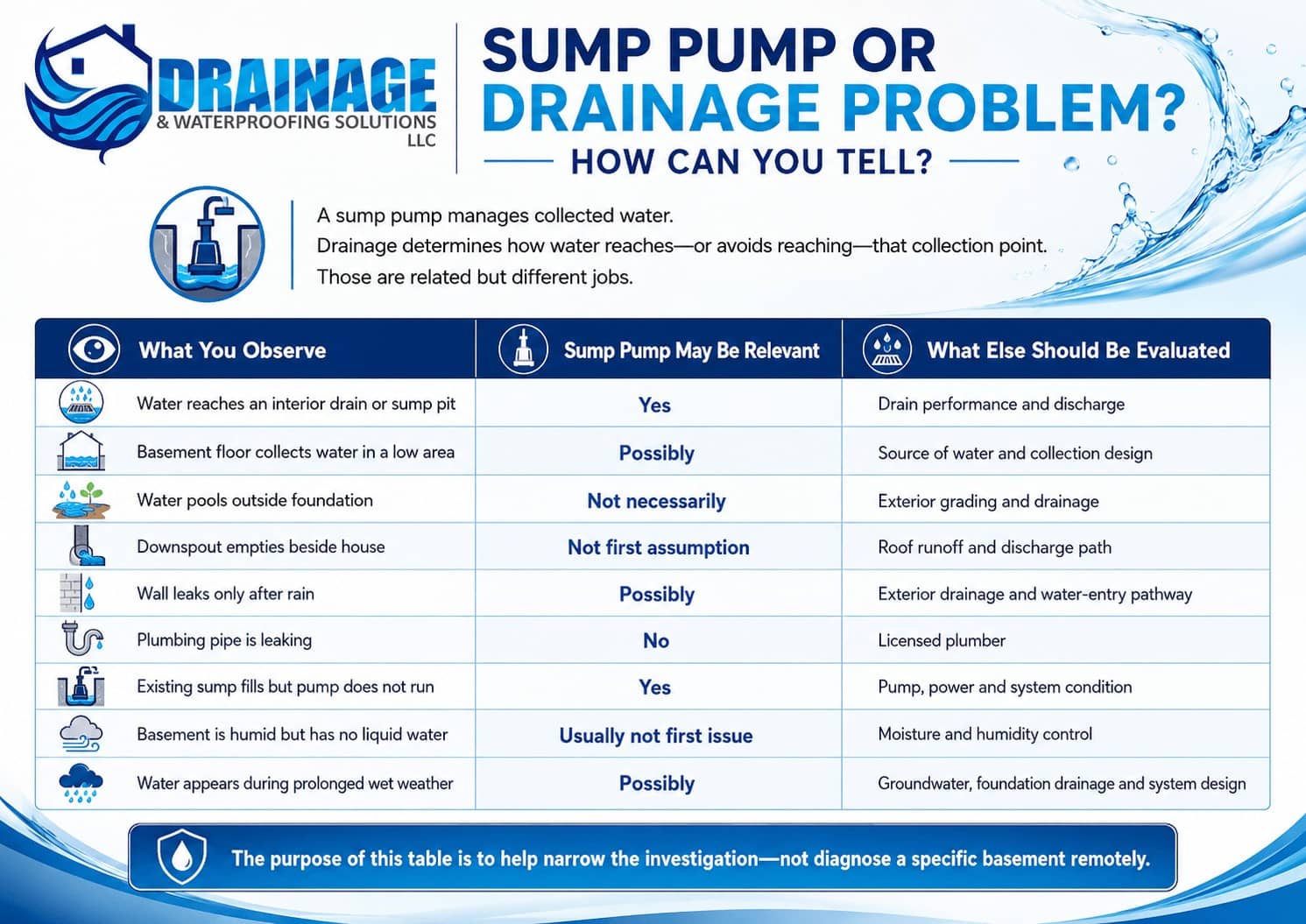
Sump Pump or Drainage Problem? How Can You Tell?

A sump pump manages collected water.

Drainage determines how water reaches—or avoids reaching—that collection point.

Those are related but different jobs.

What You Observe Sump Pump May Be Relevant What Else Should Be Evaluated
Water reaches an interior drain or sump pit Yes Drain performance and discharge
Basement floor collects water in a low area Possibly Source of water and collection design
Water pools outside foundation Not necessarily Exterior grading and drainage
Downspout empties beside house Not first assumption Roof runoff and discharge path
Wall leaks only after rain Possibly Exterior drainage and water-entry pathway
Plumbing pipe is leaking No Licensed plumber
Existing sump fills but pump does not run Yes Pump, power and system condition
Basement is humid but has no liquid water Usually not first issue Moisture and humidity control
Water appears during prolonged wet weather Possibly Groundwater, foundation drainage and system design

The purpose of this table is to help narrow the investigation—not diagnose a specific basement remotely.

Infographic comparing signs of a sump pump problem versus a drainage problem, including water pooling outside, wall leaks after rain, sump pit issues, humid basements, and drainage-related water entry concerns. Sump Pump or Drainage Problem? How to Tell the Difference

Is a Sump Pump the Same as Basement Waterproofing?

No.

A sump pump is a water-removal component.

Basement waterproofing and moisture control are broader.

Depending on the home, basement moisture control can involve:

  • Exterior drainage
  • Interior drainage
  • Foundation-water management
  • Sump pumps
  • Moisture control
  • Drainage corrections
  • Other measures based on the water pathway

A properly designed sump system can be an important part of basement waterproofing, but installing a pump does not automatically stop water from reaching the foundation.

The objective should be to manage the entire water pathway.

Can a Sump Pump Fix Water Pooling Around My Foundation?

Not by itself.

If rainwater is collecting outside next to the foundation, the exterior drainage problem deserves attention.

Possible contributors include:

  • Ground sloping toward the house
  • Downspouts releasing water close to the foundation
  • Concentrated roof runoff
  • Low landscaping areas
  • Saturated soil
  • Existing drainage limitations
  • Water traveling downhill toward the property

A sump pump inside the basement may manage some water that reaches an interior system, but it does not correct the exterior condition causing water to accumulate outside.

Drainage & Waterproofing Solutions provides foundation waterproofing and drainage evaluation when the water problem extends beyond the sump pump itself.

Do I Need a Sump Pump If Water Only Appears After Heavy Rain?

Possibly.

Rain-dependent basement water suggests that drainage, soil saturation, runoff, foundation-water pathways, or several conditions together may be involved.

During the next safe rainfall event, observe:

  • Where downspouts discharge
  • Whether water pools beside the house
  • Which direction the yard slopes
  • Whether exterior drains are flowing
  • Where basement water first appears
  • Whether an existing sump fills
  • How quickly the water recedes after the storm

Those observations can help determine whether the basement needs a sump pump, exterior drainage correction, waterproofing, repair to an existing system, or a combination.

Do I Need a Sump Pump If I Already Have a French Drain?

It depends on what type of drainage system you have and where the collected water goes.

An exterior French drain may be able to move water by gravity toward an appropriate outlet without using a pump.

An interior drainage system may collect water below the basement floor and direct it toward a sump basin, where a pump removes it from the structure.

The critical question is:

Can the collected water reach an appropriate discharge point by gravity, or does it need mechanical pumping?

That answer depends on elevation, system design, drainage destination, and site conditions.

A French drain and sump pump are not necessarily competing options. In some systems, they perform different parts of the same job.

Sump Pump vs. Gravity Drainage

Whenever practical, water-management planning should consider whether water can move through gravity drainage before assuming a pump is required.

Gravity Drainage

Gravity systems use elevation to move water from a higher point to a lower discharge point.

Potential advantages include:

  • No pump motor required
  • No reliance on electricity for basic flow
  • Fewer mechanical components

But gravity drainage only works when the property provides an appropriate elevation difference and discharge location.

Pumped Drainage

A sump pump mechanically lifts collected water and sends it through a discharge line.

It becomes useful when water collects below the elevation of the available outlet or when the system otherwise requires mechanical removal.

Neither approach is universally better.

Site conditions determine which one is appropriate.

What If I Already Have a Sump Pump?

An existing pump should not necessarily be ignored until it stops working.

Pay attention to changes such as:

  • Pump running more often than usual
  • Pump not activating when water rises
  • Unusual noises
  • Water remaining in the basin
  • Basement water appearing despite pump operation
  • Discharge water returning toward the house
  • Visible damage to the discharge line
  • Pump cycling repeatedly over short intervals

A change in performance deserves evaluation before the next major water event.

Drainage & Waterproofing Solutions also provides drainage-system inspections when an existing drainage or water-management system needs professional evaluation.

How Do I Know If My Sump Pump Is Working?

If the sump system is accessible and can be observed safely, homeowners can watch what happens when water reaches the basin.

The exact testing procedure depends on the installed pump, so follow the manufacturer's instructions rather than improvising electrical or mechanical tests.

Useful observations include:

  • Does the pump activate as water rises?
  • Does the water level decrease?
  • Does the pump stop appropriately?
  • Is water leaving through the discharge line?
  • Are there unusual sounds?
  • Does water immediately return to the basin?
  • Is the discharge point clear?

If you are uncertain how the system operates, have it inspected rather than disassembling the pump yourself.

What Happens If a Sump Pump Loses Power?

A standard electric sump pump normally depends on available electrical power.

That matters because storms capable of producing significant water can also be associated with electrical outages.

A backup system may therefore be worth evaluating for homes where continuous pumping is especially important.

Questions to consider include:

  • How quickly does the basin fill?
  • How dependent is the basement on pumping?
  • Has the property lost power during heavy storms before?
  • Is a backup pumping method appropriate?
  • Would an alarm or monitoring system be useful?

Not every home requires the same backup configuration.

Is a Battery Backup Sump Pump Worth Considering?

For a home that depends heavily on mechanical pumping to manage recurring water, backup protection may be worth considering.

A battery-backup system can provide an additional pumping method if the primary electrical system becomes unavailable or the main pump encounters certain problems.

However, a backup should not be treated as a substitute for:

  • Correct pump selection
  • Proper drainage
  • Appropriate discharge
  • Routine inspection
  • Correcting known system defects

Backup protection is redundancy—not a replacement for a properly designed primary system.

Where Should Sump Pump Water Go?

A sump pump needs an appropriate discharge location.

The line should not simply send collected water back toward the foundation, where it may return to the drainage system.

Discharge planning should account for:

  • Property slope
  • Foundation location
  • Nearby structures
  • Erosion
  • Drainage pathways
  • Applicable local requirements
  • Public versus private drainage infrastructure

The City of Raleigh provides stormwater and water-pollution guidance that homeowners can review when considering drainage and discharge conditions.

Discharge design is part of the installation—not an afterthought.

Can a Sump Pump Discharge Into the Sanitary Sewer?

Do not assume that it can.

Local plumbing, sewer, and stormwater requirements can govern where water may be discharged.

For Raleigh properties, the discharge route should be reviewed as part of the project instead of connecting a pump to an existing pipe without confirming what that pipe serves.

A professional sump pump installation in Raleigh should account for both where water is collected and where it can appropriately be discharged.

What Size Sump Pump Do I Need?

There is no responsible universal pump size for every basement.

Selection depends on factors such as:

  • How quickly water enters the basin
  • Vertical lift
  • Discharge distance
  • Pipe configuration
  • Drainage-system design
  • Expected inflow
  • Pump performance specifications
  • Backup requirements

A larger pump is not automatically better.

The pump should be selected to match the system.

Reducing the decision to horsepower alone ignores the amount of water entering the system and the resistance the pump must overcome to reach its discharge point.

Does Every Basement Need a Sump Pit?

No.

A sump pump normally needs an appropriate basin or collection point, but that does not mean every basement should have one installed.

If a house has no identified water-management need, installing a basin and pump may provide little benefit.

If an interior drainage system needs to collect and mechanically remove water, a sump basin may be an important part of that design.

System selection should follow evaluation of:

  • Foundation conditions
  • Interior drainage
  • Elevation
  • Water source
  • Water volume
  • Discharge options

Can a Sump Pump Help a Crawl Space Too?

Yes.

A sump pump may be used as part of a crawl-space drainage system when liquid water collects beneath the home and needs mechanical removal.

However, the same diagnostic principle applies.

Standing water in a crawl space can involve:

  • Exterior runoff
  • Saturated soil
  • Groundwater
  • Foundation entry
  • Existing drainage
  • Plumbing
  • Low areas beneath the home

The pump should be part of a larger water-management system rather than installed simply because the crawl space feels damp.

Drainage & Waterproofing Solutions also provides crawl-space and basement waterproofing when water beneath the home requires drainage and moisture-management work.

When Is a Sump Pump Not the Right First Solution?

A sump pump may not be the first answer when the problem can be corrected more directly at its source.

A Plumbing Leak

A failed plumbing line needs an appropriate plumbing professional.

An Overflowing Gutter

Correct the roof-drainage problem rather than simply pumping water after it reaches the basement.

Downspout Water Dumping Against the Foundation

Redirecting roof runoff appropriately may be more direct.

Poor Surface Grading

The exterior drainage pathway should be evaluated.

Humidity Without Liquid Water

A sump pump does not control airborne humidity.

Significant Structural Movement

A pump is not a structural repair. Appropriate foundation or structural evaluation may be necessary.

The best water-management plan does not start by asking which product can be installed.

It starts by identifying the source of the problem.

Do I Need a Sump Pump? Homeowner Decision Guide

What Is Happening? Sump Pump Evaluation? Other Issue to Evaluate
Interior drainage reaches a low collection point Yes Overall drainage design
Basement repeatedly gets standing water Yes Water source and foundation drainage
Existing sump fills during storms Yes Pump performance and discharge
Water only pools outside Maybe Exterior drainage first
Basement is humid but dry Usually not first step Humidity/moisture control
Downspout dumps beside foundation Maybe Roof runoff first
Plumbing line leaks No Plumber
Water enters wall-floor joint Yes Interior/exterior water pathway
Existing pump cannot keep up Yes Pump capacity plus inflow source
Water appears after power outage Yes Primary and backup pumping strategy

No table can determine what a specific basement needs, but this framework helps identify when professional sump-pump evaluation makes sense.

What Happens During a Professional Sump-Pump Evaluation?

A useful evaluation should look beyond the pump itself.

Relevant questions include:

  1. Where is the water coming from?
  2. When does the basement get wet?
  3. How is water currently collected?
  4. Is an interior drainage system present?
  5. Is there an existing sump basin?
  6. How quickly does water enter the basin?
  7. Where can the pump discharge?
  8. Does exterior drainage also need correction?
  9. Is the existing pump performing properly?
  10. Would backup protection be appropriate?

The purpose is to determine the right water-management system rather than simply installing or replacing a pump because water is present.

What Determines the Cost of Sump Pump Installation?

The cost of a sump-pump project depends on much more than the price of the pump.

Relevant factors may include:

  • Whether a sump basin already exists
  • Excavation
  • Interior drainage requirements
  • Pump specifications
  • Discharge piping
  • Vertical lift
  • Discharge distance
  • Electrical requirements
  • Backup system
  • Alarm or monitoring components
  • Accessibility
  • Existing water-management equipment
  • Restoration
  • Overall project complexity

That is why generic online pricing can be misleading.

Replacing a pump in an existing basin is fundamentally different from installing a new interior drainage system, sump basin, pump, discharge line, and backup equipment.

Homeowners researching sump pump installation Raleigh NC should compare the complete proposed scope—not simply the pump model or advertised price.

Should I Repair or Replace My Existing Sump Pump?

That depends on the condition of the pump and the larger system.

Replacement may make sense when the pump:

  • Does not activate reliably
  • Cannot move water adequately
  • Has significant mechanical problems
  • Has repeatedly failed
  • No longer matches the drainage system's needs

But what appears to be a pump failure can sometimes involve:

  • A restricted discharge
  • Electrical problems
  • Float-switch issues
  • Excessive water entering the system
  • A drainage problem upstream
  • Water returning from the discharge location

The failure should be identified before assuming the motor itself is the only problem.

Should I Have a Backup Sump Pump?

A backup system is especially worth discussing when the home depends heavily on sump pumping to prevent water from collecting in the basement.

The decision can depend on:

  • Frequency of pump operation
  • History of power outages
  • Rate of water inflow
  • Consequences if the primary pump stops
  • Existing backup equipment
  • Desired level of redundancy

The backup system should complement—not compensate for—a poorly designed primary system.

When Should Raleigh Homeowners Call About Sump Pump Installation?

Consider professional evaluation when:

  • Basement water repeatedly returns
  • An existing sump pit fills
  • Your pump no longer activates reliably
  • You are installing an interior drainage system
  • Water enters at the floor perimeter
  • Your basement depends on a pump during storms
  • A pump has failed previously
  • You are uncertain where the discharge goes
  • You need to determine whether gravity drainage is practical
  • You are comparing sump pump installation Raleigh options but do not yet know which system is appropriate

Understanding the water pathway before the next major storm makes it easier to select a system based on the actual problem rather than reacting after another wet basement.

What Should I Do Before the Contractor Arrives?

If conditions are safe, gather information that helps explain how the basement behaves.

Take Photos During or After Rain

Photograph:

  • Water entry
  • The sump pit
  • Standing water
  • Foundation walls
  • Wall-floor joints
  • Exterior pooling
  • Downspouts
  • Existing drainage outlets

Note When the Pump Runs

Does it run:

  • Only during major storms?
  • Hours after rain stops?
  • Frequently during normal weather?
  • Almost never?

Locate the Discharge

If safely visible, identify where the existing sump discharge ends.

Record Changes

Mention:

  • Landscaping work
  • Grading changes
  • Drainage repairs
  • Pump replacements
  • Power-outage water problems
  • New seepage locations

You do not need to diagnose the problem yourself.

Good observations simply give the contractor more information.

Do I Need a Sump Pump in My Basement?

You may need a sump pump when liquid water collects below grade and requires mechanical removal because gravity drainage alone cannot adequately carry it to an appropriate discharge point.

You may not need one when:

  • The basement has no liquid-water problem
  • Exterior drainage alone is the primary issue
  • Water can be managed through an appropriate gravity system
  • The symptom is humidity rather than standing water
  • A plumbing problem is causing the moisture

The right decision comes from evaluating the whole system:

water source → collection → drainage → sump → pump → discharge.

Skipping one of those steps can result in a pump that treats the symptom while leaving the actual water problem unresolved.

Request a Sump Pump and Basement Drainage Evaluation

If you are asking “Do I need a sump pump?”, the most useful next step is to determine exactly how water is reaching and leaving your basement.

Drainage & Waterproofing Solutions LLC provides drainage, waterproofing, sump-pump-related services, and sump pump installation in Raleigh and surrounding Central North Carolina communities.

The appropriate solution may involve a sump pump, repair or replacement of an existing system, drainage improvements, foundation waterproofing, or another water-management approach based on the conditions at the property.

Call (919) 508-7503 or contact Drainage & Waterproofing Solutions to discuss your basement water problem.

Frequently Asked Questions

Do I need a sump pump if my basement is dry?

Not necessarily. A consistently dry basement with no identified groundwater, seepage, or drainage problem may not benefit from installing a pump simply for the sake of having one. The decision should be based on whether water needs to be collected and mechanically removed from below grade.

Do I need a sump pump if my basement only leaks during heavy rain?

Possibly. Rain-related seepage can involve saturated soil, foundation drainage, exterior runoff, or an interior drainage system that needs a sump. The rainfall connection should first be evaluated so the pump is not used as a substitute for correcting an exterior drainage problem when another solution is more appropriate.

Can a sump pump stop basement flooding?

A properly designed sump system can remove water collected by an interior drainage system or sump basin and can be an important part of reducing basement water problems. It cannot prevent every type of flooding, plumbing failure, surface-water entry, or water problem. Its effectiveness depends on the entire collection and discharge system.

Is a sump pump the same as a French drain?

No. A French drain collects and redirects water through a gravel-and-pipe drainage system, while a sump pump mechanically removes collected water from a basin. Some systems use both: drainage collects the water and directs it toward a sump, then the pump moves it to the discharge location.

Where should a sump pump discharge?

The discharge location should move water away from the structure without simply sending it back toward the foundation. Property slope, erosion, neighboring properties, drainage infrastructure, and applicable local requirements should all be considered when planning the discharge route.

Do sump pumps work during a power outage?

A standard electric sump pump normally requires power. Homes that depend significantly on pumping during storms may benefit from evaluating an appropriate backup system. Backup configuration depends on the property's water inflow, existing equipment, electrical conditions, and the consequences of the primary pump being unavailable.

How much does sump pump installation in Raleigh cost?

There is no reliable universal price because the scope can range from replacing a pump in an existing basin to installing a new drainage system, sump pit, pump, discharge line, and backup equipment. Site conditions, excavation, pump requirements, access, drainage design, and restoration all influence the final project.

Who should install a basement sump pump?

When the pump is part of a basement drainage or waterproofing system, a qualified drainage and waterproofing contractor can evaluate the complete water pathway rather than treating the pump as an isolated appliance. Plumbing or electrical work outside that contractor's scope should be handled by the appropriate qualified trade.

Sources

Posted in Basement Waterproofing

Does a Crawl Space Need Drainage Before Encapsulation?

August 4th, 2026

Does a Crawl Space Need Drainage Before Encapsulation?

If water is actively entering or collecting in your crawl space, the drainage problem generally needs to be evaluated before the space is encapsulated. Encapsulation can help control ground moisture and humid air, but a vapor barrier or sealed crawl-space system should not simply cover an unresolved source of standing water.

That distinction matters because crawl-space moisture can come from several different places.

Some homes primarily have vapor and humidity problems. Others have actual liquid water entering from exterior runoff, saturated soil, groundwater, plumbing, or another pathway. Some have both.

The correct order is therefore:

Identify the water source → address active drainage or water entry when necessary → design the moisture-control system → encapsulate the crawl space when appropriate.

Drainage & Waterproofing Solutions LLC provides crawl-space repair and encapsulation as well as crawl-space and basement waterproofing for homeowners in Raleigh, Garner, Wake County, and other verified Central North Carolina service areas.

If you are considering encapsulation but already have standing water, wet soil, or recurring moisture beneath the home, contact Drainage & Waterproofing Solutions to have the crawl-space conditions evaluated before choosing a system.

What Is the Difference Between Crawl-Space Drainage and Encapsulation?

Crawl-space drainage and encapsulation solve related but different moisture problems.

Drainage manages liquid water.

Encapsulation helps control moisture vapor and outside air entering the crawl space.

A drainage system may be needed when actual water is collecting beneath the home or moving into the crawl space from surrounding soil or exterior runoff.

Encapsulation generally involves creating a more controlled crawl-space environment using a vapor-retarding ground cover and other moisture-control measures appropriate to the project.

The two approaches can work together, but one should not automatically be substituted for the other.

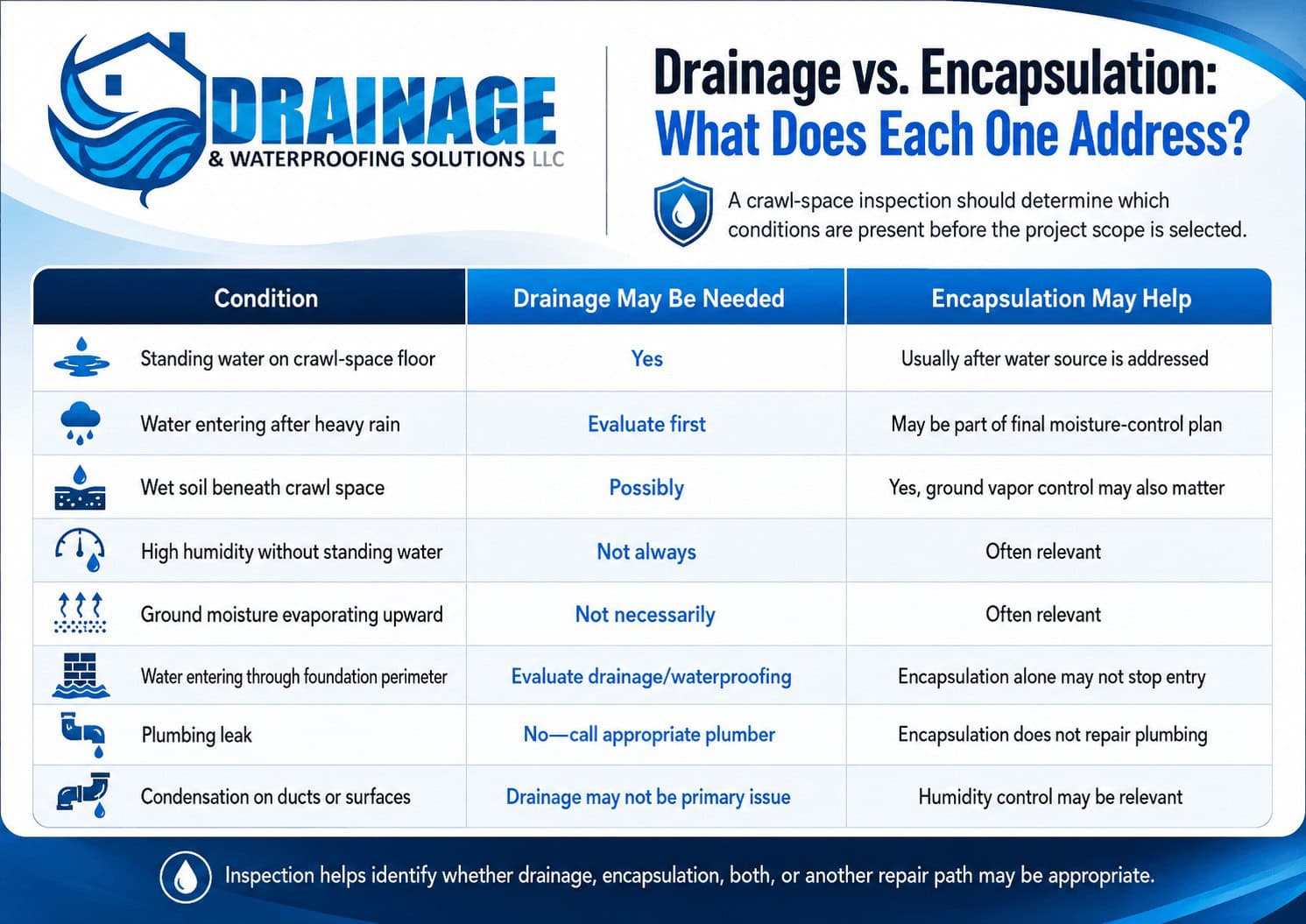
Drainage vs. Encapsulation: What Does Each One Address?

Condition Drainage May Be Needed Encapsulation May Help
Standing water on crawl-space floor Yes Usually after water source is addressed
Water entering after heavy rain Evaluate first May be part of final moisture-control plan
Wet soil beneath crawl space Possibly Yes, ground vapor control may also matter
High humidity without standing water Not always Often relevant
Ground moisture evaporating upward Not necessarily Often relevant
Water entering through foundation perimeter Evaluate drainage/waterproofing Encapsulation alone may not stop entry
Plumbing leak No—call appropriate plumber Encapsulation does not repair plumbing
Condensation on ducts or surfaces Drainage may not be primary issue Humidity control may be relevant

A crawl-space inspection should determine which of these conditions are present before the project scope is selected.

Infographic comparing drainage vs encapsulation for crawl spaces, showing when standing water, wet soil, humidity, vapor, foundation water entry, plumbing leaks, and condensation may require drainage evaluation or encapsulation. Drainage vs. Encapsulation: What Does Each One Address?

Can You Encapsulate a Crawl Space With Standing Water?

Encapsulation should not simply hide active standing water beneath a liner.

If water is entering the crawl space during rain, pooling in low areas, or remaining beneath the home for extended periods, the water pathway needs to be evaluated.

Possible causes include:

  • Poor exterior grading
  • Water pooling near the foundation
  • Saturated surrounding soil
  • Foundation-side drainage problems
  • Downspout discharge
  • Surface runoff
  • Groundwater
  • Existing drainage that is not performing
  • Plumbing leaks
  • Other water-entry pathways

The important question is not merely whether the crawl space can physically be covered.

It is whether the source of the liquid water has been properly addressed before the space is sealed.

Why Isn't a Vapor Barrier Enough for Standing Water?

A vapor barrier primarily limits moisture vapor moving from exposed soil into the crawl-space air.

It is not the same thing as a drainage system.

The U.S. Department of Energy's Building Science Education resources explain that crawl-space ground covers are part of a broader moisture-management approach and specifically recommend proper grading and perimeter drainage to prevent bulk-water intrusion. See the DOE crawl-space moisture guidance.

That difference is critical.

A vapor barrier may address moisture moving as vapor from the soil.

It does not automatically provide a path for several gallons of rainwater or groundwater collecting beneath the home.

How Can You Tell Whether the Crawl Space Has a Drainage Problem?

Look for evidence of actual liquid-water movement rather than humidity alone.

Possible signs include:

  • Standing puddles
  • Mud
  • Soil erosion
  • Water lines on foundation walls or piers
  • Saturated soil after rain
  • Water entering from one side of the crawl space
  • Low areas that repeatedly hold water
  • Drainage pipes that appear obstructed
  • A sump pump operating frequently
  • Water returning after storms

Compare those conditions with signs that may point more toward humidity or vapor:

  • Condensation
  • Damp-feeling air
  • Moisture on ductwork
  • Musty odors
  • Damp insulation
  • Elevated crawl-space humidity without obvious standing water

A property can have both categories at the same time.

Where Is the Water Coming From?

The most useful crawl-space evaluation follows the water backward to its source.

Exterior Runoff

Rain may move toward the foundation because of lot grading, hardscape, landscaping, or runoff from another part of the property.

Downspouts

Roof runoff can become concentrated beside the foundation if downspouts discharge into an unsuitable area.

Saturated Soil

Water may remain within the soil surrounding or beneath the crawl space after repeated rainfall.

Groundwater

Some properties experience water movement from below or through surrounding soil.

Plumbing

A supply, drain, or other plumbing leak can mimic a drainage problem.

Existing Drainage

An existing drainage system may be clogged, damaged, incorrectly routed, or no longer adequate for the current water pathway.

The solution depends on which source is actually present.

Does North Carolina Require Crawl-Space Drainage?

North Carolina's crawl-space requirements recognize that moisture management involves more than placing plastic on the ground.

The state's residential-code provisions for closed crawl spaces address ground vapor retarders, grading of crawl-space floors toward low areas, and drainage at those low areas. Exact requirements depend on the project, applicable code path, and local enforcement.

North Carolina's Office of State Fire Marshal also maintains specific guidance for converting a conventional crawl space into a closed crawl space, including moisture-control and permitting requirements.

Homeowners do not need to interpret the building code themselves, but this reinforces an important practical point:

Drainage and moisture control should be designed as a system.

Encapsulation is not simply a matter of putting plastic over wet ground and closing the door.

Should the Crawl-Space Floor Be Graded Before Encapsulation?

Low areas that hold water should be considered during the project evaluation.

If the crawl-space floor traps liquid water in isolated depressions, covering the ground without dealing with the drainage pattern may leave water beneath the liner.

The right response depends on the property.

Possible considerations can include:

  • Crawl-space floor elevations
  • Low points
  • Existing drainage
  • Foundation perimeter conditions
  • Sump locations
  • Discharge options
  • Exterior grading
  • Water-entry direction

Do not assume every crawl space requires major regrading.

The objective is to make sure active water has an appropriate management path.

Do You Need a Sump Pump Before Encapsulation?

Some crawl spaces need a sump pump; others do not.

A sump pump may be appropriate when the drainage design requires collected water to be mechanically removed because gravity drainage is not practical or because water repeatedly reaches a defined low point.

But a sump pump should not be treated as an automatic add-on to every encapsulation project.

Relevant questions include:

  • Is liquid water actually entering?
  • Where does it collect?
  • Can water drain by gravity?
  • Is there already a sump?
  • Is the existing pump functioning?
  • Where does the discharge go?
  • How often does water reach the low point?

Drainage & Waterproofing Solutions' current service information includes sump-pump-related water management as part of its drainage and waterproofing work.

The system should match the water problem.

What If the Crawl Space Is Only Damp but Never Has Standing Water?

A crawl space can have a significant moisture problem without visible puddles.

Ground moisture can move upward as vapor. Humid outdoor air can also contribute to damp conditions in some crawl spaces.

That is where encapsulation and controlled moisture management become especially relevant.

Possible symptoms include:

  • Musty odors
  • Condensation
  • Damp insulation
  • Moisture on ductwork
  • Elevated humidity
  • Damp wood
  • Repeated surface moisture

The U.S. Environmental Protection Agency emphasizes that moisture control is fundamental to controlling mold growth in buildings. See the EPA's mold and moisture guidance.

That does not mean every damp crawl space has mold.

It means the moisture source and humidity conditions should be managed appropriately.

What If Water Only Appears After Heavy Rain?

Rain-dependent water strongly suggests that the exterior drainage pathway should be evaluated.

During or shortly after a safe rainfall event, look at:

  • Where downspouts discharge
  • Whether water pools near the foundation
  • Which direction the yard slopes
  • Whether runoff moves toward the crawl space
  • Whether crawl-space water appears on the same side of the house
  • How long the water remains beneath the home

Take photographs if possible.

The water pathway can be much easier to understand while it is actively raining than several dry days later.

If the problem follows rainfall, Drainage & Waterproofing Solutions can also evaluate drainage-system conditions that may be contributing to the crawl-space water.

Does Exterior Yard Drainage Matter Before Encapsulation?

Yes, when outside water is contributing to the crawl-space problem.

Imagine sealing the crawl space while rainwater continues collecting against the foundation.

The new liner may make the interior look cleaner, but the exterior water problem has not disappeared.

Relevant exterior conditions may include:

  • Negative grading toward the house
  • Foundation-side puddling
  • Saturated planting beds
  • Downspouts releasing water too close to the home
  • Uphill runoff
  • Existing yard drains
  • Erosion
  • Water collecting near crawl-space vents or openings

Correcting exterior water movement can be an important part of the broader moisture-control plan.

Could a French Drain Be Needed Before Encapsulation?

Possibly—but not automatically.

A French drain may be appropriate when the confirmed drainage problem involves water moving through saturated soil or along a pathway that can be intercepted and redirected.

However, a French drain may not be appropriate if the actual problem is:

  • Plumbing
  • Gutter overflow
  • Condensation
  • A localized downspout issue
  • Another type of surface drainage problem
  • A different source of water

The crawl-space symptom should not predetermine the drainage system.

The correct solution follows the confirmed water source.

Does Encapsulation Stop Groundwater?

Encapsulation is not the same as groundwater drainage.

The liner helps isolate the crawl-space environment from exposed ground moisture, but active groundwater or bulk water still requires an appropriate water-management pathway.

If water rises into the crawl space or moves through foundation areas during wet conditions, the drainage system may need to:

  1. Collect the water.
  2. Direct it toward a controlled location.
  3. Remove or discharge it appropriately.

Encapsulation can then become part of the moisture-control system rather than a substitute for it.

What About Water Coming Through the Foundation?

Water entering through foundation areas requires evaluation of both the exterior water conditions and the crawl-space interior.

Possible pathways include:

  • Foundation joints
  • Openings
  • Cracks
  • Low foundation areas
  • Saturated soil
  • Water accumulating against the exterior

Drainage & Waterproofing Solutions provides foundation waterproofing when the confirmed condition requires foundation-focused water management.

Visible water near a foundation does not automatically mean structural failure.

Likewise, a crack does not by itself establish that the structure is failing.

When significant structural movement is suspected, an appropriately qualified structural or foundation professional may be needed.

What Should Happen Before Crawl-Space Encapsulation?

A practical pre-encapsulation sequence looks like this:

1. Identify the Moisture Type

Determine whether the problem is:

  • Humidity
  • Ground vapor
  • Liquid water
  • Condensation
  • Plumbing
  • A combination

2. Locate Active Water Sources

Observe exterior runoff, foundation-side water, crawl-space low spots, plumbing, and existing drainage.

3. Address Necessary Drainage

If actual water is entering or collecting, determine the appropriate drainage or waterproofing response.

4. Evaluate Existing Equipment

Inspect relevant sump pumps, drains, dehumidification, and other moisture-control components.

5. Design the Encapsulation

Choose the appropriate sealing and moisture-control approach for the actual crawl-space conditions.

6. Complete the Approved Work

Drainage and encapsulation should function together rather than working against each other.

7. Maintain the System

Continue checking drainage, pumps, dehumidification, and the liner after installation.

This sequence avoids treating the encapsulation material as the entire moisture-control system.

Crawl-Space Drainage Before Encapsulation: Decision Guide

Crawl-Space Condition Drainage Evaluation Encapsulation Evaluation
Standing water after rain Yes Yes, after water source is addressed
Repeated muddy low spots Yes Yes
Dry soil but high humidity Not necessarily Yes
Ground vapor/moisture Maybe Yes
Water entering through foundation Yes Yes
Plumbing leak Plumber first Reevaluate afterward
Condensation only Drainage may not be primary issue Moisture-control evaluation
Existing sump system Inspect performance Coordinate with encapsulation design
Water pooling outside foundation Exterior drainage evaluation Encapsulation may still be part of overall plan

The table is intentionally not a prescription.

Two homes with similar-looking crawl spaces can have different water sources.

Can You Encapsulate First and Fix the Drainage Later?

That approach can create unnecessary problems when active water is already present.

If a contractor seals the ground before understanding where liquid water is entering, future drainage work may require disturbing sections of the encapsulation or working around a newly installed liner.

More importantly, the homeowner may pay for the encapsulation while the original water problem remains unresolved.

A better sequence is to determine whether drainage work is necessary before finalizing the encapsulation scope.

That does not mean every homeowner needs two separate projects.

In some cases, drainage and encapsulation can be designed as one coordinated moisture-control project.

Is a Basic Vapor Barrier the Same as Full Encapsulation?

No.

A ground vapor barrier primarily reduces moisture moving upward from exposed soil.

A more comprehensive sealed or encapsulated crawl-space approach can involve additional treatment of the crawl-space environment, depending on the design.

Drainage & Waterproofing Solutions' crawl-space repair and encapsulation service addresses crawl-space moisture through a broader sealing approach than simply leaving exposed soil beneath the home.

The correct scope depends on:

  • Existing water
  • Humidity
  • Ground conditions
  • Crawl-space construction
  • Ventilation
  • Drainage
  • Mechanical equipment
  • Access

A homeowner with recurring standing water should not choose between "cheap plastic" and "full encapsulation" until the liquid-water problem has been evaluated.

Does a Closed Crawl Space Require a Permit in North Carolina?

North Carolina homeowners should discuss permitting with the contractor before converting a conventional crawl space to a closed crawl space.

The North Carolina Office of State Fire Marshal's current guidance states that converting a conventional crawl space to a closed crawl space can trigger permitting requirements because prescribed moisture-control methods may involve mechanical or electrical changes. See the NC OSFM closed crawl-space guidance.

The exact requirements can depend on the project.

Do not assume that every liner replacement or minor crawl-space task has the same permit requirements as a full conversion to a closed crawl space.

What Can Make a Crawl-Space Project More Expensive?

There is no responsible universal price for crawl-space drainage and encapsulation because project conditions vary substantially.

Factors can include:

  • Crawl-space size
  • Access
  • Existing standing water
  • Drainage requirements
  • Excavation
  • Sump-pump needs
  • Existing liner removal
  • Ground conditions
  • Foundation configuration
  • Amount of sealing required
  • Moisture-control equipment
  • Existing insulation
  • Restoration or cleanup needs
  • Overall system complexity

A dry crawl space that mainly needs vapor control is not the same project as a crawl space that fills with water after every storm.

The most accurate estimate should follow an evaluation of the actual conditions.

Should You Encapsulate a Crawl Space Before Selling a Home?

The decision should still be based on the crawl space's actual condition rather than simply preparing it to look cleaner for buyers.

If the crawl space has:

  • Standing water
  • Recurrent wet soil
  • Active drainage problems
  • Damp insulation
  • Significant humidity
  • Visible moisture symptoms

addressing the underlying water and moisture conditions is more important than cosmetic appearance alone.

A clean liner installed over an unresolved drainage problem does not change the source.

Homeowners preparing for a sale may benefit from understanding the condition and obtaining an appropriate scope before deciding what work makes sense.

When Should You Call a Drainage and Waterproofing Contractor?

Consider a professional crawl-space evaluation when:

  • Standing water returns after rain
  • Soil remains wet for long periods
  • You are planning encapsulation
  • Exterior water pools near the foundation
  • Existing drainage does not appear to work
  • The crawl space has a sump pump that needs evaluation
  • Dampness or condensation keeps returning
  • You do not know whether the problem is vapor or liquid water
  • You want to avoid encapsulating over an active drainage problem

Drainage & Waterproofing Solutions works across the related areas of drainage, waterproofing, and crawl-space moisture control, making it possible to evaluate the water problem and the encapsulation decision together.

What Should Raleigh and Garner Homeowners Do Before Requesting an Estimate?

You can make the evaluation more useful by documenting what happens during wet weather.

Before the appointment:

  1. Photograph any standing water.
  2. Note which part of the crawl space gets wet.
  3. Record whether it follows rain.
  4. Check where nearby downspouts discharge.
  5. Photograph water pooling around the exterior foundation.
  6. Note whether an existing sump pump runs.
  7. Identify existing drainage if you know where it is.
  8. Mention recent landscaping or grading changes.
  9. Explain whether the crawl space has been encapsulated before.
  10. Ask whether drainage work should occur before the new moisture-control system is installed.

You do not need to diagnose the system yourself.

You simply want to provide enough information to help identify the water pathway.

Does a Crawl Space Need Drainage Before Encapsulation?

A crawl space needs drainage addressed before encapsulation when active liquid water is entering, pooling, or remaining beneath the home and cannot be adequately managed by the encapsulation system itself.

A dry crawl space with primarily vapor or humidity concerns may not need a new drainage system.

A crawl space with recurrent standing water may need drainage, waterproofing, a sump system, exterior corrections, or another water-management approach before or as part of encapsulation.

The correct answer comes from distinguishing:

water vapor from liquid water, and moisture control from drainage.

That distinction can prevent homeowners from paying for an encapsulation system that does not address the reason the crawl space is wet.

Request a Crawl-Space Evaluation

If you are considering encapsulation but have standing water, wet soil, foundation-side runoff, or another moisture problem, Drainage & Waterproofing Solutions LLC can evaluate whether crawl-space drainage before encapsulation should be part of your project.

The goal is to develop a moisture-control plan based on the actual property conditions rather than covering an unresolved water problem.

Call (919) 508-7503 or contact Drainage & Waterproofing Solutions to discuss your crawl space.

Frequently Asked Questions

Do I need drainage before crawl-space encapsulation?

You may need drainage first if liquid water is actively entering or pooling beneath the home. If the problem is primarily ground vapor or humidity without standing water, a new drainage system may not be necessary. The crawl space should be evaluated so the water source is known before the encapsulation design is finalized.

Can you put a vapor barrier over a wet crawl space?

A vapor barrier can control moisture vapor from the ground, but it should not simply conceal recurring standing water. Active water needs an appropriate drainage or water-management path. Otherwise, liquid water may remain beneath the liner while the underlying drainage problem continues.

Does encapsulation stop water from entering a crawl space?

Encapsulation helps control ground vapor and the crawl-space environment, but it does not automatically stop every source of liquid water. Exterior runoff, groundwater, foundation entry, drainage failures, and plumbing leaks may require separate correction as part of the overall moisture-control plan.

Do I need a sump pump before encapsulation?

Not every crawl space needs a sump pump. A pump may be appropriate where collected water reaches a low point and cannot be managed effectively through gravity drainage. The decision should depend on water volume, elevation, existing drainage, discharge options, and the overall crawl-space design.

Can poor yard drainage make my crawl space wet?

Yes. Surface runoff, poor grading, foundation-side pooling, and concentrated roof discharge can allow water to collect near the crawl-space foundation. When interior moisture follows rainfall, exterior drainage should be part of the evaluation rather than treating the problem solely from inside.

Is a vapor barrier the same as crawl-space encapsulation?

No. A ground vapor barrier is one moisture-control component. Full crawl-space encapsulation generally involves a broader approach to isolating and controlling moisture within the crawl space. The exact system should be selected according to drainage, humidity, construction, and existing water conditions.

Should water under the crawl-space liner concern me?

Recurring liquid water beneath an encapsulation liner deserves evaluation because the source may still be active. The liner may hide the visible puddle without changing the drainage condition. Determine whether the water is coming from runoff, saturated soil, groundwater, plumbing, or another pathway.

Should I fix crawl-space drainage or encapsulate first?

Address active water and drainage needs before or as part of the encapsulation project. This allows the liner and moisture-control system to be designed around a crawl space that has an appropriate path for liquid water rather than installing finishes over an unresolved drainage problem.

Sources

Posted in Crawl Space Waterproofing

Why Is Water Pooling Around My Foundation After Rain?

August 1st, 2026

Why Is Water Pooling Around My Foundation After Rain?

Water pooling around your foundation after rain usually means runoff is reaching the house faster than the surrounding property can move it away. Common contributors include ground that slopes toward the home, concentrated roof runoff, downspouts discharging too close to the foundation, low areas beside the house, saturated soil, or a drainage system that is not moving water effectively.

The puddle itself does not prove that your foundation is damaged or that you automatically need foundation waterproofing.

The first step is understanding where the water is coming from, how it travels across the property, where it collects, and whether related moisture is appearing inside the basement or crawl space.

Drainage & Waterproofing Solutions LLC provides foundation waterproofing and drainage services for homeowners throughout Raleigh, Garner, Wake County, and other verified Central North Carolina service areas.

If water repeatedly collects beside your home after storms, you can request an evaluation so the property and water pathway can be reviewed before a solution is selected.

What Causes Water to Pool Around a Foundation?

Water collects around a foundation when rainfall or runoff reaches a low area near the house and does not have an effective path away.

Several conditions can contribute:

  • Ground sloping toward the house
  • Settled soil beside the foundation
  • Short or poorly directed downspouts
  • Concentrated roof runoff
  • Low landscape beds
  • Compacted or slow-draining soil
  • Water arriving from an uphill area
  • Patios or walkways directing runoff toward the house
  • Existing drains that are obstructed or no longer performing effectively
  • Repeated heavy rainfall saturating the surrounding ground

More than one factor can exist at the same property.

That is why the correct sequence is:

Symptom → possible causes → site evaluation → confirmed water path → appropriate drainage or waterproofing response.

Does Standing Water Mean My Foundation Is Failing?

No. Standing water beside a foundation does not by itself establish structural failure.

It is primarily a drainage symptom.

The concern becomes more significant when water returns repeatedly, remains beside the house for extended periods, causes erosion, or appears alongside basement or crawl-space moisture.

Foundation cracks, sloping floors, sticking doors, and visible movement also should not automatically be blamed on drainage without appropriate evaluation. Those conditions can have multiple causes.

If significant structural movement appears to be involved, an appropriately qualified structural or foundation professional may be needed.

Drainage & Waterproofing Solutions focuses on drainage, waterproofing, and moisture management rather than structural engineering.

How Can Poor Grading Cause Water to Collect Beside a House?

Grading describes the slope and shape of the ground around the property.

When the soil slopes away from the home, surface runoff has a natural path away from the foundation.

When the ground is flat, settled, or sloped toward the house, rain may instead collect along the foundation wall.

This can develop because of:

  • Original site conditions
  • Soil settlement
  • Erosion
  • Landscaping changes
  • Mulch or planting-bed buildup
  • Changes to patios or walkways
  • Repeated foot or equipment traffic
  • Soil compaction

NC State Extension recommends evaluating how water moves across a landscape and paying particular attention to poorly drained areas and low spots that remain wet after rainfall.

A drainage contractor should therefore look beyond the puddle itself and consider the surrounding elevation and water pathway.

Can Downspouts Cause Foundation Pooling?

Yes. A downspout concentrates roof runoff into a relatively small area.

If it discharges immediately beside the house or into a low area that slopes back toward the foundation, the soil can become saturated during rainfall.

Look at the affected area while it is raining from a safe location.

Ask:

  • Where does the nearest downspout discharge?
  • Does water move away from the house?
  • Does it circle back toward the foundation?
  • Does the discharge create erosion?
  • Does water collect at the corner of the home?
  • Does the surrounding grade trap the runoff?

The important issue is not simply how far a downspout extends. It is whether the discharged water reaches an appropriate drainage path rather than returning toward the structure.

What If My Gutters Overflow During Rain?

Gutter overflow can create a drainage problem even when the ground around the house is reasonably graded.

Water spilling over the edge of a gutter may fall directly beside the foundation instead of traveling through the intended downspout system.

Possible causes can include:

  • Debris
  • Obstructed outlets
  • Damaged gutter sections
  • Improper slope
  • Disconnected components
  • Rainfall exceeding the system's capacity
  • Other roof-drainage defects

Drainage & Waterproofing Solutions is not a roofing or gutter-repair contractor.

If the water source appears to be a malfunctioning roof-drainage system, a qualified gutter or roofing professional may need to correct that problem first.

A French drain should not be installed simply to compensate for a roof-drainage defect without evaluating the original source.

Why Does the Soil Stay Wet Beside My Foundation?

Persistently wet soil can indicate that water is entering the area faster than it drains.

The underlying cause may involve:

  • Surface runoff
  • Soil characteristics
  • Low elevation
  • Repeated roof discharge
  • Ground saturation
  • Water arriving from an uphill portion of the property
  • Existing subsurface drainage
  • Several consecutive wet weather events

The location matters.

A small muddy patch directly below a downspout may have a very different cause from an entire side yard that remains saturated for days after a storm.

Broad or recurring saturation may justify a professional drainage-system inspection to evaluate how water moves across and beneath the property.

Water Pooling Around Foundation: What Could Be Causing It?

What You Observe Possible Causes to Investigate What It Does Not Prove
Puddle below a downspout Concentrated roof runoff, poor discharge path, low grade Does not automatically require waterproofing
Water along one entire foundation wall Grading, slope runoff, saturated soil, drainage limitations Does not establish structural failure
Water appears only during very heavy rain Drainage capacity, runoff volume, grading Does not identify one failed component
Soil stays wet for days Poor drainage, soil saturation, low area, subsurface water Does not automatically mean a French drain is required
Basement becomes damp after the same storms Exterior drainage or another water-entry pathway may be involved Does not prove where water is entering
Crawl space has standing water Exterior drainage, groundwater, plumbing, or another source may contribute Does not prove encapsulation alone will solve it
Water appears during dry weather Plumbing, irrigation, groundwater, or another non-rain source Should not automatically be treated as stormwater runoff
Soil is washing away Concentrated runoff or erosion Does not prove the foundation itself is damaged

The purpose of this table is to narrow the investigation—not diagnose a particular property remotely.

Infographic showing common signs of water pooling around a foundation, possible drainage causes to investigate, and what each symptom does not automatically prove.

When Does Foundation Pooling Become More Concerning?

Recurring water deserves closer attention when one or more additional symptoms appear.

These may include:

  • Basement seepage after rain
  • Crawl-space standing water
  • Persistent interior dampness
  • White mineral residue on basement walls
  • Soil erosion beside the home
  • Water entering through wall or floor joints
  • A sump system running frequently during storms
  • Existing drainage that no longer appears to move water effectively

These symptoms still do not identify one specific solution.

For example, basement dampness after rain may involve exterior runoff, foundation-wall seepage, cracks, interior drainage, groundwater, or another pathway.

The appropriate solution depends on the confirmed source.

Can Water Pooling Outside Cause Basement Moisture?

Exterior water and basement moisture can be related, particularly when the soil around below-grade foundation walls remains saturated.

Water may approach a basement through several pathways, including:

  • Foundation-wall cracks
  • Wall-floor joints
  • Porous masonry
  • Openings around penetrations
  • Areas where exterior drainage is inadequate
  • Other construction joints or water pathways

Drainage & Waterproofing Solutions' basement moisture-control services address water and moisture conditions after the source and entry pattern are evaluated.

The important point is that seeing a puddle outside and moisture inside does not automatically reveal the exact pathway between them.

Both conditions should be considered together.

Can Foundation Pooling Affect a Crawl Space?

It can.

Water collecting around a crawl-space foundation may coincide with moisture beneath the home, but exterior pooling is only one possible contributor.

Crawl-space water can also involve:

  • Ground moisture
  • Exterior runoff
  • Foundation drainage
  • Plumbing leaks
  • Groundwater
  • Open vents and humid outdoor air
  • Other water-entry pathways

If active water is entering the crawl space, that water source should be addressed as part of the moisture-management plan.

Drainage & Waterproofing Solutions provides crawl-space and basement waterproofing for properties where drainage and water intrusion require professional attention.

Encapsulation should not simply conceal unresolved active water entry.

Do I Need a French Drain?

Maybe, but foundation pooling alone is not enough information to make that decision.

A French drain may be considered when water needs to be intercepted and redirected through saturated soil or along a recurring drainage pathway.

It may be relevant when:

  • A broad area remains soggy
  • Water consistently moves across a slope toward the house
  • Soil beside the foundation remains saturated
  • Existing surface drainage cannot adequately handle the problem
  • A defined subsurface drainage pathway is appropriate for the site

However, other conditions may call for a different response.

If a downspout is dumping roof runoff beside the house, fixing that discharge may be more direct.

If the grade slopes toward the house, the site elevation needs to be considered.

If water appears during dry weather, a drainage system designed for rainfall may not address the actual cause.

A French drain is a tool—not a universal answer.

Do I Need Foundation Waterproofing?

Foundation waterproofing may be appropriate when water is reaching or penetrating foundation components in a way that requires exterior or interior water-management measures.

Drainage & Waterproofing Solutions' foundation waterproofing service includes drainage and waterproofing approaches selected according to the problem being addressed.

But water pooling outside does not automatically mean a waterproof membrane, interior system, exterior excavation, or any particular waterproofing method is required.

The decision should follow the water pathway.

A homeowner may have:

  • A yard-drainage problem without interior intrusion
  • A basement-water problem without visible exterior pooling
  • Both exterior drainage and interior moisture issues
  • A roof-runoff problem
  • A plumbing problem
  • A combination of conditions

That is why diagnosis comes before system selection.

Drainage Problem or Waterproofing Problem?

Condition Drainage Evaluation Waterproofing Evaluation
Standing water in yard Often appropriate Not automatically required
Water beside foundation after rain Appropriate Consider if interior moisture is also present
Basement wall seepage Exterior drainage should be reviewed Often appropriate to investigate
Crawl-space standing water Drainage source should be evaluated May be part of broader moisture-control plan
Downspout puddle only Roof discharge and grading should be checked first Usually not first assumption
Repeated saturated soil against below-grade wall Appropriate May also warrant waterproofing evaluation
Water from suspected plumbing leak Not primarily a drainage solution Contact a plumber

Sometimes drainage and waterproofing are two parts of the same water-management plan.

Other times, correcting the exterior water pathway may be the primary need.

What Should I Check the Next Time It Rains?

One of the most useful things a homeowner can do is safely observe the property during or shortly after rainfall.

You do not need to diagnose the problem yourself. You are simply documenting the water pattern.

1. Watch Where the Water Starts

Does it come from:

  • A downspout?
  • An uphill lawn?
  • A driveway?
  • A patio?
  • A neighboring grade?
  • An overflowing gutter?
  • An unknown source?

2. Watch Where It Travels

Does runoff move:

  • Toward the house?
  • Parallel to the foundation?
  • Across a walkway?
  • Into a low section of lawn?
  • Toward an existing drain?

3. Look at Where It Stops

Does it form:

  • One small puddle?
  • A long saturated strip?
  • A muddy foundation edge?
  • A large wet side yard?

4. Check the Interior

After the storm, look at accessible basement or crawl-space areas.

Document:

  • Dampness
  • Seepage
  • Wet flooring
  • New stains
  • Mineral residue
  • Musty conditions
  • Standing water

5. Take Photos or Video

Photos taken during active rainfall can show a water pathway that may no longer be obvious once the weather clears.

That information can make an on-site evaluation more useful.

How Long Does the Water Stay After Rain?

Duration is another useful clue.

A shallow puddle that disappears quickly after an unusually intense storm is different from an area that remains saturated long after the rest of the property has dried.

Document:

  • When the rain stopped
  • How large the wet area was
  • Whether the area shrank
  • Whether the soil remained soft
  • Whether the same location floods repeatedly
  • Whether interior moisture appeared at the same time

There is no universal number of hours that diagnoses a drainage failure.

The recurring pattern matters more than a single arbitrary threshold.

Who Should Evaluate Water Around a Foundation?

Not every water problem belongs to the same trade.

What You Observe Professional to Consider
Recurring yard or foundation pooling Drainage/waterproofing contractor
Basement or crawl-space water after storms Drainage/waterproofing contractor
Existing drainage system not performing Drainage contractor
Gutter overflow or roof-drainage failure Gutter/roofing professional
Water appearing during dry weather near plumbing Licensed plumber
Wastewater odor or sewage Appropriate plumbing/septic professional
Significant structural movement Structural/foundation professional
Significant suspected mold contamination Appropriate mold professional

Drainage & Waterproofing Solutions does not need to be the answer to every water-related problem.

The right professional depends on the source.

What About Raleigh Stormwater From a Public Street?

Some Raleigh water problems involve public stormwater rather than a private residential drainage system.

The City of Raleigh maintains a Stormwater Drainage Assistance program for certain qualifying flooding and severe erosion conditions involving runoff from public streets or public property.

The City distinguishes these cases from many private-property concerns, including nuisance standing water, roof or gutter issues, private grading problems, landscaping conditions, and runoff originating from other private property.

If the water clearly originates from a public street or public drainage feature, it can be useful to review the City's eligibility criteria before assuming the entire problem must be addressed privately.

What Happens During a Professional Drainage Evaluation?

A good drainage evaluation should focus on the water pathway before selecting equipment or a system.

Relevant questions can include:

  1. When does the water appear?
  2. Where does it originate?
  3. Which direction does the property slope?
  4. Where do downspouts release roof water?
  5. Where does water collect?
  6. How long does the area remain wet?
  7. Are existing drains present?
  8. Where do existing drain lines discharge?
  9. Is moisture also present in a basement or crawl space?
  10. Is there an appropriate destination for redirected water?

Drainage & Waterproofing Solutions provides drainage-system inspections for homeowners who need help evaluating an existing drainage system and related components.

The goal is not to sell the same system to every property.

The goal is to understand the condition well enough to propose a solution that matches it.

What Solutions Might Be Considered?

The appropriate response depends on the confirmed cause.

Possible drainage or waterproofing approaches within the company's verified service scope may include:

  • French drainage
  • Foundation waterproofing
  • Interior drainage
  • Exterior drainage
  • Sump-pump-related water management
  • Crawl-space waterproofing
  • Drainage-system repair or improvement
  • Other site-specific drainage measures confirmed during evaluation

A solution should not be selected simply because one method is familiar.

If the problem is concentrated roof runoff: address how the roof water reaches and leaves the area.

If the soil slopes toward the house: grading and the overall surface-water pathway matter.

If a broad zone remains saturated: subsurface drainage may need evaluation.

If basement seepage occurs: exterior and interior water pathways may both need to be considered.

If the source is plumbing: call a plumber rather than installing stormwater drainage.

What Determines the Cost of Correcting Foundation Drainage?

The most accurate price requires a site evaluation because foundation-water and drainage projects vary substantially.

Factors can include:

  • Water source
  • Drainage route
  • Excavation
  • Drain length
  • Foundation depth
  • Soil and site conditions
  • Property access
  • Interior versus exterior work
  • Sump requirements
  • Materials
  • Existing landscaping
  • Restoration
  • Discharge location
  • Overall system complexity

A short drainage correction at one section of the property is not comparable to a deeper foundation-waterproofing project or a large drainage system crossing the yard.

Avoid relying on a generic internet price to determine what your particular property should cost.

First determine what the property actually needs.

What Should Raleigh and Garner Homeowners Do First?

If water repeatedly pools around your foundation, start with observation—not assumptions.

During the next rainfall:

  1. Watch the downspouts.
  2. Observe the property slope.
  3. Photograph the water path.
  4. Document where it pools.
  5. Check how long it remains.
  6. Look for related basement or crawl-space moisture.
  7. Note any existing drainage systems.
  8. Seek professional evaluation when the pattern continues or the source is unclear.

Do not assume that every puddle requires excavation.

Do not assume that visible water means the foundation is failing.

And do not assume that installing a French drain without understanding the source will necessarily solve the problem.

The appropriate drainage or waterproofing method depends on where the water originates, how it moves across or beneath the property, where it collects, and where it can be redirected.

Request a Drainage or Waterproofing Evaluation

If you are seeing water pooling around your foundation after rain in Raleigh, Garner, Wake County, or another verified Central North Carolina service area, Drainage & Waterproofing Solutions LLC can evaluate the drainage and moisture conditions affecting the property.

The right next step may involve drainage, foundation waterproofing, another water-management approach, or referral to another professional when the cause falls outside the company's scope.

Contact Drainage & Waterproofing Solutions to discuss what you are seeing and request an evaluation.

Frequently Asked Questions

Is water pooling around my foundation always a serious problem?

Not necessarily. One temporary puddle after unusually intense rain does not establish foundation damage. Repeated pooling, soil that remains saturated, erosion, or moisture appearing in the basement or crawl space deserves closer evaluation because those patterns suggest the property is not moving water away effectively.

Can poor grading cause water around my foundation?

Yes. Soil that is flat, settled, or sloped toward the house can direct surface runoff toward the foundation instead of away from it. Landscaping changes, erosion, settlement, and hard surfaces can all affect grading. The surrounding property should be evaluated rather than assuming a drain alone will correct the problem.

Will a French drain stop water from pooling beside my house?

It may help when the confirmed problem involves water moving through saturated soil or along a drainage pathway that a French drain can intercept. However, a French drain is not automatically the right solution for downspout discharge, gutter overflow, plumbing leaks, poor surface grading, or every other source of standing water.

Why does water pool beside my house only during heavy rain?

Heavy rainfall can reveal drainage limitations that are not obvious during lighter storms. The volume of runoff may exceed the capacity of the existing drainage path, saturate low areas, or expose grading and roof-discharge problems. Observing where the water starts and where it travels can help narrow the cause.

Does water around the foundation mean I need waterproofing?

No. Exterior pooling alone does not prove foundation waterproofing is required. The property may first need better surface drainage, roof-runoff management, subsurface drainage, or another correction. Waterproofing becomes more relevant when water is approaching or entering below-grade foundation components in a way that requires those measures.

Can foundation pooling cause crawl-space moisture?

Exterior drainage can contribute to crawl-space moisture, but it is only one possible source. Ground moisture, groundwater, plumbing, humid outside air, and other entry pathways may also contribute. Active water sources should be identified before assuming that encapsulation or another single system will solve the problem.

Should I call a drainage contractor or a plumber?

Call a drainage or waterproofing contractor when the water pattern clearly follows rainfall, yard runoff, foundation saturation, or an existing drainage system. A plumber may be more appropriate when water appears during dry weather, seems associated with supply or drain lines, or includes wastewater odors or backups.

What should I photograph before a drainage inspection?

Photograph the affected area during rainfall when it is safe, the nearest downspouts, the direction runoff travels, the deepest pooling areas, erosion, existing drains, and any basement or crawl-space moisture that appears after the same storm. These images can help show water pathways that disappear after the property dries.

Sources

Posted in Basement Moisture Control