
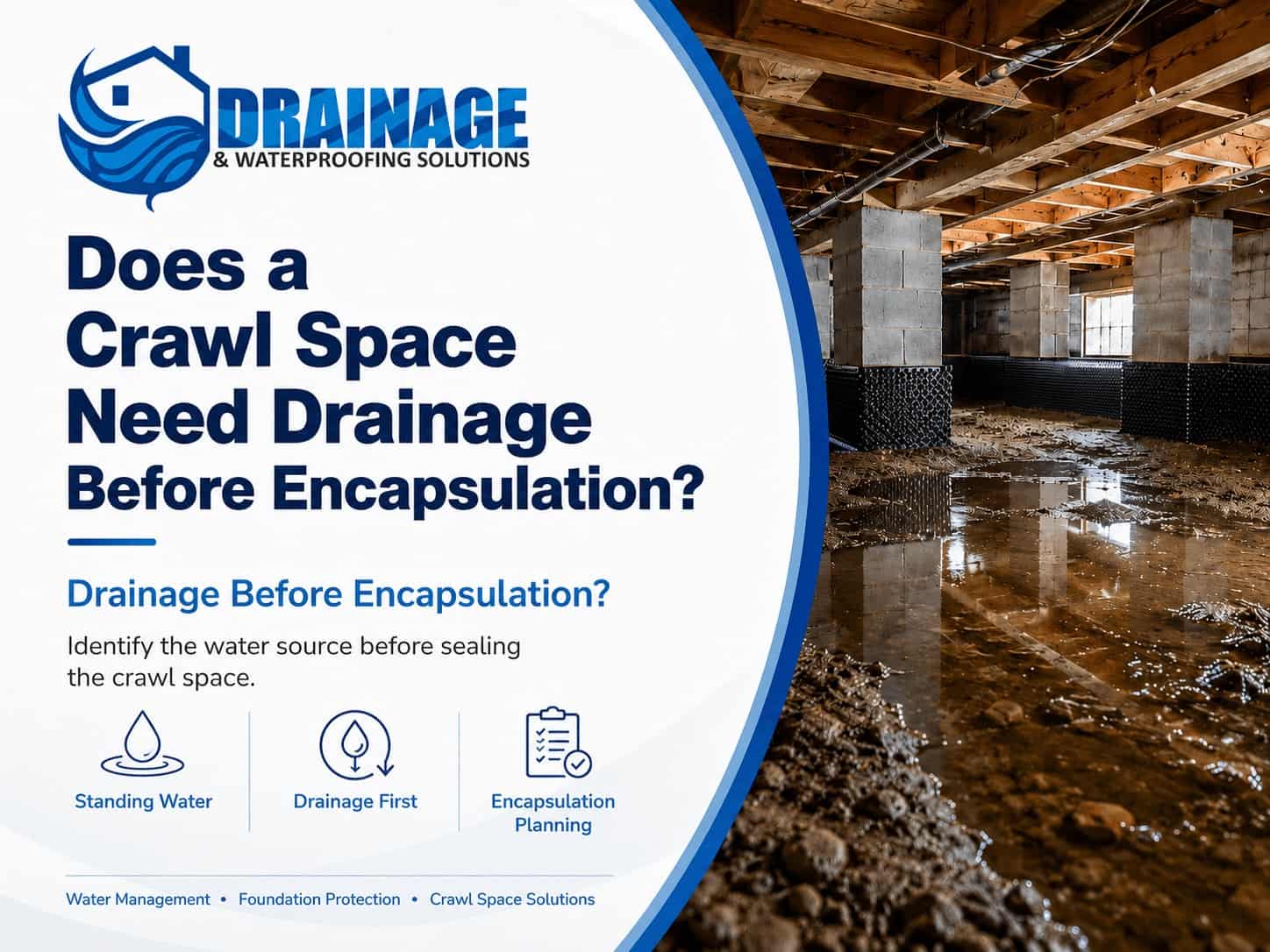
Does a Crawl Space Need Drainage Before Encapsulation?
If water is actively entering or collecting in your crawl space, the drainage problem generally needs to be evaluated before the space is encapsulated. Encapsulation can help control ground moisture and humid air, but a vapor barrier or sealed crawl-space system should not simply cover an unresolved source of standing water.
That distinction matters because crawl-space moisture can come from several different places.
Some homes primarily have vapor and humidity problems. Others have actual liquid water entering from exterior runoff, saturated soil, groundwater, plumbing, or another pathway. Some have both.
The correct order is therefore:
Identify the water source → address active drainage or water entry when necessary → design the moisture-control system → encapsulate the crawl space when appropriate.
Drainage & Waterproofing Solutions LLC provides crawl-space repair and encapsulation as well as crawl-space and basement waterproofing for homeowners in Raleigh, Garner, Wake County, and other verified Central North Carolina service areas.
If you are considering encapsulation but already have standing water, wet soil, or recurring moisture beneath the home, contact Drainage & Waterproofing Solutions to have the crawl-space conditions evaluated before choosing a system.
What Is the Difference Between Crawl-Space Drainage and Encapsulation?
Crawl-space drainage and encapsulation solve related but different moisture problems.
Drainage manages liquid water.
Encapsulation helps control moisture vapor and outside air entering the crawl space.
A drainage system may be needed when actual water is collecting beneath the home or moving into the crawl space from surrounding soil or exterior runoff.
Encapsulation generally involves creating a more controlled crawl-space environment using a vapor-retarding ground cover and other moisture-control measures appropriate to the project.
The two approaches can work together, but one should not automatically be substituted for the other.
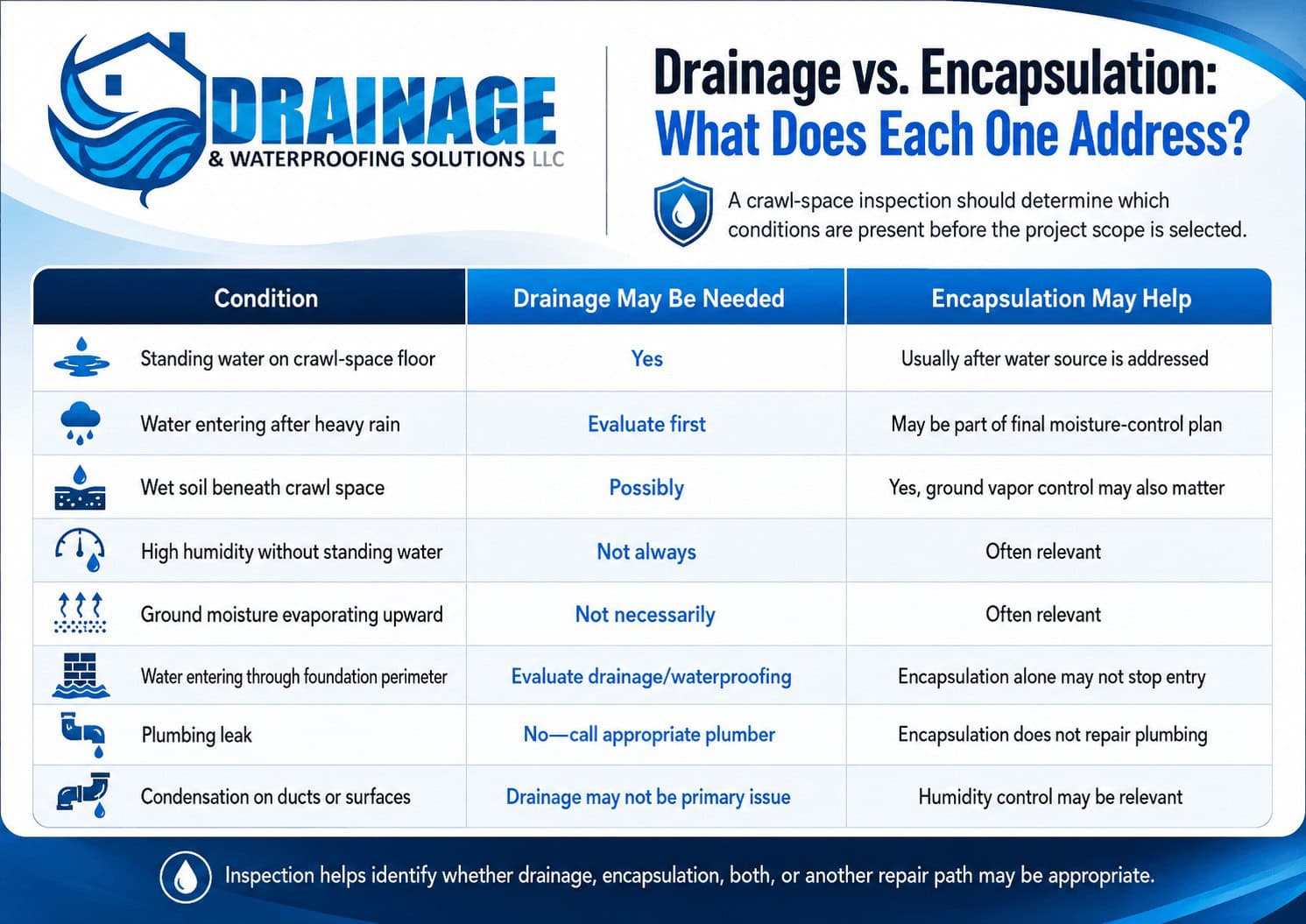
Drainage vs. Encapsulation: What Does Each One Address?
| Condition | Drainage May Be Needed | Encapsulation May Help |
|---|---|---|
| Standing water on crawl-space floor | Yes | Usually after water source is addressed |
| Water entering after heavy rain | Evaluate first | May be part of final moisture-control plan |
| Wet soil beneath crawl space | Possibly | Yes, ground vapor control may also matter |
| High humidity without standing water | Not always | Often relevant |
| Ground moisture evaporating upward | Not necessarily | Often relevant |
| Water entering through foundation perimeter | Evaluate drainage/waterproofing | Encapsulation alone may not stop entry |
| Plumbing leak | No—call appropriate plumber | Encapsulation does not repair plumbing |
| Condensation on ducts or surfaces | Drainage may not be primary issue | Humidity control may be relevant |
A crawl-space inspection should determine which of these conditions are present before the project scope is selected.
Can You Encapsulate a Crawl Space With Standing Water?
Encapsulation should not simply hide active standing water beneath a liner.
If water is entering the crawl space during rain, pooling in low areas, or remaining beneath the home for extended periods, the water pathway needs to be evaluated.
Possible causes include:
- Poor exterior grading
- Water pooling near the foundation
- Saturated surrounding soil
- Foundation-side drainage problems
- Downspout discharge
- Surface runoff
- Groundwater
- Existing drainage that is not performing
- Plumbing leaks
- Other water-entry pathways
The important question is not merely whether the crawl space can physically be covered.
It is whether the source of the liquid water has been properly addressed before the space is sealed.
Why Isn't a Vapor Barrier Enough for Standing Water?
A vapor barrier primarily limits moisture vapor moving from exposed soil into the crawl-space air.
It is not the same thing as a drainage system.
The U.S. Department of Energy's Building Science Education resources explain that crawl-space ground covers are part of a broader moisture-management approach and specifically recommend proper grading and perimeter drainage to prevent bulk-water intrusion. See the DOE crawl-space moisture guidance.
That difference is critical.
A vapor barrier may address moisture moving as vapor from the soil.
It does not automatically provide a path for several gallons of rainwater or groundwater collecting beneath the home.
How Can You Tell Whether the Crawl Space Has a Drainage Problem?
Look for evidence of actual liquid-water movement rather than humidity alone.
Possible signs include:
- Standing puddles
- Mud
- Soil erosion
- Water lines on foundation walls or piers
- Saturated soil after rain
- Water entering from one side of the crawl space
- Low areas that repeatedly hold water
- Drainage pipes that appear obstructed
- A sump pump operating frequently
- Water returning after storms
Compare those conditions with signs that may point more toward humidity or vapor:
- Condensation
- Damp-feeling air
- Moisture on ductwork
- Musty odors
- Damp insulation
- Elevated crawl-space humidity without obvious standing water
A property can have both categories at the same time.
Where Is the Water Coming From?
The most useful crawl-space evaluation follows the water backward to its source.
Exterior Runoff
Rain may move toward the foundation because of lot grading, hardscape, landscaping, or runoff from another part of the property.
Downspouts
Roof runoff can become concentrated beside the foundation if downspouts discharge into an unsuitable area.
Saturated Soil
Water may remain within the soil surrounding or beneath the crawl space after repeated rainfall.
Groundwater
Some properties experience water movement from below or through surrounding soil.
Plumbing
A supply, drain, or other plumbing leak can mimic a drainage problem.
Existing Drainage
An existing drainage system may be clogged, damaged, incorrectly routed, or no longer adequate for the current water pathway.
The solution depends on which source is actually present.
Does North Carolina Require Crawl-Space Drainage?
North Carolina's crawl-space requirements recognize that moisture management involves more than placing plastic on the ground.
The state's residential-code provisions for closed crawl spaces address ground vapor retarders, grading of crawl-space floors toward low areas, and drainage at those low areas. Exact requirements depend on the project, applicable code path, and local enforcement.
North Carolina's Office of State Fire Marshal also maintains specific guidance for converting a conventional crawl space into a closed crawl space, including moisture-control and permitting requirements.
Homeowners do not need to interpret the building code themselves, but this reinforces an important practical point:
Drainage and moisture control should be designed as a system.
Encapsulation is not simply a matter of putting plastic over wet ground and closing the door.
Should the Crawl-Space Floor Be Graded Before Encapsulation?
Low areas that hold water should be considered during the project evaluation.
If the crawl-space floor traps liquid water in isolated depressions, covering the ground without dealing with the drainage pattern may leave water beneath the liner.
The right response depends on the property.
Possible considerations can include:
- Crawl-space floor elevations
- Low points
- Existing drainage
- Foundation perimeter conditions
- Sump locations
- Discharge options
- Exterior grading
- Water-entry direction
Do not assume every crawl space requires major regrading.
The objective is to make sure active water has an appropriate management path.
Do You Need a Sump Pump Before Encapsulation?
Some crawl spaces need a sump pump; others do not.
A sump pump may be appropriate when the drainage design requires collected water to be mechanically removed because gravity drainage is not practical or because water repeatedly reaches a defined low point.
But a sump pump should not be treated as an automatic add-on to every encapsulation project.
Relevant questions include:
- Is liquid water actually entering?
- Where does it collect?
- Can water drain by gravity?
- Is there already a sump?
- Is the existing pump functioning?
- Where does the discharge go?
- How often does water reach the low point?
Drainage & Waterproofing Solutions' current service information includes sump-pump-related water management as part of its drainage and waterproofing work.
The system should match the water problem.
What If the Crawl Space Is Only Damp but Never Has Standing Water?
A crawl space can have a significant moisture problem without visible puddles.
Ground moisture can move upward as vapor. Humid outdoor air can also contribute to damp conditions in some crawl spaces.
That is where encapsulation and controlled moisture management become especially relevant.
Possible symptoms include:
- Musty odors
- Condensation
- Damp insulation
- Moisture on ductwork
- Elevated humidity
- Damp wood
- Repeated surface moisture
The U.S. Environmental Protection Agency emphasizes that moisture control is fundamental to controlling mold growth in buildings. See the EPA's mold and moisture guidance.
That does not mean every damp crawl space has mold.
It means the moisture source and humidity conditions should be managed appropriately.
What If Water Only Appears After Heavy Rain?
Rain-dependent water strongly suggests that the exterior drainage pathway should be evaluated.
During or shortly after a safe rainfall event, look at:
- Where downspouts discharge
- Whether water pools near the foundation
- Which direction the yard slopes
- Whether runoff moves toward the crawl space
- Whether crawl-space water appears on the same side of the house
- How long the water remains beneath the home
Take photographs if possible.
The water pathway can be much easier to understand while it is actively raining than several dry days later.
If the problem follows rainfall, Drainage & Waterproofing Solutions can also evaluate drainage-system conditions that may be contributing to the crawl-space water.
Does Exterior Yard Drainage Matter Before Encapsulation?
Yes, when outside water is contributing to the crawl-space problem.
Imagine sealing the crawl space while rainwater continues collecting against the foundation.
The new liner may make the interior look cleaner, but the exterior water problem has not disappeared.
Relevant exterior conditions may include:
- Negative grading toward the house
- Foundation-side puddling
- Saturated planting beds
- Downspouts releasing water too close to the home
- Uphill runoff
- Existing yard drains
- Erosion
- Water collecting near crawl-space vents or openings
Correcting exterior water movement can be an important part of the broader moisture-control plan.
Could a French Drain Be Needed Before Encapsulation?
Possibly—but not automatically.
A French drain may be appropriate when the confirmed drainage problem involves water moving through saturated soil or along a pathway that can be intercepted and redirected.
However, a French drain may not be appropriate if the actual problem is:
- Plumbing
- Gutter overflow
- Condensation
- A localized downspout issue
- Another type of surface drainage problem
- A different source of water
The crawl-space symptom should not predetermine the drainage system.
The correct solution follows the confirmed water source.
Does Encapsulation Stop Groundwater?
Encapsulation is not the same as groundwater drainage.
The liner helps isolate the crawl-space environment from exposed ground moisture, but active groundwater or bulk water still requires an appropriate water-management pathway.
If water rises into the crawl space or moves through foundation areas during wet conditions, the drainage system may need to:
- Collect the water.
- Direct it toward a controlled location.
- Remove or discharge it appropriately.
Encapsulation can then become part of the moisture-control system rather than a substitute for it.
What About Water Coming Through the Foundation?
Water entering through foundation areas requires evaluation of both the exterior water conditions and the crawl-space interior.
Possible pathways include:
- Foundation joints
- Openings
- Cracks
- Low foundation areas
- Saturated soil
- Water accumulating against the exterior
Drainage & Waterproofing Solutions provides foundation waterproofing when the confirmed condition requires foundation-focused water management.
Visible water near a foundation does not automatically mean structural failure.
Likewise, a crack does not by itself establish that the structure is failing.
When significant structural movement is suspected, an appropriately qualified structural or foundation professional may be needed.
What Should Happen Before Crawl-Space Encapsulation?
A practical pre-encapsulation sequence looks like this:
1. Identify the Moisture Type
Determine whether the problem is:
- Humidity
- Ground vapor
- Liquid water
- Condensation
- Plumbing
- A combination
2. Locate Active Water Sources
Observe exterior runoff, foundation-side water, crawl-space low spots, plumbing, and existing drainage.
3. Address Necessary Drainage
If actual water is entering or collecting, determine the appropriate drainage or waterproofing response.
4. Evaluate Existing Equipment
Inspect relevant sump pumps, drains, dehumidification, and other moisture-control components.
5. Design the Encapsulation
Choose the appropriate sealing and moisture-control approach for the actual crawl-space conditions.
6. Complete the Approved Work
Drainage and encapsulation should function together rather than working against each other.
7. Maintain the System
Continue checking drainage, pumps, dehumidification, and the liner after installation.
This sequence avoids treating the encapsulation material as the entire moisture-control system.
Crawl-Space Drainage Before Encapsulation: Decision Guide
| Crawl-Space Condition | Drainage Evaluation | Encapsulation Evaluation |
|---|---|---|
| Standing water after rain | Yes | Yes, after water source is addressed |
| Repeated muddy low spots | Yes | Yes |
| Dry soil but high humidity | Not necessarily | Yes |
| Ground vapor/moisture | Maybe | Yes |
| Water entering through foundation | Yes | Yes |
| Plumbing leak | Plumber first | Reevaluate afterward |
| Condensation only | Drainage may not be primary issue | Moisture-control evaluation |
| Existing sump system | Inspect performance | Coordinate with encapsulation design |
| Water pooling outside foundation | Exterior drainage evaluation | Encapsulation may still be part of overall plan |
The table is intentionally not a prescription.
Two homes with similar-looking crawl spaces can have different water sources.
Can You Encapsulate First and Fix the Drainage Later?
That approach can create unnecessary problems when active water is already present.
If a contractor seals the ground before understanding where liquid water is entering, future drainage work may require disturbing sections of the encapsulation or working around a newly installed liner.
More importantly, the homeowner may pay for the encapsulation while the original water problem remains unresolved.
A better sequence is to determine whether drainage work is necessary before finalizing the encapsulation scope.
That does not mean every homeowner needs two separate projects.
In some cases, drainage and encapsulation can be designed as one coordinated moisture-control project.
Is a Basic Vapor Barrier the Same as Full Encapsulation?
No.
A ground vapor barrier primarily reduces moisture moving upward from exposed soil.
A more comprehensive sealed or encapsulated crawl-space approach can involve additional treatment of the crawl-space environment, depending on the design.
Drainage & Waterproofing Solutions' crawl-space repair and encapsulation service addresses crawl-space moisture through a broader sealing approach than simply leaving exposed soil beneath the home.
The correct scope depends on:
- Existing water
- Humidity
- Ground conditions
- Crawl-space construction
- Ventilation
- Drainage
- Mechanical equipment
- Access
A homeowner with recurring standing water should not choose between "cheap plastic" and "full encapsulation" until the liquid-water problem has been evaluated.
Does a Closed Crawl Space Require a Permit in North Carolina?
North Carolina homeowners should discuss permitting with the contractor before converting a conventional crawl space to a closed crawl space.
The North Carolina Office of State Fire Marshal's current guidance states that converting a conventional crawl space to a closed crawl space can trigger permitting requirements because prescribed moisture-control methods may involve mechanical or electrical changes. See the NC OSFM closed crawl-space guidance.
The exact requirements can depend on the project.
Do not assume that every liner replacement or minor crawl-space task has the same permit requirements as a full conversion to a closed crawl space.
What Can Make a Crawl-Space Project More Expensive?
There is no responsible universal price for crawl-space drainage and encapsulation because project conditions vary substantially.
Factors can include:
- Crawl-space size
- Access
- Existing standing water
- Drainage requirements
- Excavation
- Sump-pump needs
- Existing liner removal
- Ground conditions
- Foundation configuration
- Amount of sealing required
- Moisture-control equipment
- Existing insulation
- Restoration or cleanup needs
- Overall system complexity
A dry crawl space that mainly needs vapor control is not the same project as a crawl space that fills with water after every storm.
The most accurate estimate should follow an evaluation of the actual conditions.
Should You Encapsulate a Crawl Space Before Selling a Home?
The decision should still be based on the crawl space's actual condition rather than simply preparing it to look cleaner for buyers.
If the crawl space has:
- Standing water
- Recurrent wet soil
- Active drainage problems
- Damp insulation
- Significant humidity
- Visible moisture symptoms
addressing the underlying water and moisture conditions is more important than cosmetic appearance alone.
A clean liner installed over an unresolved drainage problem does not change the source.
Homeowners preparing for a sale may benefit from understanding the condition and obtaining an appropriate scope before deciding what work makes sense.
When Should You Call a Drainage and Waterproofing Contractor?
Consider a professional crawl-space evaluation when:
- Standing water returns after rain
- Soil remains wet for long periods
- You are planning encapsulation
- Exterior water pools near the foundation
- Existing drainage does not appear to work
- The crawl space has a sump pump that needs evaluation
- Dampness or condensation keeps returning
- You do not know whether the problem is vapor or liquid water
- You want to avoid encapsulating over an active drainage problem
Drainage & Waterproofing Solutions works across the related areas of drainage, waterproofing, and crawl-space moisture control, making it possible to evaluate the water problem and the encapsulation decision together.
What Should Raleigh and Garner Homeowners Do Before Requesting an Estimate?
You can make the evaluation more useful by documenting what happens during wet weather.
Before the appointment:
- Photograph any standing water.
- Note which part of the crawl space gets wet.
- Record whether it follows rain.
- Check where nearby downspouts discharge.
- Photograph water pooling around the exterior foundation.
- Note whether an existing sump pump runs.
- Identify existing drainage if you know where it is.
- Mention recent landscaping or grading changes.
- Explain whether the crawl space has been encapsulated before.
- Ask whether drainage work should occur before the new moisture-control system is installed.
You do not need to diagnose the system yourself.
You simply want to provide enough information to help identify the water pathway.
Does a Crawl Space Need Drainage Before Encapsulation?
A crawl space needs drainage addressed before encapsulation when active liquid water is entering, pooling, or remaining beneath the home and cannot be adequately managed by the encapsulation system itself.
A dry crawl space with primarily vapor or humidity concerns may not need a new drainage system.
A crawl space with recurrent standing water may need drainage, waterproofing, a sump system, exterior corrections, or another water-management approach before or as part of encapsulation.
The correct answer comes from distinguishing:
water vapor from liquid water, and moisture control from drainage.
That distinction can prevent homeowners from paying for an encapsulation system that does not address the reason the crawl space is wet.
Request a Crawl-Space Evaluation
If you are considering encapsulation but have standing water, wet soil, foundation-side runoff, or another moisture problem, Drainage & Waterproofing Solutions LLC can evaluate whether crawl-space drainage before encapsulation should be part of your project.
The goal is to develop a moisture-control plan based on the actual property conditions rather than covering an unresolved water problem.
Call (919) 508-7503 or contact Drainage & Waterproofing Solutions to discuss your crawl space.
Frequently Asked Questions
Do I need drainage before crawl-space encapsulation?
You may need drainage first if liquid water is actively entering or pooling beneath the home. If the problem is primarily ground vapor or humidity without standing water, a new drainage system may not be necessary. The crawl space should be evaluated so the water source is known before the encapsulation design is finalized.
Can you put a vapor barrier over a wet crawl space?
A vapor barrier can control moisture vapor from the ground, but it should not simply conceal recurring standing water. Active water needs an appropriate drainage or water-management path. Otherwise, liquid water may remain beneath the liner while the underlying drainage problem continues.
Does encapsulation stop water from entering a crawl space?
Encapsulation helps control ground vapor and the crawl-space environment, but it does not automatically stop every source of liquid water. Exterior runoff, groundwater, foundation entry, drainage failures, and plumbing leaks may require separate correction as part of the overall moisture-control plan.
Do I need a sump pump before encapsulation?
Not every crawl space needs a sump pump. A pump may be appropriate where collected water reaches a low point and cannot be managed effectively through gravity drainage. The decision should depend on water volume, elevation, existing drainage, discharge options, and the overall crawl-space design.
Can poor yard drainage make my crawl space wet?
Yes. Surface runoff, poor grading, foundation-side pooling, and concentrated roof discharge can allow water to collect near the crawl-space foundation. When interior moisture follows rainfall, exterior drainage should be part of the evaluation rather than treating the problem solely from inside.
Is a vapor barrier the same as crawl-space encapsulation?
No. A ground vapor barrier is one moisture-control component. Full crawl-space encapsulation generally involves a broader approach to isolating and controlling moisture within the crawl space. The exact system should be selected according to drainage, humidity, construction, and existing water conditions.
Should water under the crawl-space liner concern me?
Recurring liquid water beneath an encapsulation liner deserves evaluation because the source may still be active. The liner may hide the visible puddle without changing the drainage condition. Determine whether the water is coming from runoff, saturated soil, groundwater, plumbing, or another pathway.
Should I fix crawl-space drainage or encapsulate first?
Address active water and drainage needs before or as part of the encapsulation project. This allows the liner and moisture-control system to be designed around a crawl space that has an appropriate path for liquid water rather than installing finishes over an unresolved drainage problem.