
Why Is My Yard Drain Not Draining? Catch Basin Clogs, Backups & Fixes
Yard drain not draining after rain? When water collects around a drainage grate instead of disappearing through it, the problem may be a clogged inlet, a sediment-filled catch basin, an underground pipe restriction, a blocked outlet, or a system that cannot handle the incoming runoff.
An existing yard drain is supposed to collect surface water and carry it toward a suitable discharge location. When any part of that route stops working, a lawn, patio, walkway, or landscaped area may remain flooded long after the storm ends.
This guide explains how residential catch basins work, what causes drainage backups, how to distinguish common failures, which maintenance steps are reasonable for homeowners, and when professional drainage repair may be necessary.
Why Is My Yard Drain Not Draining After Rain?
A yard drain not draining usually means water cannot enter the inlet, move through the catch basin and connected pipe, or discharge at the outlet as intended. Common causes include leaves covering the grate, accumulated sediment, roots or debris inside the pipe, crushed or disconnected piping, improper slope, and restricted downstream discharge.
If water backs up only during unusually heavy rain, the system may also have insufficient capacity even when the pipe is clear. The correct repair depends on identifying where flow is restricted and whether the existing system has a reliable, permissible outlet.
How Is a Residential Yard Drain Supposed to Work?
A residential yard drain collects water at or near the ground surface and conveys it through a designed route. Common installations use a grate set over a catch basin or drainage inlet, connected to underground piping that carries water toward an appropriate outlet.
The drain may serve a low spot in a lawn, a landscaped depression, a patio, a driveway, or another location where stormwater naturally collects.
Unlike a French drain, which generally uses a gravel-filled trench and may intercept water moving through soil, a catch basin primarily collects surface water through an opening. The two systems may sometimes be used together, but they perform different functions.
Surface Inlet
A grate admits runoff while limiting the entry of larger objects and surface debris.
Catch Basin
A collection chamber receives water. Some designs provide a sump area where sediment can accumulate.
Drainage Pipe
A connected pipe carries water toward the intended outlet using the system's designed flow conditions.
A catch basin may have a solid pipe connected through the side of the chamber. Water needs to reach that opening and travel through the pipe. Sediment that accumulates below the outlet elevation may be expected in some designs, but excessive buildup can obstruct the flow path.
Some residential systems have a surface discharge outlet, while others discharge into an approved stormwater facility or another permitted drainage arrangement. The correct outlet depends on the property and local requirements.
The Four Parts of a Working Yard Drain
Rainwater flows toward the low area where the inlet is installed.
Water passes through the inlet rather than remaining on the surface.
The connected line moves collected water toward its discharge location.
The outlet releases water through a suitable and unobstructed route.
Diagnostic principle: A failure at any stage can produce standing water at the inlet. Looking only at the grate can miss a restriction farther underground or at the outlet.
Does Water in the Catch Basin Mean the Drain Is Clogged?
Not necessarily. Some catch basins retain water in a lower sump section below the outlet pipe. A small amount of standing water inside the chamber can be compatible with the design.
Water that rises above the connected outlet or backs up onto the lawn is a different concern. The observation should be interpreted using the basin configuration, rainfall conditions, and downstream discharge.
Seven Common Reasons a Yard Drain Stops Draining
A clogged grate is the most visible possibility, but it is not the only reason water may remain around an existing yard drain.
Leaves and Debris Blocking the Drain Grate
Leaves, pine needles, grass clippings, mulch, and other landscaping debris may collect over a drain grate. When enough material covers the openings, water has difficulty entering the catch basin.
This problem often becomes more noticeable after storms or periods of leaf fall. Water can collect around the grate even though the underground pipe remains clear.
From safe ground, visible loose debris can sometimes be removed with ordinary tools during dry conditions. Repeated blockage may indicate that the location receives more landscaping material than the existing inlet can manage without frequent cleaning.
Sediment Buildup Inside the Catch Basin
A catch basin can accumulate soil, sand, mulch fragments, and other particles carried by runoff. Some chamber designs intentionally provide space below the outlet for sediment to settle.
However, when sediment approaches or covers the outlet opening, water may have difficulty entering the connected pipe. Debris may also be carried into downstream sections.
Sediment buildup often develops gradually. Homeowners may notice that a drain takes longer to clear after each storm.
Excessive recurring sediment may also suggest erosion, disturbed soil, or poor landscaping around the inlet. Cleaning the basin without controlling the incoming sediment may lead to repeated blockages.
Blocked Underground Drainage Pipe
A pipe can become obstructed by soil, organic matter, roots, construction debris, or material that passes through the basin. Restrictions may occur several feet or farther downstream from the visible inlet.
The catch basin may look clean while water remains unable to leave through the connected line. The degree of blockage and the pipe's condition determine which cleaning method is appropriate.
An underground restriction should not be assumed to be a simple soft clog. A separated pipe, crushed section, or root-damaged joint may require repair rather than ordinary flushing.
Poor Pipe Slope or a Low Spot in the Line
Many gravity-based yard drainage systems depend on an appropriate elevation difference between the inlet and the outlet.
A line that lacks adequate slope may move water slowly. A sagging section can collect sediment and retain water, increasing the risk of recurring restrictions.
Pipe slope should be evaluated according to the actual installation, pipe dimensions, design requirements, and available outlet elevation. A universal slope recommendation without assessing the site can be misleading.
Standing water visible inside a pipe does not independently prove improper installation, but repeated sediment accumulation and poor flow may justify a closer inspection.
Crushed, Disconnected, or Damaged Drain Pipe
Underground piping may be damaged by soil settlement, unsuitable backfill, vehicle loading, heavy landscape equipment, root activity, or other forces.
A cracked or separated pipe can allow sediment to enter and may reduce the line's effective flow. A crushed section can restrict or stop water movement.
The surface symptoms may resemble a clog. However, repeated cleaning may not provide a lasting solution when the pipe has a structural defect.
Where damage is suspected, a professional may recommend an appropriate pipe inspection before determining whether a section requires replacement.
Blocked or Submerged Discharge Outlet
The inlet and underground pipe can be clear while the system still backs up because water cannot leave at the outlet.
A surface outlet may become covered by soil, leaves, roots, sediment, or landscape material. In other cases, the outlet discharges into an area where water levels are temporarily high.
Submergence can reduce the available discharge capacity and may produce backup into the connected pipe.
Any attempt to modify an outlet should consider erosion control, property boundaries, easements, stormwater rules, and the receiving drainage system.
Too Much Runoff for the Existing Drainage System
A yard drain may work during ordinary rainfall but overflow during major storms because the incoming water exceeds the system's hydraulic capacity.
New patios, expanded driveways, roof drainage changes, altered grading, and neighboring runoff can all change how much water reaches an inlet.
An inlet may also be too small or poorly positioned to intercept the runoff flowing across the surface, even when the connected pipe remains unobstructed.
Cleaning cannot make an undersized system adequate for every storm. A capacity problem may require design changes, additional collection points, runoff management, or another site-specific solution.
What Are the Warning Signs of a Clogged or Failing Yard Drain?
Different symptoms can suggest different types of restrictions. The table below is intended to help homeowners document a problem before an inspection, not to replace diagnosis.
| What You Notice | Possible Explanation | What to Investigate |
|---|---|---|
| Water pools over the grate | Debris covering inlet or downstream backup | Visible grate condition and basin water level |
| Basin fills but drains slowly | Sediment, pipe restriction, poor slope, or outlet issue | Outlet opening and connected line |
| Drain works in light rain but floods during storms | Capacity limitation or downstream high water | Runoff volume and discharge conditions |
| Mud collects in the basin | Sediment transported by runoff | Erosion and surrounding landscaping |
| Water appears near buried pipe route | Possible pipe separation, leakage, or another water source | Pipe condition and nearby utilities |
| Little or no water exits the outlet | Upstream restriction or no incoming flow | Continuity and outlet accessibility |
| Outlet is submerged during storms | Receiving area water level limiting discharge | Downstream drainage conditions |
| Drain backs up repeatedly after cleaning | Recurring debris source, pipe defect, or design problem | Whole-system assessment |
Why Does My Catch Basin Overflow During Heavy Rain?
A catch basin overflows when water enters faster than the system can convey and discharge it. A blocked grate may contribute, but the problem may also involve a restricted outlet, undersized pipe, high downstream water, or unusually concentrated runoff.
The timing matters. A basin that overflows immediately during light rainfall deserves a different investigation from one that works normally until prolonged storms saturate the surrounding property.
Why Is the Yard Soggy Even Though the Drain Is Clear?
A clear catch basin cannot necessarily remove water that never reaches its inlet.
If the lawn contains low areas away from the drain, soil compaction, unsuitable grading, or saturated ground, standing water may remain even when the pipe operates correctly.
This differs from general yard-drainage design, covered in the company's existing guide to yard drainage problems . This article focuses on faults in an existing drainage system.
How Can You Tell Where a Yard Drain Is Blocked?
The key is to establish whether water can enter the inlet, leave the basin, move through the pipe, and exit the system.
A restriction at one stage may create symptoms at another. For example, an obstructed outlet can cause water to rise at the catch basin even when the basin itself is clean.
Inspect the Grate
Observe visible leaves, mulch, sediment, or objects covering the inlet.
Observe Basin Level
Note whether water rises above the connected outlet rather than remaining only in a lower sediment sump.
Locate the Outlet
Identify the intended discharge point when its location is safely known.
Record Storm Pattern
Compare light-rain performance with intense or prolonged rainfall events.
Review Yard Changes
Consider recent landscaping, new paving, excavation, or added downspouts.
Document Recurrence
Record whether the same problem returns shortly after cleaning.
Can You Diagnose a Blockage by Watching the Outlet?
Observing the outlet can help when the route is known and the outlet is safely accessible. Little or no discharge while the basin is backing up may indicate a restriction, but it does not tell you exactly where that restriction occurs.
An outlet may also be submerged, connected to a larger system, or hidden behind landscaping. Do not enter ditches, stormwater structures, or flooded areas to inspect the discharge point.
When Is a Drain Camera Inspection Useful?
Where repeated blockages, suspected pipe damage, unknown routing, or persistent poor performance remain unresolved, a qualified contractor may recommend camera inspection when the pipe configuration allows it.
Camera inspection can help identify some obstructions, damaged sections, separated joints, and changes in pipe condition.
Not every residential drain line is suitable for camera access, and a camera image alone does not establish the full hydraulic capacity of the system.
What Can Homeowners Safely Check When a Yard Drain Stops Working?
Minor debris at the surface may be manageable without excavation. Underground pipes, unstable structures, and unknown connections require more caution.
Reasonable Initial Steps
- Photograph the flooded area from safe ground.
- Remove loose surface debris when conditions are dry.
- Note the depth and location of visible water.
- Record rainfall and how long pooling lasts.
- Observe a known outlet from a safe position.
- Request professional help if backup recurs.
Avoid Risky Shortcuts
- Entering flooded basins, ditches, or excavations.
- Reaching into unknown underground piping.
- Using chemicals to dissolve yard-drain blockages.
- Forcing equipment through fragile pipes.
- Digging near underground utilities without proper locating.
- Redirecting runoff onto neighboring property.
Do not enter a catch basin or stormwater structure. Confined spaces, moving water, unstable covers, sharp debris, electrical utilities, and contaminated runoff can create serious hazards.
Before any excavation, follow North Carolina's applicable underground utility locating requirements. If a drain contains sewage, chemicals, or unknown contaminants, avoid contact and seek appropriate professional assistance.
Should You Flush a Yard Drain With a Garden Hose?
A gentle rinse may help remove loose debris from a known, accessible surface component when water has a verified discharge route and the system is not already backing up.
However, adding water to a blocked drain can worsen pooling, force water into unwanted areas, or hide the actual failure.
Avoid high-pressure cleaning equipment unless the pipe condition, material, and configuration are known. Professional cleaning methods should be selected for the installed system.
Yard Drain Not Draining: Common Causes and Repair Options
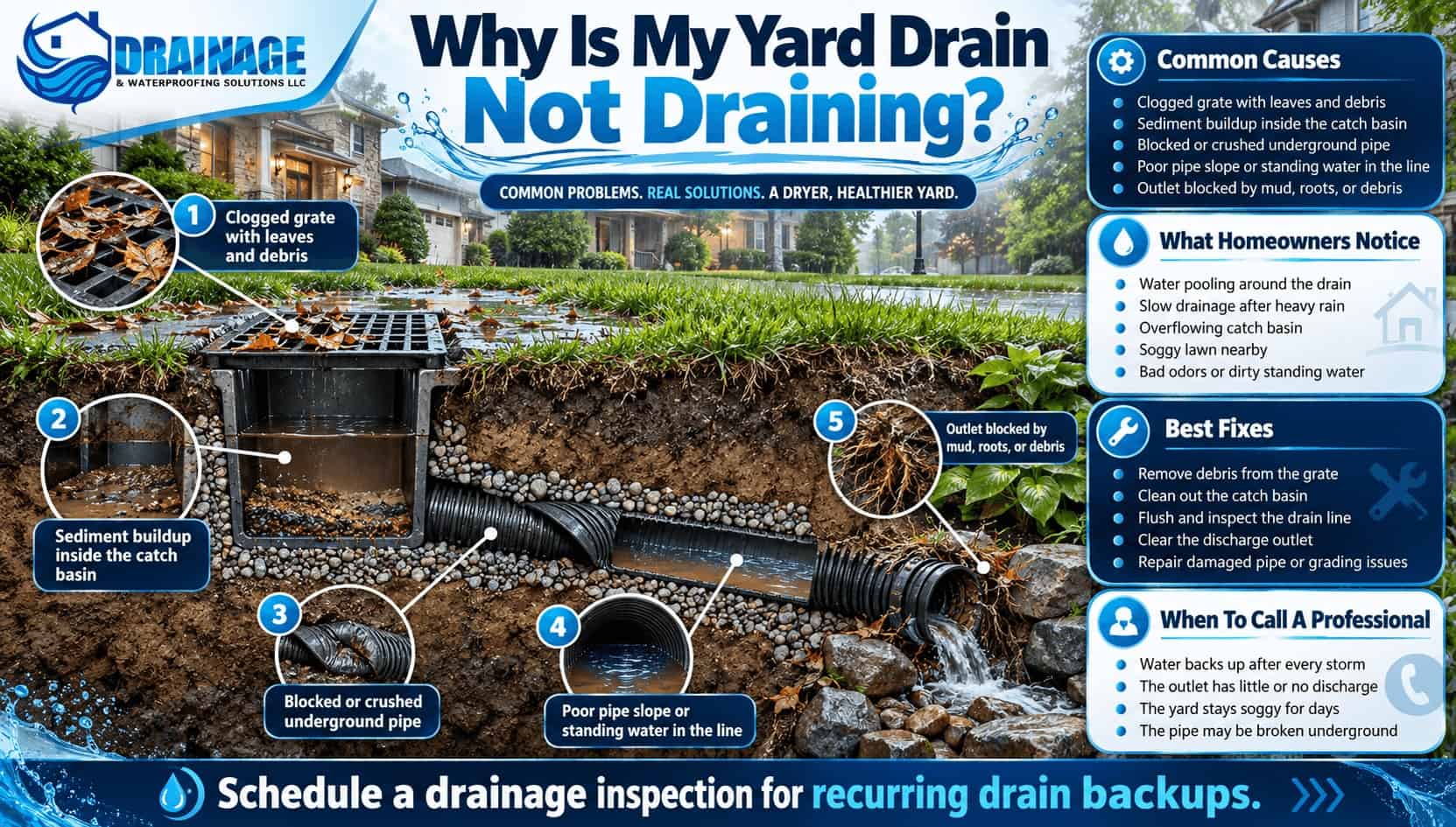
The following infographic illustrates a typical surface drainage pathway, from the grate and catch basin through underground piping to the outlet.
It highlights potential blockage locations, common warning signs, and possible corrective measures.
How to Interpret the Cutaway
The pictured defects are different failure possibilities, not necessarily conditions that occur together. The line may be blocked at the inlet, within the basin, inside the buried pipe, or at the outlet. An undersized system can also overflow without a physical blockage.
What Are the Best Solutions for a Yard Drain That Is Not Draining?
The appropriate repair depends on the cause and condition of the installed system. A drain should not be rebuilt simply because water pooled during one unusually intense storm.
Likewise, repeated cleaning is not a lasting solution when the pipe is crushed or its outlet cannot discharge water.
1. Remove Leaves and Debris From the Drain Grate
When surface debris prevents water from reaching the inlet, cleaning the grate may restore normal collection.
Homeowners can reduce recurrence by keeping nearby landscaping materials away from the drain opening and checking the grate after major storms.
If the same drain clogs constantly, investigate whether grading, mulch movement, or nearby vegetation contributes.
2. Remove Excess Sediment From the Catch Basin
A basin containing excessive sediment may need cleaning to restore access to the outlet pipe.
Some catch basins have removable grates and accessible sediment collection chambers. Others require specialized maintenance.
Cleaning should not damage the basin or connections. Where a basin is deep, unstable, heavy, or difficult to access, professional servicing is more appropriate.
Controlling upstream erosion and debris sources can reduce how quickly the basin fills again.
3. Clear an Obstructed Underground Drain Line
Where inspection identifies a pipe blockage and the line remains structurally sound, an appropriate cleaning method may restore flow.
Methods vary by pipe material, diameter, access, obstruction type, and condition.
Excessive pressure or force can damage older or fragile piping. A damaged pipe may require repair instead of further cleaning.
4. Restore a Restricted Discharge Outlet
If the outlet is blocked by debris, sediment, or vegetation, appropriate maintenance may restore water movement.
An outlet that becomes submerged during storms may require a broader downstream drainage assessment.
Discharge modifications should respect property boundaries, easements, erosion requirements, and local stormwater rules. Do not assume that an outlet can simply be moved to the nearest ditch or street.
5. Repair Crushed or Disconnected Underground Piping
A damaged section may need to be excavated and replaced after its location and condition are confirmed.
Repair should address why the pipe failed, including unsuitable support, soil settlement, external loading, or poor connections when those conditions apply.
A properly restored pipe should have an appropriate grade, connection method, and backfill arrangement for its intended use.
6. Correct Inadequate Drainage Capacity or Inlet Placement
If the pipe is clear but water repeatedly exceeds the system's capacity, improving the design may be necessary.
Options could include additional collection inlets, improved grading, runoff diversion, larger suitably designed piping, or other site-specific stormwater measures.
The selected solution depends on runoff volume, the available outlet, property constraints, and applicable standards.
Installing another basin without verifying where the water can discharge may add collection capacity without solving the backup.
Which Repair Matches the Confirmed Problem?
| Confirmed Issue | Possible Repair | What It Does Not Fix |
|---|---|---|
| Debris over grate | Clear the inlet and control debris sources | Blocked underground piping |
| Excess sediment in basin | Remove sediment and investigate erosion | A crushed downstream pipe |
| Obstruction in intact pipe | Appropriate line cleaning | Improper pipe elevation or inadequate capacity |
| Damaged underground pipe | Targeted pipe repair or replacement | Excess runoff beyond design capacity |
| Blocked discharge outlet | Outlet maintenance or correction | Unrelated inlet restrictions |
| System undersized for runoff | Evaluate collection, conveyance and discharge design | A separate structural pipe defect |
| Water never reaches inlet | Assess grading or inlet placement | A downstream restriction if one also exists |
Drainage & Waterproofing Solutions LLC provides drainage and waterproofing services for homeowners in its North Carolina service area. Explore its drainage and waterproofing services to learn about broader water-management options.
Is Your Yard Drain Clogged, Broken, or Simply Undersized?
These problems can look similar at ground level, but they call for different repair decisions.
Clogged or Restricted Drain
- May previously have drained normally.
- Performance can worsen gradually.
- Leaves, roots, or sediment may be present.
- Cleaning may help when piping is sound.
- Recurring clogs may reveal a hidden defect.
Capacity or Design Problem
- May overflow mainly during intense rainfall.
- Can occur even with a clear pipe.
- Runoff may have increased after landscaping changes.
- Outlet conditions can limit performance.
- May require redesign instead of cleaning.
Can a Broken Pipe Look Like a Clogged Drain?
Yes. A crushed or disconnected pipe may restrict water movement and cause backup in the basin. It may also allow sediment to enter repeatedly.
When a drain is cleaned but stops working again soon afterward, the line should be evaluated for more than ordinary leaf or sediment buildup.
When Is Standing Water Normal After a Major Storm?
Some temporary surface water can occur during unusually intense rainfall when runoff temporarily exceeds a system's capacity.
However, persistent or recurring flooding deserves evaluation, particularly when water threatens a foundation, enters structures, creates unsafe walking conditions, or damages landscaping.
No single drainage time applies to every yard. The appropriate performance standard depends on the site, system design, rainfall, and receiving outlet.
How Much Does It Cost to Fix a Yard Drain That Is Not Draining?
Repair costs vary substantially because an accessible debris blockage is different from a buried pipe failure or a complete drainage redesign.
A reliable estimate depends on confirming the underlying problem and identifying the work needed to restore the intended water pathway.
Access
Easy-to-reach inlets require different work from buried pipes beneath landscaping.
Pipe Condition
An intact clogged line may need cleaning, while a damaged line may need excavation and repair.
Pipe Length
Longer or complicated routes can require more investigation and labor.
Discharge Route
An unsuitable or blocked outlet may expand the repair beyond the basin.
Site Conditions
Utilities, trees, paving, soil conditions, and access affect repair complexity.
System Capacity
A poorly sized or positioned system may require redesign instead of maintenance alone.
Should You Replace the Entire Drainage System?
Not automatically. If the catch basin, underground pipe, and outlet are in generally sound condition, a localized repair or cleaning may be sufficient.
Replacement becomes more relevant when components are extensively damaged, the installed drainage route is unsuitable, or the system cannot meet reasonable site requirements.
Avoid choosing a full replacement solely because a grate overflowed. Likewise, avoid paying for repeated cleaning without investigating why a blockage keeps returning.
How Can You Keep a Yard Drain Working Properly?
A maintained yard drain is less likely to become restricted by debris, but maintenance cannot correct structural damage or inadequate system design.
Four Things to Monitor
Check for leaves, mulch, and debris covering the inlet.
Watch for excessive sediment near the outlet opening.
Observe known discharge points for visible restrictions.
Record changes in pooling duration after rainfall.
Before Heavy Rainfall
Remove loose surface debris when the drain can be accessed safely. Keep mulch piles, grass clippings, and other landscaping material away from the grate.
Where the basin is designed for accessible maintenance, follow the manufacturer's or contractor's recommended cleaning procedure.
After Heavy Rainfall
Observe whether water drains as expected and whether soil or debris has washed into the basin.
Photographs taken during and after storms may be useful for identifying whether the drain performs differently under varying rainfall conditions.
After Landscaping or Construction
Check the drain after new patios, walkways, driveways, garden beds, tree work, or underground utility installation.
These activities can change runoff patterns, cover inlets, affect pipe support, or damage buried sections.
When to Schedule Professional Evaluation
Arrange an inspection when backups persist despite reasonable surface maintenance, the drain overflows regularly, a pipe appears damaged, or the discharge location is uncertain.
A professional can assess whether the problem involves cleaning, component repair, or redesign.
Why Do Existing Yard Drains Back Up in Raleigh and Surrounding Areas?
Properties around Raleigh, Garner, Cary, Apex, Durham, Wake Forest, Fayetteville, and Southern Pines may experience intense rainfall and periods of saturated soil.
How this affects an existing drainage system depends on the property's grading, runoff catchment, soil conditions, pipe elevation, and discharge outlet.
Some properties have yards that drain toward a low catch basin. Others receive runoff from roofs, patios, driveways, or adjacent higher ground.
A drain that was adequate before exterior renovations may receive more runoff after paving, grading, or landscaping changes.
Similarly, an outlet that previously discharged freely may be affected by sediment, vegetation, or changes in the receiving drainage area.
Does North Carolina Clay Soil Cause Catch Basins to Clog?
Clay-rich soil can contribute fine sediment when runoff transports exposed soil into a drain, but soil texture alone does not prove the cause of a blockage.
Basin clogging depends on upstream erosion, grate design, maintenance, pipe conditions, and the quantity of sediment entering the system.
Can Yard Drainage Problems Affect a Foundation?
They can when runoff accumulates near the foundation or is redirected toward below-grade structures.
However, standing water near a catch basin does not automatically mean foundation damage has occurred.
Where water also enters the basement or crawl space, evaluate those pathways separately. Read the company's guide to water pooling around foundations for broader foundation runoff considerations.
Does Every Home Need a French Drain Instead?
No. A French drain and a catch basin serve different water-management functions.
A catch basin may be appropriate for collecting surface runoff, while a French drain may intercept certain subsurface flows. Some properties benefit from both; others need a different approach.
Replacing a clogged catch basin with a French drain without diagnosing the actual problem can leave the water pathway unresolved.
The company's existing yard-drainage solutions guide discusses broader system selection. This article is specifically about repairing an installed yard drain.
Evidence and Diagnostic Limits
Visible standing water does not reveal the condition of the entire underground drainage system. A basin may overflow because of a restriction, an undersized inlet, high downstream water, or changes in runoff. The correct repair should follow an assessment of both collection and discharge conditions.
Frequently Asked Questions About Yard Drains That Are Not Draining
1. Why is my yard drain not draining after rain?
A yard drain may stop draining because leaves obstruct the grate, sediment blocks the catch basin, or debris restricts the underground pipe. The discharge outlet may also be blocked or submerged. Some systems overflow during heavy rainfall because their capacity is insufficient. Determining whether water can enter, travel through, and leave the system helps identify the correct repair.
2. How do I know if my catch basin is clogged?
A catch basin may be clogged when water remains above the outlet opening, debris covers the grate, or sediment has accumulated enough to restrict flow. However, water in a lower sediment sump may be normal for some basin designs. A clear basin can also back up when an underground pipe or downstream outlet is restricted.
3. Can I unclog a yard drain myself?
Homeowners can sometimes remove loose debris from an accessible surface grate under safe conditions. More extensive cleaning may require equipment and knowledge of the pipe material, route, and discharge point. Avoid entering basins, digging near unlocated utilities, or forcing tools into unknown pipes. Recurring backup or suspected pipe damage warrants professional evaluation.
4. Why does my yard drain work during light rain but overflow in heavy rain?
A yard drain that works during light rain but overflows during intense storms may lack adequate collection or discharge capacity for the incoming runoff. High downstream water levels can also limit discharge. A partial blockage may contribute, but overflow during heavy rain does not prove the pipe is clogged. Evaluate the entire system and runoff volume.
5. How can I tell if an underground yard drain pipe is broken?
A damaged underground drain pipe may cause recurring backups, unexpected water appearing along the pipe route, sediment entering the system, or poor performance after cleaning. These symptoms are not conclusive because blockages and outlet problems can look similar. When damage is suspected, a qualified contractor may recommend inspection of accessible piping before excavation.
6. Should there be standing water inside my catch basin?
Some catch basins have a lower sediment sump that can retain water below the outlet pipe. This does not necessarily indicate a blockage. Water rising above the outlet and flooding the surrounding surface is different and may signal restricted flow or excessive runoff. The basin's design and operating conditions determine how to interpret the water level.
7. Will flushing a yard drain with a hose clear the blockage?
A gentle rinse may remove loose debris from certain accessible components, but adding water to a blocked system can worsen pooling or backup. Flushing also cannot repair a crushed pipe, correct poor slope, or resolve inadequate discharge capacity. High-pressure equipment can damage unsuitable piping and should be used only with an appropriate assessment of the system.
8. Why does water back up from my yard drain after it was cleaned?
Water may back up again when an obstruction remains farther downstream, sediment repeatedly enters the line, a pipe is damaged, or the discharge outlet cannot release water. An undersized system can also overflow even after thorough cleaning. Repeated failures suggest that the whole collection, conveyance, and discharge route should be evaluated rather than repeatedly cleaning the grate.
9. Should I replace my clogged yard drain with a French drain?
Not automatically. Catch basins primarily collect surface runoff, while French drains are commonly designed to intercept water moving through soil. Replacing one with the other may not address the existing problem. If the catch basin or pipe can be repaired, replacement may be unnecessary. The appropriate system depends on water source, soil, grading, and the available outlet.
10. When should I call a yard drainage professional?
Contact a drainage professional when a yard drain repeatedly backs up, water remains around the inlet despite surface cleaning, a buried pipe may be damaged, or the discharge outlet is unclear. Professional evaluation is also appropriate when flooding threatens the home or requires excavation. The goal is to identify the actual restriction or design issue before selecting repairs.
Yard Drain Not Draining in Raleigh, NC?
When water repeatedly backs up around a catch basin, clearing the visible grate may not be enough. The inlet, basin, buried pipe, and discharge outlet all need to function as an effective drainage system.
Drainage & Waterproofing Solutions LLC provides drainage and waterproofing services to homeowners across its North Carolina service area.
The company offers written estimates with on-site evaluations. Its published policy states that estimates are free within a 60-mile radius of the Raleigh/Garner area; a trip or estimate charge applies outside that area.
Sources & Technical References
-
U.S. Environmental Protection Agency
Stormwater Discharges from Municipal Sources . Background on stormwater runoff and the importance of managing drainage systems and their discharge. Municipal stormwater rules are not a substitute for property-specific requirements. -
North Carolina Department of Environmental Quality
Stormwater Program . State resources concerning stormwater management and water-quality protection. -
Drainage & Waterproofing Solutions LLC
Drainage and Waterproofing Services . Company information about surface drainage, grading, French drains, and water management solutions. -
Drainage & Waterproofing Solutions LLC
Solving Yard Drainage Problems . Existing homeowner guidance on general yard drainage and system selection.
Technical limitations: This article provides general homeowner education. It does not replace an on-site inspection, underground utility locating, engineered drainage design, or applicable local stormwater review. The correct repair depends on the installed system, its outlet, and the property's actual conditions.

Reviewed by Drainage & Waterproofing Solutions Staff
Drainage & Waterproofing Solutions LLC is a locally owned, family-operated company providing yard drainage, foundation waterproofing, crawl-space moisture control, and related services in North Carolina.
The company's published service areas include Raleigh-Durham and Fayetteville-Southern Pines. Its work focuses on evaluating water intrusion and developing drainage solutions suited to the property.