
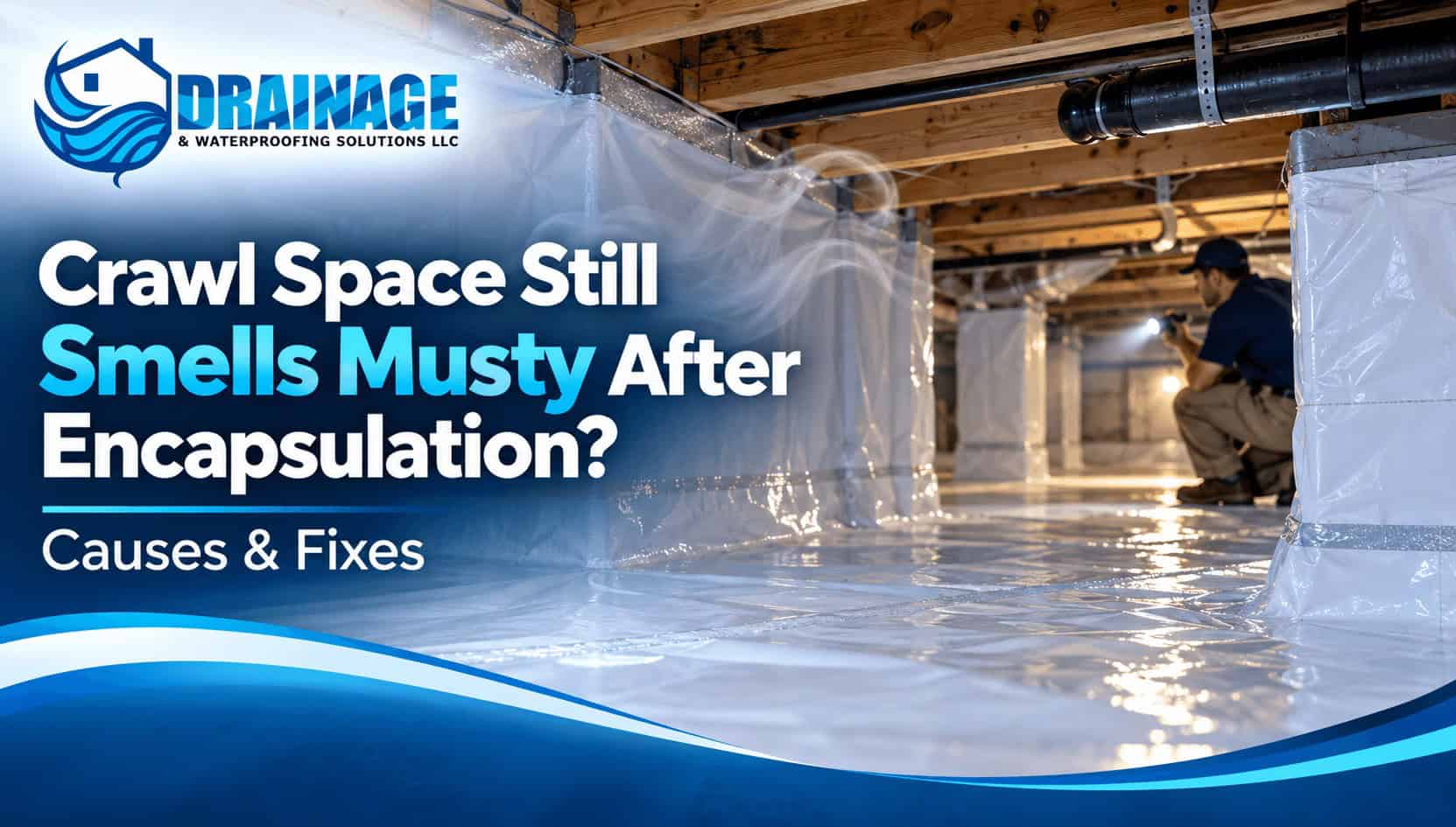
Why Does My Crawl Space Still Smell Musty After Encapsulation?
Crawl space musty odor after encapsulation can be frustrating, especially when the work was supposed to help control moisture beneath your home. A persistent earthy or stale smell may indicate damp building materials, air leakage, incomplete vapor barrier sealing, plumbing problems, hidden water intrusion, or an odor source that has not yet been identified.
A properly designed encapsulation system can reduce ground moisture and uncontrolled humid air entering a crawl space. However, it does not automatically remove odors already absorbed by materials or correct a continuing water source that was overlooked.
This guide explains how to troubleshoot persistent odors after encapsulation is already installed, which warning signs matter, and how to determine whether the solution involves drying, drainage, air sealing, material remediation, or equipment service.
Why Does a Crawl Space Still Smell Musty After Encapsulation?
A crawl space musty odor after encapsulation usually means that an odor source remains or that moisture conditions have not been fully controlled. Possible causes include damp floor framing, old insulation, contaminated debris, air leaks, a damaged or incomplete vapor barrier, liquid water beneath or above the liner, plumbing leaks, or ineffective humidity control.
A newly encapsulated space may need time for previously damp materials to dry, but a persistent smell should not be dismissed as normal without checking moisture levels and locating the source. Odor alone cannot confirm mold, identify the moisture pathway, or prove that the encapsulation installation failed.
What Does a Musty Smell in an Encapsulated Crawl Space Actually Mean?
A musty smell is a sensory clue, not a diagnosis. People often describe odors from damp wood, stored materials, wet dust, microbial activity, or enclosed spaces as earthy, stale, or musty. Similar descriptions can arise from different sources.
Crawl space encapsulation commonly involves a ground vapor barrier, sealed seams, treatment of appropriate perimeter details, air leakage control, and a designed approach to managing humidity. The exact assembly depends on the house and applicable construction requirements.
If the system was installed properly but the smell continues, the investigation should focus on the condition of materials that were already damp, whether water is still entering, whether air is moving from untreated areas, and whether the odor is actually originating inside the crawl space.
Moisture Source
Check whether water is still entering through soil, foundation walls, plumbing, or another pathway.
Odor Reservoir
Wood, insulation, dust, debris, and other materials may retain odors after visible drying begins.
Air Movement
Leaks and pressure differences can transport odors through access openings, floor penetrations, or ducts.
Can Encapsulation Work Correctly While an Odor Remains?
Yes. A vapor barrier can reduce ground moisture without immediately removing odors stored in old materials. For example, framing or subflooring that was wet before installation may continue drying after the ground has been covered.
However, lingering smell should not automatically be attributed to normal drying. An active leak or contaminated material can produce similar symptoms. Measurements and inspection are more reliable than assuming every post-installation odor will eventually disappear.
Important Distinction
Encapsulation controls particular pathways of moisture entry. It is not automatically a mold-remediation service, plumbing repair, drainage installation, air-cleaning treatment, or guarantee that existing odors will vanish. Those issues may require separate evaluation.
Is a Musty Smell Normal Immediately After Crawl Space Encapsulation?
Some residual odor may remain after encapsulation, particularly when the crawl space had been damp for a long period before work began. Wood, masonry, insulation, and other materials do not necessarily reach a new moisture equilibrium immediately.
The time required depends on temperature, prior wetting, moisture load, air circulation, the drying method, and whether materials continue receiving water. There is no reliable universal number of days after which every crawl space should become odor-free.
Four Questions That Separate Drying From a Continuing Problem
Record whether the odor becomes less noticeable over successive days under similar conditions.
Compare relative humidity and material moisture trends instead of judging by smell alone.
A recurring increase after storms may indicate water entry or changing air movement.
Compare safe observations near the access door, floor penetrations, and nearby indoor areas.
An odor that diminishes while monitored moisture levels improve may be associated with ongoing drying, but this relationship does not prove the source. Persistent or worsening odors, new staining, standing water, or damp insulation indicate a need for further investigation.
What If the Crawl Space Smelled Fine at First but Started Smelling Later?
A smell that begins weeks or months after installation deserves a fresh assessment. Possible changes include a plumbing leak, new rainwater intrusion, an open access door, damaged liner seams, dehumidifier problems, or water condensing on cooler surfaces.
The change in timing is useful because it suggests that the space may not be experiencing exactly the same conditions as when installation was completed.
Eight Reasons a Crawl Space Still Smells Musty After Encapsulation
These causes can occur separately or together. The objective is to identify the conditions responsible for the odor without assuming that every musty smell indicates mold or that every encapsulation requires replacement.
Previously Wet Wood or Subflooring Has Not Fully Dried
Wood joists, beams, sill plates, and subflooring may absorb moisture during prolonged exposure to humid crawl-space conditions. Once the ground vapor barrier and enclosure are improved, those materials may still hold moisture.
Depending on conditions, trapped moisture within or adjacent to framing can take time to dissipate. Damp wood can also support microbial growth when appropriate conditions persist.
A wood-moisture meter used correctly can provide more useful information than a single ambient humidity reading. Moisture readings must be interpreted for the material, meter type, temperature, and actual conditions.
If framing remains abnormally damp or shows visible deterioration, the source should be identified before deciding whether drying, cleaning, repair, or replacement is required.
Old Insulation or Debris Is Retaining Odors
Insulation that became wet before encapsulation may retain odor or contamination even after the crawl space floor has been covered. Old cardboard, construction debris, damaged materials, animal nesting residue, and settled organic dust can also contribute.
A new vapor barrier does not remove these materials automatically. Where existing insulation was left in place, its condition deserves attention if moisture or odor persists.
Material removal may be necessary when damage, contamination, or persistent moisture is confirmed. Whether replacement is appropriate depends on the assembly and the scope of the problem.
Air Leaks Around Access Doors, Vents, or Penetrations
An encapsulated crawl space is not necessarily airtight. Openings around a crawl-space access door, rim joists, utility penetrations, vents, or other connections may still allow humid outdoor air to enter.
Air leakage can affect moisture levels and transport odors into the house. In certain conditions, humid air contacting cooler surfaces can produce condensation.
The appropriate correction depends on the crawl space's ventilation or conditioning design. Sealing arbitrary openings without understanding combustion safety, drainage, mechanical systems, or applicable code requirements can create new problems.
Vapor Barrier Seams or Perimeter Details Are Incomplete
A ground vapor barrier reduces moisture vapor transmission from underlying soil. If seams are open, edges are detached, penetrations are unsealed, or the liner has been punctured, moisture may enter through those discontinuities.
Improper fastening around piers or the foundation perimeter can also leave gaps that limit the intended moisture-control performance.
However, a gap does not automatically explain every odor. The location, size, surrounding moisture conditions, and remaining enclosure design all matter.
Repairs should use materials and methods compatible with the installed liner and its manufacturer's requirements.
Liquid Water Is Entering Beneath or Above the Liner
Encapsulation does not automatically stop groundwater, rainwater intrusion, or plumbing discharge. Active liquid water can remain beneath a barrier or appear on its surface when a separate source has not been corrected.
Possible pathways include foundation seepage, exterior runoff, high water levels in surrounding soil, and damaged supply or drain piping.
Moisture beneath an intact vapor barrier does not necessarily escape directly into the crawl-space air. The concern is whether the water indicates a continuing intrusion problem, escapes through gaps, damages building materials, or affects the long-term system design.
For detailed guidance about drainage planning, see Does a Crawl Space Need Drainage Before Encapsulation? That article addresses drainage requirements before installation; this guide focuses on diagnosing conditions that remain afterward.
Humidity Control or Dehumidifier Performance Is Inadequate
Some closed crawl spaces use a dehumidifier or another code-accepted approach to moisture control. When that system cannot manage the moisture load, damp conditions may persist.
Potential issues include restricted airflow, incorrect settings, inadequate capacity, a blocked condensate drain, malfunctioning controls, or an ongoing source of humid air.
A dehumidifier that runs frequently is not automatically defective. Likewise, a unit that displays a reasonable humidity reading does not prove there are no localized wet materials or water intrusion.
The separate guide on crawl space dehumidifiers running constantly explains equipment-specific troubleshooting in greater detail.
Microbial Growth or Contaminated Materials Remain
Musty odors can be associated with microbial growth on persistently damp materials, but smell alone cannot confirm the presence, type, extent, or source of mold.
Existing growth may remain on wood, insulation, or other surfaces after an encapsulation system is installed. Simply covering the ground does not necessarily clean or remove affected materials elsewhere.
The U.S. Environmental Protection Agency emphasizes controlling the underlying moisture source when addressing mold problems. Cleaning or remediation methods should be selected based on the materials, extent of contamination, and safety considerations.
Avoid disturbing extensive suspect growth without appropriate protective measures and professional guidance.
The Odor Comes From Plumbing, HVAC, Pests, or Another Area
Not every odor detected near a crawl-space access opening originates from the soil, vapor barrier, or wood framing.
A drain leak, dry plumbing trap, wastewater problem, animal remains, pest activity, wet duct insulation, or stored material may produce a smell that resembles ordinary dampness.
Air pressure and duct leakage can move odors between parts of the house, making the apparent source misleading.
Where there are sewage, fuel, chemical, or other potentially hazardous odors, the response should follow the suspected hazard and involve the appropriate qualified professional rather than ordinary moisture maintenance.
What Can the Timing and Location of the Musty Smell Tell You?
The way an odor changes over time can help prioritize an investigation. These patterns do not establish a diagnosis, but they can direct attention toward specific components.
| Odor Pattern | Possible Explanations | Useful Next Check |
|---|---|---|
| Strongest after rain | Runoff, seepage, wet soil, drainage defects, or changes in air movement | Exterior grading, drain outlets, visible water pathways |
| Strongest in humid weather | Air leakage, condensation, or excessive moisture load | Humidity trends, enclosure details, cooler surfaces |
| Present immediately after installation | Previously damp materials, debris, residual odor, or an unresolved source | Original moisture conditions and material drying trends |
| Begins months later | New leak, damaged liner, equipment change, pest activity, or air movement | Recent changes and newly affected areas |
| Strongest near access door | Local air leakage or nearby odor reservoir | Access seals, adjoining materials, pressure differences |
| Noticeable through floor registers | Possible duct leakage or odor transport | HVAC inspection and duct integrity |
| Sewage-like or chemical odor | Plumbing or potentially hazardous source | Leave when appropriate and contact the relevant specialist |
Why Can the House Smell Musty Even if the Crawl Space Looks Clean?
A white vapor barrier may make a crawl space appear clean, but appearance does not establish the condition of hidden materials or prove that air leakage has been controlled.
Odors can travel through plumbing and wiring penetrations, floor assemblies, access openings, or leaking ducts. Pressure differences generated by mechanical systems and weather may influence where those odors become noticeable.
The indoor source should therefore be investigated alongside the crawl space, especially when the smell is strongest in one room rather than throughout the building.
What Should Homeowners Check Before Paying for More Encapsulation Work?
Before authorizing major repairs, collect observations that help distinguish residual odors from ongoing moisture and identify which professional trade may be needed.
Odor Timeline
Record when the smell began and whether it improves, worsens, or changes with rain or temperature.
Humidity Trend
Review readings over time, not just a single number from the equipment display.
Water Evidence
Look for visible staining, standing water, or condensation from a safe accessible position.
Barrier Condition
Document visible gaps, detached seams, damage, or unexplained water accumulation.
Material Condition
Note signs of wet insulation, deteriorated framing, damp debris, or unusual staining.
Other Sources
Consider plumbing, HVAC, pests, and nearby rooms before blaming the liner.
Avoid entering areas with standing water near electrical equipment, damaged wiring, unstable framing, suspect sewage contamination, or strong unexplained chemical or fuel odors. Crawl spaces can contain limited access, hazardous air, pests, and other conditions requiring trained inspection.
If an odor is strong, sudden, chemical-like, fuel-like, or accompanied by dizziness, headache, nausea, or breathing difficulty, leave the affected area and seek appropriate emergency or utility assistance from a safe location.
Should You Lift the Vapor Barrier to Look for Water?
Avoid cutting, peeling back, or disconnecting a newly installed liner simply to investigate an odor. This can damage seams and compromise the moisture-control assembly.
A qualified installer or inspector can determine where inspection access is appropriate and how the barrier should be restored. Any work near wiring, plumbing, or potentially contaminated water requires additional care.
What Measurements Are Most Useful?
Relative humidity readings, temperature, material moisture measurements, documented condensation, and visible signs of liquid water can help build a clearer picture.
Measurements should be taken with suitable equipment and interpreted alongside the crawl-space design and outdoor conditions. A single dry reading does not rule out a localized wet area.
Crawl Space Musty Odor After Encapsulation: Causes and Solutions
This infographic shows potential hidden moisture pathways and common conditions that may allow odors to remain after a crawl space has been encapsulated.

How to Use This Infographic
Treat these pathways as inspection possibilities rather than confirmed defects. The presence of an odor does not establish that the liner is damaged, that microbial growth is present, or that a dehumidifier must be replaced.
How Do You Get Rid of a Musty Smell After Crawl Space Encapsulation?
The effective solution depends on what is producing or transporting the odor. Simply replacing the vapor barrier, adding fragrances, or installing a larger dehumidifier may leave the underlying problem unchanged.
1. Correct Active Drainage or Plumbing Problems
Where liquid water continues entering the crawl space, identify its source before modifying the liner or equipment.
Potential solutions include appropriate exterior runoff management, drainage repairs, sump-system evaluation, foundation water-control measures, or plumbing repairs.
The correct approach depends on site conditions and which water pathway has been confirmed.
Learn about the company's drainage system inspection services for evaluating broader water-management issues.
2. Repair Incomplete Air-Sealing Details
Where unintended air leakage has been confirmed, appropriate repairs may involve access doors, penetrations, rim areas, or other enclosure details.
The system should be evaluated as a whole. Closed-crawl-space designs must account for approved moisture-control methods, mechanical equipment, ventilation, and applicable safety requirements.
Improperly sealing an opening without considering these factors can interfere with the intended design.
3. Restore Damaged Vapor Barrier Seams and Connections
Torn sections, detached perimeter connections, and gaps around piers may need compatible repairs.
Repair methods should follow the installed system's specifications. Generic household tape or sealant may not provide the same long-term performance as appropriate materials.
A confirmed liner defect does not automatically require replacing the entire encapsulation system.
4. Assess Damp, Damaged, or Contaminated Materials
Materials that remain wet or contaminated after installation may require drying, cleaning, removal, or replacement.
The response depends on the type of material, the extent of damage, possible contamination, and whether the moisture source has been corrected.
Existing wood framing should not be discarded or chemically treated simply because it smells musty. Its actual condition should be evaluated.
5. Verify the Installed Moisture-Control Method
Where a dehumidifier or other designed conditioning method is part of the system, check whether it is operating as intended.
A technician may review humidity settings, airflow, condensate drainage, equipment capacity, sensor readings, and maintenance requirements.
If humid air leakage or standing water remains, equipment adjustments alone may not resolve the odor.
6. Address Plumbing, HVAC, or Pest Sources Separately
When investigation identifies a plumbing, ductwork, pest, or another non-encapsulation source, the appropriate trade should handle that problem.
For example, a drain leak needs plumbing attention, while an HVAC air distribution problem may require mechanical evaluation.
A targeted repair is generally more appropriate than replacing encapsulation materials unrelated to the odor.
Which Fix Matches the Confirmed Problem?
| Confirmed Condition | Appropriate Response | What It Does Not Automatically Fix |
|---|---|---|
| Continuing water intrusion | Identify and repair drainage or plumbing source | Odors already stored in damaged materials |
| Incomplete air sealing | Correct appropriate enclosure gaps | A separate ground or plumbing leak |
| Damaged vapor barrier | Compatible seam or liner repair | Active water entering beneath the assembly |
| Wet insulation or debris | Evaluate, dry, clean, or remove as appropriate | Uncorrected ongoing moisture entry |
| Dehumidifier underperformance | Test, maintain, repair, or replace when justified | Standing water or damaged framing |
| Plumbing, HVAC, or pest source | Repair through relevant qualified trade | Independent enclosure defects |
For broader information about encapsulation and crawl-space repairs, visit Crawl Space Repair & Encapsulation . The company's service page explains its crawl-space water-control and repair work.
Can a Crawl Space Smell Musty Even When Humidity Looks Normal?
Yes. A relative-humidity reading describes the air at the sensor location and time. It does not establish that every framing member, hidden cavity, or surface is dry.
A localized plumbing leak or previously wet material may remain a problem even when average air humidity has improved. Likewise, an odor reservoir may persist after the moisture conditions that originally caused it have changed.
What Humidity Level Should an Encapsulated Crawl Space Have?
The U.S. Environmental Protection Agency generally recommends indoor relative humidity below 60%, ideally between 30% and 50% where practical.
Closed crawl spaces have design-specific requirements, and the proper operating range can depend on climate, temperature, equipment, and the assembly. Avoid using one humidity number as proof that a crawl space is completely free of moisture or microbial concerns.
Useful Indicators
- Humidity trends over several days
- Wood-moisture measurements where appropriate
- Absence of new condensation or water intrusion
- Equipment functioning as specified
- Improving material and odor conditions
Unreliable Shortcuts
- One humidity reading as a complete diagnosis
- Assuming a running dehumidifier is broken
- Assuming a clean liner means everything is dry
- Replacing equipment without measuring performance
- Using fragrance to conceal recurring odors
Should You Turn the Dehumidifier Down to Remove the Smell?
Do not change humidity settings arbitrarily to chase an odor. An unnecessarily aggressive setting may increase energy use without addressing the actual source.
Review the manufacturer's instructions and the crawl-space design. If readings remain elevated despite equipment operation, evaluate moisture loading, airflow, drainage, sensors, and equipment performance.
Does a Musty Smell After Encapsulation Mean There Is Mold?
No. A musty smell alone cannot confirm mold or identify a particular organism. Possible odor sources include damp organic materials, dust, residual contamination, plumbing, and microbial activity.
However, persistent moisture creates conditions where mold may grow on susceptible materials. Visible suspect growth, recurring wetting, or substantial damage should be assessed appropriately.
EPA guidance emphasizes moisture control as an essential component of preventing and correcting mold problems in buildings. Cleaning or remediation must address the source that allows materials to remain wet.
Should You Spray Bleach, Disinfectant, or Odor Neutralizer Into the Crawl Space?
Do not use chemical products as a substitute for finding the water or odor source. Spraying chemicals into poorly ventilated spaces can introduce exposure risks and may damage building materials or equipment.
Products should only be used for their labeled purposes and with appropriate safety measures. Some contaminated materials require specialized cleaning or removal rather than surface spraying.
When Should You Seek Additional Professional Help?
Seek appropriate professional evaluation when there is extensive suspect microbial growth, sewage contamination, damaged structural materials, or ongoing water intrusion that cannot be safely assessed.
People with respiratory concerns or symptoms should obtain individual guidance from a qualified healthcare professional; a crawl-space odor diagnosis is not a medical assessment.
How Can You Keep an Encapsulated Crawl Space From Smelling Musty Again?
Long-term odor prevention depends on keeping the intended moisture-control system working and responding promptly to new leaks, damage, or changes in humidity.
Four Things to Monitor After Encapsulation
Look for new signs of leaks, standing water, and runoff after storms.
Document visible seam damage, punctures, or detached perimeter connections.
Watch changes in readings and follow equipment maintenance instructions.
Note fresh stains, wet insulation, condensation, or deteriorating wood.
After Heavy Rain
Watch for changes in the odor, new moisture evidence, drainage-system activity, and runoff around the foundation. If the smell repeatedly increases after storms, arrange a drainage evaluation rather than assuming the liner is responsible.
During Humid Weather
Review humidity trends and whether the installed conditioning system is operating as designed. Inspect access doors and other visible enclosure details for damage or unexpected openings.
After Plumbing, HVAC, or Electrical Work
Contractors accessing the crawl space can inadvertently damage vapor barriers or leave penetrations unsealed. Check that disturbed components are restored using compatible materials and appropriate methods.
When the Smell Returns Unexpectedly
Record the timing and what changed before scheduling repairs. A new odor does not necessarily mean the entire encapsulation system needs replacement.
A targeted inspection can determine whether the problem involves water intrusion, enclosure damage, equipment performance, or a different source altogether.
Why Can Post-Encapsulation Odors Be Difficult to Diagnose in North Carolina?
Homes in Raleigh, Durham, Cary, Apex, Garner, Fayetteville, Southern Pines, and nearby communities may experience periods of substantial outdoor humidity and repeated rainfall.
These conditions can place varying moisture loads on crawl spaces depending on lot slope, soil properties, roof drainage, foundation construction, and enclosure details.
For example, a crawl space located below a sloping yard may experience more lateral water movement after storms than one on a well-drained site. A leaky access door may expose the space to humid outdoor air during warm weather.
The same odor symptom can therefore have different causes at neighboring properties. This is why the inspection should evaluate the installed system and site conditions rather than assume one universal explanation.
How Is This Different From Needing Encapsulation in the First Place?
A home with exposed ground, open vents, and uncontrolled crawl-space humidity may need an initial moisture-control design. That question is addressed in the company's general crawl space encapsulation guide .
This article concerns a different situation: the system is already installed, yet a musty odor remains or develops afterward. The next step should be to verify the source rather than automatically recommend another installation.
What an Odor Investigation Cannot Establish on Its Own
An odor description cannot confirm hidden mold, define the extent of wood damage, prove a liner defect, or identify buried drainage failures. A credible recommendation may require material moisture readings, equipment evaluation, visual inspection, and assessment by the appropriate trade.
Frequently Asked Questions About Musty Odors After Crawl Space Encapsulation
1. Why does my crawl space still smell musty after encapsulation?
A crawl space can continue smelling musty after encapsulation because damp wood, insulation, debris, hidden water intrusion, air leakage, or another odor source remains. Encapsulation reduces certain moisture pathways but does not automatically dry or remove all affected materials. Check humidity trends, material conditions, the vapor barrier, and any continuing water entry before assuming the installation has failed.
2. How long should a musty smell last after encapsulation?
There is no universal time for a musty odor to disappear after crawl space encapsulation. Previously damp materials may continue drying, and residual odors can persist depending on the original conditions. What matters is whether moisture measurements and the odor are improving. A smell that remains strong, grows worse, or returns after rain deserves further investigation rather than an assumption that more waiting will solve it.
3. Does a musty smell mean my encapsulation was installed incorrectly?
Not necessarily. A persistent musty smell can come from previously wet materials, a plumbing leak, microbial contamination, HVAC air movement, or another unrelated source. Installation defects such as open seams or incomplete air sealing are also possible. A proper assessment should examine the condition of the completed system and the odor pathway before identifying workmanship as the cause.
4. Can moisture remain beneath a crawl space vapor barrier?
Yes. Moisture can remain in soil beneath a ground vapor barrier, and liquid water may accumulate if drainage or groundwater conditions are unresolved. An intact barrier is designed to limit moisture vapor movement, so moisture beneath it does not automatically mean humid crawl-space air. However, water escaping through openings, affecting structural materials, or indicating continuing intrusion should be evaluated.
5. Can a crawl space smell musty even with low humidity?
Yes. Low or controlled relative humidity at one sensor does not guarantee every material is dry or that no odor reservoir remains. Old insulation, debris, damp wood in a localized area, or plumbing problems can produce odors independently of average humidity. A useful investigation combines air readings with visual observations, material measurements, and inspection of other potential sources.
6. Will a dehumidifier remove a musty crawl space odor?
A dehumidifier can help reduce excessive air moisture when it is part of an appropriate system, but it cannot remove every odor source. It will not repair a plumbing leak, clear drainage, remove contaminated insulation, or correct a damaged vapor barrier. If humidity is already controlled, replacing or upgrading the dehumidifier may not address the reason the smell remains.
7. Should I replace the vapor barrier if the smell remains?
Not automatically. Replacing an intact vapor barrier without identifying the odor source can be unnecessary and expensive. A persistent smell may arise from damp wood, insulation, air leakage, drainage problems, or plumbing. If the liner has confirmed damage, a compatible repair may be sufficient. Full replacement should be considered only when the existing assembly's condition and repair needs justify it.
8. Does a musty smell mean mold is growing under my house?
A musty odor can be associated with microbial growth, but smell alone cannot confirm mold or determine its extent. Damp organic materials and other sources can create similar odors. Look for ongoing moisture, visible suspect growth, and damaged materials, and seek appropriate professional assessment when necessary. Controlling the moisture source is essential if mold remediation is required.
9. Why does the musty smell get worse after rain?
An odor that becomes stronger after rain may indicate increased moisture, water intrusion, changing air movement, or previously damp materials becoming wetter. Potential sources include foundation seepage, exterior runoff, drainage defects, and plumbing or enclosure problems. The rainfall pattern is a useful clue, but it does not identify which component has failed without further inspection.
10. When should I call a crawl space professional after encapsulation?
Request a crawl space evaluation when the odor persists without improvement, returns after storms, or occurs alongside standing water, damaged liner sections, wet wood, condensation, or elevated humidity. A professional can help separate enclosure problems from drainage, plumbing, equipment, or material-related issues. Strong sewage, fuel, or chemical odors may instead require urgent help from another appropriate specialist.
Still Dealing With a Musty Crawl Space After Encapsulation?
A persistent smell does not automatically mean that your entire encapsulation system needs to be replaced. The right solution begins with evaluating moisture sources, enclosure details, affected materials, and the installed water-management system.
Drainage & Waterproofing Solutions LLC provides crawl-space repair, encapsulation, waterproofing, and drainage-related services throughout its North Carolina service area.
Sources & Technical References
-
U.S. Environmental Protection Agency
A Brief Guide to Mold, Moisture and Your Home . EPA guidance on controlling building moisture, recognizing damp materials, and addressing conditions associated with mold growth. -
U.S. Environmental Protection Agency
Mold Course: Chapter 2 . Additional information about moisture sources, building conditions, and mold-related concerns. -
U.S. Department of Energy
Building America Solution Center . Technical guidance covering building-envelope moisture management, crawl-space design, air sealing, and vapor-control principles. -
Drainage & Waterproofing Solutions LLC
Crawl Space Repair & Encapsulation . Company information about crawl-space repair and moisture-control services.
Evidence and limitations: This guide is educational and does not replace an on-site assessment, applicable building-code review, licensed trade evaluation, or individual medical advice. Odor descriptions cannot independently confirm mold, hidden water damage, or installation defects. Recommendations depend on measured conditions and the actual construction assembly.

Reviewed by Drainage & Waterproofing Solutions Staff
Drainage & Waterproofing Solutions LLC provides crawl-space repair and encapsulation, foundation waterproofing, drainage, and moisture-control services for homeowners in North Carolina.
The company serves the Raleigh-Durham and Fayetteville-Southern Pines areas. Its work focuses on identifying water intrusion and helping property owners select appropriate drainage and waterproofing solutions.