
Why Is My Basement Window Well Filling With Water? Causes & Fixes
October 1st, 2026Why Is My Basement Window Well Filling With Water? Causes & Fixes
Basement window well flooding can turn an exterior drainage problem into a source of basement water intrusion. When rainwater accumulates around a below-grade window, it may reach the sill, penetrate vulnerable joints, damage interior materials, or expose weaknesses in the drainage system.
This guide explains why basement window wells flood, how to distinguish a blocked drain from excess runoff, which repairs may help, and what homeowners can do to reduce recurring water damage.
Why Does a Basement Window Well Fill With Water?
Basement window well flooding occurs when water enters the well faster than its drainage system can remove it. Common causes include clogged drains, negative landscape grading, concentrated downspout runoff, saturated soil, damaged drainage components, and inadequate discharge routes.
The correct solution depends on identifying both where the water originates and where it should discharge. Cleaning debris may resolve an accessible obstruction, while recurring flooding may require drainage repairs, runoff diversion, grading improvements, or window well reconstruction. A window well cover alone cannot correct a failed drainage system.
How Is a Basement Window Well Supposed to Drain?
A basement window well is an excavated area outside a window installed below the surrounding ground level. Its retaining walls hold soil away from the window, allowing light and, where designed, ventilation or emergency escape access.
Because the bottom of a window well is below grade, it can naturally collect rainfall and surface runoff. Effective designs therefore need to manage water before it enters the well, collect incidental water, and allow that water to leave through an appropriate drainage pathway.
Surface Water Control
Proper grading, suitable landscaping, and downspout discharge reduce the amount of stormwater reaching the well.
Water Collection
Drainage materials and an appropriately designed inlet help collect water reaching the bottom of the excavation.
Reliable Discharge
A suitable outlet allows collected water to leave rather than accumulating against the basement window.
Some older window wells contain gravel without a separately visible drainpipe. Whether this is adequate depends on soil infiltration, rainfall, the surrounding foundation drainage, and the well's water exposure.
Gravel can provide temporary storage and allow water to reach a drain, but it does not create a reliable discharge route when surrounding soil remains saturated.
The Four Stages of Window Well Flooding
Following the water pathway helps distinguish a drainage failure from a problem that begins elsewhere on the property.
Rain reaches the roof, lawn, paved areas, and exposed window well.
Ground slopes and roof drainage direct water toward the foundation.
Incoming water exceeds the well's drainage capacity.
Water may rise toward vulnerable window and wall connections.
Actual drainage systems vary. Water may enter directly from above, flow over the surrounding soil, move laterally through saturated ground, or back up through connected piping. The repair must address the pathway responsible for the flooding.
Seven Common Causes of Basement Window Well Flooding
The visible water level is a symptom. The actual problem may be located in the well, the yard, the roof drainage arrangement, or an underground outlet.
Clogged or Restricted Window Well Drain
A window well drain can become obstructed by leaves, mud, fine sediment, roots, and other debris. Over time, material may collect inside the underground pipe or around the inlet where water enters the system.
When the drainage pathway becomes restricted, water may accumulate during rainfall instead of leaving the well at the intended rate.
A visible blockage at the grate is not the same as a crushed buried pipe, a separated connection, or an outlet that has become submerged. Cleaning the surface may not correct a restriction farther downstream.
Landscape Grading That Slopes Toward the Foundation
Landscape grading describes the slope of the ground surrounding a property. When the soil slopes toward the house, runoff may collect against the foundation and enter low openings such as window wells.
Grading can change after construction. Settled backfill, erosion, mulch buildup, raised landscape borders, and new paving can redirect water toward a previously protected window.
Even a working window well drain may struggle when a large portion of the surrounding yard channels runoff directly into it.
Downspouts Discharging Too Close to the Window Well
Gutters collect water from a relatively large roof area. During heavy rainfall, the resulting downspout flow can overwhelm a small window well.
Short downspout extensions, disconnected underground piping, clogged gutter outlets, and poorly selected discharge locations can concentrate runoff near a basement opening.
Rerouting the discharge may help, but the new outlet needs to direct water to an appropriate location without creating erosion, flooding, or drainage problems on neighboring property.
Heavy Rainfall and Saturated Soil
After prolonged rainfall, the surrounding ground may absorb additional water more slowly. Surface runoff increases, while underground drainage systems may receive more water than usual.
Under these conditions, water may reach the well from above, move laterally through nearby soil, or back up because the available outlet cannot discharge water fast enough.
Flooding during a major storm does not necessarily prove that a pipe is clogged. It may reveal insufficient capacity or an unsuitable discharge arrangement.
Leaves, Mulch, and Sediment Accumulation
Uncovered window wells may collect leaves, pine needles, grass clippings, mulch, and windblown soil.
As organic material breaks down, it may form a dense layer over gravel or drainage openings. Fine sediment can also migrate deeper into the drainage materials.
Recurring mud and mulch accumulation may indicate that surrounding runoff is washing landscape materials into the excavation. Removing surface debris alone will not correct that upstream source.
Damaged Window Well Walls and Connections
Metal window wells may corrode, while other retaining materials can develop displaced joints, cracks, or loosened connections.
Deterioration may allow water and soil to enter through the sides. It may also compromise the well's ability to retain the surrounding earth.
Bowed, loose, or unstable retaining walls deserve professional evaluation. Excavating beside a failing well or removing its walls can create soil-collapse hazards.
Deteriorating Basement Window Frames and Seals
Water may penetrate aging glazing seals, damaged window frames, deteriorated perimeter joints, or improperly installed window assemblies.
Leakage can become apparent when standing water reaches a vulnerable part of the installation.
However, damaged seals and inadequate drainage are separate conditions. A replacement window may correct a defective assembly, but it does not prevent water from accumulating in the surrounding well.
How Do You Know a Basement Window Well Drain Is Failing?
Window well drainage problems often develop gradually. Recognizing changes in drainage performance can help homeowners investigate before water reaches finished basement materials.
| Warning Sign | Possible Explanation | Recommended Response |
|---|---|---|
| Standing water after rain | Restricted drainage or insufficient outlet capacity | Document drainage time and inspect the system |
| Water reaching the window frame | Severe accumulation or overwhelmed drainage | Arrange prompt drainage evaluation |
| Mud and mulch inside the well | Surface runoff transporting landscaping material | Review soil grading and runoff paths |
| Rust or bowed retaining walls | Corrosion, movement, or failing connections | Evaluate retaining components and surrounding soil |
| Interior window staining | Water intrusion, condensation, or another moisture source | Trace moisture timing and entry location |
| Musty odor nearby | Persistent dampness or wet materials | Identify the moisture source and assess materials |
| Flooding only during intense storms | Excess runoff or inadequate drainage capacity | Inspect downspouts, grading, and discharge |
What These Warning Signs Cannot Prove
Standing water does not automatically prove a drain is clogged. A leaking window does not necessarily mean the window itself is defective. Basement stains can also develop from separate moisture pathways. Accurate diagnosis should consider rainfall timing, exterior runoff, visible water levels, and the condition of the installed drainage system.
How Can You Identify the Source of Window Well Flooding?
A useful investigation starts with observable evidence instead of immediately replacing drains, windows, or landscaping.
Rainfall Pattern
Determine whether flooding occurs after ordinary rain, prolonged wet weather, or intense storms.
Roof Runoff
Look for downspouts, overflowing gutters, and runoff entering from nearby roof drainage components.
Ground Slope
Identify low spots, settled backfill, raised landscaping, and surfaces that direct water toward the foundation.
Visible Drainage
Observe accessible drain openings, debris accumulation, and standing water without disturbing buried components.
Well Structure
Document corrosion, loose retaining walls, separated joints, and evidence of surrounding soil movement.
Interior Evidence
Record wet window frames, staining, flooring damage, and when moisture appears relative to rainfall.
Does Standing Water Always Mean the Drain Is Clogged?
No. Water may remain because the outlet is submerged, the surrounding soil cannot absorb additional water, the drainage network lacks sufficient capacity, or the original system has no effective discharge point.
A functioning inlet cannot overcome an inadequate outlet. For that reason, professional evaluation may need to extend beyond the visible well.
Why Does the Problem Return After Previous Repairs?
Recurring flooding often means that the original work corrected only one symptom.
Replacing a deteriorated window seal may reduce leakage temporarily while leaving water accumulating outside. Clearing a drain may temporarily restore flow, but new sediment can accumulate when runoff continues washing soil into the well.
The objective is to correct the complete drainage pathway rather than repeatedly removing water after every storm.
What Should You Do if a Basement Window Well Is Flooding Right Now?
If water rises toward the window during an active storm, preventing injuries is more important than attempting an immediate drainage repair.
Do not enter a flooded window well, touch wet electrical equipment, open a window while water presses against it, or disturb unstable retaining walls. Keep children and pets away. If flooding reaches potentially energized equipment, avoid the affected area and contact the appropriate emergency or electrical professional.
Safer Immediate Actions
- Observe conditions from safe ground.
- Photograph visible water levels and runoff.
- Keep people away from unstable soil and damaged glass.
- Move unaffected belongings away from vulnerable areas when safe.
- Contact qualified help when water continues rising or entering the home.
Actions to Avoid
- Entering a deep or flooded window well.
- Opening a basement window against accumulated water.
- Digging beside unstable retaining walls.
- Connecting drains to unidentified piping.
- Pumping water directly back toward the foundation.
Temporary water removal may be appropriate in some situations, but pumping requires suitable equipment, electrical safety, and an acceptable discharge location. Water discharged toward the same foundation may simply recirculate.
Once immediate hazards have passed, the underlying drainage problem should be evaluated before relying on temporary measures as a permanent solution.
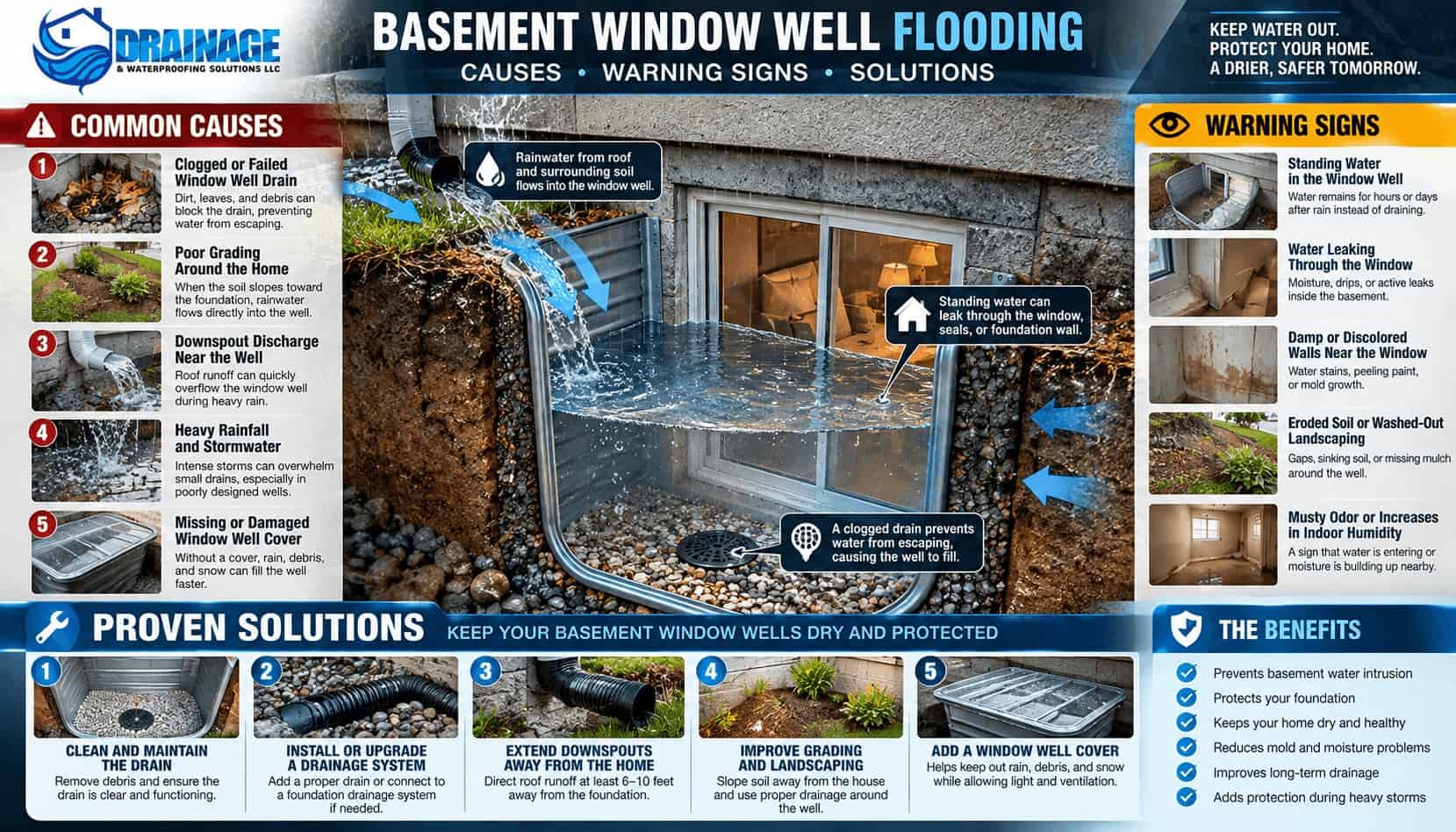
Basement Window Well Flooding: Causes, Warning Signs & Solutions
The following infographic illustrates how clogged drains, poor grading, roof runoff, and other conditions may cause water to collect beside a below-grade basement window.
The Most Important Takeaway
Window well flooding is generally a water-management problem, not merely a window problem. Correcting excess runoff, maintaining effective drainage, and addressing damaged components together can provide a more dependable approach than relying on sealant or covers alone.
What Are the Best Solutions for Basement Window Well Flooding?
The best repair depends on the verified failure. A drainage professional should consider incoming runoff, the well's condition, the available outlet, and how the proposed work may affect other drainage components.
1. Restore Accessible Drainage
When leaves or other debris obstruct a visible inlet, safe maintenance may restore drainage. More extensive restrictions may require inspection beneath the gravel or inside buried piping.
Cleaning is effective only when the remaining system can discharge water. A damaged pipe, unsuitable outlet, or overwhelmed downstream network may require additional repair.
2. Repair or Install a Proper Window Well Drain
Where the existing drainage arrangement has failed, repair may involve replacing damaged piping, correcting a connection, or establishing an appropriate outlet.
Drainage design should account for elevation, capacity, backflow potential, maintenance access, and applicable requirements. Connecting a new inlet to an overwhelmed foundation drain may create additional problems rather than resolving flooding.
3. Extend or Reroute Downspouts
Redirecting roof runoff away from a vulnerable window well may reduce the amount of water entering the area during storms.
Extensions and underground conveyance systems should carry water to an appropriate discharge location without causing erosion, nuisance drainage, or water returning toward another section of the foundation.
4. Correct Negative Landscape Grading
Surface grading improvements can redirect rainfall before it reaches a below-grade opening. Work may involve correcting settled soil, reshaping local drainage paths, or modifying landscaping that concentrates runoff.
Any grading changes should preserve building clearances, avoid obstructing windows or ventilation, and account for nearby walks, patios, and drainage routes.
5. Repair or Replace Damaged Window Well Walls
Corroded retaining walls, loose connections, displaced sections, and deteriorated materials may require repair or replacement.
Where soil movement is present, the retaining function should be evaluated before excavation. Deeper wells and emergency escape openings may also be subject to additional clearance, access, and cover requirements.
6. Repair Damaged Windows and Perimeter Joints
Damaged frames, glazing, or perimeter joints may allow water entry when the well fills. Appropriate repairs can address these specific weaknesses.
Window repairs should be coordinated with drainage corrections when water accumulation is also present. A new seal is not a substitute for controlling runoff and standing water outside the opening.
Which Repair Matches Each Problem?
| Confirmed Problem | Possible Solution | What It Does Not Fix |
|---|---|---|
| Surface debris restriction | Safe maintenance and drain inspection | Broken buried piping |
| Failed underground drain | Repair or replacement of affected components | Excess surface runoff |
| Roof runoff directed into well | Downspout rerouting | Independent drain blockages |
| Ground slopes toward foundation | Grading corrections | Deteriorated window seals |
| Damaged retaining wall | Well repair or replacement | Inadequate drainage capacity |
| Defective window assembly | Window or joint repair | Recurring water accumulation |
Broader foundation water-management problems may require evaluation beyond the window well. Learn more about foundation waterproofing , basement moisture control , and drainage system inspections .
Do Window Well Covers Prevent Basement Flooding?
A properly selected window well cover can reduce direct rainfall and debris entry, but it cannot guarantee a dry window well.
Water may still enter from surrounding soil, poor grading, concentrated runoff, or drainage backup beneath the cover.
What Covers Can Help With
- Reducing falling leaves and debris
- Limiting some direct precipitation
- Reducing routine cleaning needs
- Providing suitable protection when properly installed
What Covers Cannot Reliably Fix
- Clogged underground drains
- Negative grading around the foundation
- Water moving through surrounding soil
- Downstream drainage overload
- Damaged window frames or foundation joints
Where a basement window serves as a required emergency escape and rescue opening, any cover must meet applicable requirements for opening and removal. A cover should never obstruct emergency escape.
Can Sealant Alone Waterproof a Basement Window Well?
Sealant may repair certain gaps or joints, but it cannot create a reliable drainage outlet. Applying sealant while allowing water to collect against a below-grade window may leave the underlying problem unresolved.
When leakage involves the frame or perimeter, the appropriate repair depends on the installation and condition of the materials. Drainage and window integrity should be evaluated separately when both are contributing factors.
How Much Does Basement Window Well Drainage Repair Cost?
Window well drainage repair costs vary because the work may range from limited maintenance to underground piping replacement, excavation, structural repair, and landscaping restoration.
A reliable estimate depends on diagnosing the failure and determining how the proposed repair will discharge collected water.
Repair Complexity
Removing accessible debris is different from replacing damaged buried piping.
Window Well Depth
Deeper wells may require additional excavation, access, and safety precautions.
Soil Conditions
Saturated ground, unstable soil, and difficult access can affect repair scope.
Available Outlet
Establishing a suitable discharge route may require work beyond the window well.
Existing Damage
Corrosion, damaged windows, and deteriorated connections may require separate repairs.
Site Restoration
Landscaping, paving, and disturbed surfaces may need restoration after work.
Be cautious about universal repair prices provided without an inspection. An inexpensive repair may become costly if it treats only the visible symptom and flooding returns.
Ask contractors to explain the confirmed cause, the components included in the proposal, the intended discharge route, and any necessary ongoing maintenance.
How Can Homeowners Prevent Window Well Flooding?
Routine inspection and maintenance can reduce debris accumulation and help identify changes in drainage performance before serious water intrusion occurs.
Inspect Before and After Heavy Rain
Observe accessible wells for leaves, mulch, and sediment during dry conditions.
Confirm roof runoff is not being directed into the window well.
Document unusual standing water following rainfall.
Look for deterioration, loose retaining walls, and damaged covers.
Before Heavy Rain
Check accessible drainage openings from a safe location and remove ordinary surface debris only when it can be done without entering a hazardous excavation.
Make sure downspouts are not directing water toward the opening and look for soil depressions, erosion, or landscaping changes that concentrate runoff near the foundation.
After Heavy Rain
Observe whether water drains normally or remains against the window. Photograph new staining, indoor leakage, and evidence that runoff has washed mulch or soil into the well.
Repeated changes in drainage performance deserve investigation even when no major interior damage has occurred.
After Landscaping or Exterior Construction
Review drainage patterns after installing patios, walkways, garden beds, retaining walls, or other features that affect surface runoff.
These changes can redirect water toward the foundation and create problems that were not present when the original drainage system was designed.
When Should You Schedule a Professional Inspection?
Schedule an evaluation when standing water repeatedly approaches the window, the drain appears ineffective, the well walls are deteriorating, or interior moisture develops.
Excavation, underground piping connections, and retaining-wall work should be evaluated by appropriately qualified professionals.
Why Is Window Well Drainage Important in Raleigh and Central North Carolina?
Homes in Raleigh and surrounding Central North Carolina communities can experience heavy rainfall, seasonal storms, and extended periods of wet ground.
The effect on an individual home depends on its elevation, lot slope, soil characteristics, roof drainage arrangement, and the location of below-grade openings.
A basement window well beside a sloping driveway may receive substantially more concentrated runoff than one beneath a protected landscaped area. Similarly, a well next to a large roof downspout may face water volumes beyond what its size suggests.
Clay-rich soils can affect drainage in certain areas, but soil type alone does not determine which repair is appropriate. Surface grading, groundwater conditions, installed drainage, and discharge location must be considered together.
Drainage & Waterproofing Solutions LLC serves the Raleigh-Durham and Fayetteville-Southern Pines areas. The company's services include foundation waterproofing , basement moisture control , and drainage system inspections .
How Is Window Well Flooding Different From Other Basement Leaks?
Window well flooding involves water collecting around a specific below-grade opening. Water entering through a foundation crack, across a basement floor, or along the wall-floor joint may have a different source.
Those problems should not automatically be treated as window well failures. A focused diagnosis helps distinguish local surface-water accumulation from broader foundation moisture problems.
Evidence and Diagnostic Limitations
Visible water identifies where accumulation or leakage occurred, but it may not show where the problem originated. No photograph, odor, stain, or single rainfall observation can establish the condition of buried drainage piping. Reliable recommendations may require an on-site inspection and evaluation of the complete drainage pathway.
Frequently Asked Questions About Basement Window Well Flooding
1. Why does my basement window well fill with water every time it rains?
A basement window well may repeatedly fill because the drain is blocked, surrounding soil directs runoff toward the house, or the outlet cannot remove water quickly enough. Nearby downspouts and saturated ground can contribute. Recurring flooding suggests a water-management problem, but it does not automatically prove that a pipe is clogged. Both the incoming water source and the drainage outlet should be evaluated.
2. Can a clogged window well drain flood my basement?
Yes. A clogged window well drain can allow water to rise against a below-grade window. When water reaches vulnerable glazing, frames, or perimeter joints, it may enter the basement and damage nearby materials. Restrictions can occur at the visible inlet or farther underground. Cleaning surface debris may help a minor blockage, but persistent flooding requires evaluation of the entire drainage route.
3. How long should water remain in a window well after rain?
There is no universal drainage time for every window well. Performance depends on rainfall intensity, soil saturation, the drainage arrangement, and its available outlet. However, recurring standing water against a basement window, indoor leakage, or noticeably slower drainage than before should prompt investigation. Temporary moisture within gravel is different from water rising high enough to threaten the window.
4. Will adding more gravel fix a flooded window well?
Adding gravel alone is not a dependable solution when water lacks an effective discharge route. Gravel can provide temporary storage and help water reach a functioning drain, but it cannot repair a clogged pipe, correct negative grading, or stop excessive roof runoff. The existing drainage arrangement and surrounding ground conditions should be evaluated before additional material is installed.
5. Do window well covers stop basement leaks?
Window well covers can reduce direct rainfall and debris entry, but they do not reliably prevent water entering from surrounding soil, poor grading, or drainage backup. A cover should complement an effective water-management system rather than replace it. Where the window is required for emergency escape, the cover must also comply with applicable opening and removal requirements.
6. Can I connect a window well drain to a foundation drain?
Some drainage designs allow window well connections to foundation drainage systems, but suitability depends on the existing configuration and applicable requirements. The receiving system must have adequate capacity, appropriate elevation, acceptable discharge, and protection against unwanted backflow. Connecting another inlet to an overwhelmed system may worsen flooding. A qualified professional should evaluate the connection before installation.
7. Why does water leak through my basement window during heavy rain?
Water may enter through a basement window when the surrounding well fills, the window assembly has deteriorated, or both problems occur together. Poor grading and concentrated roof runoff can increase water exposure. Diagnosis should include the exterior drainage pathway and the window's frame, glazing, and perimeter joints rather than assuming sealant alone will solve the problem.
8. Should I replace my basement window if the well floods?
Not necessarily. Window replacement may be appropriate when the frame, glazing, or installation has deteriorated. However, a new window does not correct an overflowing well, blocked drain, or poorly routed downspout. If water repeatedly accumulates, the exterior drainage problem should be evaluated even when the window also requires repair. Both conditions may need attention.
9. Is a flooded basement window well an emergency?
A flooded window well can become urgent when water enters the basement, reaches electrical equipment, presses against damaged glass, or is accompanied by unstable soil or retaining walls. Keep people away from hazardous areas and seek appropriate emergency assistance when necessary. Even when water recedes, recurring accumulation deserves investigation before another storm.
10. When should I contact a basement waterproofing professional?
Contact a drainage or waterproofing professional when a window well repeatedly fills, drainage performance changes, water reaches the basement window, or indoor moisture appears after rain. Professional evaluation is especially important when repair may require excavation, underground piping, or retaining-wall work. The objective is to identify the complete water source and discharge pathway.
Need Help With Basement Window Well Flooding in Raleigh, NC?
If your basement window well repeatedly fills with water, correcting the visible symptom may not be enough.
A drainage evaluation can help identify whether surface runoff, downspouts, grading, underground piping, or damaged well components contribute to the problem.
Drainage & Waterproofing Solutions LLC provides drainage and waterproofing services for homeowners throughout its North Carolina service area.
Sources & Technical References
-
U.S. Environmental Protection Agency
A Brief Guide to Mold, Moisture and Your Home . Guidance on moisture control and damp building materials. -
University of Minnesota Extension
Moisture in Basements: Causes and Solutions . Educational guidance on basement moisture sources and surface-water control. -
U.S. Department of Energy —
Building America Solution Center
Building America Solution Center . Technical resources covering building-envelope moisture management and foundation drainage.
Technical limitations: This guide provides general homeowner information and does not replace an on-site drainage assessment, structural evaluation, or applicable building-code review. Actual repair requirements depend on the property and installed system.

Reviewed by Drainage & Waterproofing Solutions Staff
Drainage & Waterproofing Solutions LLC provides drainage, foundation waterproofing, basement moisture control, and related water-management services for homeowners in North Carolina.
The company's service areas include Raleigh-Durham and Fayetteville-Southern Pines. Its published services focus on evaluating moisture problems and selecting drainage solutions appropriate to the property.