
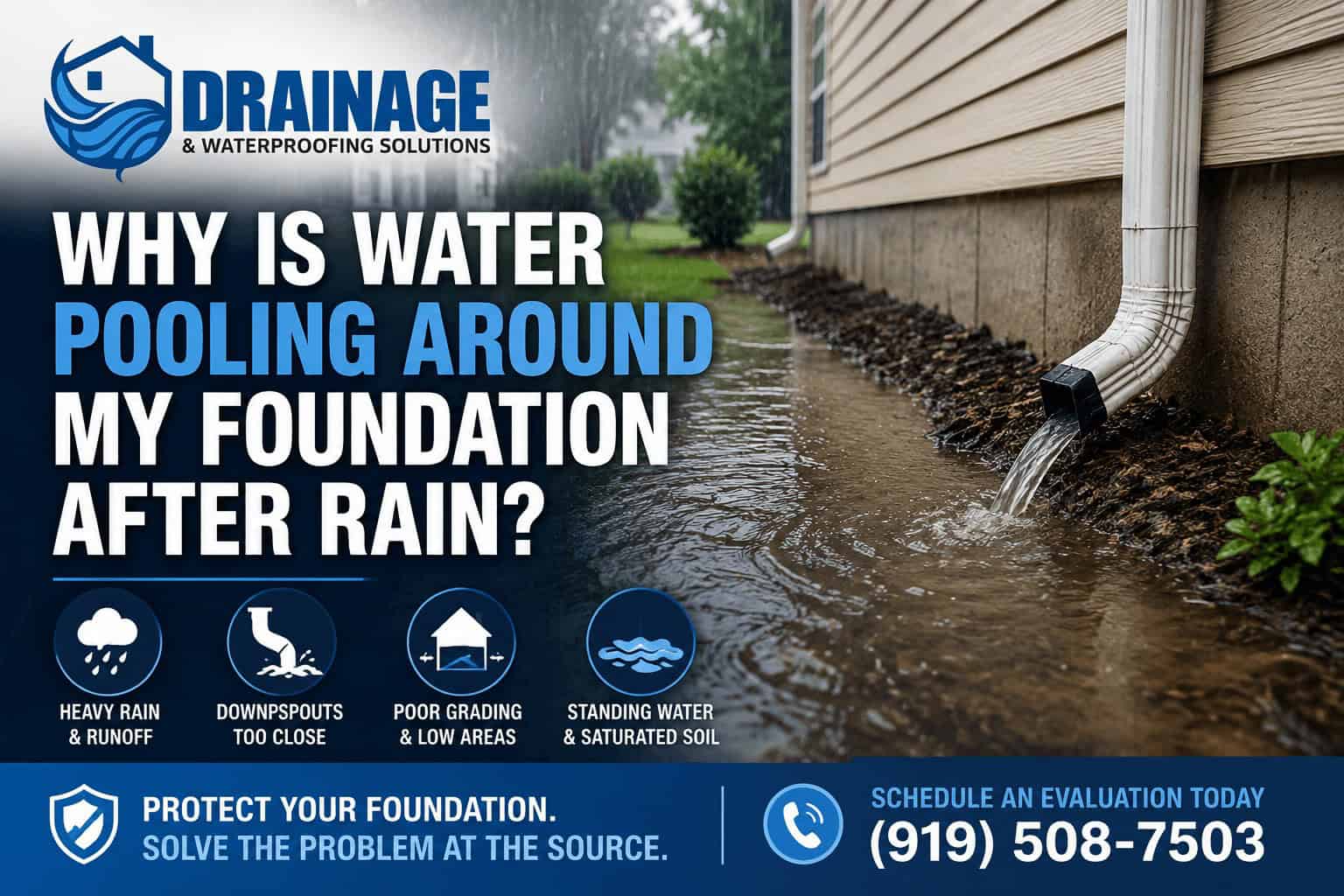
Why Is Water Pooling Around My Foundation After Rain?
Water pooling around your foundation after rain usually means runoff is reaching the house faster than the surrounding property can move it away. Common contributors include ground that slopes toward the home, concentrated roof runoff, downspouts discharging too close to the foundation, low areas beside the house, saturated soil, or a drainage system that is not moving water effectively.
The puddle itself does not prove that your foundation is damaged or that you automatically need foundation waterproofing.
The first step is understanding where the water is coming from, how it travels across the property, where it collects, and whether related moisture is appearing inside the basement or crawl space.
Drainage & Waterproofing Solutions LLC provides foundation waterproofing and drainage services for homeowners throughout Raleigh, Garner, Wake County, and other verified Central North Carolina service areas.
If water repeatedly collects beside your home after storms, you can request an evaluation so the property and water pathway can be reviewed before a solution is selected.
What Causes Water to Pool Around a Foundation?
Water collects around a foundation when rainfall or runoff reaches a low area near the house and does not have an effective path away.
Several conditions can contribute:
- Ground sloping toward the house
- Settled soil beside the foundation
- Short or poorly directed downspouts
- Concentrated roof runoff
- Low landscape beds
- Compacted or slow-draining soil
- Water arriving from an uphill area
- Patios or walkways directing runoff toward the house
- Existing drains that are obstructed or no longer performing effectively
- Repeated heavy rainfall saturating the surrounding ground
More than one factor can exist at the same property.
That is why the correct sequence is:
Symptom → possible causes → site evaluation → confirmed water path → appropriate drainage or waterproofing response.
Does Standing Water Mean My Foundation Is Failing?
No. Standing water beside a foundation does not by itself establish structural failure.
It is primarily a drainage symptom.
The concern becomes more significant when water returns repeatedly, remains beside the house for extended periods, causes erosion, or appears alongside basement or crawl-space moisture.
Foundation cracks, sloping floors, sticking doors, and visible movement also should not automatically be blamed on drainage without appropriate evaluation. Those conditions can have multiple causes.
If significant structural movement appears to be involved, an appropriately qualified structural or foundation professional may be needed.
Drainage & Waterproofing Solutions focuses on drainage, waterproofing, and moisture management rather than structural engineering.
How Can Poor Grading Cause Water to Collect Beside a House?
Grading describes the slope and shape of the ground around the property.
When the soil slopes away from the home, surface runoff has a natural path away from the foundation.
When the ground is flat, settled, or sloped toward the house, rain may instead collect along the foundation wall.
This can develop because of:
- Original site conditions
- Soil settlement
- Erosion
- Landscaping changes
- Mulch or planting-bed buildup
- Changes to patios or walkways
- Repeated foot or equipment traffic
- Soil compaction
NC State Extension recommends evaluating how water moves across a landscape and paying particular attention to poorly drained areas and low spots that remain wet after rainfall.
A drainage contractor should therefore look beyond the puddle itself and consider the surrounding elevation and water pathway.
Can Downspouts Cause Foundation Pooling?
Yes. A downspout concentrates roof runoff into a relatively small area.
If it discharges immediately beside the house or into a low area that slopes back toward the foundation, the soil can become saturated during rainfall.
Look at the affected area while it is raining from a safe location.
Ask:
- Where does the nearest downspout discharge?
- Does water move away from the house?
- Does it circle back toward the foundation?
- Does the discharge create erosion?
- Does water collect at the corner of the home?
- Does the surrounding grade trap the runoff?
The important issue is not simply how far a downspout extends. It is whether the discharged water reaches an appropriate drainage path rather than returning toward the structure.
What If My Gutters Overflow During Rain?
Gutter overflow can create a drainage problem even when the ground around the house is reasonably graded.
Water spilling over the edge of a gutter may fall directly beside the foundation instead of traveling through the intended downspout system.
Possible causes can include:
- Debris
- Obstructed outlets
- Damaged gutter sections
- Improper slope
- Disconnected components
- Rainfall exceeding the system's capacity
- Other roof-drainage defects
Drainage & Waterproofing Solutions is not a roofing or gutter-repair contractor.
If the water source appears to be a malfunctioning roof-drainage system, a qualified gutter or roofing professional may need to correct that problem first.
A French drain should not be installed simply to compensate for a roof-drainage defect without evaluating the original source.
Why Does the Soil Stay Wet Beside My Foundation?
Persistently wet soil can indicate that water is entering the area faster than it drains.
The underlying cause may involve:
- Surface runoff
- Soil characteristics
- Low elevation
- Repeated roof discharge
- Ground saturation
- Water arriving from an uphill portion of the property
- Existing subsurface drainage
- Several consecutive wet weather events
The location matters.
A small muddy patch directly below a downspout may have a very different cause from an entire side yard that remains saturated for days after a storm.
Broad or recurring saturation may justify a professional drainage-system inspection to evaluate how water moves across and beneath the property.
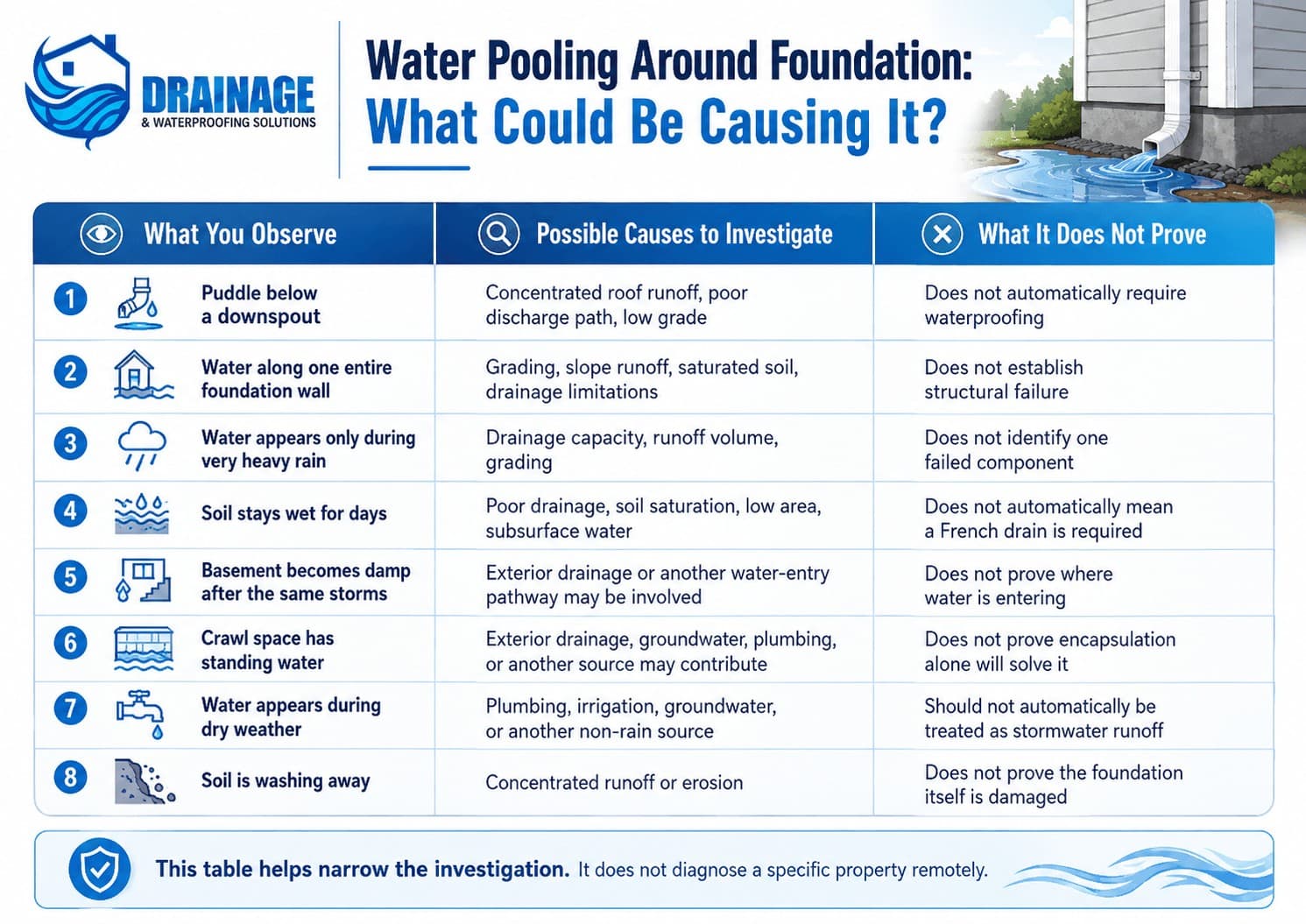
Water Pooling Around Foundation: What Could Be Causing It?
| What You Observe | Possible Causes to Investigate | What It Does Not Prove |
|---|---|---|
| Puddle below a downspout | Concentrated roof runoff, poor discharge path, low grade | Does not automatically require waterproofing |
| Water along one entire foundation wall | Grading, slope runoff, saturated soil, drainage limitations | Does not establish structural failure |
| Water appears only during very heavy rain | Drainage capacity, runoff volume, grading | Does not identify one failed component |
| Soil stays wet for days | Poor drainage, soil saturation, low area, subsurface water | Does not automatically mean a French drain is required |
| Basement becomes damp after the same storms | Exterior drainage or another water-entry pathway may be involved | Does not prove where water is entering |
| Crawl space has standing water | Exterior drainage, groundwater, plumbing, or another source may contribute | Does not prove encapsulation alone will solve it |
| Water appears during dry weather | Plumbing, irrigation, groundwater, or another non-rain source | Should not automatically be treated as stormwater runoff |
| Soil is washing away | Concentrated runoff or erosion | Does not prove the foundation itself is damaged |
The purpose of this table is to narrow the investigation—not diagnose a particular property remotely.
When Does Foundation Pooling Become More Concerning?
Recurring water deserves closer attention when one or more additional symptoms appear.
These may include:
- Basement seepage after rain
- Crawl-space standing water
- Persistent interior dampness
- White mineral residue on basement walls
- Soil erosion beside the home
- Water entering through wall or floor joints
- A sump system running frequently during storms
- Existing drainage that no longer appears to move water effectively
These symptoms still do not identify one specific solution.
For example, basement dampness after rain may involve exterior runoff, foundation-wall seepage, cracks, interior drainage, groundwater, or another pathway.
The appropriate solution depends on the confirmed source.
Can Water Pooling Outside Cause Basement Moisture?
Exterior water and basement moisture can be related, particularly when the soil around below-grade foundation walls remains saturated.
Water may approach a basement through several pathways, including:
- Foundation-wall cracks
- Wall-floor joints
- Porous masonry
- Openings around penetrations
- Areas where exterior drainage is inadequate
- Other construction joints or water pathways
Drainage & Waterproofing Solutions' basement moisture-control services address water and moisture conditions after the source and entry pattern are evaluated.
The important point is that seeing a puddle outside and moisture inside does not automatically reveal the exact pathway between them.
Both conditions should be considered together.
Can Foundation Pooling Affect a Crawl Space?
It can.
Water collecting around a crawl-space foundation may coincide with moisture beneath the home, but exterior pooling is only one possible contributor.
Crawl-space water can also involve:
- Ground moisture
- Exterior runoff
- Foundation drainage
- Plumbing leaks
- Groundwater
- Open vents and humid outdoor air
- Other water-entry pathways
If active water is entering the crawl space, that water source should be addressed as part of the moisture-management plan.
Drainage & Waterproofing Solutions provides crawl-space and basement waterproofing for properties where drainage and water intrusion require professional attention.
Encapsulation should not simply conceal unresolved active water entry.
Do I Need a French Drain?
Maybe, but foundation pooling alone is not enough information to make that decision.
A French drain may be considered when water needs to be intercepted and redirected through saturated soil or along a recurring drainage pathway.
It may be relevant when:
- A broad area remains soggy
- Water consistently moves across a slope toward the house
- Soil beside the foundation remains saturated
- Existing surface drainage cannot adequately handle the problem
- A defined subsurface drainage pathway is appropriate for the site
However, other conditions may call for a different response.
If a downspout is dumping roof runoff beside the house, fixing that discharge may be more direct.
If the grade slopes toward the house, the site elevation needs to be considered.
If water appears during dry weather, a drainage system designed for rainfall may not address the actual cause.
A French drain is a tool—not a universal answer.
Do I Need Foundation Waterproofing?
Foundation waterproofing may be appropriate when water is reaching or penetrating foundation components in a way that requires exterior or interior water-management measures.
Drainage & Waterproofing Solutions' foundation waterproofing service includes drainage and waterproofing approaches selected according to the problem being addressed.
But water pooling outside does not automatically mean a waterproof membrane, interior system, exterior excavation, or any particular waterproofing method is required.
The decision should follow the water pathway.
A homeowner may have:
- A yard-drainage problem without interior intrusion
- A basement-water problem without visible exterior pooling
- Both exterior drainage and interior moisture issues
- A roof-runoff problem
- A plumbing problem
- A combination of conditions
That is why diagnosis comes before system selection.
Drainage Problem or Waterproofing Problem?
| Condition | Drainage Evaluation | Waterproofing Evaluation |
|---|---|---|
| Standing water in yard | Often appropriate | Not automatically required |
| Water beside foundation after rain | Appropriate | Consider if interior moisture is also present |
| Basement wall seepage | Exterior drainage should be reviewed | Often appropriate to investigate |
| Crawl-space standing water | Drainage source should be evaluated | May be part of broader moisture-control plan |
| Downspout puddle only | Roof discharge and grading should be checked first | Usually not first assumption |
| Repeated saturated soil against below-grade wall | Appropriate | May also warrant waterproofing evaluation |
| Water from suspected plumbing leak | Not primarily a drainage solution | Contact a plumber |
Sometimes drainage and waterproofing are two parts of the same water-management plan.
Other times, correcting the exterior water pathway may be the primary need.
What Should I Check the Next Time It Rains?
One of the most useful things a homeowner can do is safely observe the property during or shortly after rainfall.
You do not need to diagnose the problem yourself. You are simply documenting the water pattern.
1. Watch Where the Water Starts
Does it come from:
- A downspout?
- An uphill lawn?
- A driveway?
- A patio?
- A neighboring grade?
- An overflowing gutter?
- An unknown source?
2. Watch Where It Travels
Does runoff move:
- Toward the house?
- Parallel to the foundation?
- Across a walkway?
- Into a low section of lawn?
- Toward an existing drain?
3. Look at Where It Stops
Does it form:
- One small puddle?
- A long saturated strip?
- A muddy foundation edge?
- A large wet side yard?
4. Check the Interior
After the storm, look at accessible basement or crawl-space areas.
Document:
- Dampness
- Seepage
- Wet flooring
- New stains
- Mineral residue
- Musty conditions
- Standing water
5. Take Photos or Video
Photos taken during active rainfall can show a water pathway that may no longer be obvious once the weather clears.
That information can make an on-site evaluation more useful.
How Long Does the Water Stay After Rain?
Duration is another useful clue.
A shallow puddle that disappears quickly after an unusually intense storm is different from an area that remains saturated long after the rest of the property has dried.
Document:
- When the rain stopped
- How large the wet area was
- Whether the area shrank
- Whether the soil remained soft
- Whether the same location floods repeatedly
- Whether interior moisture appeared at the same time
There is no universal number of hours that diagnoses a drainage failure.
The recurring pattern matters more than a single arbitrary threshold.
Who Should Evaluate Water Around a Foundation?
Not every water problem belongs to the same trade.
| What You Observe | Professional to Consider |
|---|---|
| Recurring yard or foundation pooling | Drainage/waterproofing contractor |
| Basement or crawl-space water after storms | Drainage/waterproofing contractor |
| Existing drainage system not performing | Drainage contractor |
| Gutter overflow or roof-drainage failure | Gutter/roofing professional |
| Water appearing during dry weather near plumbing | Licensed plumber |
| Wastewater odor or sewage | Appropriate plumbing/septic professional |
| Significant structural movement | Structural/foundation professional |
| Significant suspected mold contamination | Appropriate mold professional |
Drainage & Waterproofing Solutions does not need to be the answer to every water-related problem.
The right professional depends on the source.
What About Raleigh Stormwater From a Public Street?
Some Raleigh water problems involve public stormwater rather than a private residential drainage system.
The City of Raleigh maintains a Stormwater Drainage Assistance program for certain qualifying flooding and severe erosion conditions involving runoff from public streets or public property.
The City distinguishes these cases from many private-property concerns, including nuisance standing water, roof or gutter issues, private grading problems, landscaping conditions, and runoff originating from other private property.
If the water clearly originates from a public street or public drainage feature, it can be useful to review the City's eligibility criteria before assuming the entire problem must be addressed privately.
What Happens During a Professional Drainage Evaluation?
A good drainage evaluation should focus on the water pathway before selecting equipment or a system.
Relevant questions can include:
- When does the water appear?
- Where does it originate?
- Which direction does the property slope?
- Where do downspouts release roof water?
- Where does water collect?
- How long does the area remain wet?
- Are existing drains present?
- Where do existing drain lines discharge?
- Is moisture also present in a basement or crawl space?
- Is there an appropriate destination for redirected water?
Drainage & Waterproofing Solutions provides drainage-system inspections for homeowners who need help evaluating an existing drainage system and related components.
The goal is not to sell the same system to every property.
The goal is to understand the condition well enough to propose a solution that matches it.
What Solutions Might Be Considered?
The appropriate response depends on the confirmed cause.
Possible drainage or waterproofing approaches within the company's verified service scope may include:
- French drainage
- Foundation waterproofing
- Interior drainage
- Exterior drainage
- Sump-pump-related water management
- Crawl-space waterproofing
- Drainage-system repair or improvement
- Other site-specific drainage measures confirmed during evaluation
A solution should not be selected simply because one method is familiar.
If the problem is concentrated roof runoff: address how the roof water reaches and leaves the area.
If the soil slopes toward the house: grading and the overall surface-water pathway matter.
If a broad zone remains saturated: subsurface drainage may need evaluation.
If basement seepage occurs: exterior and interior water pathways may both need to be considered.
If the source is plumbing: call a plumber rather than installing stormwater drainage.
What Determines the Cost of Correcting Foundation Drainage?
The most accurate price requires a site evaluation because foundation-water and drainage projects vary substantially.
Factors can include:
- Water source
- Drainage route
- Excavation
- Drain length
- Foundation depth
- Soil and site conditions
- Property access
- Interior versus exterior work
- Sump requirements
- Materials
- Existing landscaping
- Restoration
- Discharge location
- Overall system complexity
A short drainage correction at one section of the property is not comparable to a deeper foundation-waterproofing project or a large drainage system crossing the yard.
Avoid relying on a generic internet price to determine what your particular property should cost.
First determine what the property actually needs.
What Should Raleigh and Garner Homeowners Do First?
If water repeatedly pools around your foundation, start with observation—not assumptions.
During the next rainfall:
- Watch the downspouts.
- Observe the property slope.
- Photograph the water path.
- Document where it pools.
- Check how long it remains.
- Look for related basement or crawl-space moisture.
- Note any existing drainage systems.
- Seek professional evaluation when the pattern continues or the source is unclear.
Do not assume that every puddle requires excavation.
Do not assume that visible water means the foundation is failing.
And do not assume that installing a French drain without understanding the source will necessarily solve the problem.
The appropriate drainage or waterproofing method depends on where the water originates, how it moves across or beneath the property, where it collects, and where it can be redirected.
Request a Drainage or Waterproofing Evaluation
If you are seeing water pooling around your foundation after rain in Raleigh, Garner, Wake County, or another verified Central North Carolina service area, Drainage & Waterproofing Solutions LLC can evaluate the drainage and moisture conditions affecting the property.
The right next step may involve drainage, foundation waterproofing, another water-management approach, or referral to another professional when the cause falls outside the company's scope.
Contact Drainage & Waterproofing Solutions to discuss what you are seeing and request an evaluation.
Frequently Asked Questions
Is water pooling around my foundation always a serious problem?
Not necessarily. One temporary puddle after unusually intense rain does not establish foundation damage. Repeated pooling, soil that remains saturated, erosion, or moisture appearing in the basement or crawl space deserves closer evaluation because those patterns suggest the property is not moving water away effectively.
Can poor grading cause water around my foundation?
Yes. Soil that is flat, settled, or sloped toward the house can direct surface runoff toward the foundation instead of away from it. Landscaping changes, erosion, settlement, and hard surfaces can all affect grading. The surrounding property should be evaluated rather than assuming a drain alone will correct the problem.
Will a French drain stop water from pooling beside my house?
It may help when the confirmed problem involves water moving through saturated soil or along a drainage pathway that a French drain can intercept. However, a French drain is not automatically the right solution for downspout discharge, gutter overflow, plumbing leaks, poor surface grading, or every other source of standing water.
Why does water pool beside my house only during heavy rain?
Heavy rainfall can reveal drainage limitations that are not obvious during lighter storms. The volume of runoff may exceed the capacity of the existing drainage path, saturate low areas, or expose grading and roof-discharge problems. Observing where the water starts and where it travels can help narrow the cause.
Does water around the foundation mean I need waterproofing?
No. Exterior pooling alone does not prove foundation waterproofing is required. The property may first need better surface drainage, roof-runoff management, subsurface drainage, or another correction. Waterproofing becomes more relevant when water is approaching or entering below-grade foundation components in a way that requires those measures.
Can foundation pooling cause crawl-space moisture?
Exterior drainage can contribute to crawl-space moisture, but it is only one possible source. Ground moisture, groundwater, plumbing, humid outside air, and other entry pathways may also contribute. Active water sources should be identified before assuming that encapsulation or another single system will solve the problem.
Should I call a drainage contractor or a plumber?
Call a drainage or waterproofing contractor when the water pattern clearly follows rainfall, yard runoff, foundation saturation, or an existing drainage system. A plumber may be more appropriate when water appears during dry weather, seems associated with supply or drain lines, or includes wastewater odors or backups.
What should I photograph before a drainage inspection?
Photograph the affected area during rainfall when it is safe, the nearest downspouts, the direction runoff travels, the deepest pooling areas, erosion, existing drains, and any basement or crawl-space moisture that appears after the same storm. These images can help show water pathways that disappear after the property dries.