
Homeowner Troubleshooting Guide
Why Is My Sump Pump Running Constantly? Causes, Risks, and Solutions for Raleigh-Area Homes
A sump pump that keeps running is usually responding to continuous water, a control problem, or water that is cycling back into the pit. During a major storm, a pump may run frequently and still be working normally. It becomes a warning sign when it never shuts off, restarts every few seconds, continues long after rain ends, or cannot keep the water level down.
For homeowners in Raleigh, Garner, Cary, Apex, Durham, Clayton, Fuquay-Varina, Holly Springs, Wake Forest, Fayetteville, Southern Pines, Wilson, and nearby Central North Carolina communities, the right fix depends on the entire water-management system—not only the pump. The sump pit, float switch, check valve, discharge line, foundation drainage, grading, gutters, soil, and groundwater conditions can all affect how often the pump runs.
Raleigh-Area GuidanceSafe Diagnostic StepsProfessional Solutions
The Short Answer
Quick Answer: Why Does a Sump Pump Keep Running?
A sump pump may keep running because water is entering the pit continuously, the float switch is stuck, the pump is too small or worn, the check valve is failing, or the discharge line is blocked or sending water back toward the foundation. Frequent operation during heavy rain can be normal if the pump lowers the water and shuts off between cycles. Continuous operation, rapid on-and-off cycling, unusual noise, overheating, or a rising pit level requires prompt attention.
Safety warning: If water is approaching the basement or crawl-space floor, the pump cannot keep up, or electrical equipment is exposed to water, stay out of the wet area and contact a qualified professional. Do not stand in water while touching the pump, plug, extension cord, outlet, or electrical panel.
Is It Normal for a Sump Pump to Run Constantly During Heavy Rain?
A sump pump may run for long periods during intense or prolonged rain because the drainage system is collecting water faster than usual. That does not automatically mean the pump has failed. The important questions are whether the pump lowers the water level, shuts off after the float drops, and discharges water safely away from the home.
In North Carolina, site conditions can keep water moving toward a foundation after the rain has stopped. N.C. Cooperative Extension notes that much of the subsoil in the Piedmont has high clay content. Clay-rich and compacted soil can move water slowly and remain wet for extended periods. That means a correctly operating pump may continue cycling while saturated soil drains.
However, a pump that truly never shuts off should not be dismissed as normal storm behavior. Continuous operation can shorten equipment life and may indicate that the system is recirculating the same water, receiving more water than it can manage, or failing to recognize that the pit has emptied.
| What You Observe | What It May Mean | Recommended Response |
|---|---|---|
| Long cycles only during heavy rain | High but temporary water inflow | Monitor the pit level and discharge outlet |
| Pump runs continuously and the water level falls | Stuck float, incorrect switch position, or control problem | Arrange inspection before the motor is overworked |
| Pump runs continuously but the water level rises | Insufficient capacity, blockage, pump wear, or extreme inflow | Treat as urgent because flooding may occur |
| Pump starts and stops every few seconds | Short cycling, water returning through the line, or a small pit | Have the check valve, float, pit, and discharge reviewed |
| Pump keeps running after dry weather returns | Persistent groundwater, recirculation, or mechanical fault | Schedule a full drainage-system inspection |
| Pump hums but little or no water leaves | Obstruction, damaged impeller, air lock, or failing pump | Stop relying on the pump and request prompt service |
What Does the Sump Pump’s Running Pattern Tell You?
The phrase “running constantly” can describe several different behaviors. Identifying the pattern helps narrow the cause and allows a contractor to inspect the right components first.
The Pump Never Shuts Off
If the pit is nearly empty but the motor continues running, the float or switch may be stuck in the on position. The switch can also be obstructed by the pit wall, piping, wiring, or debris. A pump that runs dry can overheat and wear prematurely, so this pattern deserves quick attention.
The Pump Runs for a Long Time While Water Keeps Entering
Continuous inflow may come from saturated soil, a high seasonal water table, poorly controlled roof runoff, negative grading, a leaking water line, or drainage directed toward the home. In this situation, the pump may be functioning correctly but handling a larger water problem that begins outside the pit.
The Pump Starts and Stops Rapidly
Rapid cycling is different from continuous operation. It can happen when discharged water flows backward into the pit after each cycle, the float has too little travel, the sump basin is too small for the inflow, or the discharge outlet sends water back toward the foundation. The motor experiences repeated starts, which can increase wear.
The Pump Runs but Cannot Lower the Water
This is the most urgent pattern. The pump may be undersized for the inflow, partially blocked, worn, improperly installed, or restricted by the discharge line. If the level continues rising, stored belongings and finished materials should be moved only when it is safe to do so. Avoid entering standing water where electrical hazards may be present.
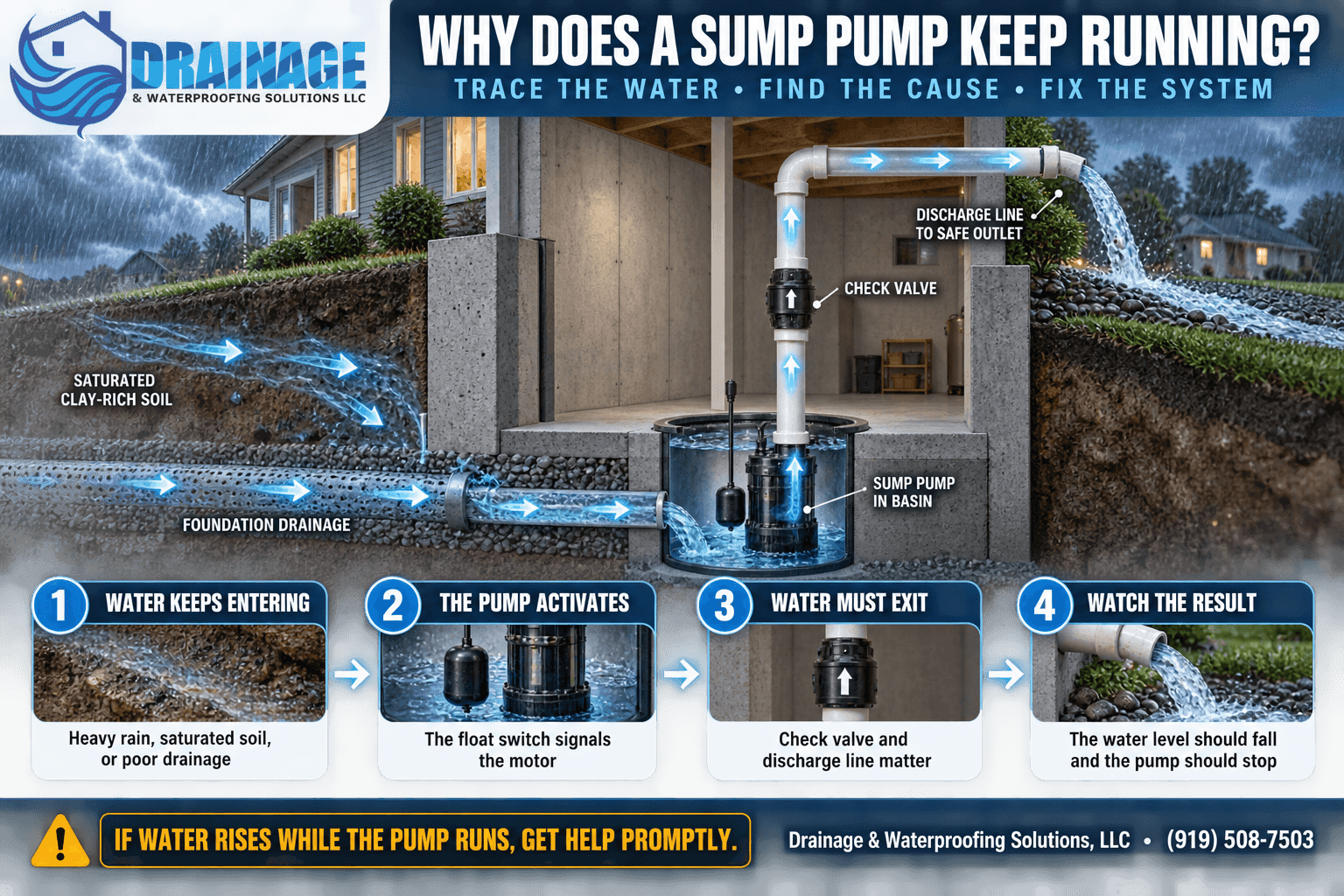
Eight Common Reasons a Sump Pump Keeps Running
1. Heavy Rain or Saturated Ground Is Sending in More Water
A perimeter drain or internal drainage system collects water and directs it to the sump basin. During prolonged rain, that system may deliver a steady flow. The pump must continue working until inflow slows. This can be expected temporarily, but it also reveals how dependent the home is on the pump during storms.
If the pump previously cycled normally but suddenly runs nonstop during ordinary rain, something may have changed. Soil settlement, clogged surface drainage, altered landscaping, a disconnected downspout, nearby construction, or a restricted discharge route can increase the amount of water reaching the foundation.
2. The Float Switch Is Stuck or Poorly Positioned
The float switch tells the pump when to start and stop. If the float catches on the basin wall, pump housing, pipe, cable, or debris, the motor may remain on after the water has dropped. A switch can also fail internally or be installed with too little clearance.
Do not reach into a wet sump pit while the unit is energized. A technician can disconnect power safely, confirm that the float moves through its intended range, test activation and shutoff levels, and determine whether repositioning or replacement is appropriate.
3. The Check Valve Is Missing, Reversed, or Failing
A check valve is designed to keep water in the discharge pipe from flowing back into the sump basin after the pump stops. If it does not close correctly, the pump may remove water, shut off, receive the same water again, and restart. Homeowners often hear water rushing or thumping back toward the pit when this happens.
Backflow can create short cycling and unnecessary wear even when the pump itself is in good condition. The valve type, direction, location, connections, and discharge configuration should be reviewed together.
4. The Discharge Line Is Blocked or Restricted
A crushed, clogged, disconnected, poorly sloped, or obstructed discharge line can limit flow. Debris, sediment, roots, damaged fittings, or a blocked termination point may prevent water from leaving at the intended rate. In cold conditions, exposed sections can also freeze.
The symptom may be a pump that runs longer, sounds strained, or moves little water at the outlet. A blocked line can also cause leaks at fittings or send water back toward the pit. Because hidden discharge piping can be difficult to evaluate, a professional inspection may be needed.
5. Discharged Water Is Returning to the Foundation
The pump may be moving water correctly but releasing it where the water can drain back toward the house. This creates a loop: water leaves the sump, saturates soil beside the foundation, enters the drainage system again, and returns to the pit.
The correct discharge location depends on the lot, slope, soil, system design, neighboring property, and local requirements. Water should not be redirected in a way that creates erosion, icing, nuisance runoff, or a problem on another property. A drainage professional can evaluate a safe route rather than selecting an arbitrary extension distance.
6. The Pump Is Too Small, Worn, or Damaged
Pump capacity must match the vertical lift, pipe size, fittings, discharge distance, and water volume. A pump that is too small for the system may run almost continuously during conditions a properly selected unit could manage in normal cycles. A worn impeller or aging motor may also reduce real-world performance.
Bigger is not automatically better. An oversized pump can empty a small basin very quickly and cycle too often. Proper selection requires system measurements rather than choosing equipment by horsepower alone.
7. The Sump Basin or Drainage Layout Is Contributing to Short Cycling
A small basin fills quickly and gives the pump less time between cycles. A float with limited movement can produce the same behavior. If the inlet pipes, pump, switch, and basin do not work as a coordinated system, repeated cycling may continue even after individual parts are replaced.
The inspection should consider the usable basin volume, inlet elevation, pump placement, float travel, accumulated sediment, cover, and connection to the surrounding drainage system.
8. A Plumbing Leak or Other Water Source Is Feeding the Pit
Not all continuous water is stormwater or groundwater. A leaking supply line, irrigation problem, water-heater discharge, condensate route, or other source may contribute to unexpected inflow. One clue is a pump that continues running through dry weather when it previously became quiet.
A drainage contractor can evaluate the waterproofing system, but a suspected plumbing leak may require a licensed plumber. The goal is to identify the source before replacing equipment that is merely responding to the water.
What Can Happen If a Sump Pump Runs Nonstop?
A sump pump is designed to move water, but continuous operation can expose weaknesses in the system. The immediate concern is not simply the electric bill. The larger risk is losing pumping capacity while water is still entering the home.
- Motor wear or overheating: A unit that cannot rest may fail sooner, especially if it runs with little water around it.
- Basement or crawl-space flooding: If the pump fails while inflow remains high, the basin can overflow.
- Rapid cycling damage: Repeated starts can stress the switch and motor.
- Hidden discharge problems: A leak or blockage may release water where it is not visible.
- Recurring moisture: Persistent water can contribute to damp materials, odors, elevated humidity, and conditions that support microbial growth.
- False confidence: Motor noise does not prove that water is leaving the property effectively.
The U.S. Environmental Protection Agency’s moisture-control guidance emphasizes managing how water enters and moves through buildings, including site drainage and foundations. A pump is one component of that broader moisture-control strategy; it cannot compensate indefinitely for every exterior drainage or waterproofing defect.
What Can a Homeowner Safely Check?
You do not need to dismantle the pump to collect useful information. A few observations can help determine urgency and give the contractor a clearer starting point.
- Observe the water level from a dry location. Is it falling, stable, or rising while the pump runs?
- Time the cycles. Record how long the pump runs and how quickly it restarts.
- Note the weather. Did the behavior begin during heavy rain, after the rain, or during dry conditions?
- Listen for changes. Grinding, humming, rattling, gurgling, or repeated thumping can help locate a problem.
- Look at the discharge outlet from a safe exterior location. Confirm whether water is flowing and whether it is pooling near the foundation.
- Check visible gutters and downspouts. Overflowing gutters or disconnected extensions can concentrate roof water beside the home.
- Photograph or record the condition. Water patterns may disappear before the appointment.
- Check the backup system indicator if one is installed. Follow the manufacturer’s instructions without opening energized equipment.
What Should You Avoid?
- Do not stand in water while touching electrical equipment.
- Do not remove covers or reach into the pit while the pump is energized.
- Do not repeatedly unplug a pump when water is actively rising.
- Do not assume a silent pump is safe if the pit level is high.
- Do not permanently reroute discharge water onto a neighbor’s property or into an unapproved connection.
- Do not replace the pump before checking the switch, valve, discharge route, and water source.
If you are unsure whether the basement is electrically safe, remain outside the affected area and contact an appropriate emergency or electrical professional. Once immediate hazards are controlled, the drainage and waterproofing system can be evaluated.
Professional Diagnostic Framework
What Should a Professional Sump-Pump and Drainage Inspection Include?
A useful inspection should determine both why the pump is operating and whether the water is leaving safely. Replacing the pump without examining the surrounding system can leave the original problem unresolved.
| Component | What Should Be Evaluated | Why It Matters |
|---|---|---|
| Pump | Operation, capacity, sound, wear, impeller performance, and installation | Confirms whether the unit can move the incoming water |
| Float or switch | Clearance, activation level, shutoff level, and freedom of movement | Determines whether the pump receives correct start and stop signals |
| Sump basin | Size, sediment, cover, pump position, inlet locations, and usable volume | Reveals causes of short cycling and restricted operation |
| Check valve | Direction, sealing, condition, placement, and backflow | Prevents discharged water from returning to the pit |
| Discharge piping | Leaks, blockages, slope, fittings, termination, and visible damage | Confirms that water can leave without recirculating |
| Interior drainage | Flow, clogs, connections, and signs of perimeter seepage | Shows how water reaches the sump and whether drainage is working |
| Exterior water management | Grading, downspouts, low areas, soil saturation, and foundation-adjacent pooling | Identifies water sources that may be overloading the pump |
| Backup protection | Battery condition, backup activation, alarm, and maintenance status when present | Supports protection during outages or primary-pump failure |
Inspection support for installed systemsDrainage & Waterproofing Solutions, LLC offers drainage system inspections for internal drain systems the company installs. The website lists six-month and yearly inspections and identifies the internal drain system, sump pump, and dehumidifier with filter change as inspection components. Homeowners with a different system or an active water emergency should describe the equipment and condition when calling so the appropriate next step can be discussed.
Match the Cause to the Fix
How Is the Right Solution Chosen?
The correct repair depends on the diagnosed cause. A constantly running pump is a symptom, not a complete diagnosis.
| Confirmed Problem | Potential Solution | Important Limitation |
|---|---|---|
| Stuck or failed float switch | Clear interference, reposition, or replace the correct component | The pump and pit layout should still be tested afterward |
| Backflow through discharge pipe | Correct or replace the check valve and review piping | Exterior recirculation may also be present |
| Blocked or damaged discharge line | Clear, repair, or reroute the line as appropriate | The outlet must release water safely and lawfully |
| Pump cannot meet measured demand | Select a properly sized replacement based on the system | Horsepower alone does not determine correct capacity |
| Small basin or restricted float travel | Correct the pit, switch, or system layout | Changing only the pump may not stop short cycling |
| Exterior water loading | Correct grading, roof runoff, surface drainage, or foundation drainage | The solution must fit the property rather than use one generic drain |
| Foundation or basement water intrusion | Design a coordinated drainage and waterproofing plan | Coatings alone may not address water pressure or entry paths |
Does a Constantly Running Pump Mean You Need a New Pump?
No. A new pump will not correct a stuck installation layout, a failed check valve elsewhere in the line, an obstructed discharge, or water released beside the foundation. Replacement is appropriate when testing shows that the existing unit is damaged, unreliable, improperly sized, or near the end of its serviceable life. Diagnosis should come first whenever conditions allow.
Would a Second or Backup Pump Help?
A backup system may provide important protection during power loss, primary-pump failure, or unusually high water inflow, but it does not replace correction of the underlying problem. The existing pit, power source, discharge capacity, alarm, and maintenance plan should be considered. Read the company’s guide to whether a basement needs a sump pump for a broader explanation of system selection.
Could Exterior Drainage Reduce Pump Demand?
Sometimes. If roof runoff, surface water, or foundation-adjacent pooling is driving the inflow, improving exterior water management may reduce the amount reaching the interior system. The solution could involve grading, downspout management, surface collection, a properly designed French drain, or another site-specific approach. Interior and exterior systems should be planned together so one does not undermine the other.
Why Raleigh-Area Soil and Drainage Conditions Matter
Central North Carolina homes do not all experience water in the same way. Lot elevation, construction disturbance, fill soil, slope, drainage routes, and foundation type can create very different conditions even within the same neighborhood.
N.C. Cooperative Extension explains that high-clay Piedmont subsoil tends to move water slowly and may stay wet for long periods. Construction compaction can reduce water movement further. Around a home, these conditions can contribute to prolonged soil saturation and increased drainage demand after storms. This does not prove that every Raleigh-area property has a clay-related sump problem, but it is an important local factor to evaluate.
Water pooling beside the home is another clue. If you see foundation-adjacent standing water, review the guide to water pooling around a foundation after rain. When water is entering through basement surfaces or joints, a broader crawl-space and basement waterproofing assessment may be more appropriate than treating the pump alone.
How Can You Reduce the Chance of Future Sump-Pump Problems?
Preventive maintenance cannot eliminate every storm or equipment failure, but it can reveal vulnerabilities before the basement depends on the pump most.
- Observe normal cycle length so changes are easier to recognize.
- Keep safe access to the sump basin and do not bury it behind stored items.
- Have the pump, float, check valve, and discharge route inspected periodically.
- Keep gutters and downspouts functioning and watch for roof water beside the foundation.
- Look for new low spots, erosion, or settlement around the home.
- Confirm that the exterior discharge area remains open and does not return water to the house.
- Follow the manufacturer’s maintenance instructions for the primary and backup equipment.
- Test alarms and backup power on the recommended schedule when installed.
- Schedule an inspection before severe weather if the system has shown warning signs.
- Address basement or crawl-space moisture as a system rather than relying on one device.
FEMA advises homeowners to maintain sump pumps, and the EPA emphasizes ongoing inspection and maintenance as part of building moisture control. Preventive checks are especially important when the basement is finished, valuable items are stored below grade, or the home has a history of water entry.
When Should You Call for Help?
Request prompt professional help if the water level is rising, the pump cannot remove water, the motor will not stop, the unit smells hot, the breaker trips, the discharge has little flow, or water is appearing elsewhere in the basement or crawl space. Those signs can indicate that the home is losing protection while water is still entering.
A non-emergency inspection is appropriate when the pump cycles more often than before, continues well after rain, makes new sounds, sends water back toward the foundation, or has not been checked recently. Early diagnosis can distinguish a simple control problem from a larger drainage or waterproofing issue.
Drainage & Waterproofing Solutions, LLC is locally owned and family operated, with more than 20 years of experience stated on the company website.
Frequently Asked Questions About Sump Pumps That Keep Running
How long should a sump pump run after heavy rain?
There is no universal number of minutes because run time depends on rainfall, soil saturation, groundwater, pit size, pump capacity, and the drainage system. A pump may cycle for hours after prolonged rain if water is still entering. It should normally lower the pit level and shut off between cycles. If it never stops, cannot lower the water, or continues through dry weather, arrange an inspection.
Is it bad for a sump pump to run continuously?
Continuous operation can increase wear and may lead to overheating or failure, particularly if the pit is nearly empty. It can also indicate that the pump is overwhelmed or that discharged water is returning. A long cycle during exceptional rain is not automatically a defect, but nonstop operation should be investigated before the system fails while water is still entering.
Why does my sump pump run every few minutes when it is not raining?
Water may still be draining through saturated soil after a storm, especially where clay-rich or compacted soil slows movement. Other possibilities include a high water table, leaking plumbing, irrigation, check-valve backflow, or discharge water returning to the foundation. Record the weather and cycle timing, then have the source and complete discharge route evaluated if the pattern continues.
Why does my sump pump turn on and off every few seconds?
This is called short cycling. Common causes include a failed or missing check valve, a small sump basin, limited float travel, an incorrectly positioned switch, or water flowing back from the discharge pipe. Short cycling creates repeated motor starts and may shorten equipment life. The pump, float, basin, valve, and discharge line should be evaluated as one system.
Can a stuck float make a sump pump run nonstop?
Yes. If the float is trapped against the pit wall, piping, wiring, debris, or the pump itself, it may remain in the on position after the water drops. The switch can also fail internally. Do not reach into a wet energized pit. A technician can disconnect power safely, test float movement and switching, and correct the cause.
Can a clogged discharge line cause constant sump-pump operation?
Yes. A blocked, crushed, frozen, or poorly routed discharge line can reduce the amount of water leaving the pit. The pump may run longer or continuously while the level falls slowly or rises. Little flow at the outlet, new pump sounds, leaks, or water returning toward the house are warning signs that the discharge route needs inspection.
Does a constantly running sump pump always need replacement?
No. The cause may be a stuck float, failed check valve, blocked discharge line, small basin, exterior drainage problem, or unusually high inflow. Replacing the pump alone will not correct those conditions. Replacement makes sense when testing confirms that the unit is damaged, unreliable, incorrectly sized, or no longer delivering the capacity the system needs.
Should I unplug a sump pump that will not stop?
Do not unplug it if water is actively rising unless a qualified professional directs you and the area is electrically safe. Removing power can allow the pit to overflow. If the pit is nearly empty and the motor continues running, treat it as a service issue, avoid contact with wet electrical equipment, and obtain prompt guidance from a drainage, electrical, or emergency professional as appropriate.
Can poor yard drainage make a sump pump run more often?
Yes. Negative grading, foundation-adjacent pooling, overflowing gutters, poorly routed downspouts, and saturated soil can increase the amount of water reaching foundation drainage. The pump may be responding correctly to an exterior problem. A complete inspection should examine the yard, roof runoff, foundation perimeter, interior drainage, sump basin, and discharge outlet before selecting a solution.
Who should inspect a constantly running sump pump in Raleigh, NC?
A drainage and waterproofing professional should evaluate the sump pump together with the basin, float switch, check valve, discharge line, interior drainage, and exterior water conditions. Drainage & Waterproofing Solutions, LLC serves Raleigh and surrounding Central North Carolina communities. Call (919) 508-7503 to describe the symptoms and ask which inspection or service is appropriate.
Sources and Evidence
- U.S. Environmental Protection Agency: Moisture Control Guidance for Building Design, Construction and Maintenance
- Federal Emergency Management Agency: Maintain Your Sump Pump
- N.C. Cooperative Extension: Modifying Soil for Plant Growth Around Your Home
- Drainage & Waterproofing Solutions, LLC: Drainage System Inspections
Evidence status: Reviewed September 20, 2026. This article provides general educational information. Pump capacity, electrical safety, drainage design, discharge requirements, and repair recommendations depend on the equipment, property, water source, site conditions, and applicable local rules. An on-site evaluation is necessary for a property-specific diagnosis.