
Sump Pump Discharge Too Close to House? Why Water Returns & How to Fix It
Sump pump discharge that empties too close to your house can undermine the purpose of an otherwise functioning basement drainage system. Instead of moving collected water away from the foundation, the outlet may release it where the ground slopes back toward the home, allowing water to pool, soak into nearby soil, or potentially return to the drainage system.
This can happen even when the sump pump itself turns on correctly and moves water through the pipe. A functioning pump does not automatically mean the discharge route is working properly.
This guide explains how sump pump discharge systems work, why water sometimes returns toward the foundation, how to recognize recirculation and outlet restrictions, which repairs may help, and how to plan a safer discharge location for a North Carolina home.
Can Sump Pump Discharge Too Close to a House Cause Water to Return?
Yes. Sump pump discharge can contribute to water returning toward a foundation when the outlet releases water where grading, soil conditions, or drainage pathways allow it to move back toward the house. This may increase local soil saturation and, in some conditions, contribute to water re-entering the foundation drainage system.
Potential solutions include moving the outlet to an appropriate location, correcting the discharge route, repairing a blocked or damaged line, improving surface grading, or installing a suitable drainage outlet. There is no universal discharge distance that guarantees water will move away from every house. Site conditions and applicable local rules determine the appropriate solution.
How Is a Sump Pump Discharge System Supposed to Work?
A sump pump removes water collected in a sump basin, commonly located in the lowest part of a basement or crawl-space drainage system. Water may reach the basin through interior perimeter drains, other collection components, or site-specific pathways.
When the water reaches the pump's operating level, the float switch or another control activates the pump. The pump pushes water through the discharge piping toward an outlet outside the building.
That outlet must release water in a manner that does not simply create another drainage problem beside the foundation.
Collection
Water enters the sump basin from the designed drainage or collection system.
Pumping
The pump activates and pushes collected water into the discharge line.
Discharge
Water travels through the line toward a suitable discharge point away from vulnerable areas.
A complete sump pump installation involves more than choosing the pump itself. Discharge piping, fittings, elevation, flow resistance, controls, check-valve configuration, and the receiving outlet all affect how the system performs.
For homeowners trying to determine whether they need a pump in the first place, the company's existing Do I Need a Sump Pump? guide explains system selection. This article focuses specifically on the discharge route of an existing sump pump.
Four Stages of Effective Sump Pump Discharge
Foundation drainage directs water toward the sump basin.
The pump starts when the basin reaches its operating level.
The discharge line transports water toward the outlet.
Water leaves through an appropriate route without being directed back.
The critical distinction: A sump pump may perform the first three stages successfully while the fourth stage remains defective. The pump can move water efficiently, yet the outlet may still release it in the wrong place.
What Is the Difference Between the Discharge Pipe and the Outlet?
The discharge pipe transports water from the pump. The outlet is where that water leaves the system.
A pipe can be properly connected to a working pump while the outlet is located too close to the house, blocked by landscaping, or discharging into an unsuitable low area.
For this reason, a discharge inspection should evaluate the whole route rather than checking only the pipe attached to the pump.
Seven Reasons Sump Pump Discharge Water Returns Toward a House
Several different problems can produce standing water beside the foundation. The outlet may be poorly positioned, the line may be restricted, or the property may direct water back toward the home after discharge.
Discharge Outlet Located Too Close to the Foundation
An outlet that empties directly beside a basement wall can concentrate a substantial amount of pumped water into a small area of soil.
If the soil does not absorb and redistribute the water adequately, the area may become saturated. Water may remain on the surface or move through nearby soil.
Depending on the foundation drainage arrangement, some of that water may eventually return toward the same collection system that the pump is trying to empty.
The appropriate correction depends on ground slope, soil conditions, discharge volume, nearby openings, and a suitable destination. Simply extending the pipe a short distance without checking these factors may not resolve the issue.
Yard Grading Slopes Back Toward the House
Even when a discharge outlet is located some distance away, water may travel back toward the foundation if the surrounding ground slopes in that direction.
Low spots, settled backfill, raised landscaping beds, walkway edges, and changes from previous construction can redirect runoff.
A discharge line can therefore appear long enough while still releasing water into an area that drains toward the house.
Correcting this condition may require improved surface grading, a different discharge location, or another planned drainage route.
Blocked or Buried Discharge Outlet
An outlet may become obstructed by leaves, mulch, soil, grass growth, roots, or accumulated sediment.
Landscape work can also bury or cover an outlet that was previously visible.
When the discharge path is restricted, the pump may move less water than expected. Depending on the severity, water may back up in the line or the pump may struggle to empty the basin.
A blocked outlet is different from an outlet that is simply too close to the house. The first problem involves flow restriction; the second involves the destination of the released water.
Underground Discharge Pipe Is Damaged or Improperly Routed
Buried discharge piping may develop cracks, disconnected joints, crushed sections, or other defects.
Poor support, settlement, root activity, external loading, and inappropriate pipe materials may contribute to damage.
A damaged underground line can release water before it reaches the intended outlet, causing localized wet soil or recurring surface pooling.
A line that retains water in low sections may also have increased exposure to sediment accumulation or freezing where temperatures allow.
Repairs should be based on the actual pipe layout and the location of the defect.
Water Re-Enters the Same Foundation Drainage System
Recirculation occurs when some of the discharged water returns to the collection system and is pumped again.
This can happen when the outlet releases water into soil or surface drainage that leads back toward the home's foundation.
The amount that returns depends on the soil, grading, drainage connections, water volume, and site conditions.
Recirculation can increase pump activity, but frequent cycling by itself does not prove this is happening. A defective check valve, small basin, high inflow, or control problem can produce similar symptoms.
Frozen or Partially Frozen Discharge Line
During freezing weather, water retained in exposed or poorly drained sections of the discharge line may freeze and restrict flow.
An underground pipe near the surface or an outlet where water accumulates may also be vulnerable under certain conditions.
A frozen line can prevent the pump from discharging normally, even when the motor and float switch are functioning.
Freeze prevention depends on the local climate, pipe routing, burial conditions, drainage, and the manufacturer's installation requirements.
Do not use open flames, unsafe electrical heaters, or excessive force to thaw drainage piping.
Outlet Discharges Into an Overloaded or Unsuitable Drainage Area
A sump discharge outlet may be located away from the immediate foundation but still empty into a depression, saturated area, or drainage system that cannot receive additional water at that time.
Where downstream conditions restrict discharge, water may back up or accumulate around the outlet.
A connection to an existing drainage line also needs to be evaluated for capacity, backflow potential, maintenance access, and applicable rules.
The solution may involve outlet correction, drainage redesign, or rerouting water to a more appropriate destination.
How Can You Tell if Your Sump Pump Discharge Is Causing Problems?
The most useful clues involve where water appears, when the pump runs, and how the water moves after leaving the outlet.
| What You Notice | Possible Explanation | Recommended Investigation |
|---|---|---|
| Water pools beside the foundation after pumping | Discharge too close, negative grading, or low ground near outlet | Observe outlet location and runoff direction |
| Pump runs frequently after rain ends | Continuing groundwater inflow, recirculation, check-valve issue, or controls | Review basin, discharge and cycling pattern |
| Little water exits while the pump operates | Pipe restriction, leak, frozen line, or pump problem | Inspect discharge route and pump performance |
| Wet soil appears along buried pipe route | Possible underground leak or another moisture source | Investigate pipe integrity and nearby drainage |
| Water flows across a walkway or driveway | Unsuitable outlet location or grading | Evaluate rerouting and safety concerns |
| Erosion develops near outlet | Concentrated discharge or unsuitable outlet protection | Assess flow and erosion control |
| Basement seepage returns during storms | Insufficient drainage, pump failure, discharge issues, or another water pathway | Evaluate complete water-management system |
| Outlet freezes during cold weather | Water retained in vulnerable pipe sections | Check line routing and freeze exposure |
Can the Sump Pump Work Normally While the Discharge Is Wrong?
Yes. The pump may start, move water through the connected piping, and stop after lowering the basin water level.
If the outlet discharges into an area that returns water toward the foundation, the pump may still be functioning mechanically.
This is why discharge placement and surface drainage should be evaluated separately from motor operation.
One Symptom Is Not a Diagnosis
Frequent sump pump cycling does not automatically prove water recirculation. Standing water near an outlet does not automatically mean a foundation leak has occurred. A reliable assessment combines pump behavior, outlet location, water pathways, soil conditions, and the existing drainage design.
What Is Sump Pump Water Recirculation, and Why Does It Matter?
Sump pump recirculation is the repeated movement of some water from the discharge outlet back into the drainage or collection system.
A properly operating sump pump removes water from the collection basin. However, if discharged water travels back toward the foundation, some of it may enter the same drainage network again.
The result can be additional pump operation without effectively moving all the water away from the vulnerable area.
How Water Can Return to the Same Sump System
Groundwater or seepage enters the foundation drainage system.
Water is pumped through the discharge pipe.
Water is released where it can migrate toward the foundation.
Some water may re-enter the collection system and be pumped again.
This is a possible hydraulic pathway, not something that can be confirmed by hearing a pump run. Site-specific observations and inspection are needed to establish whether recirculation is occurring.
Is Short Cycling the Same as Recirculation?
No. Short cycling generally describes a pump turning on and off repeatedly over short intervals.
It can result from a defective or missing check valve, an incorrectly positioned float switch, a small sump basin, high inflow, an oversized pump relative to the basin, or other system conditions.
Recirculation can contribute to repeated pumping, but it is only one possible explanation.
What Does a Check Valve Do?
A check valve is designed to limit water flowing backward through the discharge pipe toward the sump basin after the pump stops.
It does not prevent water that was released outside from moving through the yard or soil back toward the foundation.
Therefore, replacing a check valve will not correct an exterior discharge outlet that releases water in the wrong location.
How Can You Identify a Sump Pump Discharge Problem?
The safest initial assessment focuses on visible water movement, the pump's operating pattern, and known discharge components.
Homeowners do not need to excavate piping or open electrical equipment to collect useful information for a professional.
Locate the Outlet
Identify where the discharge line ends, when safely visible.
Observe Water Flow
Check whether pumped water flows away from or toward the house.
Review Ground Slope
Look for low spots, settled soil, or grading toward the foundation.
Document Cycling
Note when the pump starts and stops during and after rain.
Check Visible Damage
Observe accessible piping for disconnections, leaks, or damaged fittings.
Record Recent Changes
Note landscaping, pipe work, soil settlement, or outlet changes.
Why Is the Outlet Location Important?
The outlet determines where the pumped water enters the surrounding drainage environment.
An outlet may be positioned several feet away but still empty into a low area that directs water back toward the structure.
Conversely, the appropriate distance for another property may be different because its grade, soil, drainage network, and discharge opportunities are different.
What if the Discharge Pipe Is Buried?
A buried line should not be excavated based solely on a wet patch or an assumed pipe route.
The location of the actual discharge should be established where possible, and underground utilities must be appropriately located before digging.
A qualified contractor may use suitable testing or inspection methods to identify restrictions, damage, or an unsuitable outlet.
Does a Discharge Problem Always Require a New Pump?
No. If the pump is functioning correctly, the correction may involve outlet relocation, line repair, grading, or another drainage measure.
Replacing the pump without addressing an inappropriate discharge route may leave the exterior water problem unchanged.
What Should You Do if Sump Pump Discharge Is Flooding Near Your House?
If water is accumulating beside the foundation or entering the basement, prioritize safe observation and professional assistance.
Do not enter standing water where electrical equipment may be energized. Avoid touching wet outlets, cords, appliances, or electrical panels.
Do not disconnect a sump pump during an active water intrusion event unless a qualified person has determined the appropriate safe action.
Never attempt underground excavation near utilities without proper utility locating. Do not use open flames to thaw frozen discharge piping.
Safer Initial Actions
- Observe the outlet from safe ground.
- Photograph discharge water and pooling.
- Document when the pump operates.
- Keep children away from flooded areas.
- Move unaffected belongings when safe.
- Request help when water enters living space.
Avoid These Actions
- Handling electrical equipment in water.
- Cutting or disconnecting unknown piping.
- Digging near unlocated utilities.
- Connecting discharge to an unidentified sewer.
- Directing water onto a neighboring property.
- Forcing tools through a frozen or damaged pipe.
What if the Sump Pump Is Running but No Water Comes Out?
A pump that appears to operate without visible discharge may have a blocked line, frozen pipe, damaged connection, air-lock issue, internal pump defect, or another mechanical problem.
It may also discharge through an outlet that is not readily visible.
If the basin continues filling, basement water is rising, or the pump is making unusual noises, arrange prompt professional evaluation rather than repeatedly operating or disassembling the equipment.
Sump Pump Discharge Too Close to House: Causes, Warning Signs & Fixes
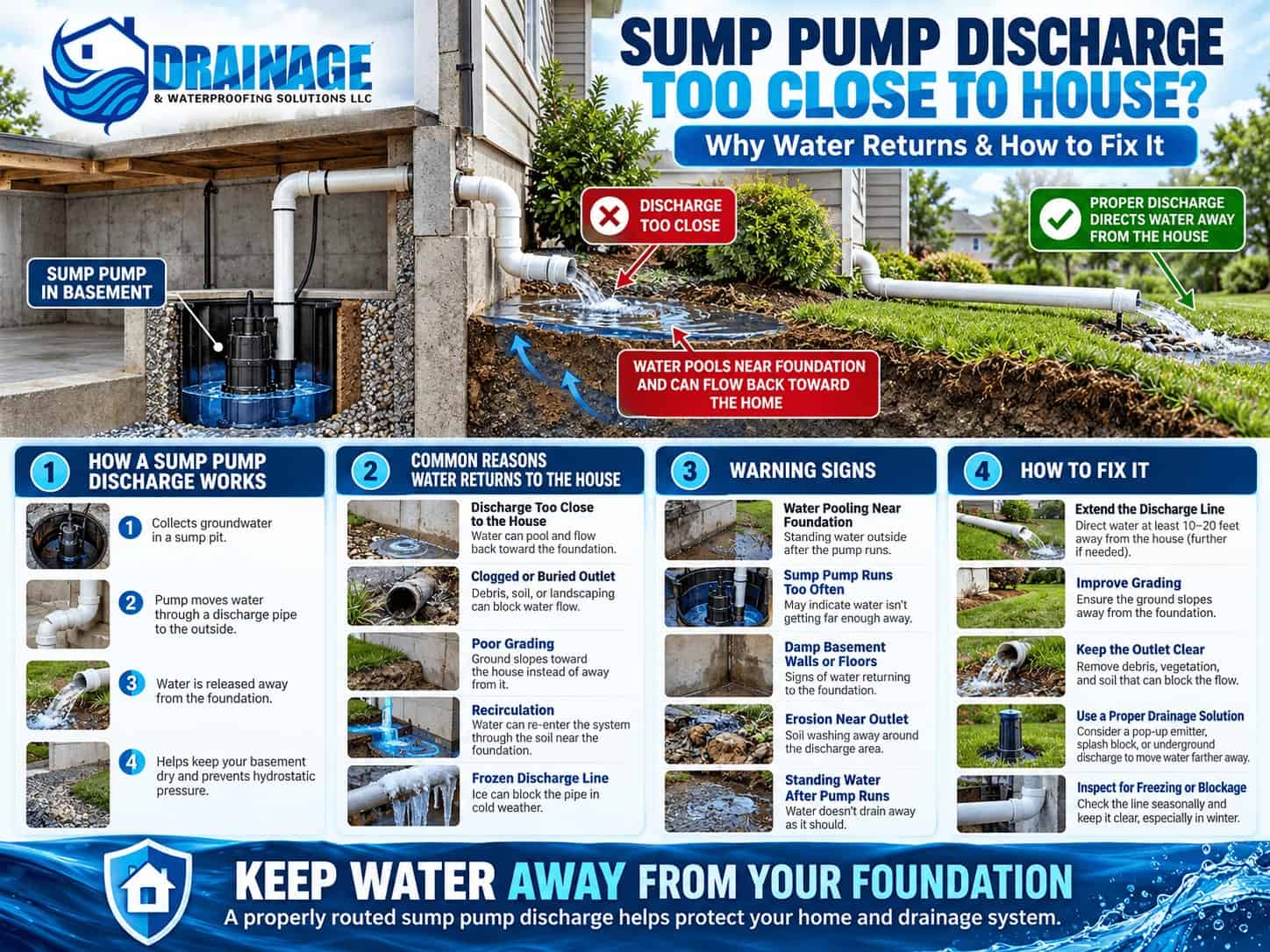
The following infographic illustrates how a basement sump pump moves water through an exterior discharge line, and why an outlet positioned near the foundation may allow water to return.
Important Distance Clarification
The infographic includes an example of extending a discharge line approximately 10–20 feet. This is not a universal minimum, code requirement, or guarantee. A suitable discharge point must be selected according to property grading, soil conditions, local requirements, and where water can safely drain.
What Are the Best Ways to Fix Sump Pump Discharge Problems?
The right repair is the one that addresses the confirmed failure while allowing the sump system to operate as designed.
Some problems require only limited maintenance. Others need a different outlet, grading correction, buried pipe repair, or changes to the drainage design.
1. Extend the Discharge Line to an Appropriate Location
Where the outlet is too close to the foundation, extending or rerouting the discharge may reduce water accumulation near the house.
The new destination should be selected based on ground slope, runoff pathways, erosion potential, neighboring properties, and applicable local requirements.
Longer piping can increase friction losses and affect pump performance, particularly where there are multiple bends or significant elevation changes.
The pump and pipe system should be evaluated together to verify that the revised route remains appropriate.
2. Correct Soil Grading That Sends Water Back Toward the Foundation
If surrounding soil slopes toward the house, water may return even after the discharge line has been extended.
Regrading may help direct surface runoff away from the structure. The work should account for building clearances, walkways, patios, landscaping, and existing drainage routes.
The objective is not simply to raise soil beside the outlet, but to create an appropriate surface water pathway.
3. Clear Debris From an Accessible Discharge Outlet
When leaves, mulch, sediment, or vegetation obstruct an accessible outlet, appropriate maintenance may restore normal discharge.
However, recurring restrictions may indicate poor outlet protection, sediment movement, or a downstream issue.
A buried or submerged outlet should not be forced open without understanding its connection and receiving drainage.
4. Repair a Damaged or Disconnected Discharge Pipe
A cracked, separated, crushed, or leaking pipe may need localized repair or replacement.
Where the line is underground, the pipe route and affected section should be identified before excavation.
Repairs should consider pipe material, support, fittings, water flow, and protection from expected site conditions.
5. Use a Properly Designed Discharge Outlet
Depending on the property, a suitable discharge arrangement might use a surface outlet, an approved underground conveyance route, a properly designed pop-up emitter, or another permissible stormwater solution.
Not every option works on every lot.
A pop-up emitter, for example, must be located where released water can continue draining rather than pooling and moving back toward the house.
Outlet selection should also address maintenance, freezing exposure, erosion control, and local discharge restrictions.
6. Correct Discharge-Line Freezing Vulnerabilities
Where freezing has restricted a discharge line, the remedy may involve changes to routing, drainage, exposure, or other system components.
The correct approach depends on pipe configuration and the local climate.
Water should not be allowed to accumulate in vulnerable pipe sections when the system design requires them to drain.
Do not improvise with unsafe heaters, open flames, or electrical devices near wet conditions.
7. Evaluate Pump Performance and Discharge Capacity Together
If the discharge route is being substantially changed, the pump's operating conditions may change too.
Vertical lift, pipe length, fittings, friction losses, and expected inflow affect whether the pump can deliver adequate water through the new route.
A larger pump is not automatically the answer.
A qualified contractor should evaluate the pump performance information and drainage design before recommending equipment replacement.
Which Solution Matches the Confirmed Problem?
| Confirmed Problem | Potential Solution | What It Does Not Fix |
|---|---|---|
| Discharge outlet too close to foundation | Extend or reroute to a suitable location | A separate pump or check-valve defect |
| Ground slopes toward house | Correct surface grading and runoff | A blocked discharge pipe |
| Outlet obstructed by debris | Safe maintenance and outlet inspection | An incorrectly routed underground line |
| Damaged buried discharge pipe | Repair or replace affected section | Inadequate downstream drainage |
| Discharge area repeatedly saturates | Evaluate outlet destination and receiving capacity | A float switch malfunction |
| Frozen discharge pipe | Correct vulnerable routing and drainage conditions | Unrelated groundwater inflow |
| Pump cycles frequently because water returns | Correct confirmed recirculation route | Other causes of short cycling |
If recurring water also affects basement walls or floors, a broader foundation drainage assessment may be appropriate. Learn more about foundation waterproofing and drainage system inspections from Drainage & Waterproofing Solutions LLC.
How Far From the House Should a Sump Pump Discharge?
There is no single distance that guarantees proper sump pump discharge for every home.
A discharge outlet needs to direct water away from the foundation to a suitable receiving area or approved drainage route.
The correct location depends on several site-specific factors.
Ground Slope
Water should not be directed back toward the home by the surrounding grade.
Soil Conditions
Soil permeability and saturation affect how water moves after discharge.
Discharge Volume
The amount and frequency of pumping influence the required receiving area capacity.
Nearby Structures
Other foundations, walkways, driveways, and neighboring properties must be considered.
Erosion Potential
Concentrated water may wash away soil when the outlet is inadequately protected.
Local Requirements
Permitted stormwater connections and discharge locations vary by jurisdiction.
Can Sump Pump Discharge Go Into a Storm Drain?
Not automatically. Connections to public stormwater infrastructure may require authorization, permits, or compliance with local standards.
A nearby storm drain is not permission to connect private discharge piping.
The appropriate local authority should be consulted before modifying connections to municipal drainage.
Can Sump Pump Water Go Into a Sanitary Sewer?
Do not assume that it can. Sanitary sewer systems are intended to carry wastewater, and local requirements may prohibit or restrict sump water connections.
An unidentified pipe should never be used as a discharge destination without confirming its purpose and whether the connection is permitted.
Is Burying a Sump Pump Discharge Line Better?
A buried discharge line may protect piping from some physical damage and reduce visual clutter, but burial alone does not guarantee proper performance.
A buried line still needs an appropriate slope or hydraulic design, suitable materials, maintenance access, and a functioning outlet.
Low sections may retain water, and underground leaks can be harder to identify.
The decision should be based on the complete site drainage plan.
Is It a Sump Pump Failure or a Discharge Drainage Problem?
The difference matters because repairing the wrong component may leave water returning after every storm.
Discharge or Exterior Drainage Problem
- Pump may start and stop normally.
- Water is visibly leaving the outlet.
- Pooling develops near the foundation.
- Ground slope may direct water back.
- Underground pipe or outlet may be defective.
- Correction may involve routing or grading.
Pump or Internal System Problem
- Pump may fail to activate.
- Water level may continue rising in the basin.
- Float switch may malfunction.
- Check valve may allow pipe water to return.
- Mechanical capacity may be inadequate.
- Correction may require equipment servicing.
Some homes experience both types of problems. For example, a partially restricted discharge line may reduce pump performance while the outlet also releases water into poorly graded soil.
The entire water pathway should be evaluated when symptoms do not fit one clear explanation.
Should You Install a Bigger Sump Pump?
Not simply because water collects near the outlet. A larger pump can send water through the same inappropriate discharge path more quickly.
Pump sizing should follow the expected inflow, vertical lift, pipe configuration, performance curve, and drainage-system design.
When the existing pump operates correctly, the discharge destination may be the more important problem to address.
How Can You Prevent Sump Pump Discharge Problems?
Regular observation can help identify outlet restrictions, erosion, line damage, and changes in discharge performance before they contribute to interior flooding.
Four Areas to Monitor
Observe for leaves, mud, vegetation, and other restrictions.
Verify discharge does not visibly run back toward the house.
Look for damaged fittings, exposed sections, and leaks.
Document unusual cycling and changes during rainstorms.
Before Heavy Rain
Check known, accessible discharge components for visible debris and damage.
Make sure nearby landscaping has not covered the outlet. Observe whether surface grading directs water away from the structure.
During and After Rainfall
From a safe position, watch where pumped water travels.
Record unusual pooling, erosion, or increased pump cycling. Photographs can help a contractor understand conditions that may not be visible during dry-weather inspection.
Before Freezing Weather
Inspect exposed discharge sections for obvious damage or places where water may be retained.
Have vulnerable piping evaluated before cold conditions when recurring freeze problems have occurred.
After Landscaping or Excavation
Check the discharge route after installing walkways, patios, garden beds, retaining walls, or underground utilities.
Such work can alter grading, bury outlets, or damage piping.
How Much Does Sump Pump Discharge Repair Cost?
Costs vary because the work may involve a small exterior correction or an extensive underground drainage modification.
The scope depends on the actual cause, not simply whether water is visible.
| Cost Factor | Why It Matters |
|---|---|
| Outlet relocation | Distance, destination and site access affect work |
| Underground pipe | Excavation, fittings and restoration may be required |
| Existing pump capacity | A revised discharge route may change operating demands |
| Grading corrections | Landscape and surface restoration vary by property |
| Drainage connections | Permits and receiving system conditions may affect design |
| Damaged components | Check valves, piping or pump equipment may need separate work |
Avoid accepting a universal repair price without understanding the water pathway and the proposed discharge destination.
A site evaluation should establish whether the best solution involves maintenance, pipe repair, rerouting, outlet correction, grading, or broader foundation drainage work.
Why Does Sump Pump Discharge Placement Matter for North Carolina Homes?
Homes around Raleigh, Garner, Cary, Apex, Durham, Wake Forest, Fayetteville, Southern Pines, and nearby areas may experience periods of intense rainfall and saturated ground.
During wet weather, foundation drainage systems may collect more water than usual. A sump pump that releases water too close to the structure may add to local soil saturation rather than reducing it.
The effect depends on the property. A home on a sloping lot can behave differently from one in a low area.
Clay-rich soils can affect infiltration in some locations, but soil type alone does not establish where a discharge outlet should be placed.
The location should be chosen using the property's grading, runoff pathways, receiving drainage, and applicable municipal requirements.
What if the Property Has a French Drain?
A French drain and a sump pump may serve different roles in the same overall water-management system.
A French drain can collect or redirect certain groundwater or subsurface flows. A sump pump can mechanically remove water collected at a low point.
Whether a sump discharge can connect to another drainage system depends on the design and available capacity.
The line should not be connected simply because another underground pipe is nearby.
Can Improper Discharge Contribute to Basement Seepage?
It can when water released near the house contributes to local saturation or follows a pathway toward vulnerable foundation areas.
However, basement seepage can also result from other groundwater and foundation conditions. The discharge route should be evaluated alongside other possible sources.
For broader moisture management, see the company's Basement Waterproofing Raleigh guide .
Technical Limitations
Standing water near a sump discharge does not prove foundation damage or confirm that water is recirculating. Pump cycling patterns also cannot establish recirculation without evaluating check-valve operation, water inflow, controls, and discharge conditions.
The correct recommendation depends on an assessment of the actual system and site.
Frequently Asked Questions About Sump Pump Discharge
1. How far from the house should a sump pump discharge?
There is no single discharge distance that works for every house. The outlet should direct water away from the foundation to an appropriate drainage location without creating erosion, returning water, or affecting neighboring properties. Soil conditions, ground slope, discharge volume, and local requirements all matter. A commonly suggested extension length is not a substitute for site-specific discharge planning.
2. Can a sump pump discharge too close to the house cause basement flooding?
Yes, under some conditions. Discharge released beside the foundation may increase local soil saturation or flow toward the home. That water can contribute to foundation moisture problems and may re-enter a connected drainage system. However, nearby pooling does not automatically mean basement flooding will occur. The actual risk depends on grading, soil, foundation conditions, and water pathways.
3. Why does my sump pump keep pumping the same water?
Water recirculation can occur when discharge moves back toward the foundation and re-enters the collection system. However, frequent pump cycling can also result from a faulty check valve, high groundwater inflow, a small basin, or float-switch problems. The outlet and pump operation should be evaluated together before assuming the same water is being pumped repeatedly.
4. Can I extend my sump pump discharge pipe myself?
A simple accessible extension may be feasible in some installations, but the discharge location and pipe configuration still need to be appropriate. Longer routes, buried pipes, elevation changes, or connections to other drainage systems require greater care. Incorrect routing can increase pump resistance or send water toward another vulnerable area. Consult a qualified professional when the design is uncertain.
5. Why is water pooling around my sump pump discharge outlet?
Water may pool because the outlet releases flow into a low area, surrounding soil is saturated, the ground slopes poorly, or downstream drainage is restricted. The outlet may also be partially blocked by landscaping or debris. Correcting the problem requires determining whether water is accumulating because of its destination, a physical blockage, or insufficient receiving capacity.
6. Should a sump pump discharge line be buried?
A buried discharge line may be appropriate for some properties, but it must be designed with suitable routing, pipe materials, hydraulic capacity, drainage, and outlet access. Burial alone does not prevent freezing, leakage, or water returning toward the foundation. An above-ground route may work better in some situations. The correct choice depends on site conditions and local requirements.
7. Can a sump pump discharge into a storm drain or sanitary sewer?
Do not connect sump discharge piping to a public storm drain or sanitary sewer without confirming the applicable local requirements and obtaining any necessary authorization. Stormwater and sanitary systems serve different purposes, and unauthorized connections may be prohibited. A qualified contractor or the relevant local authority can help determine a suitable, permitted discharge route.
8. What should I do if my sump pump discharge pipe freezes?
A frozen discharge line can restrict water movement and prevent the pump from emptying the basin normally. Avoid open flames, unsafe electrical heaters, and forcing tools into the pipe. If water is rising inside the home, seek prompt professional assistance. Long-term prevention may require changes to pipe routing, drainage, exposure, or outlet design rather than repeatedly thawing the same line.
9. Will a check valve stop sump pump water from returning to my foundation?
No. A check valve is intended to reduce backflow through the discharge pipe toward the sump basin after the pump stops. It does not prevent water released outside from moving across the yard or through soil toward the foundation. If the exterior discharge destination is wrong, the outlet and drainage pathway need to be evaluated separately.
10. When should I call a drainage professional about sump pump discharge?
Contact a drainage professional when water repeatedly pools near the foundation, the discharge outlet is blocked or damaged, the pump runs unusually often, or basement moisture returns. Professional evaluation is especially important when underground piping, grading, municipal drainage connections, or pump capacity may be involved. The objective is to confirm the source and correct the full discharge pathway.
Sump Pump Discharge Problems in Raleigh, NC?
If your sump pump releases water beside the house or water repeatedly returns toward the foundation, the problem may involve more than the pump itself.
Drainage & Waterproofing Solutions LLC provides drainage and waterproofing services for homeowners in Raleigh and surrounding North Carolina communities.
An evaluation can help identify whether the appropriate solution involves outlet relocation, grading correction, pipe repair, or broader foundation drainage work.
Sources & Technical References
-
U.S. Department of Energy —
Building America Solution Center
Building America Solution Center . Technical guidance covering foundation drainage, moisture management, building-envelope water control, and related design considerations. -
City of Raleigh —
Stormwater Management
Stormwater Services . Local information about stormwater management and drainage responsibilities. Property-specific connections and permissions require verification with the relevant authorities. -
North Carolina Department
of Environmental Quality
Stormwater Program . State-level information about stormwater management and water quality. -
Drainage & Waterproofing Solutions LLC
Drainage System Inspections . Company service information describing inspections of sump pumps, discharge lines, and related drainage components. -
Drainage & Waterproofing Solutions LLC
Foundation Waterproofing . Company information about integrated interior and exterior drainage and foundation moisture management.
Evidence and limitations: This guide provides general homeowner information and does not replace an on-site drainage inspection, plumbing or electrical evaluation, engineered drainage design, or applicable local code and stormwater review. The correct repair depends on the installed system, property grading, available discharge, and site conditions.

Reviewed by Drainage & Waterproofing Solutions Staff
Drainage & Waterproofing Solutions LLC is a locally owned, family-operated company providing foundation waterproofing, basement drainage, crawl-space moisture control, and drainage-system services for North Carolina homeowners.
The company's published services include sump pump and drainage-system inspection, discharge-line evaluation, foundation waterproofing, and related water-management solutions.