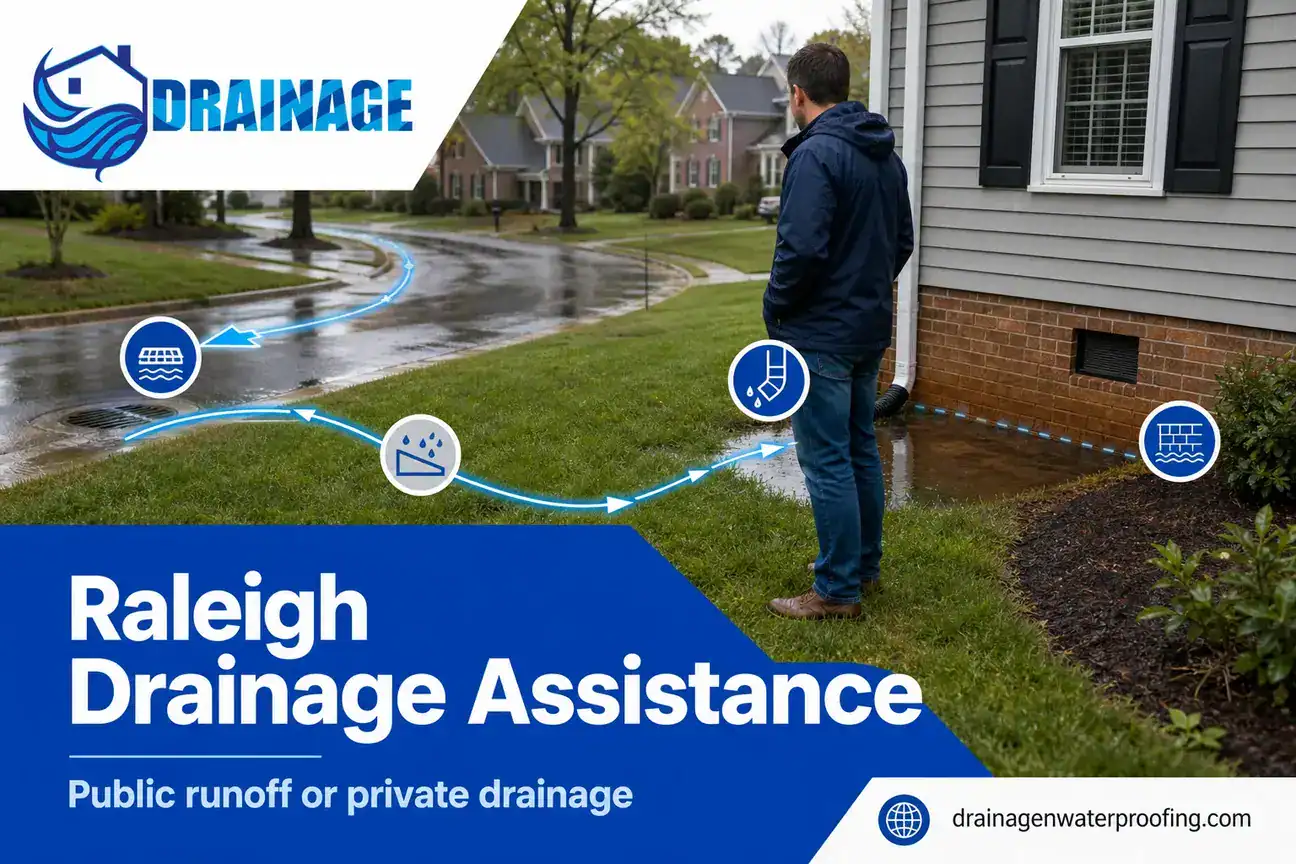
Raleigh Drainage Assistance: When to Call the City
Quick Answer: Raleigh drainage assistance is worth checking when water appears to be coming from a public street or public property onto your Raleigh property. If the problem is mainly soggy soil, downspout discharge, grading against the house, basement seepage, crawl-space dampness, or foundation moisture, it is usually a private-property drainage or waterproofing issue that needs an on-site contractor inspection. The City of Raleigh program is not the same thing as residential drainage repair, and the right next step depends on tracing the water source.
For Raleigh homeowners, the confusing part is that water does not respect property lines. Stormwater runoff may start in the street, cross a curb, collect in a swale, soak the lawn, and then show up as damp soil near the foundation. Or the water may be coming from your own roof, gutters, downspouts, grading, driveway, patio, or underground soil pressure. Those two situations can look similar after a hard storm, but they point to different solutions.
The City of Raleigh says, “We fund drainage projects that reduce stormwater runoff coming from public streets”. That is a public stormwater assistance program, not a general wet-yard or wet-basement service. If your concern is private yard drainage, seepage through a foundation wall, water at the basement floor joint, or crawl-space moisture, a contractor inspection is usually the practical next step.
Raleigh drainage assistance decision tree for homeowners
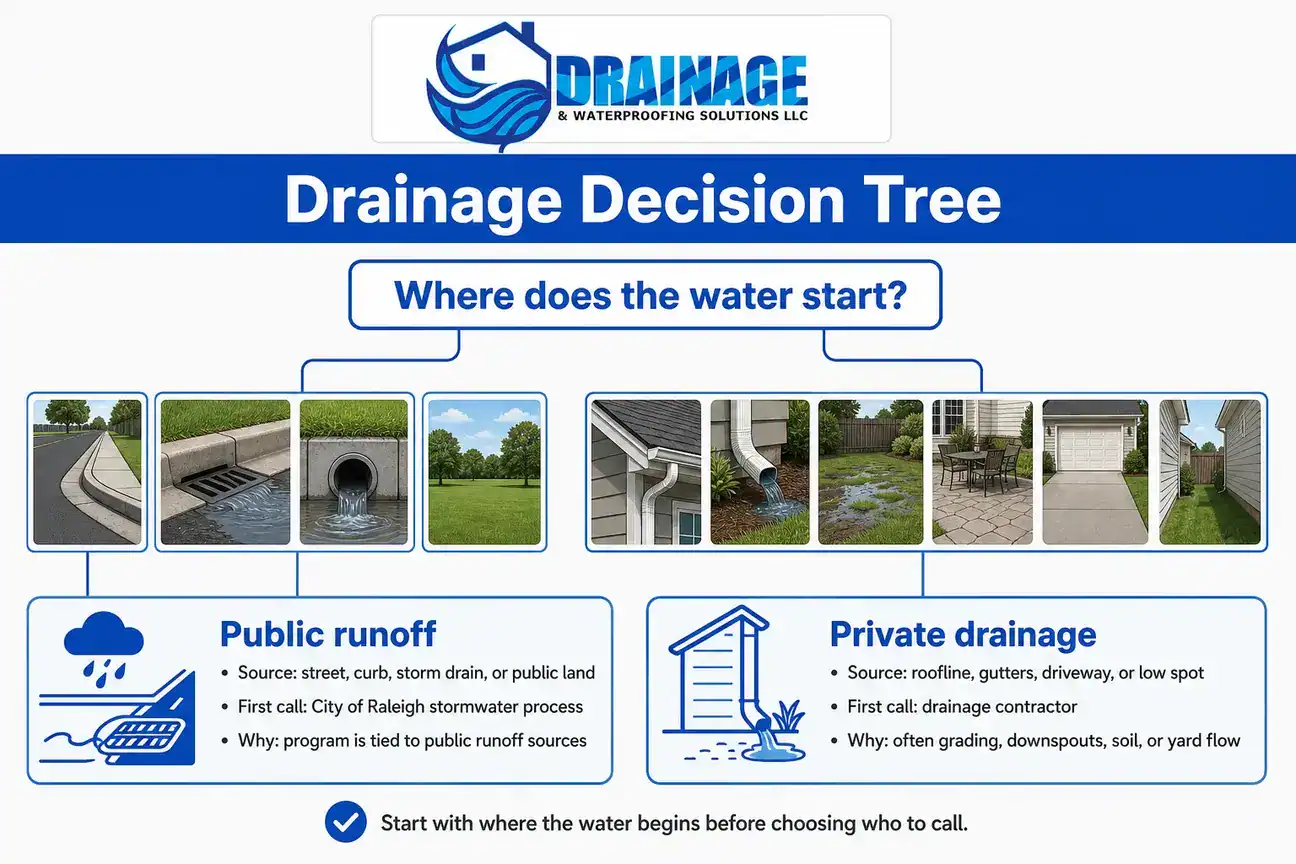
Use this first-pass decision tree before you make calls. It will not replace a site visit, but it can help you decide whether to start with the City of Raleigh, a drainage contractor, a plumber, or another professional.
| What you see | Most likely first call | Why it matters |
|---|---|---|
| Water clearly flows from a public street, curb, public storm drain area, or public property onto your Raleigh property | City of Raleigh stormwater process | The city program is tied to public runoff sources and has eligibility requirements. |
| Standing water starts near your roofline, gutter outlets, low spots, patio, driveway, or side yard | Drainage contractor | This usually points to private-property grading, downspouts, soil, or yard drainage. |
| Moisture appears at the foundation wall, basement floor joint, or crawl-space perimeter after rain | Drainage and waterproofing contractor | The inspection needs to trace outside water, hydrostatic pressure, and interior moisture paths. |
| Water appears when fixtures run, drains back up, or the wet spot smells like sewage | Plumber or sewer/septic professional | Supply, drain, sewer, or septic problems are not drainage contractor work. |
| Cracks, settlement, bowing walls, or structural movement are the main concern | Structural engineer | A drainage inspection can address water sources, but structural evaluation belongs to a structural professional. |
This is why a clear water-source diagnosis matters. A city program cannot redesign every downspout or basement system. A contractor should not promise that a private drain can solve a public infrastructure issue. A good decision starts by separating where the water starts from where you notice the damage.
Stormwater runoff: signs the source may be public
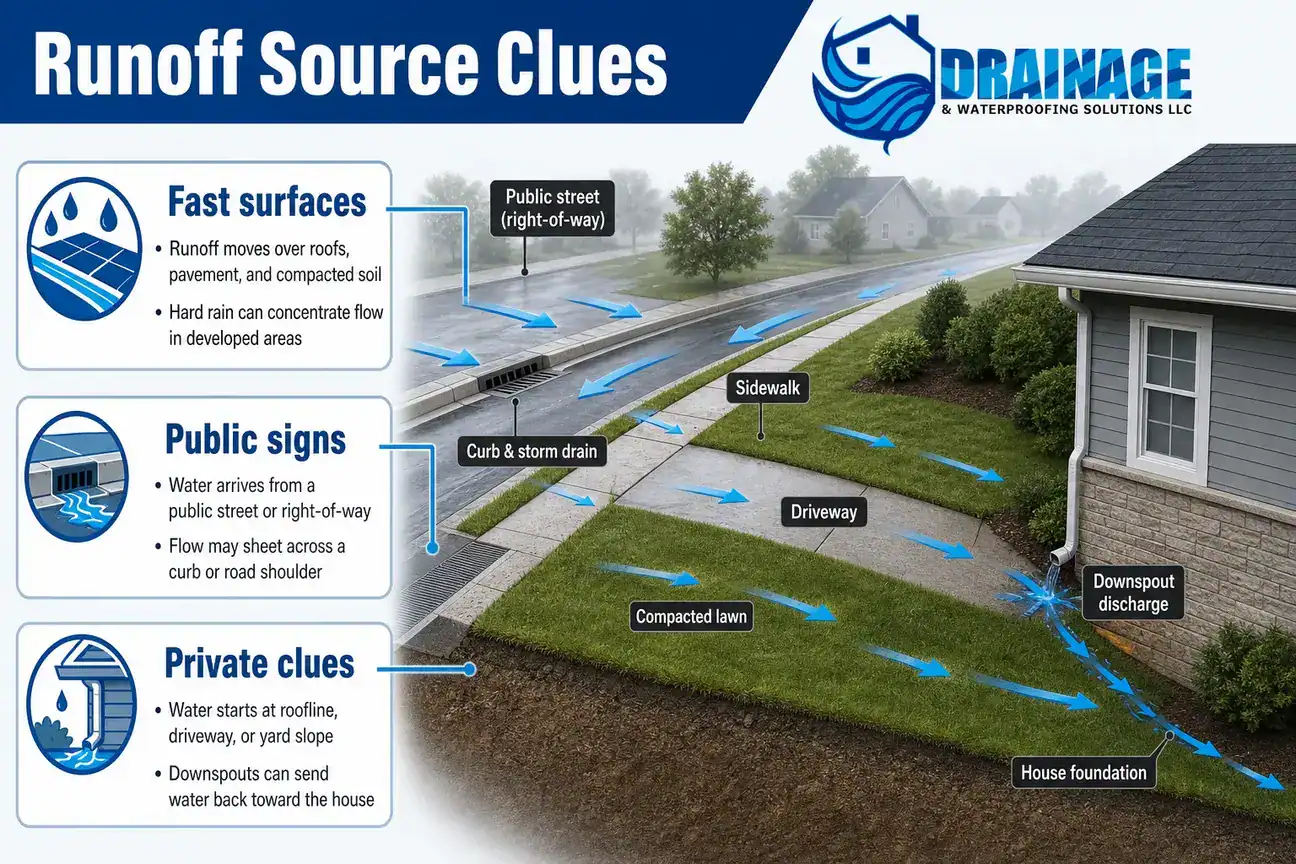
Stormwater runoff is rainwater that travels across roofs, pavement, compacted soil, lawns, driveways, streets, and other surfaces instead of soaking in where it falls. In developed neighborhoods, runoff can move quickly during hard rain, especially where roads, driveways, sidewalks, and sloped yards concentrate water.
Public involvement is more likely when you can see water arriving from a public street, public right-of-way, public storm drain area, or public property before it enters your yard. That may look like a sheet of water crossing the curb, a channel forming from the road shoulder, or repeated flow that starts outside your property during storms.
It is less likely to be a city assistance issue when the water starts at your own roof, downspouts, landscape beds, driveway, patio, pool deck, retaining wall area, or low side yard. Those are still real problems, but they usually fall into private drainage design, re-grading, or waterproofing instead of public stormwater assistance.
Some lots can also be hard to read because water may travel below the surface. A yard can look dry in one area while water collects along the foundation, under a crawl space, or at the basement wall. This can happen where soils are compacted or clay-heavy, or where water moves along disturbed backfill around the house.
When you are trying to decide, document the path of water during a storm if you can do it safely from indoors or from a protected area. Short videos, photos, and notes about where water first appears are often more helpful than photos taken days later after the water has drained away.
Public street runoff and what Raleigh’s program covers
Public street runoff is the key distinction in this topic. The City of Raleigh’s Drainage Assistance Program is described as funding drainage projects that reduce runoff coming from public streets. The program is for qualifying properties in Raleigh where public runoff or runoff from public property is entering the property.
The city page also explains that applicants must meet requirements, including property ownership in Raleigh and willingness to provide a permanent easement. In plain terms, the program is set up around public stormwater problems, not private wet-basement repair, private French drain installation, or general landscape drainage.
Separately, if you see a clogged public storm drain or catch basin in Raleigh, use the city’s stormwater maintenance or reporting process instead of trying to remove grates, enter inlets, or work in traffic. That kind of report is different from asking whether a private yard or basement problem qualifies for drainage assistance.
That does not mean a homeowner should ignore public water that is contributing to a private moisture problem. If public runoff is the main source, the city may be the right place to start. But if water is collecting because of your own grading, roof drainage, soil conditions, basement wall seepage, or crawl-space moisture, you may still need a private drainage or waterproofing plan even if the city reviews a nearby stormwater concern.
One practical way to think about it is this: city assistance may address the public runoff source when the situation qualifies; residential drainage repair addresses how water behaves on and around your house. Those may overlap on some properties, but they are not the same service.
Drainage easement requirements homeowners should understand
A drainage easement is a legal property interest that allows drainage work, access, or maintenance in a defined area. The Raleigh program information says applicants must donate a permanent drainage easement. That requirement is important because it means the program is not just a quick service call to clear a puddle.
Homeowners should read the city’s current requirements carefully and ask the city direct questions before assuming they qualify. An easement may affect part of the property, and the city’s review process may look at public runoff sources, project feasibility, and program requirements that a private contractor does not control.
A drainage easement is also different from a private agreement between neighbors. Homeowners should not redirect water onto a neighbor’s property, into a sanitary sewer, or toward public systems without proper review. If a project could affect a neighbor, a public right-of-way, a stream, or a public drainage system, the homeowner should check with the appropriate local authority before work begins.
For many private drainage jobs, the better question is not “Do I need an easement?” but “Where can water be safely collected and discharged?” A contractor inspection looks for a practical outlet, the slope needed to move water, buried utility conflicts, soil limitations, and whether surface drainage, subsurface drainage, or waterproofing is the better fit.
Foundation moisture that points to private-property repair
Foundation moisture is usually a private-property diagnosis unless the main water source is clearly public runoff entering the property. Common clues include damp block or poured concrete walls, efflorescence, musty basement air, water at the wall-floor joint, wet crawl-space soil, or recurring humidity after storms.
The EPA’s homeowner mold and moisture guidance is direct: “Fix leaks and seepage”. It also says, “The ground should slope away from the house,” and “Put a plastic cover over dirt in crawlspaces to prevent moisture from coming in from the ground.” Those are not one-size-fits-all repairs, but they are good reminders that moisture control starts with the source.
In contractor terms, the source may be roof water discharging beside the home, negative grading, saturated soil against the foundation, hydrostatic pressure, an unsealed crawl-space floor, or an interior humidity problem. Sometimes the outside symptoms are obvious. Other times the outside grade looks acceptable, but water still moves through foundation materials or collects below the slab.
If water shows up at the basement wall-floor joint, an inspection may look for hydrostatic pressure under or beside the slab. If the crawl space is damp, the inspection may look at exterior drainage, exposed soil, vapor barrier condition, ventilation, dehumidification needs, and whether an interior drain or sump pump is appropriate.
Drainage & Waterproofing Solutions, LLC provides foundation waterproofing, basement moisture control, and crawl space and basement waterproofing services for these kinds of private-property moisture problems. The right system depends on the water source, the structure, soil conditions, and the homeowner’s goals.
Yard drainage checks you can safely make first
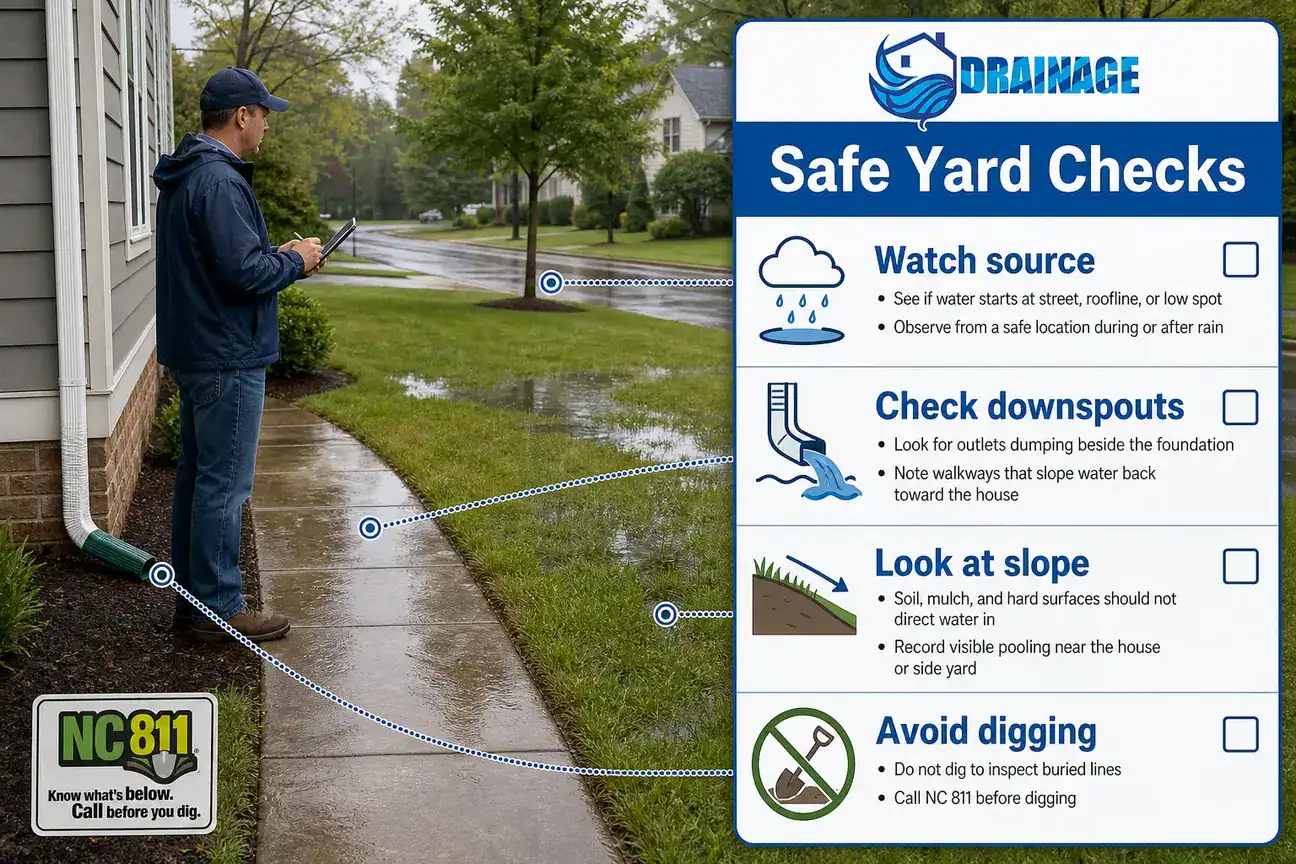
Before you call anyone, there are a few safe yard drainage observations that can make the next conversation more useful. Do these from a safe location. Do not walk through floodwater near electrical equipment, and do not dig to investigate buried lines without calling NC 811 first.
- Watch where water starts. Does it enter from the street, a neighbor’s yard, your roofline, a driveway, or a low spot near the house?
- Check downspout discharge. Look for gutter outlets that dump water beside the foundation or onto a walkway that slopes back toward the house.
- Look at grading and slope. Soil, mulch, and hard surfaces should not direct water toward the foundation.
- Note timing. Water that appears only during heavy street flow may point in a different direction than water that appears after ordinary roof runoff.
- Check crawl-space or basement symptoms. Musty air, wet walls, damp insulation, or wet soil may mean the problem extends beyond the lawn.
- Photograph the pattern. Capture where water begins, where it travels, and where it collects.
The EPA notes that moisture correction can range from simple steps to more involved work. In its moisture-control guidance, the agency says “Correcting moisture problems may be as simple as redirecting downspout runoff away from the foundation”. On other homes, re-grading, subsurface drainage, basement waterproofing, or crawl-space work may be needed.
Yard drainage is not just about getting water out of sight. The discharge point matters. Water should not be routed onto a neighbor’s property or into a sanitary sewer. The inspection should consider where water can move safely and legally after it leaves the problem area.
Where French drains fit when the city is not the fix
A French drain can be a good fit when water needs to be collected below the surface and moved to a suitable outlet. It is often considered for soggy side yards, water collecting near a foundation, or groundwater that follows a predictable path through soil. But it is not the answer to every wet spot.
For example, if water is simply pouring out of a downspout beside the foundation, extending or redirecting that discharge may be the first step. If the whole yard slopes toward the house, grading may matter more than a buried drain. If water is entering at the basement floor joint, an interior drain system and sump pump may be part of the discussion. If exposed crawl-space soil is contributing to humidity, encapsulation or a vapor barrier may be needed.
Drainage & Waterproofing Solutions, LLC offers French drains for private-property drainage problems where that approach fits the site. A proper plan looks at slope, soil, collection area, outlet options, depth, surrounding structures, and maintenance access. No drain should be treated as a shortcut around public stormwater rules, utility safety, or neighbor impacts.
For crawl spaces and basements, Building America guidance on drains or sump pumps in basements or crawl spaces discusses drainage or sump pumps where site conditions call for them. That kind of system should be matched to the water source, not selected because it is familiar or common.
How an on-site inspection separates public and private causes
A contractor inspection is the right next step when the evidence points to private drainage, waterproofing, basement moisture, or crawl-space moisture. The inspection should begin with the water source, not a preselected product.
On the outside, the inspector may look at roof drainage, downspout discharge, grading and slope, hardscapes, low spots, soil conditions, basement window wells, crawl-space access areas, retaining wall drainage, and safe discharge routes. On some properties, the inspection also has to account for tight side yards, soil conditions, additions, older grading changes, patios, and landscaping that may have built up against the foundation.
Inside, the inspection may look for water stains, damp block, efflorescence, musty odors, sump pump location, floor cracks, wall-floor seepage, and crawl-space vapor barrier conditions. For crawl spaces, the inspector may look at exposed soil, standing water, insulation, duct conditions, and signs that humid air is lingering.
When the issue is stormwater runoff from outside the property, a contractor may still help you understand what is happening on your lot, but city eligibility is not the contractor’s decision. When the issue is private drainage, a city program may not address the cause. That is why the first goal is to separate public source, private source, plumbing source, and structural concern.
If you want a contractor to evaluate a private drainage or moisture issue, you can request a free estimate from Drainage & Waterproofing Solutions, LLC or call (919) 508-7503. Within 60 miles of the Raleigh/Garner area, the estimate includes an on-site inspection, a written plan, and a written quote and timeline. Outside that radius, a $200 trip/estimate charge applies.
Moisture control inside the home still matters
Even when the visible problem starts outdoors, indoor moisture control matters. Water that reaches a basement, crawl space, or foundation can affect materials, humidity, comfort, and the way the home smells. The goal is not only to move water away but also to reduce the moisture conditions that let problems keep coming back.
The EPA says, “If wet or damp materials or areas are dried 24-48 hours after a leak or spill happens, in most cases mold will not grow.” The same EPA guide also says to “keep indoor humidity below 60 percent (ideally between 30 and 50 percent) relative humidity.” Drainage & Waterproofing Solutions, LLC does not provide mold testing, mold remediation, or health assessments, but moisture control is part of preventing repeated damp conditions.
For a crawl space, private repairs might include drainage corrections, a vapor barrier, a sump pump where appropriate, dehumidification, sealing measures, or full encapsulation. The EPA says to “Put a plastic cover over dirt in crawlspaces to prevent moisture from coming in from the ground.” Building America also supports managing drainage and using drains or sump pumps in basements or crawl spaces where appropriate.
For homeowners comparing options, crawl space encapsulation is different from a simple plastic ground cover, and both are different from exterior yard drainage. Encapsulation may be part of a broader moisture-control plan, especially when exposed soil, humidity, and air movement are part of the issue.
When to call the City of Raleigh first
Call or contact the City of Raleigh first when your best evidence points to public runoff as the source. That might include water that begins at a public street, public drainage area, or public property and then enters your property during rain. It may also include recurring erosion or flow patterns that appear tied to public runoff rather than your roof, grading, or private hardscapes.
Be ready to describe the path of water, not just the final wet area. The city will need to evaluate the situation under its own program rules. The public program may involve requirements that are different from hiring a contractor, including the drainage easement requirement discussed earlier.
Do not wait for a city program review if you also have active water entering a basement, crawl space, or electrical area. Keep people away from flooded areas near outlets, panels, appliances, HVAC equipment, or extension cords. For active leaks, plumbing backups, or electrical hazards, contact the appropriate professional. Drainage contractors handle water management around and under the home, not electrical hazards, sewer repair, or emergency flood cleanup.
When to call a contractor before or after the city
Call a drainage and waterproofing contractor when the water appears to be a private-property issue or when you need a practical plan for the house itself. That includes repeated soggy yard areas, water near the foundation, damp basement walls, crawl-space moisture, downspout problems, or water that collects because of grading and slope.
A contractor inspection may also be useful after you contact the city if the city process addresses only public runoff while your home still needs private moisture control. For example, a public flow path may explain why water reaches the yard, while foundation waterproofing, grading, French drains, or basement moisture control may still be needed to protect the home from recurring damp conditions.
The repair may be simple or involved. It may be downspout correction, grading adjustments, a French drain, an interior drain system, a sump pump, crawl-space work, or foundation waterproofing. The inspection should match the fix to the source instead of assuming one product can solve every water problem.
Drainage & Waterproofing Solutions, LLC is locally owned and family operated and brings more than 20 years of experience to residential drainage and waterproofing work in the Raleigh/Garner area and surrounding central North Carolina. The company provides free written estimates within 60 miles of Raleigh/Garner; each estimate includes an on-site inspection, a written plan, and a written quote and timeline.
Safety notes before you investigate water problems
Do not enter a flooded basement or crawl space if water may be near energized outlets, electrical panels, HVAC equipment, appliances, extension cords, or sump pump wiring. If there is an electrical concern, stay out and call the right professional.
Do not dig exploratory trenches, install drains, or probe deeply in the yard without utility marking. Call NC 811 before digging. Buried electric, gas, water, communications, and other lines can be present even in areas that look open.
If you see significant structural cracks, bowing, settlement, or movement, talk with a structural engineer. Drainage work can address water sources, but it is not a substitute for structural evaluation.
If you see mold-like growth or smell musty odors, focus first on moisture correction and cleanup guidance from the EPA. Drainage & Waterproofing Solutions, LLC does not perform mold testing or remediation and does not make health diagnoses.
If you are considering a closed or sealed crawl space, confirm permit requirements with your local building department. North Carolina guidance from the Office of State Fire Marshal indicates that closed crawl space work can require a permit, so homeowners should verify what applies before work begins.
Putting Raleigh drainage assistance in the right lane
The simplest way to make a good call is to ask, “Where does the water begin?” If the answer is a public street or public property in Raleigh, the City of Raleigh’s stormwater program may be the right first conversation. If the answer is your roof, grading, downspouts, side yard, foundation, basement, or crawl space, you are probably looking at a private-property drainage or waterproofing diagnosis.
Raleigh drainage assistance can be important for public stormwater problems, but it should not be confused with residential drainage repair. A wet yard or damp basement may need French drains, re-grading, foundation waterproofing, basement moisture control, or crawl-space work. The right solution depends on an on-site inspection and a clear understanding of the water source.
For private-property water problems around the home, Drainage & Waterproofing Solutions, LLC can inspect the site and explain the options without promising a one-size-fits-all result. You can contact us to request a free estimate within 60 miles of Raleigh/Garner, or call (919) 508-7503 during business hours.
This article is general homeowner information. The right drainage or waterproofing solution depends on an on-site inspection of your property.
Frequently Asked Questions
Does the City of Raleigh fix wet yards and wet basements?
Not as a general residential drainage repair service. The City of Raleigh Drainage Assistance Program is tied to stormwater runoff from public streets or public property. Wet yards, basement seepage, crawl-space dampness, grading problems, and downspout issues are often private-property drainage or waterproofing concerns.
What counts as public stormwater runoff versus private drainage?
Public stormwater runoff is more likely when water starts from a public street, public right-of-way, public storm drain area, or public property before entering your lot. Private drainage is more likely when water starts from your roof, gutters, downspouts, driveway, patio, grading, landscaping, or soil around the foundation.
Do I need a drainage easement to qualify for Raleigh’s program?
The City of Raleigh’s Drainage Assistance Program states that applicants must be willing to donate a permanent drainage easement. Homeowners should review the city’s current requirements directly and ask the city how an easement would apply to their property before assuming eligibility.
What should I check before calling a contractor?
Safely note where water begins, where it travels, and where it collects. Check downspouts, grading, low spots, hard surfaces, crawl-space dampness, basement water stains, and timing after storms. Photos or videos taken during rain can help an inspector understand the water path.
When is a French drain a better fit than grading?
A French drain may fit when subsurface water needs to be collected and moved to a suitable outlet. Grading may be the better first step when surface water is simply sloping toward the home. Many properties need both surface and subsurface drainage considerations, so an on-site inspection matters.
When should I call a plumber instead of a drainage contractor?
Call a plumber when water appears during fixture use, when drains back up, when there is a suspected supply leak, or when the problem may involve sewer or septic lines. Drainage and waterproofing contractors address rainwater, groundwater, foundation seepage, crawl-space moisture, and related site drainage issues.
How fast should wet materials be dried to reduce mold risk?
The EPA advises drying wet or damp materials and areas within 24 to 48 hours after a leak or spill when possible. Drainage & Waterproofing Solutions, LLC does not provide mold testing or remediation, but correcting the moisture source is an important first step.
Can a crawl space stay damp even if the yard looks dry?
Yes. Crawl-space moisture can come from exposed soil, humid air, poor drainage, foundation seepage, plumbing issues, or water that moved below the surface after rain. A dry-looking lawn does not always mean the crawl space is dry, especially after repeated wet weather.
Sources
- City of Raleigh — Drainage Assistance
- U.S. Environmental Protection Agency — A Brief Guide to Mold, Moisture and Your Home
- U.S. Environmental Protection Agency — Moisture Control Guidance for Building Design, Construction and Maintenance
- Building America Solution Center — Drain or Sump Pump Installed in Basements or Crawlspaces
- North Carolina Office of State Fire Marshal — 106.1 Permit Required, Closed Crawl Space