
How to Tell if Basement Water Is Groundwater or a Plumbing Leak
November 13th, 2026Basement Water Plumbing Leak or Groundwater? Essential Clues
Quick Answer: If you are trying to sort out a basement water plumbing leak from groundwater, start with timing, location, and what was running when the water appeared. Water that follows heavy rain, shows up at the wall-floor joint, or increases with sump pump activity may be more consistent with groundwater or runoff. Water that appears during fixture use, near a water heater or laundry area, or during dry weather may point more toward a plumbing source. Neither pattern proves the cause, so suspected supply, drain, sewer, or appliance leaks should go to a plumber, while recurring rain-related seepage may call for a drainage and waterproofing inspection.
The important word is may. A puddle is not always located where the water entered. Water can travel along framing, block, concrete, utilities, cracks, or the slab before it becomes visible. A basement leak after rain can be exterior water, but a pipe can also fail during the same wet week. Likewise, water near a bathroom can be a plumbing concern, but it can also be groundwater following a path of least resistance.
This guide is meant to help Raleigh and Triangle homeowners organize observations before choosing the next call. It is not a remote diagnosis. The goal is to identify whether the pattern is more consistent with a plumber’s work, a drainage and waterproofing inspection, or both. Good basement water source notes also help you explain what you are seeing without guessing at the repair.
Why the basement water source matters before choosing a fix
A drainage system and a plumbing repair solve different problems. A French drain will not repair a broken supply line. A plumber’s repair will not correct roof runoff, poor grading, footing-drain problems, foundation seepage, or hydrostatic pressure against a below-grade wall.
That is why identifying the basement water source comes before choosing a system. The U.S. Environmental Protection Agency gives the plain starting point for moisture control: “Fix leaks and seepage” in EPA moisture-control guidance. That wording matters because “leaks” and “seepage” are not always the same repair category.
A supply-line leak, drain leak, sewer issue, water heater leak, washing-machine discharge problem, or condensate problem belongs with a plumber or the appropriate equipment professional. Exterior water that enters through walls, the wall-floor joint, window wells, slab cracks, or foundation openings is a drainage and waterproofing problem. Sometimes a home has both.
For a homeowner, the practical question is not “Can I diagnose this from one symptom?” The better question is: “Which clues make plumbing more likely, which clues make groundwater more likely, and what should I do safely before calling someone?” A clear basement water source record keeps that question practical.
Groundwater basement leak clues that point toward exterior water
A groundwater basement leak is often tied to weather, soil saturation, surface runoff, or water collecting around the foundation. In Raleigh and the surrounding Triangle, storms can be intense and localized, so a house may see water even when a nearby neighborhood gets less rain. The National Weather Service Raleigh office is a useful local reference for storm and rainfall conditions when you are comparing wet-basement timing with recent weather.
A pattern more consistent with exterior water is water that appears during a storm, shortly after a storm, or after several wet days. It may show up at the wall-floor joint, along a foundation wall, through a floor crack, at a window well, or near a sump pit. Sump pump activity that increases during wet weather is another clue that groundwater or footing drainage may be involved.
A groundwater basement leak may also be connected to what is happening outside. Downspouts that dump water near the foundation, low soil beside the house, clogged gutters, walkways sloping toward the wall, or standing water near a window well can all contribute to wet-basement conditions. These clues do not prove the source, but they help narrow where an on-site inspection should look.
In many Raleigh-area yards, compacted or slow-draining soil can make drainage problems more noticeable. When water has nowhere to go, it can collect against foundation walls or move toward the lowest available point. If the home has a basement or partial basement, exterior water pressure may become visible as seepage, damp masonry, water at the wall-floor joint, or a recurring musty smell.
A basement leak after rain may continue after the storm ends. Soil and foundation drainage do not reset the moment the sky clears. Water can keep moving through saturated soil, toward a footing drain, or toward the sump pit for hours or longer. That delayed timing is still consistent with exterior water, but it does not rule out a plumbing problem.
Exterior-water clues become stronger when they repeat. For example, if water appears in the same corner after heavy storms, the sump pump runs more in wet weather, and water is also standing beside that exterior wall, a drainage inspection makes sense. A recurring groundwater basement leak should be evaluated in the context of the whole site, not just the wet spot inside.
The right answer may involve grading, downspout management, French drains, foundation waterproofing, an interior drain system, sump pump evaluation, or a combination chosen after looking at the site. A groundwater basement leak pattern often depends on how roof water, surface water, and soil moisture reach the foundation.
Basement leak after rain: what timing can and cannot prove
A basement leak after rain is one of the most useful clues, but it is not a final diagnosis. Rain timing may point toward runoff, saturated soil, hydrostatic pressure, window-well drainage, or foundation seepage. It can also be coincidence. A water heater, supply line, drain connection, or appliance can leak during the same week a storm passes through.
Write down when the water appeared. Was it during the storm, the next morning, two days later, or only after several days of wet ground? Did it happen after a single thunderstorm, or only after repeated rain? Did water appear in one spot, or did several walls and floor areas become damp?
A basement leak after rain that starts at the same wall each time is different from one that appears below a bathroom ceiling or near a washing machine. The first pattern may point toward exterior water movement, while the second keeps plumbing high on the list. Timing and location work best when they are considered together.
Next, compare the water event with household use. Did someone take a shower, run the washing machine, flush a nearby toilet, drain a tub, use a dishwasher, or operate a water softener shortly before the water showed up? If yes, plumbing should stay on the list, even if it also rained.
A recurring basement leak after rain often deserves a look at exterior grading, gutters, downspouts, window wells, sump pump discharge, and foundation-water entry points. EPA moisture-control guidance also notes the importance of outside drainage and water control around the home, including keeping water from flowing toward the house. But the safest approach is to gather observations and avoid assuming one symptom tells the whole story.
If a basement leak after rain shows up only after long soaking weather, the soil around the house may be holding water longer than the basement makes obvious. If the same area gets wet after nearly every storm, that pattern is worth documenting before an inspection.
Plumbing leak basement clues that deserve a plumber
A plumbing leak basement pattern usually has a relationship to a fixture, appliance, pipe, drain, or mechanical system. Water that appears during dry weather, begins suddenly, drips from above, repeats below a bathroom or laundry area, or continues when no rain has occurred may be more consistent with plumbing than exterior seepage.
Common plumbing-related possibilities include a supply line, drain line, toilet seal, tub or shower drain, washing-machine hose, water heater, utility sink, dishwasher line, refrigerator line, hose bib, condensate drain, or sewer-related backup. Drainage & Waterproofing Solutions, LLC does not provide plumbing, sewer, or septic repair, so those concerns should be evaluated by a plumber or the appropriate plumbing professional.
A plumbing leak basement clue becomes stronger when the water event can be repeated. If a puddle appears every time the upstairs shower runs, every time the washing machine drains, or every time a toilet flushes, that is different from water that only appears after storms. Repetition tied to fixture use is a practical reason to call a plumber first.
Water near a water heater, utility area, laundry area, bathroom, kitchen plumbing wall, or mechanical room also deserves caution. The location alone does not prove plumbing, because exterior water can migrate. Still, those areas contain supply lines, drain lines, valves, tanks, pumps, and condensate equipment that should not be ignored.
A plumbing leak basement issue can also be intermittent. A drain may leak only when a certain fixture is used, while a supply leak may show up even when it has not rained. That is why dry-weather water is a strong reason to keep plumbing on the short list.
Water behavior matters too. Spraying, dripping from overhead, warmth, sudden pooling, sewage-like odor, or backup around a drain or cleanout are plumbing warning signs. Do not touch unknown water, open plumbing cleanouts, or handle electrical equipment while standing in water. If water may have reached outlets, appliances, the electrical panel, or energized equipment, keep people out of the area and call the appropriate professional.
Compare clues without diagnosing from symptoms alone
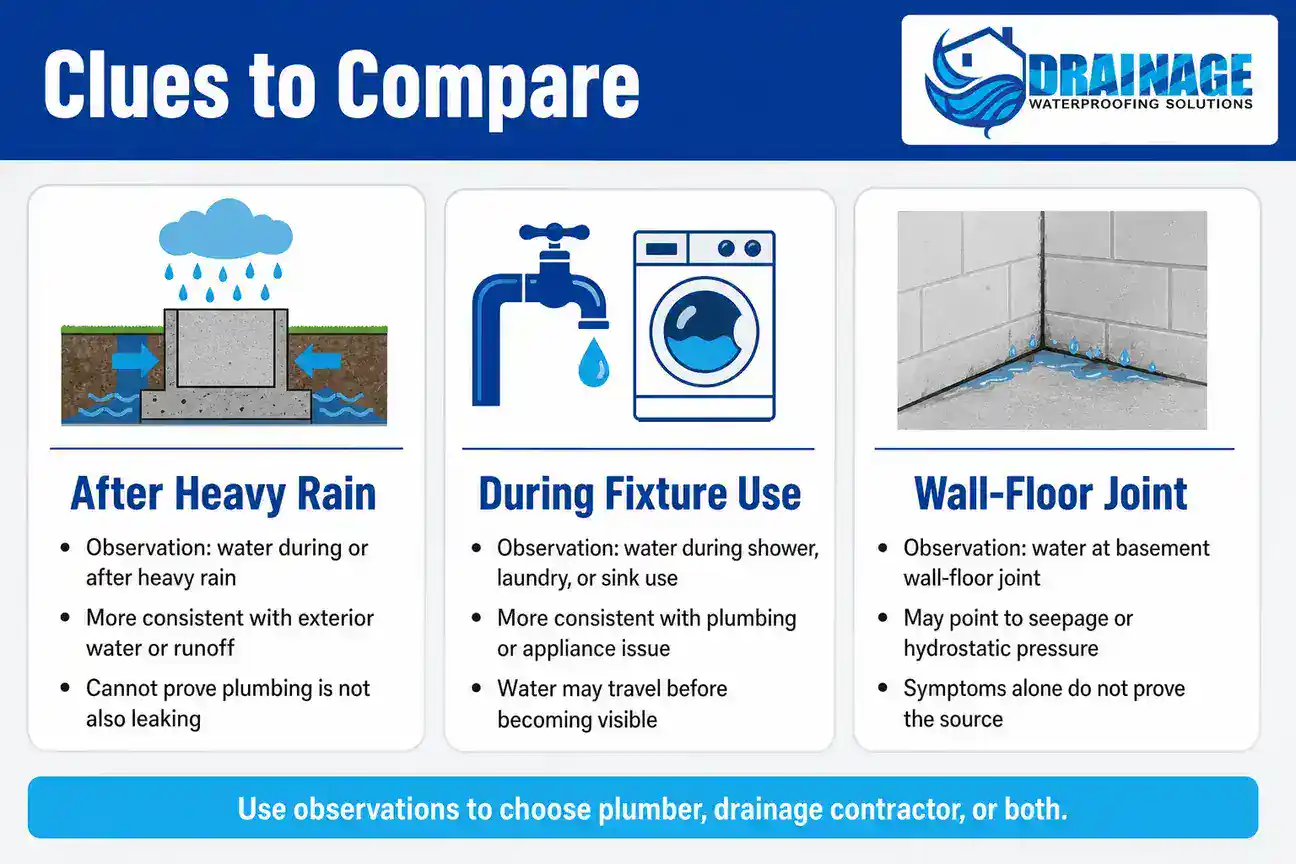
The table below can help you sort observations. It is not a test that proves the source. Use it to decide whether the next call should be a plumber, a drainage and waterproofing contractor, or both.
| What you observe | More consistent with | What it cannot prove |
|---|---|---|
| Water appears during or after heavy rain | Exterior water, runoff, or groundwater | A plumbing leak occurring at the same time is still possible |
| Water appears during shower, laundry, toilet, or sink use | Plumbing drain, supply, fixture, or appliance issue | Water may still travel from another source before becoming visible |
| Water at the wall-floor joint | Foundation seepage, footing drainage, or hydrostatic pressure | A plumbing line within or below the slab may also be involved |
| Water near a water heater, laundry, or utility area | Plumbing, condensate, or appliance leak | Exterior water can migrate to the same low area |
| Water continues during dry weather | Plumbing, condensation, stored moisture, or another indoor source | Groundwater can persist after a storm in some conditions |
| Sump pump runs more during storms | Groundwater collection or footing drainage | A plumbing leak can also add water to the sump area |
| Sewage-like odor or backup around a drain | Drain or sewer concern | Odor alone is not a complete diagnosis |
Two homes can show similar puddles for different reasons. One may need plumbing repair. Another may need foundation waterproofing or an interior drain system. A third may need both a plumber and a drainage plan because the home has more than one water source.
For example, a groundwater basement leak may look like a thin line of water along a wall, while a plumbing leak basement pattern may leave a similar puddle in the same low area. The visible water is the clue, not the conclusion.
Finding the basement water source with safe homeowner checks
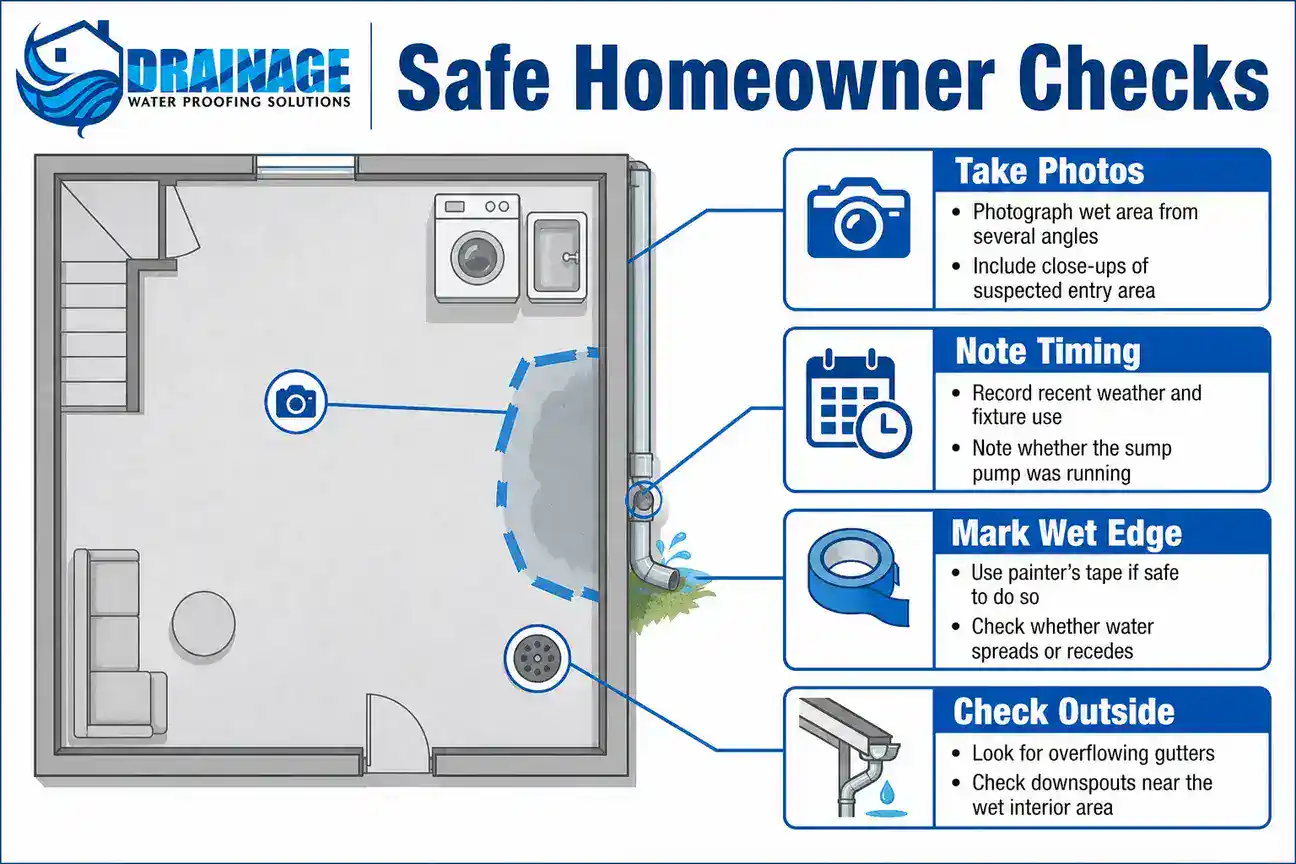
You can collect useful information without opening walls, digging trenches, or taking risks. Start with photos. Photograph the wet area from several angles, then take close-ups of the suspected entry area. Include a date and note recent weather, fixture use, and whether the sump pump was running.
Mark the visible edge of the wet area with painter’s tape or a removable marker if it is safe to do so. Check later to see whether the water spreads, recedes, or returns in the same place. Do not remove finishes, cut drywall, pull up flooring, or disturb materials if you are unsure what is behind them.
From ground level, look outside near the wet interior area. Are gutters overflowing? Are downspouts discharging beside the foundation? Is soil sloping toward the house? Is mulch piled high against the wall? Is there a window well holding water? Is the sump discharge sending water back toward the foundation?
Inside, look only at accessible plumbing. Check under sinks, around toilets, near the washing machine, near a water heater, and around visible drain or condensate lines. Do not dismantle plumbing, operate unfamiliar valves, or touch electrical equipment in a wet area.
If you understand your water meter and can check it safely, you may use it as one clue. Turn off water-using fixtures and appliances, avoid using water for a short observation period, and see whether the meter continues to move. Continued movement may support a plumbing investigation, but it is not a conclusive test. Automatic equipment, meter sensitivity, and hidden systems can complicate what you see.
Your basement water source notes should include what changed when fixtures were not being used. If water still spreads during dry weather, that may strengthen the plumbing question. If it appears only after storms, your notes may support a drainage and waterproofing inspection.
Before any digging for drainage work, call NC 811. Underground utilities can be present even where a homeowner does not expect them. Also avoid routing water toward a neighbor’s property or into a sanitary sewer. The correct discharge approach depends on site conditions and local requirements.
Basement water plumbing leak clues that should be handled first
If the water pattern is strongly connected to fixture use, appliance operation, dry-weather flow, or visible pipe moisture, handle the plumbing question first. A drainage system cannot repair a broken pipe, a leaking water heater, a backed-up drain, or a sewer-related problem.
Call a plumber first when you notice water that appears while a shower, tub, sink, toilet, dishwasher, washing machine, water heater, or condensate system is operating. Also call a plumber if water appears near a drain or cleanout, has a sewage-like odor, backs up rather than seeps in, or continues when no rain has occurred.
A plumbing leak basement concern is especially important if water is actively spreading toward finished walls, flooring, stored belongings, outlets, or mechanical equipment. Keep children and pets away from unidentified water. Do not enter a flooded basement if water may have reached electrical equipment, appliances, outlets, or the panel.
A plumbing leak basement pattern should not be covered up with waterproofing materials before the plumbing question is addressed. If the source is a pipe, fixture, appliance, or drain, the first repair belongs with the professional who handles that system.
Once a plumber has repaired or ruled out a plumbing source, remaining moisture may still need attention. Some homeowners discover a plumbing repair solved one problem but did not correct a recurring exterior seepage pattern. That is when a drainage or waterproofing inspection may be the next step.
When a drainage or waterproofing inspection makes sense
A drainage and waterproofing inspection makes sense when the pattern is tied to rain, groundwater, foundation-wall dampness, water at the wall-floor joint, wet window wells, sump pump activity during storms, or standing water near the foundation. It also makes sense when the basement stays damp after plumbing has been evaluated.
Drainage & Waterproofing Solutions, LLC provides residential drainage, waterproofing, crawl space, and basement moisture services in the Raleigh/Garner area and surrounding central North Carolina. For basement and crawl space concerns, the inspection looks at the water source, grading and slope, foundation entry points, sump pump or drain-system conditions, and moisture patterns. The result is a written plan, written estimate, and estimated timeline.
If the basement water source appears exterior, possible options may include basement moisture control, crawl space and basement waterproofing, grading and downspout improvements, French drain evaluation, foundation waterproofing, an interior drain system, or sump pump improvements. The right system depends on the property, so it should not be chosen from symptoms alone.
For homeowners within 60 miles of Raleigh/Garner, Drainage & Waterproofing Solutions, LLC offers a free written estimate that includes an on-site inspection, a detailed written plan, and a written cost quote and estimated timeline. Outside that radius, a $200 trip/estimate charge applies. To start that process, you can request a free estimate or call (919) 508-7503 during regular business hours.
Cost depends on what the inspection finds: where the water is entering, how much excavation or interior access is needed, whether drainage discharge is feasible, whether a sump pump is involved, how the foundation and slab are built, and whether crawl space or basement humidity also needs attention. This article does not estimate project pricing because the work depends on those site-specific conditions.
What fixes may match each source or condition
The repair should match the water source. A broad moisture-control plan may include more than one step, but each step should solve a defined problem. A basement water source that is exterior seepage needs a different plan than a source tied to a fixture or drain.
For sump pumps, footing-drain connections, and discharge planning, the DOE Building America Solution Center / PNNL resource on drains or sump pumps installed in basements or crawlspaces describes collecting water and moving it away through an appropriate drain or sump pump approach. That is why discharge location, pump conditions, and site drainage all matter during an inspection.
| Source or condition | Potential next step | Important boundary |
|---|---|---|
| Roof runoff, downspouts, or poor slope | Grading, downspout management, surface drainage, or French-drain evaluation | Discharge must be appropriate for the property and local requirements |
| Foundation seepage or groundwater pressure | Foundation waterproofing, interior drainage, sump pump, or combined evaluation | The right system depends on the home and site conditions |
| Sump pump or installed drain-system concern | Drainage system inspections and maintenance where applicable | The $150 maintenance inspection applies only to internal drain systems the company installed |
| Supply, drain, sewer, or appliance leak | Plumber or appropriate equipment professional | Not a drainage-contractor repair |
| Wet materials or suspected mold growth | Correct the moisture source and follow appropriate cleanup guidance | The company does not provide mold testing, remediation, or health assessments |
| Major cracks, movement, or settlement concerns | Structural engineer | Do not diagnose structural failure from water symptoms |
For existing customers with an internal drain system installed by Drainage & Waterproofing Solutions, LLC, the company offers 6-month and yearly maintenance inspections for $150 per appointment. That appointment includes inspection of the internal drain system, sump pump, and dehumidifier with a filter change. This maintenance service is separate from the free written estimate for new drainage or waterproofing concerns.
Basement moisture control after the water source is addressed
Once the main water source is identified, the next issue is moisture control. Bulk water should be addressed first. If exterior water is entering, humidity control alone will not stop seepage. If plumbing is leaking, a waterproofing system will not fix the pipe. If condensation is part of the problem, drainage alone may not correct indoor humidity.
EPA mold guidance notes that damp areas such as basements can be places where mold may grow, and wet materials should be addressed. If materials were wet, follow EPA guidance on mold, moisture, and cleanup and consult an appropriately qualified specialist for mold testing, remediation, or health concerns. Drainage & Waterproofing Solutions, LLC does not provide mold testing, remediation, or health assessments.
Basement moisture control may involve different measures depending on the cause: correcting seepage, managing humidity, improving drainage, addressing vapor movement, protecting stored items, or improving sump and drain-system performance. In crawl spaces, moisture control may also involve vapor barriers, encapsulation, sealed crawl space work, or dehumidification, depending on the home.
If a conventional crawl space is being converted to a closed crawl space, North Carolina’s Office of the State Fire Marshal states that a permit is required for that conversion. Confirm current requirements with the local building department before work begins.
Do not treat encapsulation, waterproofing, a dehumidifier, or a sump pump as a universal answer. Each one solves a different part of the moisture picture. A good plan starts by separating groundwater, rain-driven seepage, plumbing leaks, humidity, and material damage as much as possible.
When the record suggests a groundwater basement leak, moisture control may come after drainage and entry points are addressed. When the record suggests plumbing, the plumbing repair comes first. If both are present, the plan should separate the repairs instead of pretending one product solves every moisture condition.
Raleigh-area details that can affect the investigation
In Raleigh, Garner, Cary, and the Triangle, wet-basement calls often involve a mix of grading, roof runoff, slow-draining soil behavior, sump pump performance, and below-grade entry points. Older and newer homes can both have drainage problems when water is directed toward the foundation or when exterior drainage has changed over time.
Heavy summer thunderstorms and tropical-storm rain can make timing clues easier to see. After a storm, note where water stands in the yard, where downspouts discharge, whether the sump pump runs, and whether the wet basement area is on the same side of the house as exterior ponding. These observations are more useful than guessing from the puddle alone.
A damp crawl space can also be part of the same moisture pattern, especially where grading, downspouts, or ground moisture affect both the crawl space and basement areas. If a home has both a crawl space and a basement or partial basement, the inspection should consider how water is moving around the whole foundation, not just one room.
Drainage & Waterproofing Solutions, LLC is locally owned and family operated, with more than 20 years of experience in drainage, waterproofing, and crawl space work. The company’s role is to inspect drainage and waterproofing conditions and recommend a written plan where those services fit. If the basement water source appears to be plumbing, sewer, septic, mold, or structural, the right next step is the appropriate professional for that issue.
What to do next when the source is still unclear
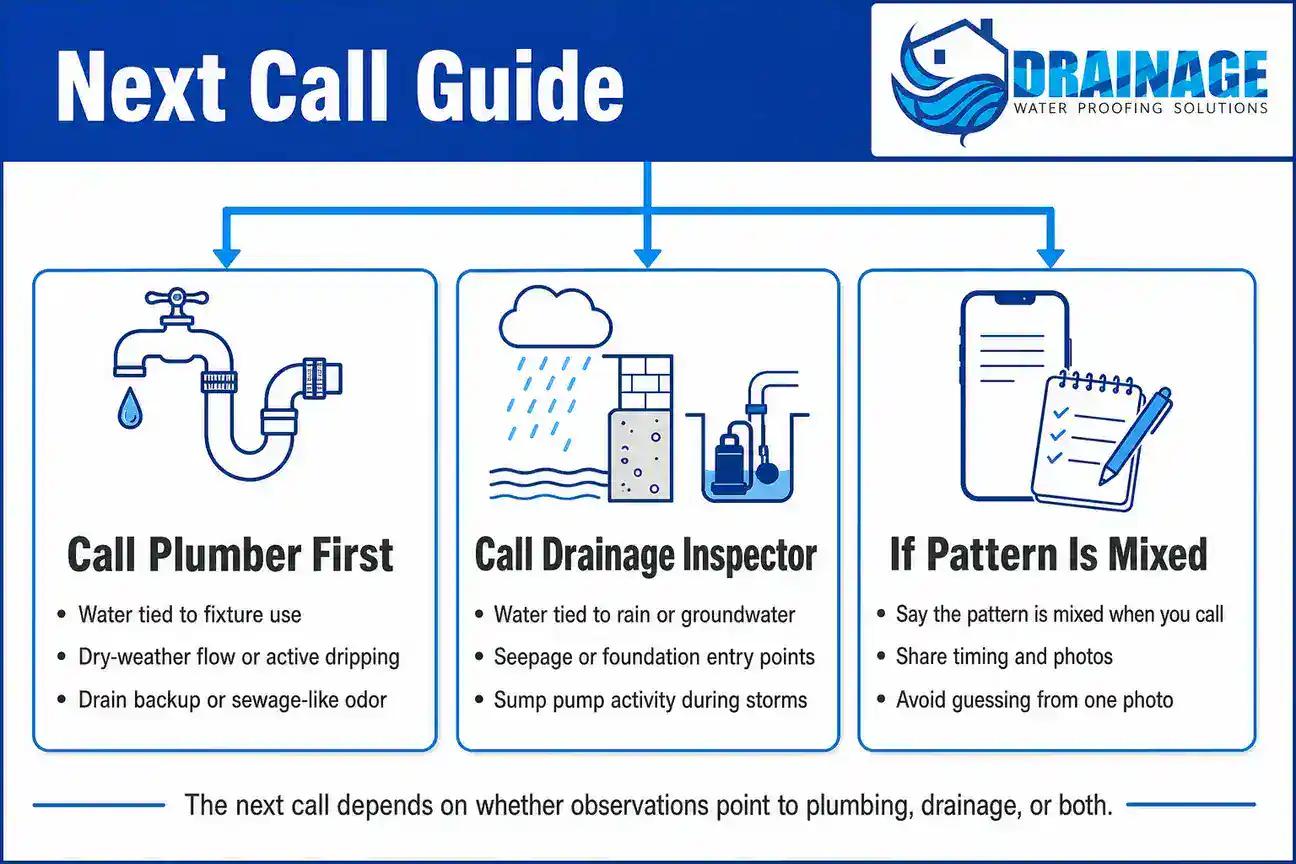
If the observations point toward a plumbing leak, call a plumber first. That includes water tied to fixture use, dry-weather flow, meter movement when no water should be running, active dripping or spraying, drain backup, sewage-like odor, or water near plumbing equipment.
If the observations point toward rain, groundwater, seepage, grading, sump pump activity, or foundation entry points, a drainage and waterproofing inspection is a practical next step. A repeated groundwater basement leak or recurring basement leak after rain should not be handled by guessing at a system from a single photo.
If the pattern is mixed, say so when you call. Tell the plumber or drainage contractor what you observed: rainfall timing, fixture use, exact location, water behavior, sump pump activity, and whether the water changed after fixtures were turned off. Those details save time and help each professional stay in the right lane.
For unclear rain-related water or recurring exterior moisture patterns in the Raleigh/Garner area, Drainage & Waterproofing Solutions, LLC can provide a free written estimate within 60 miles of Raleigh/Garner. The estimate includes an on-site inspection, a written plan, a written quote, and an estimated timeline. You can request an estimate through the contact page or call (919) 508-7503. Suspected plumbing leaks should be directed to a plumber.
Bottom line: A basement water plumbing leak and groundwater seepage can look similar from inside the basement. Timing, location, fixture use, water behavior, sump activity, and safe meter observations can point you in the right direction, but an on-site inspection is what determines the right repair. Whether the notes suggest a plumbing leak basement pattern, a groundwater problem, or both, the next step should match the source.
This article is general homeowner information. The right drainage or waterproofing solution depends on an on-site inspection of your property.
Frequently Asked Questions
Can groundwater enter a basement after the rain has stopped?
Yes. Water can continue appearing after rain because soil and foundation drainage conditions do not change immediately. Continued seepage after a storm can still be consistent with exterior water, but it does not rule out a plumbing leak.
Does basement water near a bathroom always mean a plumbing leak?
No. Water can travel through framing, masonry, cracks, or the slab and emerge near a bathroom even when the entry point is elsewhere. Fixture timing, visible plumbing moisture, and a professional inspection provide better evidence than location alone.
How can a homeowner use the water shutoff or meter as a clue?
Stop using fixtures and appliances, then observe whether the meter continues moving if the meter is accessible and understood. Continued movement may support a plumbing investigation, but this is not a conclusive test; a plumber should evaluate suspected supply, drain, or sewer leaks.
Is water at the wall-floor joint groundwater?
It may be related to foundation seepage, hydrostatic pressure, or footing drainage, especially when it follows wet weather. However, plumbing beneath or within the slab can produce water in a similar area, so the location does not establish the source.
Should a homeowner call a plumber or a waterproofing contractor first?
Call a plumber first when water is tied to fixture use, dry-weather flow, active dripping, a drain backup, sewage-like odor, or plumbing equipment. Call for a drainage or waterproofing inspection when the pattern is tied to rain, groundwater, sump activity, foundation seepage, or water collecting near the foundation.
Can clean-looking basement water still be a plumbing problem?
Yes. Water appearance is only one clue. Clear water could come from a supply line, condensate, rain-driven seepage, or groundwater. Avoid relying on color alone, and keep unidentified water away from children, pets, electrical equipment, and stored belongings.
What should I record before requesting an inspection?
Record the date, recent rain, fixture or appliance use, the exact wet area, water behavior, sump pump activity, odors, and whether the water changed over time. Photos and notes help a plumber or drainage contractor understand the pattern before inspecting the home.
Sources
- U.S. Environmental Protection Agency: Moisture Control Guidance for Building Design, Construction and Maintenance
- U.S. Environmental Protection Agency: A Brief Guide to Mold, Moisture and Your Home
- DOE Building America Solution Center / PNNL: Drain or Sump Pump Installed in Basements or Crawlspaces
- National Weather Service Raleigh
- North Carolina Office of the State Fire Marshal: 106.1 Permit Required, Closed Crawl Space