
Why Is My Crawl Space Wet After Heavy Rain?
November 11th, 2026Wet Crawl Space After Heavy Rain: Why It Happens
Quick Answer: A wet crawl space after heavy rain usually means water is reaching the house faster than the property can move it away. The source may be surface runoff, downspout discharge, groundwater, poor grading, or humid air rather than one single defect. The timing, location, and amount of water help narrow the possibilities, but an on-site inspection is what determines whether drainage, a sump pump, a vapor barrier, dehumidification, or encapsulation is appropriate.
[ARTICLE_BODY_IMAGE_PLACEHOLDER: featured]
For Raleigh-area homeowners, heavy rain can reveal drainage weaknesses that stay hidden during normal weather. A crawl space may look fine most of the year, then show puddles, wet soil, musty odors, or damp insulation after a strong storm. That does not automatically mean the house has one specific problem. Water may be arriving from the roof, the yard, the foundation perimeter, exposed soil, or a combination of sources.
The goal is to identify the water source before choosing a fix. A vapor barrier, French drain, sump pump, dehumidifier, or encapsulation system can each have a place, but none of them should be treated as a one-size-fits-all answer. The right plan depends on how water moves across the lot, how the crawl space is built, where the low points are, and whether the issue is bulk water, ground moisture, humidity, or something outside a waterproofing contractor’s scope.
What a wet crawl space means after a storm
A wet crawl space after a storm is a symptom, not a diagnosis. It tells you that moisture is present under the house, but it does not tell you whether that moisture came from storm runoff, groundwater, downspouts, open soil, condensation, or a plumbing-related source.
When a crawl space after rain becomes wet during or soon after a storm, that timing often points toward rain-driven water. Surface runoff may be moving toward the foundation. Gutters may be overflowing. Downspouts may be releasing roof water near the crawl-space wall. A low access door or low foundation area may be letting water reach the interior. Those patterns matter, but none of them proves the cause by itself.
If moisture remains well after the weather clears, the situation may be different. Soil around the house can stay wet after a storm, especially where the lot drains slowly or low areas hold water. Water may also collect at the lowest portion of the crawl space and remain there until it evaporates or drains away. In some homes, humidity and condensation keep the space damp even when there is no obvious puddle.
Homeowners should also keep non-rain sources in mind. A supply leak, drain leak, sewer issue, or septic-related concern can create moisture that happens to be noticed after rain. Those are not services Drainage & Waterproofing Solutions, LLC provides, and a qualified plumber or the appropriate specialist should be involved when plumbing, sewer, or septic issues are suspected.
Visible growth or a musty smell should be handled carefully. The article is not identifying mold species or making health claims. The U.S. Environmental Protection Agency explains that moisture control is central to managing mold concerns; in its homeowner guidance, EPA recommends fixing the water problem and drying wet materials rather than focusing only on the visible growth.
Why a crawl space after rain may point to exterior water
A crawl space after rain often becomes wet because water outside the home is not being moved away quickly enough. Roof water, driveway runoff, patios, compacted soil, and yard low spots can all send water toward the foundation. In Raleigh and the Triangle, lots vary widely, so the same storm can affect one house very differently from another house on the same street.
The most helpful clue is timing. If water appears during rainfall or immediately afterward, look outside first. Stand in a safe place during a rain event and watch how water travels across the yard. Does it move toward the crawl-space side of the house? Does it collect near the access door? Are gutters spilling over? Is there a downspout outlet dumping water beside the foundation?
The location inside the crawl space also matters. Water concentrated along one wall, at one corner, or near the access opening can line up with an outside condition. For example, a low side yard, a disconnected downspout extension, or high mulch against the foundation may match the wet area. Still, it takes an on-site inspection to confirm how those observations fit together.
A storm can expose a drainage problem that does not show up in ordinary rain. That is why a once-dry crawl space can suddenly look wet after a stronger event. The storm did not necessarily create a new defect; it may have made an existing drainage path visible.
Soil conditions also affect how water behaves. Raleigh-area properties commonly encounter Piedmont conditions, but soil, slope, fill, landscaping, and construction details vary by property. NC State Extension’s guidance on modifying soil around the home discusses how soil conditions and amendments affect water movement and plant growth; it should not be used to assume that soil alone caused water under a particular house.
When you describe a crawl space after rain to a contractor, be specific about what changed. A thin damp area along one wall, water on top of a vapor barrier, and a puddle near the access opening can point to different water paths. Photos taken safely from the access opening can help document the pattern.
How crawl space standing water changes the concern
Crawl space standing water deserves closer attention than general dampness because it usually means bulk water has collected somewhere under the house. Bulk water is different from normal humidity or slightly damp soil. It can sit at low points, along the perimeter, on top of a displaced vapor barrier, or near a sump basin if one exists.
If crawl space standing water appears only after heavy rain and drains away quickly, surface runoff or a temporary overload may be involved. If it stays for days, returns repeatedly, or appears at the same low point, the inspection should look at foundation-edge drainage, soil saturation, crawl-space floor elevation, and whether water needs a collection route.
Hydrostatic pressure is another term homeowners often hear. In plain language, it refers to water pressure from saturated soil pushing against below-grade or partially below-grade parts of the foundation. That pressure may contribute to seepage in some homes, but it should not be assumed from a photo or a single puddle. The inspection needs to look at where water is entering, where it collects, and how the site drains.
Interior drainage and a sump pump may be relevant when water must be collected from the lowest portions of the foundation and moved away. The DOE Building America Solution Center states that bulk water must be drained from the lowest portions of the foundation, and it discusses drains and sump pumps in basements or crawl spaces. The discharge route still has to be appropriate for the property and local rules.
If crawl space standing water is close to wiring, outlets, pumps, or other equipment, do not enter the space to investigate. Observe from a safe location and arrange an inspection. Standing water changes the safety picture, especially when you do not know the depth, the footing conditions, or what is under the water.
Drainage & Waterproofing Solutions, LLC provides crawl space and basement waterproofing services when an inspection shows that an interior drainage approach, sump pump, or related waterproofing plan fits the water source. That evaluation should come before choosing equipment.
How crawl space drainage and downspouts affect the foundation
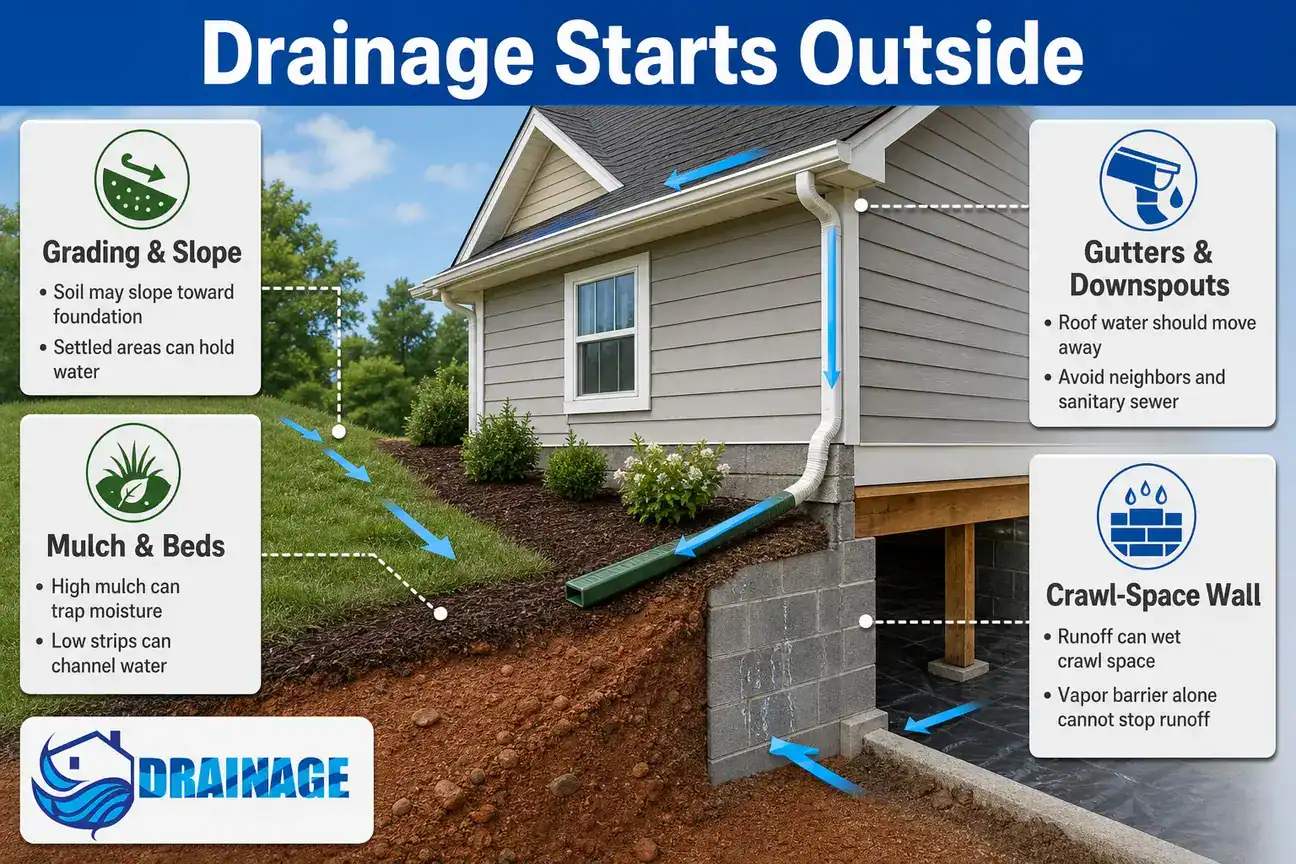
Crawl space drainage begins outside. If roof water and surface runoff are directed toward the foundation, the crawl space may get wet even if the space itself has a vapor barrier or dehumidifier. Exterior drainage should move water away from the house without sending it onto a neighbor’s property or into a sanitary sewer.
The first outside check is grading and slope. Walk around the house after rain and look for soil that slopes toward the foundation, settled areas near the wall, mulch piled high against the house, or landscaping beds that trap water. A low strip beside the foundation can act like a shallow channel that keeps water against the crawl-space wall.
The second check is the gutter system. Gutters that overflow during rain can drop water right beside the foundation. Downspouts that end too close to the house can concentrate roof water in one place. Disconnected extensions, crushed outlet pipes, and blocked splash blocks can all change where water goes.
Good crawl space drainage is not just a pipe or a trench. It is a planned path that considers where water starts, where it collects, and where it can discharge without causing another problem. That is why roof runoff, yard slope, and foundation entry points need to be reviewed together.
When a property needs a designed collection route rather than a simple surface adjustment, French drain installation may be part of the discussion. A French drain is not automatically the answer for every wet crawl space, but it can be useful where water needs to be collected and routed to a suitable discharge location.
Surface water planning also has limits. Some drainage changes may involve local rules, stormwater concerns, or discharge restrictions. Homeowners should avoid routing water toward neighboring property, public areas where it creates a hazard, or sanitary sewer systems.
Downspout water flow is a small detail with a big effect
Downspout water flow matters because the roof can deliver a large amount of water to a few concentrated points during a storm. If those points are near the crawl-space wall, a single downspout can make one corner wetter than the rest of the house.
Watch downspout water flow from a safe location during rain. You do not need to stand in runoff or climb a ladder. Look for water spilling over gutters, shooting out of seams, pooling at the outlet, or flowing back toward the foundation after it leaves the extension.
Also check what happens at the end of the downspout. An outlet that appears long enough in dry weather may still discharge into a low spot that drains back toward the house. A buried extension may be blocked or disconnected. A splash block may be pointed the wrong way. These are simple observations, not a complete diagnosis.
If downspout water flow lines up with the wettest part of the crawl space, the inspection should trace that route. Sometimes the correction is straightforward. Other times, the outlet needs to connect to a broader crawl space drainage strategy so water can be carried to a suitable location.
Repeated downspout water flow toward the same corner can also explain why one side of the crawl space looks worse than the rest. That pattern is especially useful when the crawl space after rain dries in some areas but stays wet near one wall.
Could dampness come from humidity instead of bulk water?
A crawl space can be damp without obvious puddles. That is why it helps to separate crawl space standing water from wet soil, condensation, and elevated humidity. These problems can overlap, but they are not the same.
Ground moisture can rise from exposed soil. A missing, torn, or displaced ground cover may allow moisture from the ground to affect the crawl-space environment. Building America’s guidance on water management for an existing crawlspace floor describes approaches for managing crawl-space floor moisture, including ground cover and drainage considerations. A ground cover can help with soil moisture, but it does not remove active bulk water entering from outside.
Humid air can also create problems. In warm, humid weather, moisture can condense on cooler surfaces such as ducts, pipes, framing, or insulation. The crawl space may smell musty or feel damp even when you do not see a puddle. A humidity reading can be useful, but it should not be treated as a complete diagnosis by itself.
EPA homeowner guidance says, “If possible, keep indoor humidity below 60 percent (ideally between 30 and 50 percent) relative humidity.” That guidance is helpful for understanding moisture control, but it is not a guarantee that one dehumidifier will solve every crawl-space problem. If bulk water is entering first, that water source still needs to be addressed.
A vapor barrier, dehumidifier, and encapsulation system each addresses a different part of the moisture picture. A vapor barrier helps reduce moisture coming from exposed soil. A dehumidifier can help manage air moisture when conditions call for it. Encapsulation can address the crawl-space environment more broadly, but it should be planned around the actual water source, drainage conditions, and local requirements.
Humidity can also make a crawl space after rain feel damp after visible water is gone. That does not mean drainage no longer matters. It means the inspection should separate what is entering as liquid water from what remains as air moisture.
What to observe: downspout water flow and crawl space drainage
You do not need to enter a wet crawl space to gather useful information. In fact, entering can be unsafe if there is standing water, wiring, outlets, pumps, or other energized equipment. Safe observations from outside and from the access opening can help the inspector understand when the moisture appears and where it concentrates.
A simple storm log can be useful. Note whether the crawl space after rain has puddles, damp soil, odors, or water on top of the vapor barrier. Record whether crawl space standing water disappears quickly or remains after the weather clears.
Outside the house
Start with the yard and roof drainage. Look at the ground from the foundation outward. If the soil slopes back toward the house, water may be moving toward the crawl-space wall. If mulch or soil is high against the foundation, it may hold moisture where the wall needs to dry.
Check gutters and downspouts during rain only from a safe spot. Note whether water spills over the gutter edge, leaks behind the gutter, or exits the downspout too close to the house. Observe downspout water flow at the outlet and where it travels after leaving the extension.
Look for puddles near the foundation, erosion channels in mulch, washed-out soil, or water collecting beside the access door. If paved areas, neighboring runoff, or a side-yard swale direct water toward the home, make note of that pattern. Do not start digging to test a line or install drainage before contacting NC 811.
Those outside clues often shape the crawl space drainage discussion. If water is moving toward the house before it ever reaches the crawl-space wall, an inside-only fix may not address the full problem.
At the crawl-space access
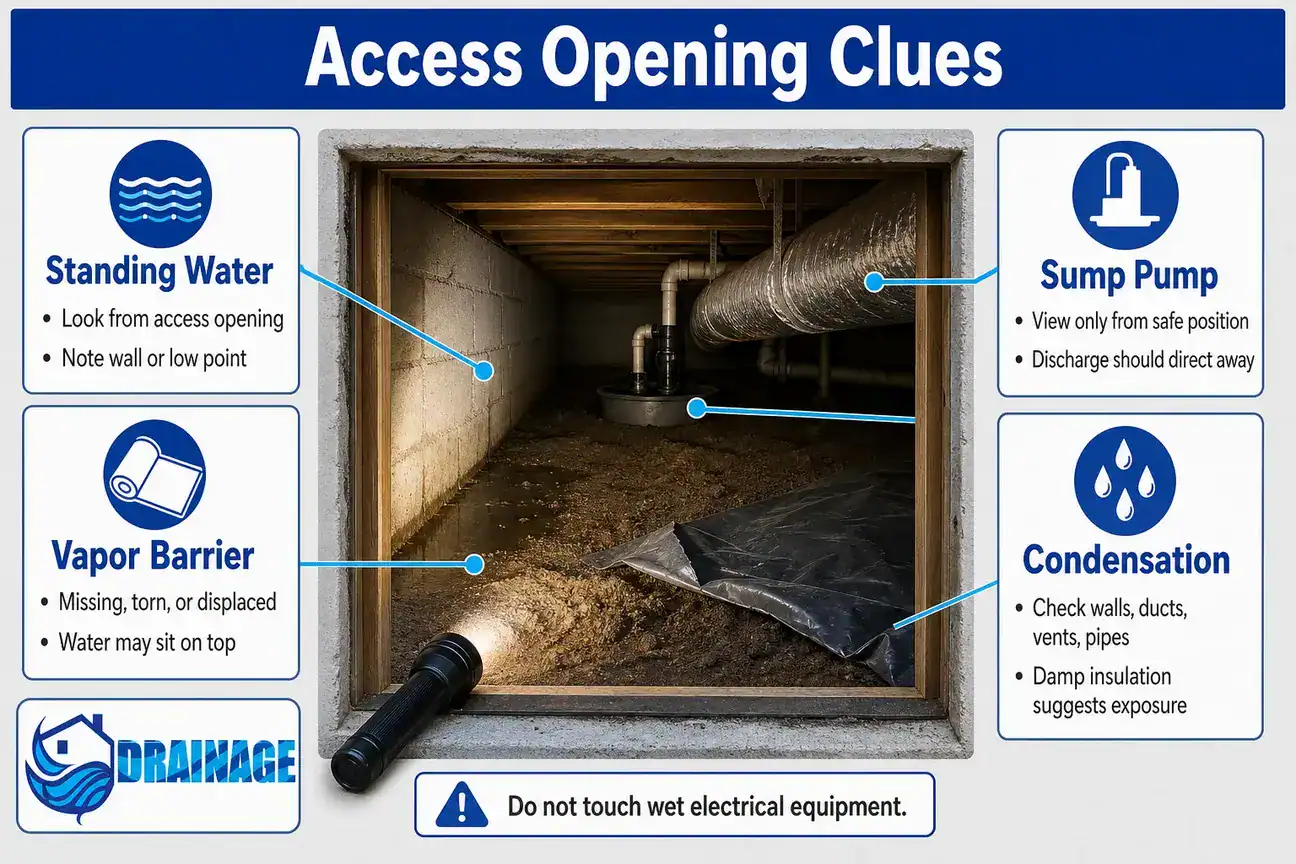
From the access opening, look for visible crawl space standing water, wet soil, water concentrated at one wall, or a low point where water gathers. Notice whether the vapor barrier is missing, torn, displaced, or holding water on top. If a sump pump is present, look only from a safe position to see whether the discharge appears connected and directed away from the foundation.
Also watch for condensation on walls, ducts, vents, or pipes. Damp or fallen insulation can suggest ongoing moisture exposure, but it does not tell you the source by itself. Avoid touching suspected mold, wet electrical equipment, exposed wires, outlets, or pumps.
If you see significant cracks, settlement concerns, or signs of movement, a structural engineer is the right professional to evaluate structural questions. Drainage and waterproofing work can address water management, but it should not be used as a substitute for structural engineering when movement or settlement is the concern.
What an on-site inspection looks for
An on-site inspection connects the homeowner’s observations with the property conditions. The inspector should ask when water appears, how long it remains, whether the crawl space dries between storms, and whether the pattern has changed over time. Photos taken during rain can be helpful if they can be taken safely.
Next, the inspection traces exterior drainage. That includes grading and slope, low spots, roof drainage, downspout water flow, yard puddling, access-door elevation, and any visible route that carries water toward the house. In Raleigh-area homes, this outside step is often just as important as the crawl-space view.
Inside or at the crawl-space opening, the inspection looks for low points, wet perimeter areas, foundation-edge conditions, existing drains, sump equipment, discharge routing, vapor-barrier condition, condensation, and signs of ongoing humidity. The goal is to separate bulk water from ground moisture and air moisture.
A careful inspection also asks whether crawl space standing water is the main problem or only one part of a broader moisture pattern. If the floor is dry but the framing and ducts are damp, humidity control may matter more. If the floor has repeated puddles, the collection and discharge path becomes more important.
The inspection should also identify conditions outside the contractor’s scope. Plumbing, sewer, or septic concerns should go to the appropriate specialist. Structural cracks, settlement, or movement concerns should go to a structural engineer. Mold testing, remediation, and health assessments are not services Drainage & Waterproofing Solutions, LLC provides.
If the property is within 60 miles of Raleigh/Garner, Drainage & Waterproofing Solutions, LLC offers a free estimate that includes an on-site inspection, a written plan, a written quote, and an estimated timeline. For properties outside that radius, a $200 trip/estimate charge applies. Homeowners can request a free estimate or call (919) 508-7503 during business hours.
Which fix might match the water source?
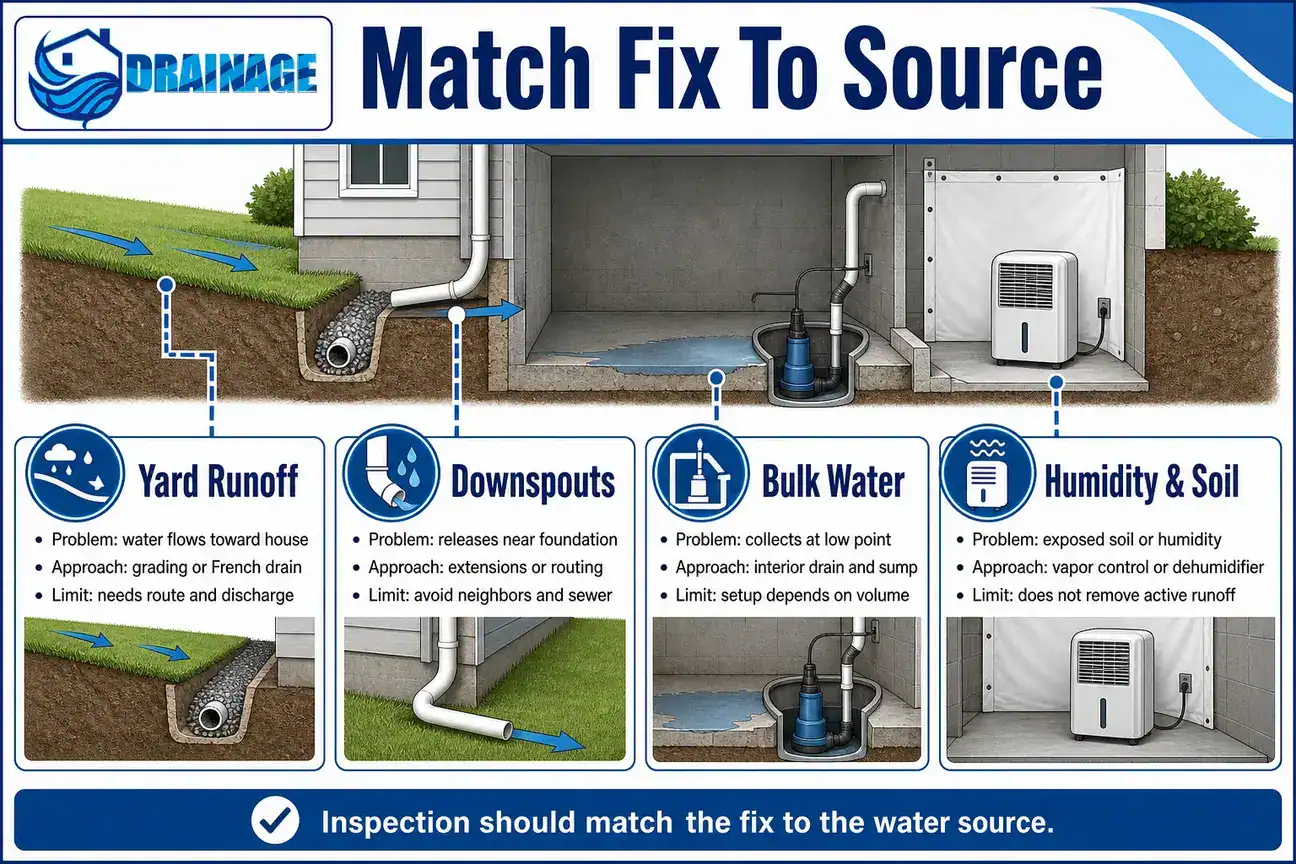
The right fix depends on what the inspection finds. A simple downspout correction may help one home, while another home may need exterior drainage, an interior drain system, a sump pump, vapor control, dehumidification, encapsulation, or a combination. No drainage or waterproofing system should be described as guaranteed, permanent, or maintenance-free.
| Observed problem | Possible approach | Honest limitation |
|---|---|---|
| Water flowing toward the house or collecting in the yard | Grading correction or French drain | Requires a suitable route and discharge location |
| Downspouts releasing water near the foundation | Corrected extensions or drainage routing | Must not discharge toward neighbors or sanitary sewer |
| Bulk water collecting at a low crawl-space point | Interior drainage system and possibly sump pump | Requires inspection of elevation, collection path, power, and discharge |
| Moisture rising from exposed soil | Ground vapor barrier | Does not by itself remove active bulk water |
| Persistent humid air or condensation | Dehumidification and moisture control | Does not replace correction of exterior water entry |
| Multiple moisture pathways | Crawl-space repair and encapsulation | Scope depends on drainage, vapor control, access, equipment, and local requirements |
Exterior French drains may fit where water needs to be collected before it reaches the foundation or moved through a planned route. Interior drainage and sump equipment may fit where water is already entering or collecting at a low point. The inspection should decide whether either approach is appropriate for the specific property.
A vapor barrier may be recommended when exposed soil is contributing to moisture. Dehumidification may be relevant where humid air and condensation are part of the issue. If the crawl-space environment needs a broader plan, crawl space encapsulation may be discussed after active water entry and drainage have been evaluated.
A sealed crawl space is different from simply laying plastic on the ground. It can involve closing or sealing crawl-space openings, managing ground moisture, and controlling humidity. In North Carolina, closed-crawl-space work may also involve permitting depending on the project scope and local administration.
If crawl space drainage is part of the plan, ask what the system is collecting and where the water will go. If the recommendation focuses on humidity, ask how the plan handles any active water entry first. Those questions keep the repair matched to the source.
When not to treat the problem as a DIY project
Some wet-crawl-space observations call for a professional evaluation rather than trial-and-error fixes. Recurring crawl space standing water, water that remains after the weather clears, water near electrical equipment, or a wet area that cannot be connected to an obvious outside source should be inspected before repairs are chosen.
Professional help is also wise when the home already has a sump pump or drain system that may not be working as intended. A pump may have a power issue, discharge problem, clogged line, poorly placed basin, or a water volume that exceeds the system’s current setup. The solution depends on what is actually happening, not just on the presence of a pump.
Homeowners should avoid DIY excavation near utilities. Before digging, contact NC 811 so underground utilities can be marked. Also avoid sending discharge water toward a neighbor, public walkway, street hazard, or sanitary sewer. A drainage route that solves one homeowner’s problem by creating another problem is not a good plan.
If you are considering closed crawl-space work, confirm permit requirements with the local building department. The North Carolina Office of State Fire Marshal states that a permit is required to convert a conventional crawl space to a closed crawl space under the conditions described in its interpretation, including the cited closed-crawl-space conversion scenario.
Finally, do not use a waterproofing contractor as a substitute for the wrong trade. Structural cracks or settlement concerns should be evaluated by a structural engineer. Plumbing, sewer, and septic concerns should go to the appropriate specialist. Suspected mold should be handled according to EPA moisture and cleanup guidance, and Drainage & Waterproofing Solutions, LLC does not provide mold testing or remediation.
How to think about Raleigh storms, soil, and drainage
After a major storm, it is tempting to blame one thing: clay soil, gutters, the neighbor’s yard, the crawl-space door, or the lack of a vapor barrier. Any of those may play a role, but the safer approach is to trace the water path. Where does water start, where does it concentrate, and where can it leave the property without creating another problem?
Raleigh and Triangle homes often deal with heavy rain events, mature landscaping, additions, patios, compacted side yards, and crawl-space-heavy housing stock. At the same time, every lot is different. A low side yard in Raleigh is not the same as a sandier property condition in Southern Pines, and neither should be diagnosed from a distance.
A good crawl space drainage plan starts with the exterior. Gutters and downspouts should be reviewed. Grading should be checked. Yard low spots and discharge routes should be evaluated. Then the crawl-space interior can be assessed for bulk water, ground moisture, and humidity. That sequence helps avoid installing the wrong system for the wrong source.
If a drain system, sump pump, vapor barrier, dehumidifier, or encapsulation system is recommended, ask what problem each part is meant to solve. A French drain may address water outside. An interior drain may collect water inside the foundation perimeter. A sump pump may move collected water away. A vapor barrier may reduce ground moisture. Encapsulation and humidity control may help manage the crawl-space environment.
For existing customers with internal drain systems installed by Drainage & Waterproofing Solutions, LLC, the company offers 6-month and yearly drainage system inspections for those installed systems. That $150 maintenance inspection includes the internal drain system, sump pump, and dehumidifier inspection with filter change. It is separate from the free estimate process for new concerns.
Bottom line for a wet crawl space in the Triangle
A wet crawl space after heavy rain should be evaluated by source, not by guesswork. The most useful clues are when water appears, where it shows up, how long it remains, how the yard drains, and what the gutters and downspouts are doing during a storm.
If the problem is rain-driven runoff, exterior drainage or downspout correction may be the first conversation. If water is collecting at a low point, an interior drain and sump pump may be relevant. If exposed soil and humidity are the main issues, a vapor barrier, dehumidification, or broader crawl-space repair may fit. Many homes have more than one moisture pathway, which is why an on-site inspection matters.
Drainage & Waterproofing Solutions, LLC is a locally owned and family-operated drainage, waterproofing, and crawl space contractor serving Raleigh, Garner, and the surrounding Triangle area, with more than 20 years of experience. To talk through a crawl-space moisture concern, homeowners can request an on-site estimate through the contact page or call (919) 508-7503. The estimate includes a written plan, written quote, and estimated timeline when the property is within the free-estimate radius.
This article is general homeowner information. The right drainage or waterproofing solution depends on an on-site inspection of your property.
Frequently Asked Questions
Why is my crawl space wet after heavy rain but dry during normal weather?
Storm-driven runoff, gutter overflow, downspout discharge, or saturated soil may be contributing. The timing alone does not identify the exact source; the wet location and exterior drainage pattern need to be reviewed.
Why does my crawl space still feel damp after the rain stops?
Water may remain in the soil, drainage may be slow, or humid air may be condensing on cooler surfaces. Persistent dampness can also have a non-rain source, so an inspection should distinguish bulk water from humidity and plumbing-related moisture.
Will a vapor barrier stop a wet crawl space?
A ground vapor barrier can reduce moisture entering from exposed soil, but it is not a substitute for correcting active surface water, groundwater, or foundation seepage. If bulk water is entering the crawl space, the water source still needs to be addressed.
Do I need a French drain or a sump pump?
That depends on where water collects and where it can be safely discharged. A French drain may collect or redirect water outside, while a sump pump may be relevant when water must be collected at a low point and pumped away from the foundation. An on-site inspection should determine whether either approach fits.
Is encapsulation the same as waterproofing?
No. Encapsulation generally addresses the crawl-space environment through ground vapor control, air sealing, and humidity management, while waterproofing and drainage address bulk water entering or collecting around the foundation. Some homes need one approach; others need coordinated measures.
Can I enter a wet crawl space to inspect it?
Do not enter standing water or approach exposed wiring, outlets, pumps, or other energized equipment. Observe from the access opening when possible and arrange a professional inspection if conditions are unsafe.
Does closing a crawl space require a permit in North Carolina?
NC OSFM says a permit is required to convert a conventional crawl space to a closed crawl space. Confirm current requirements with the local building department before work begins.
Sources
- U.S. Environmental Protection Agency: A Brief Guide to Mold, Moisture and Your Home
- DOE Building America Solution Center: Drain or Sump Pump Installed in Basements or Crawlspaces
- DOE Building America Solution Center: Water Management for Existing Crawlspace Floor
- NC State Extension: Modifying Soil for Plant Growth Around Your Home
- North Carolina Office of State Fire Marshal: 106.1 – Permit Required for Closed Crawl Space