
Why Is My Crawl Space Dehumidifier Running Constantly? Causes, Warning Signs, and Solutions
September 12th, 2026The Short Answer
A crawl space dehumidifier running constantly usually means one of two things: the equipment is facing a continuous moisture load, or it cannot remove moisture efficiently enough to reach the set point. Common causes include humid air leakage, an incomplete or damaged vapor barrier, standing water, foundation seepage, a blocked condensate drain, a dirty filter or coil, poor air circulation, an aggressive humidity setting, incorrect sizing, or declining equipment performance. The right repair depends on measured humidity and an inspection of the entire moisture-control system—not run time alone.
Is It Normal for a Crawl Space Dehumidifier to Run Constantly?
Not always—but a long cycle is not automatically a failure. A dehumidifier can run for many hours when outdoor air is very humid, after heavy rain, during the first days after installation, or while damp wood, masonry, soil, and insulation release stored moisture. In those situations, the machine may be performing necessary drying work.
The more useful question is whether the system is making measurable progress. Check the relative-humidity reading, the amount of condensate being removed, changes in odors or condensation, and whether the machine eventually cycles off. The U.S. Environmental Protection Agency recommends keeping indoor relative humidity below 60%, ideally between 30% and 50% when practical. Crawl-space targets should also account for the system design, season, equipment instructions, and local conditions.
| Operating Pattern | What It May Mean | Recommended Response |
|---|---|---|
| Long cycles after installation | Materials and air may still be drying | Track humidity over several days |
| Long cycles during humid weather | The moisture load may be temporarily high | Compare readings with drier weather |
| Runs constantly but humidity falls | The unit is removing moisture but still has a heavy load | Inspect for ongoing water and air leakage |
| Runs constantly and humidity stays high | Capacity, airflow, drainage, moisture entry, or equipment performance may be limiting control | Arrange a full system inspection |
| Runs in dry weather with little condensate | Sensor, setting, airflow, refrigerant system, or control issue may be involved | Check the manual and request equipment service |
What Can the Running Pattern Tell You?
Run time is only one clue. The timing, humidity trend, sound, airflow, and water removal pattern of a crawl space dehumidifier can help separate a normal moisture load from an equipment or building problem.
Pattern A
Mostly After Rain
Look for foundation seepage, standing water, wet soil, drainage problems, roof runoff, or a vapor barrier that allows ground moisture to enter.
Pattern B
Mostly in Summer
Humid outdoor air may be entering through open vents, an unsealed access door, rim-joist gaps, duct penetrations, or other leakage paths.
Pattern C
Sudden Change
A new leak, torn liner, open door, blocked filter, failed drain, sensor problem, or loss of dehumidifier performance may have changed the system.
Root-Cause Checklist
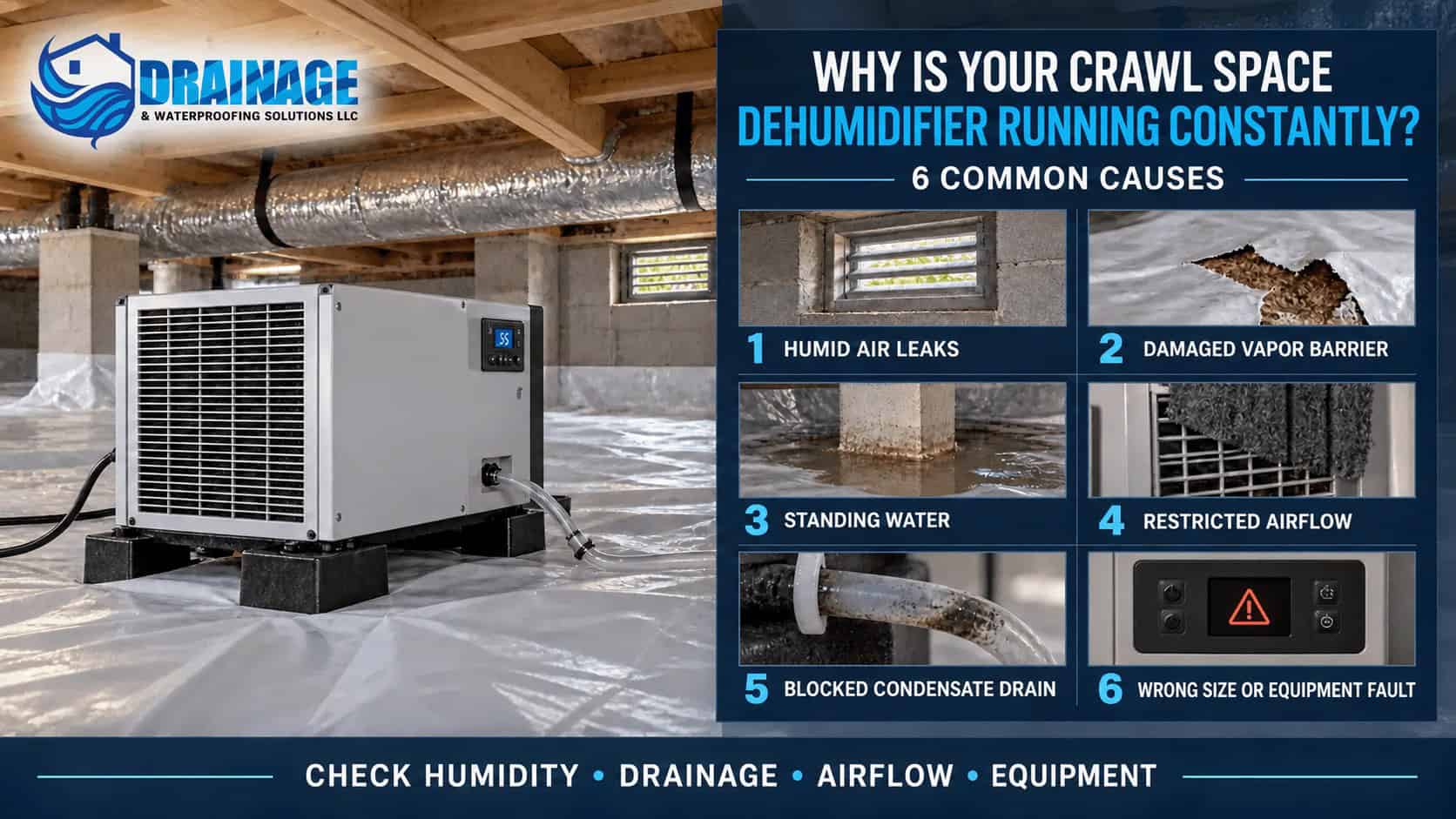
Nine Common Reasons a Crawl Space Dehumidifier Keeps Running
Each crawl space dehumidifier problem should be evaluated as part of the complete moisture-control system. The following causes can occur separately or together.
1. Humid Outdoor Air Is Entering the Crawl Space
In warm, humid conditions, outdoor air can carry more moisture than the crawl-space air. Open vents, a poorly sealed door, gaps at penetrations, and air leaks at the rim joist can continually replace dried air with humid air. The dehumidifier then works against an almost unlimited moisture supply.
2. The Ground Vapor Barrier Is Missing or Incomplete
Bare earth continually releases moisture into crawl-space air. A thin sheet that covers only part of the ground—or has open seams, gaps around columns, detached edges, or punctures—may reduce some evaporation without creating a reliable moisture boundary. EPA guidance specifically identifies bare-earth crawl spaces as common locations for hidden moisture and mold problems.
3. Liquid Water Is Entering
A dehumidifier is designed to remove water vapor from air; it is not a substitute for drainage. Foundation seepage, plumbing leaks, groundwater, roof runoff, negative grading, or water entering through vents can keep materials wet and overwhelm the machine. Standing water or a wet liner requires source control and drainage evaluation.
4. The Humidity Setting Is Too Low
An unnecessarily aggressive set point can force the unit to chase a level the space cannot maintain economically—or may not reach at all during severe weather. Do not select a number by guesswork. Use the equipment instructions, reliable independent measurements, crawl-space design, and professional guidance to establish an appropriate setting.
5. The Filter or Coil Is Dirty
Restricted airflow reduces the volume of moist air moving across the coil. Dust, insulation fibers, pest debris, and a neglected filter can increase run time and reduce water removal. A dirty coil may require service; follow the manufacturer’s instructions and disconnect power before any permitted maintenance.
6. Air Cannot Circulate Through the Space
Blocked intake or discharge openings, poor placement, closed interior zones, hanging insulation, stored materials, or an unusually divided crawl space can create humid pockets. The sensor may repeatedly detect damp air near the unit while other sections receive little drying airflow.
7. Condensate Is Not Draining Correctly
A kinked hose, clogged line, improper slope, failed condensate pump, frozen line, or unsuitable discharge point can interrupt normal operation. Depending on the equipment, a drain problem may cause shutdowns, leaks, cycling, alarms, or reduced performance. Water should leave the system without returning to the crawl space or creating a new foundation problem.
8. The Unit Is Undersized for the Actual Load
Crawl-space square footage matters, but sizing also depends on ceiling height, temperature, air leakage, initial dampness, drainage conditions, and the amount of moisture entering. A unit that is too small may remove water continuously without ever catching up. Adding a larger machine without correcting water entry, however, can merely mask the underlying problem.
9. A Sensor or Mechanical Component Is Failing
A humidity sensor that reads incorrectly, weak fan, icing coil, refrigerant-system problem, control fault, or aging compressor can extend run time while reducing moisture removal. Unusual sounds, repeated icing, burning odors, hot wiring, water leakage, or error codes justify prompt service rather than continued trial-and-error operation.
Important: A Dehumidifier Does Not Replace Drainage
If water is pooling on the liner, entering at the foundation, or keeping soil and wood wet, the priority is to identify and manage the liquid-water source. That may involve exterior runoff, grading, gutters, downspouts, foundation drainage, an interior drainage system, a sump pump, plumbing repair, or a combination appropriate to the property.
Dehumidification controls water vapor. Drainage controls liquid water. A durable crawl-space system may need both.
Safe Checks Homeowners Can Make
Do not enter a crawl space that has standing water near electrical equipment, suspected sewage, exposed wiring, visible structural instability, strong chemical odors, wildlife, or unsafe access. When conditions are safe and the manufacturer permits it, these non-invasive observations can help a professional understand the pattern.
- Record the humidity reading. Note the displayed relative humidity at the same times each day for several days. Compare it with a separate hygrometer if available.
- Check the setting. Confirm that the humidistat was not accidentally lowered and that the unit is not in a continuous-run mode.
- Look for water from the access opening. Observe puddles, wet liner, wall staining, damp soil, plumbing drips, or condensation without disturbing electrical equipment.
- Inspect accessible barrier edges. Look for loose seams, tears, uncovered earth, open vents, or a door that no longer seals.
- Check accessible airflow areas. Make sure belongings, insulation, or debris are not blocking the intake or discharge. Do not dismantle the unit.
- Review the filter instructions. Inspect or replace the filter only as directed by the manufacturer, with power safely disconnected when required.
- Observe the condensate route. Look for obvious kinks, leaks, overflowing containers, or a failed pump alarm. Do not reroute water without knowing where it will discharge.
- Document timing. Note rainfall, outdoor humidity, odors, noises, error codes, and whether the unit ever stops. Photos and a simple log can reveal patterns that a single inspection might miss.
When Should You Call for Help?
Prompt Attention
- Standing water near wiring or equipment
- Burning smell, sparks, or hot electrical components
- Active plumbing leak or sewage
- Rapidly spreading water
- Visible structural sagging or instability
Schedule an Inspection
- Humidity will not reach the setting
- Musty odor or condensation persists
- The liner is wet or damaged
- The unit runs but produces little water
- Run time suddenly changes without obvious weather changes
What Should a Professional Inspection Evaluate?
Replacing a crawl space dehumidifier without examining the surrounding system can leave the original moisture source unresolved. A useful inspection follows the water from outside the home through the crawl space and out through the condensate or drainage system.
| Component | What Should Be Evaluated | Why It Matters |
|---|---|---|
| Humidity conditions | Independent readings in multiple zones and over time | Confirms whether the displayed reading represents the whole space |
| Dehumidifier | Capacity, setting, airflow, coils, sensor, fan, temperature, and water removal | Shows whether the unit is operating as designed |
| Vapor barrier | Coverage, seams, wall attachment, columns, penetrations, tears, and trapped water | Identifies paths for ground moisture and bulk water |
| Crawl-space enclosure | Vents, access door, rim joist, wall openings, and utility penetrations | Reveals humid-air leakage and uncontrolled ventilation |
| Drainage and water entry | Standing water, seepage, plumbing, grading, gutters, downspouts, drains, and sump equipment | Separates vapor control from liquid-water management |
| Condensate disposal | Line slope, blockage, pump function, leaks, termination, and backflow risk | Confirms removed water actually leaves safely |
| Wood and insulation | Moisture readings, staining, decay, microbial growth, condensation, and sagging | Shows the duration and consequences of excessive moisture |
| Air distribution | Obstructions, separated zones, ducting, intake clearance, and discharge direction | Determines whether dry air reaches the entire crawl space |
Drainage & Waterproofing Solutions, LLC lists six-month and yearly inspections for internal drain systems the company installs. Its published inspection components include the internal drain system, sump pump, and dehumidifier with filter change. Homeowners can review the company’s drainage system inspection service and ask whether that inspection or another service fits the system and symptoms at their property.
How Is the Right Solution Chosen?
The dehumidifier’s run time is a symptom, not a complete diagnosis. The best solution corrects the confirmed source of moisture or loss of performance.
| Confirmed Problem | Potential Solution | Important Limitation |
|---|---|---|
| Dirty filter or blocked airflow | Manufacturer-approved cleaning, filter replacement, and clearance correction | Maintenance will not correct active water intrusion |
| Open vents or enclosure leaks | Correct sealing within an appropriate closed-crawl-space design | Changes must remain compatible with code, combustion safety, and system design |
| Damaged or incomplete liner | Repair seams and penetrations or install an appropriate vapor-control system | Do not seal active water beneath the liner without correcting drainage |
| Standing water or seepage | Correct runoff, grading, drainage, plumbing, foundation entry, or sump conditions as diagnosed | A larger dehumidifier is not a liquid-water solution |
| Blocked condensate route | Clear, repair, reroute, or replace the drain or condensate pump as appropriate | The termination must release water safely |
| Insufficient capacity | Select equipment using space volume, temperature, moisture load, and manufacturer performance data | Sizing alone cannot overcome uncontrolled water or air leakage |
| Mechanical or sensor failure | Qualified diagnosis, repair, or replacement | The entire crawl-space system should still be checked after equipment work |
Why Raleigh-Area Crawl Spaces Can Carry a Heavy Moisture Load
Warm-season humidity, storm-driven rain, damp soil, shaded foundations, and slow-drying conditions can keep moisture pressure high beneath Central North Carolina homes. A vented or leaky crawl space may admit humid outdoor air, while runoff and saturated soil can add liquid water from below or around the foundation.
This is why a crawl space dehumidifier should not be evaluated as an isolated appliance. The enclosure, ground barrier, drainage, foundation, plumbing, air circulation, and condensate route all affect how hard it must work.
Research summarized by the U.S. Department of Energy found that closed, conditioned crawl spaces performed better than vented crawl spaces under humid conditions in monitored North Carolina homes. That does not mean every crawl space needs the same design; it reinforces the need to treat moisture control as a building system.
Evidence and Diagnosis
What Does Constant Run Time Prove—and What Does It Not Prove?
Constant operation proves only that the controls are continuing to call for dehumidification—or that a control or mechanical fault is preventing a normal stop. Run time by itself cannot identify the source. The same symptom can result from extreme weather, a wet crawl space that is still drying, outside-air leakage, liquid-water entry, an unsuitable setting, inadequate airflow, incorrect capacity, or equipment failure.
Use Trends, Not One Reading
A single humidity number may reflect sensor location or a temporary condition. Readings taken at consistent times, in more than one representative area, and across wet and dry weather provide better evidence. Record whether humidity is falling, stable, or rising while the machine runs.
Confirm Water Removal
A running fan does not confirm effective dehumidification. Condensate flow, supply-air conditions, coil behavior, error codes, and an independent humidity reading help show whether the unit is actually removing moisture. Equipment testing should follow the manufacturer’s service procedures.
Inspect the Moisture Path
Even a functioning dehumidifier may run continuously when moisture enters faster than it can be removed. Inspecting roof runoff, grading, foundation entry, plumbing, exposed soil, liner seams, vents, access doors, and condensate disposal prevents an appliance-only diagnosis from overlooking the building problem.
Practical takeaway: The strongest diagnosis combines measured humidity trends, evidence of water entry, enclosure conditions, airflow observations, condensate removal, and equipment testing. No single symptom establishes the repair on its own.
How Can You Reduce Future Dehumidifier Stress?
A crawl space dehumidifier performs best when exterior drainage, the ground barrier, enclosure sealing, airflow, and routine equipment maintenance work together.
Control Roof Runoff
Keep gutters functional and route downspout water away from the foundation through an appropriate drainage path.
Correct Surface Drainage
Address low areas, erosion, and slopes that direct rainwater toward the crawl-space foundation.
Maintain the Moisture Barrier
Inspect accessible seams, wall edges, and penetrations after service work or storage activity that could damage the liner.
Follow Equipment Maintenance
Use the manufacturer’s filter, coil, drain, and service schedule rather than waiting for performance to decline.
Monitor, Don’t Guess
Place reliable humidity sensors in representative locations and watch trends across weather changes.
Inspect the Whole System
Have drainage, sump equipment, dehumidification, and the enclosure checked together when performance changes.
Does Constant Operation Mean You Need a New Dehumidifier?
No. Replacement is appropriate when testing shows that the unit is damaged, unreliable, no longer performing to specification, or incorrectly sized for the confirmed load. A new machine will not repair a plumbing leak, stop groundwater, seal open vents, reconnect a vapor barrier, improve grading, or clear a drainage system.
Diagnose first. Then decide whether the solution is maintenance, equipment repair, replacement, drainage work, enclosure repair, or a coordinated combination.
People Also Ask
Frequently Asked Questions
How many hours a day should a crawl space dehumidifier run?
There is no universal number. Run time changes with outdoor humidity, rainfall, crawl-space temperature, initial dampness, air leakage, unit capacity, and the selected humidity level. The more useful measure is whether humidity trends downward and the unit eventually cycles while the space remains dry.
Is it bad for a crawl space dehumidifier to run continuously?
A properly operating unit may run for extended periods under a heavy moisture load, but nonstop operation increases energy use and equipment wear. If humidity never reaches the setting, the space remains damp, or the unit runs through dry conditions, the moisture source and equipment should be evaluated.
Why is my dehumidifier running but the humidity is not dropping?
Possible causes include ongoing water entry, outside-air leakage, an incomplete vapor barrier, blocked airflow, a dirty filter or coil, incorrect sizing, poor air distribution, low crawl-space temperature, sensor error, or mechanical decline. Independent humidity measurements and a system inspection can narrow the cause.
What humidity should I set my crawl space dehumidifier to?
Use the equipment manufacturer’s guidance and the design requirements of your crawl-space system. EPA recommends indoor relative humidity below 60%, ideally 30% to 50% when practical, but a crawl-space setting should reflect seasonal conditions, equipment capability, and professional assessment rather than an arbitrary number.
Should a crawl space dehumidifier run more after heavy rain?
It can. Rain may raise soil moisture, expose foundation seepage, increase water beneath the liner, or add moisture through drainage and air leaks. A temporary increase can be understandable. Repeated nonstop operation after storms suggests that runoff, drainage, foundation entry, or vapor-barrier conditions should be checked.
Can open crawl space vents make a dehumidifier run constantly?
Yes, especially during warm and humid weather. Open vents can continually admit moisture-laden outdoor air, increasing the load. Vent changes should be part of a properly designed and code-compliant crawl-space approach, not an isolated do-it-yourself change.
Can a torn vapor barrier cause long dehumidifier cycles?
Yes. Tears, open seams, uncovered soil, detached wall edges, and unsealed penetrations allow ground moisture into the crawl space. Repairs should restore an appropriate continuous moisture boundary, but any standing water or drainage problem beneath the barrier must also be addressed.
Will a larger dehumidifier solve the problem?
Only if testing confirms inadequate capacity after moisture sources and airflow conditions are addressed. Oversizing or replacing equipment will not correct standing water, a plumbing leak, poor grading, failed drainage, open vents, or barrier defects. Capacity should be selected as part of the complete system.
Why does the crawl space still smell musty with a dehumidifier?
Odors can persist when materials remain damp, hidden water entry continues, microbial growth or contaminated debris is present, the crawl space leaks air, or the unit cannot circulate dry air throughout the space. Moisture correction should come before cosmetic odor treatment.
Who should inspect a constantly running crawl space dehumidifier in Raleigh, NC?
A drainage and waterproofing professional can evaluate the dehumidifier together with the vapor barrier, enclosure, foundation, drainage, sump equipment, condensate route, and exterior water conditions. Equipment-specific electrical or refrigeration repairs may require the appropriate qualified trade. Drainage & Waterproofing Solutions, LLC serves Raleigh and surrounding Central North Carolina communities; call (919) 508-7503 to describe the symptoms and ask which inspection is appropriate.
Solve the Moisture Load, Not Just the Symptom
Request a Crawl Space Moisture and Drainage Evaluation
If your crawl space dehumidifier runs constantly, does not reach its setting, or operates alongside standing water, odors, condensation, or a wet vapor barrier, have the complete moisture pathway evaluated before replacing equipment.
Drainage & Waterproofing Solutions, LLC provides crawl-space repair and encapsulation, sealed crawl-space solutions, drainage services, waterproofing, and inspections for Raleigh and surrounding Central North Carolina service areas.
Related Resources
Editorial Sources
This homeowner guide references moisture-control guidance from the U.S. Environmental Protection Agency, crawl-space building-science information from the U.S. Department of Energy Building America Solution Center, and the North Carolina Residential Code section addressing closed crawl spaces. This content provides general information and does not replace an on-site inspection, manufacturer instructions, or advice from the appropriate licensed trade.