
Basement Water Outage: 7 Safe Next Steps for Raleigh Homes
Quick Answer: A basement water outage is first a safety problem, not a pump-repair problem. If storm water is in the basement and the power is out, do not step into standing water or touch the sump pump, outlet, breaker, furnace, water heater, or electrical panel if anything may be wet. FEMA/Ready.gov flood safety guidance says not to touch electrical equipment if it is wet or if you are standing in water, and to turn off electricity only if it is safe to do so. A backup sump pump may help in some outages, but it cannot fix every water source, mechanical problem, discharge blockage, or long power interruption.
Basement water outage: the safety-first rule
When a Raleigh-area storm knocks out power and water starts collecting near the sump pit, the natural instinct is to go downstairs and “just check the pump.” That is where homeowners can get into trouble. A wet basement can involve electrical hazards, contaminated water, slick surfaces, hidden debris, and equipment that should not be handled until the area is safe.
If you cannot reach the area from dry ground, do not go in. Keep children and pets away. Do not wade through water to reach the sump pump, an outlet, a breaker panel, a furnace, a water heater, a dehumidifier, extension cords, or stored belongings. If there is an immediate threat to life, contact emergency services. If the concern is electrical, contact the utility or a qualified electrician as appropriate.
Floodwater can also carry debris or contaminants and may hide trip hazards. Ready.gov advises avoiding floodwater and not walking, swimming, or driving through it. In a basement, that means the safest next step may be to stay upstairs, document what you can see from a safe location, and wait until power and electrical safety are addressed.
Basement flood safety starts before anyone tries to save a box, reset a breaker, or unplug a pump. During power outage flooding, the safest choice is often to slow down and keep people away from the wet area until the electrical risk is clear.
Drainage & Waterproofing Solutions, LLC is a residential drainage, waterproofing, and moisture-control contractor, not an emergency electrical service. The information below is meant to help you think clearly about basement flood safety, what not to touch, and what details are useful later during an on-site inspection.
Basement flood safety: 7 safe next steps during the outage
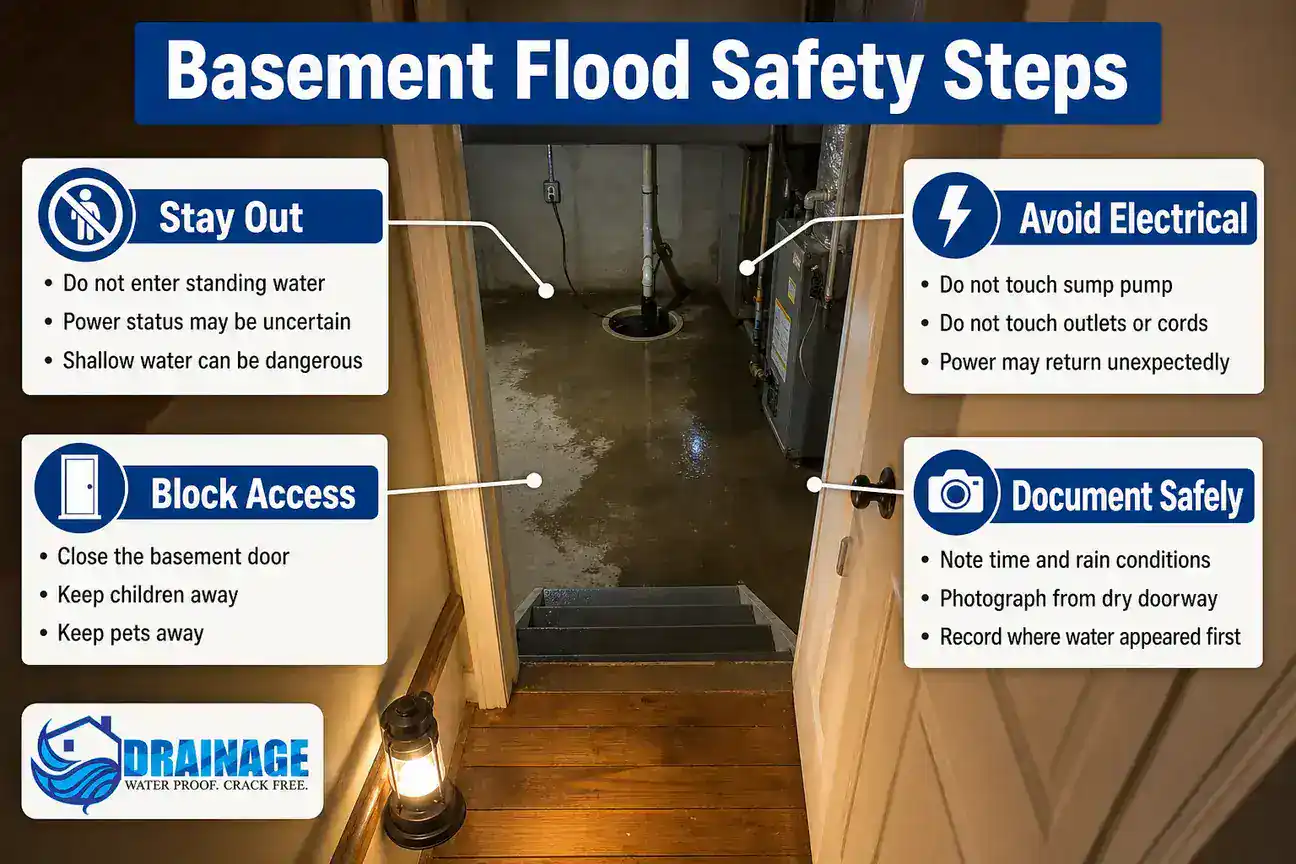
Use these seven steps as a practical order of operations. They are not a substitute for emergency guidance, electrical evaluation, or a property-specific inspection, but they can help reduce risk during power outage flooding.
Step 1: Stay out of standing water
Do not enter the basement if water is on the floor and power status is uncertain, especially if outlets, cords, appliances, or mechanical equipment may be wet. Shallow water can still be dangerous when electricity may be involved.
Step 2: Keep people and pets away
Close the basement door or block access if needed. Children and pets may not understand that a small amount of water can still be unsafe around wiring, outlets, plugged-in equipment, and mechanical systems.
Step 3: Do not touch wet electrical equipment
That includes the sump pump, pump plug, extension cords, outlet, breaker, furnace, water heater, washer, dryer, and dehumidifier. Do not assume equipment is safe because the power is out; power may return unexpectedly.
Step 4: Turn off electricity only if it is safe
If the panel is dry and reachable from a dry surface, Ready.gov says to turn off electricity to help prevent shock. If reaching the panel requires entering water, do not do it yourself.
Step 5: Move valuables only from a safe, dry area
If boxes or furniture can be moved without stepping into water, move them. If not, leave them until the area is safe. Belongings are not worth the risk of entering a wet basement with uncertain electrical conditions.
Step 6: Watch for changing conditions
Stormwater can rise, and outages can last longer than expected. Do not become trapped in a basement trying to save belongings, and do not keep checking the sump pit if conditions are worsening.
Step 7: Document what you can see safely
From a dry location, note the time, rain conditions, water depth if visible, where water appears first, and whether the pump was running before the outage. Photos from a dry landing or doorway can be useful later, but only if you can take them safely.
Those notes matter because a sump pump outage does not always tell you where the water came from. The outage may simply remove the device that normally manages water entering from groundwater, surface runoff, or another source.
Good notes also help separate a sump pump outage from a roof-drainage problem, a grading problem, or a plumbing concern. For basement flood safety, write down what happened only from a dry place where you do not have to touch wet equipment.
Sump pump outage: why the primary pump stopped
A standard electric sump pump depends on utility power. If the circuit has no power, the pump cannot run. That is the simple reason a sump pump outage often shows up when storm conditions cause a power interruption.
That said, “the power went out” and “the pump failed” are not always the same thing. Once the area is safe to evaluate, several conditions may be relevant:
- A utility outage stopped the pump completely.
- A breaker or GFCI interruption cut power to the pump circuit.
- The pump plug was loose or disconnected.
- The float switch was stuck or blocked.
- The discharge pipe was disconnected, frozen, crushed, clogged, or otherwise obstructed.
- The check valve or discharge route was not allowing water to leave properly.
- The pump was running but could not keep up with the water entering the pit.
- The pump had a mechanical problem unrelated to the outage.
Those are possibilities, not a remote diagnosis. A sump pump outage during a storm is often a clue, but it is not enough to identify the water source, the condition of the pump, or the right waterproofing approach.
It also helps to think of the pump as the last defense in the system. Water may be collecting in the sump pit because exterior drainage, grading, foundation drainage, groundwater pressure, or an interior drain system is sending water there. If the pump stops, the symptom becomes visible. The underlying water source may have existed before the outage.
After a sump pump outage, the useful question is not only whether the motor restarted. It is also whether the pit filled unusually fast, whether the discharge route was clear, and whether power outage flooding exposed a drainage condition that had been hidden during normal operation.
What to check only after power returns
After power comes back, do not rush into the basement. The first question is still whether the area is dry and safe enough to approach. Do not reset a breaker, handle a pump plug, move cords, or operate equipment while standing in water or while equipment is wet.
If the floor is dry around the pump area, equipment is not wet, and you can approach safely, you may be able to make simple visual observations:
- Is the sump pump plugged into its outlet?
- Does the float appear free to rise and fall, without debris blocking it?
- Does the discharge pipe appear connected?
- Is the discharge outlet outside visibly blocked by debris?
- Does the pump make unusual noise after power returns?
- Did a breaker or GFCI trip?
Do not reach into standing water. Do not dismantle the pump. Do not bypass safety devices. Do not repeatedly reset a breaker or GFCI that trips again. If the electrical device trips more than once, stop and arrange qualified electrical evaluation.
Once the basement is safe enough to observe, write down the sequence. Did water appear before the outage, during the outage, or only after heavy rain continued? Was the pump running before power failed? Did the water rise at the wall-floor joint, around the sump pit, near a stairwell, or near an appliance? These details can help an inspector separate pump performance from the water source.
After a sump pump outage, do not assume the pump is the only part of the system worth checking. The float, outlet, discharge pipe, exterior outlet, pit, and incoming drain lines all matter, and some observations can only be made safely after the wet area is no longer an electrical concern.
Power outage flooding: groundwater, runoff, or plumbing?
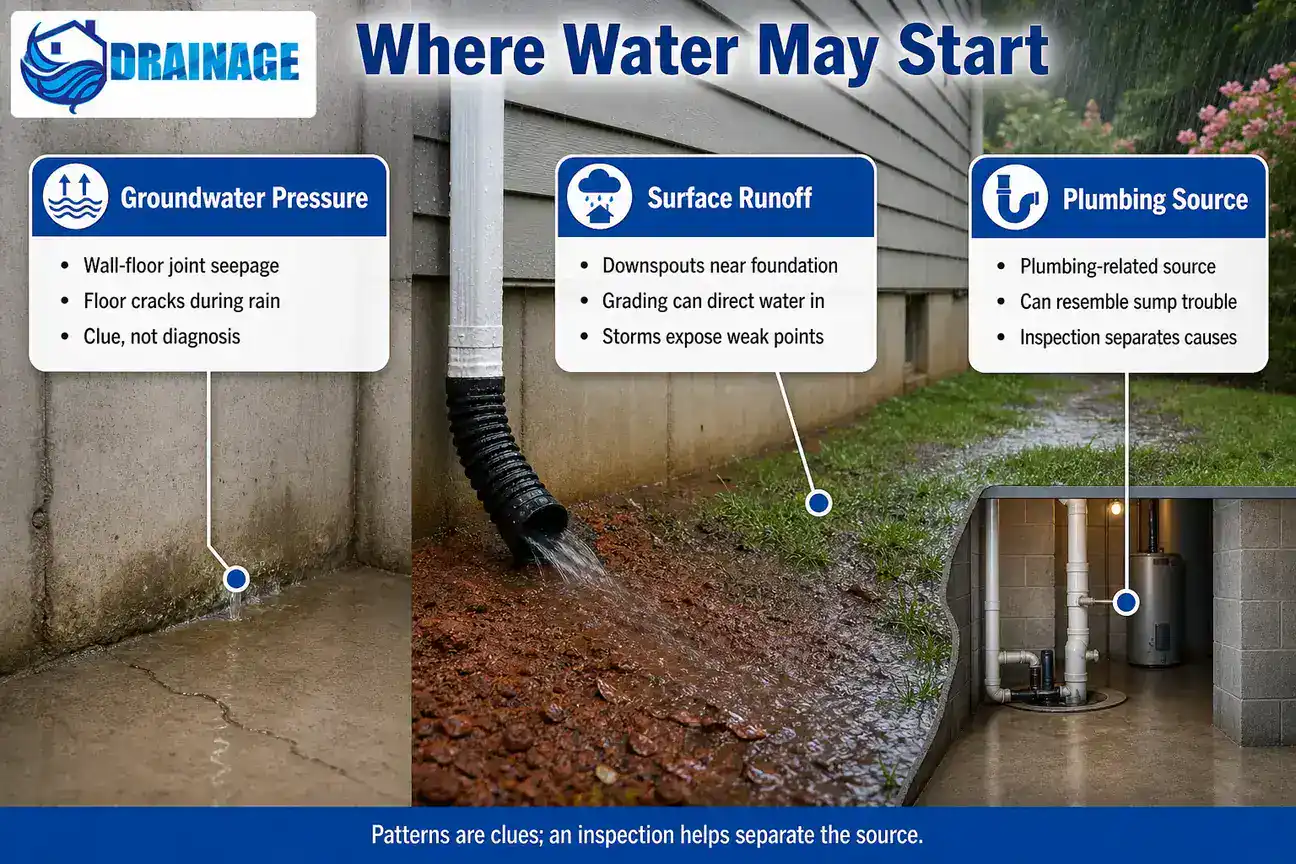
Power outage flooding can make every wet spot look like a sump pump problem. In reality, water may be entering from groundwater pressure, surface runoff, or a plumbing-related source. A homeowner can look for patterns, but pattern recognition is not the same as diagnosis.
For basement flood safety, treat those patterns as clues rather than conclusions. A power outage flooding event may reveal the first visible water, but the same basement may also have grading issues, downspout problems, or groundwater pressure during storms.
| Observation | May be consistent with | Limits of the observation |
|---|---|---|
| Water rises at the wall-floor joint or through floor cracks during or after rain | Groundwater pressure, hydrostatic pressure, or an interior drainage concern | Does not establish the exact entry path or the right repair |
| Water appears near a door, stairwell, window well, downspout, or foundation wall after heavy rain | Surface runoff, poor grading, concentrated roof drainage, or window-well overflow | A site inspection is needed to evaluate slope, discharge, and foundation conditions |
| Water appears near a water heater, washing machine, bathroom, supply line, or drain | Plumbing or appliance leak | A plumber may be the appropriate professional; Drainage & Waterproofing Solutions, LLC does not provide plumbing, sewer, or septic repair |
| Water appears without recent rain and follows a fixture, pipe, or drain line | Plumbing leak, drain issue, or sewer-related concern | Remote observations cannot distinguish all plumbing or sewer causes |
| Musty air, damp materials, or elevated humidity remain after visible water is removed | Ongoing moisture, wet materials, condensation, or inadequate moisture control | The company does not provide mold testing, mold remediation, or health assessments |
Groundwater can enter through joints, floor cracks, wall cracks, porous materials, or pressure against the foundation after intense or prolonged rain. If that pattern is confirmed on site, solutions may involve interior drainage, sump equipment, or foundation waterproofing, depending on the structure and water source.
Surface runoff is different. It may come from roof water dumping near the foundation, downspouts discharging too close to the house, soil sloping toward the wall, overwhelmed yard drainage, or stormwater concentrating near a low entry point. In those conditions, French drain installation, grading improvements, downspout management, or other drainage changes may be considered after a site inspection.
Plumbing water is different again. A supply line, appliance, fixture, drain, sewer connection, or water heater can create water that has nothing to do with rainfall or groundwater. If water appears near plumbing fixtures, follows a pipe, smells like a drain issue, or occurs without rain, a plumber may be the right first call.
One power outage flooding event can involve more than one clue. Water at the sump pit may appear at the same time as runoff near a basement stairwell, or damp air may remain after standing water is removed. That is why a site inspection looks at the whole drainage path rather than only the pump.
Backup sump pump limits homeowners should understand
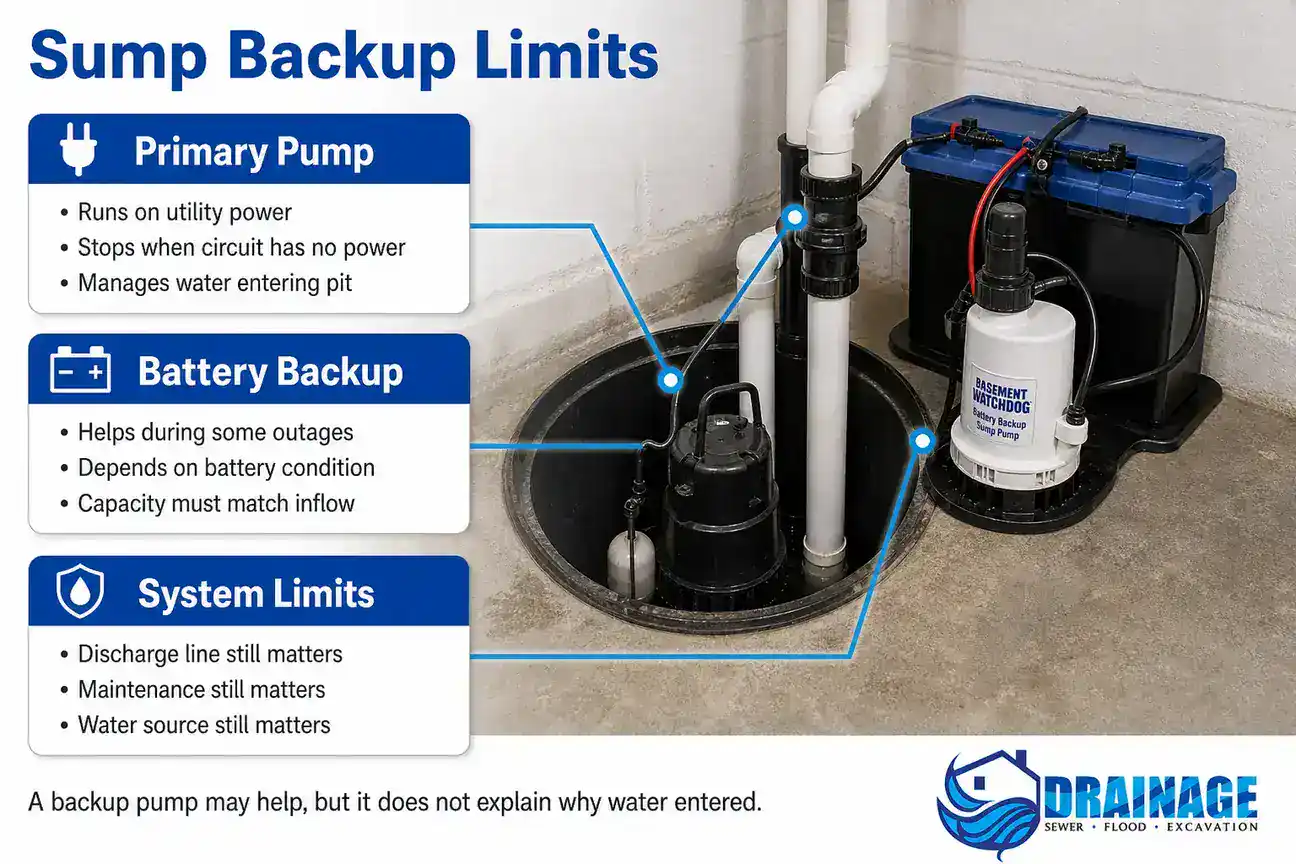
A backup sump pump can be useful in some outage situations, and Ready.gov tells homeowners to consider a sump pump with a battery. The important word is consider. A battery backup is not an automatic answer for every basement water event, and it does not remove the need to understand why water is reaching the basement in the first place.
A backup sump pump may help keep an appropriately designed sump system operating when utility power is unavailable. Its usefulness depends on battery condition, pump capacity, water inflow, the discharge line, the pump pit, and maintenance. If incoming water is modest and the backup equipment is in good condition, it may reduce the chance that water overtops the pit during a shorter outage.
But a backup sump pump cannot restore power to the home. It cannot repair a failed primary pump. It cannot clear a blocked discharge line. It cannot correct poor grading, redirect roof runoff, seal every foundation entry point, or repair a plumbing leak. It also cannot promise protection through a prolonged outage, especially if water is entering faster than the backup can pump or longer than the battery can support.
That is why a backup sump pump should be treated as one layer in a broader water-management plan. During an on-site inspection, the bigger question is not just “Do I need a backup?” It is “Where is the water coming from, how is it supposed to leave, and what happens when one part of the system cannot operate?”
A backup sump pump is also different from general moisture control. It may move water from a sump pit during an outage, but it will not dry wet materials, correct humidity, or solve moisture entering through a crawl space. Those conditions need to be evaluated separately.
How basement moisture control fits after the water is gone
After visible water is removed and electrical safety is addressed, moisture can still remain in flooring, walls, framing, stored belongings, insulation, and adjacent crawl-space materials. The absence of standing water does not mean the space is dry.
EPA mold and moisture guidance emphasizes controlling moisture and addressing wet materials. For homeowners, the practical takeaway is simple: dry what can be dried safely, remove or isolate wet belongings when appropriate, and correct the water source rather than relying only on air movement or a dehumidifier.
A dehumidifier may help manage residual humidity after safe power restoration, but it is not a substitute for correcting water entry. If the sump pit keeps filling, a wall-floor joint stays damp, or musty conditions return after storms, humidity control alone may not solve the problem.
This is where basement moisture control and drainage evaluation overlap. One house may need improved exterior drainage. Another may need an interior drain system. Another may need vapor-control work in a crawl space. Some homes need more than one measure because stormwater, groundwater, and indoor humidity can show up together.
Drainage & Waterproofing Solutions, LLC does not provide mold testing, mold remediation, or health assessments. If mold cleanup is a concern, follow EPA guidance and use the appropriate professional for that work.
What an on-site inspection looks for after power outage flooding
An on-site inspection matters because safe observations from the stairs cannot answer every question. A waterproofing and drainage evaluation looks at how water approaches the home, how it enters or collects, where it should drain, and which parts of the system are working or not working.
After power outage flooding, an inspector will want to understand both the outage event and the normal drainage conditions around the home. A sump pump outage may be one symptom, but the inspection also considers whether water is being directed toward the foundation before it ever reaches the pit.
Depending on the home, an inspection may consider:
- Where water first appears inside the basement or crawl space.
- Whether the sump pit receives water from an interior drain system.
- Whether the pump and discharge route appear appropriate for the water being collected.
- Whether exterior grading sends water toward or away from the foundation.
- Whether downspouts, roof drainage, patios, walkways, or low areas concentrate runoff.
- Whether wall-floor joints, floor cracks, or foundation walls show moisture patterns.
- Whether crawl-space vapor control, drainage, or encapsulation should be evaluated separately.
- Whether the signs point toward plumbing, sewer, septic, or structural concerns that require another professional.
The Building America Solution Center guidance on drains and sump pumps is a helpful technical reference for the idea that basements and crawl spaces may use drain or sump-pump systems to manage water. The right system still depends on the property, foundation, soil conditions, discharge route, and maintenance.
If an interior system, crawl-space system, or waterproofing approach is appropriate, crawl space and basement waterproofing options are considered based on the confirmed water source. The goal is not to sell the same fix for every wet basement. The goal is to match the fix to the path water is taking.
Drainage fixes are not interchangeable
Waterproofing conversations can get confusing because several fixes sound similar. A French drain, an interior drain system, grading correction, foundation waterproofing, encapsulation, vapor barrier, dehumidifier, and sump pump all address different parts of a moisture problem.
For example, a yard drainage improvement may help when runoff collects against the foundation. Foundation waterproofing may be considered where foundation water entry is part of the issue. Interior drainage may be appropriate when water must be collected and directed to a sump. Moisture control may be needed when humidity remains after bulk water is handled. Crawl-space encapsulation may be considered when the crawl space has its own vapor and moisture concerns.
Exterior drainage work also needs to be planned carefully. Water should not be routed onto a neighbor’s property or into a sanitary sewer. If digging is involved, homeowners should contact NC 811 before excavation near utilities. Around a house, NC State Extension’s guidance on modifying soil around the home explains that soils near homes are often disturbed or compacted, which is one reason grading and drainage conditions need to be evaluated on site rather than guessed from the surface.
Closed or sealed crawl-space work can require a permit in North Carolina, depending on the project and local requirements. The NC Office of State Fire Marshal interpretation on closed crawl spaces is one reason homeowners should confirm requirements with the local building department before work begins. Do not assume every project has the same permit path.
A backup sump pump may belong in that larger plan, but it should not be used to ignore grading, roof runoff, blocked discharge, or repeated water entry. Likewise, basement flood safety during an outage does not end the moment the water level drops; damp materials and the original water path still need attention.
When to request a drainage or waterproofing inspection
After the immediate safety issue is over, an inspection makes sense when water returns after storms, the sump pump repeatedly struggles, or you cannot tell whether the source is groundwater, runoff, or plumbing. It also makes sense when the yard stays saturated near the foundation, downspouts discharge near basement walls, or a crawl space stays damp or musty.
For homeowners within 60 miles of Raleigh/Garner, Drainage & Waterproofing Solutions, LLC offers a free written estimate that includes an on-site inspection, a written plan, a written quote, and an estimated timeline. You can request a free estimate or call (919) 508-7503 during normal business hours. Outside that radius, a $200 trip/estimate charge applies.
If your notes show repeated power outage flooding or more than one sump pump outage during storm season, bring that information to the estimate appointment. It can help the inspection focus on the pump, the discharge route, the grading, and any water path that may be overloading the system.
For customers with internal drain systems installed by Drainage & Waterproofing Solutions, LLC, drainage system inspections are available as six-month or yearly maintenance inspections. The $150 appointment applies only to internal drain systems the company installed and includes the internal drain system, sump pump, and dehumidifier inspection with filter change.
Neither an estimate nor a maintenance inspection should be treated as emergency service. During an active electrical or flood-safety hazard, stay out of the water and contact the appropriate emergency, utility, electrical, or plumbing professional as the situation requires.
Local Raleigh storm conditions can expose weak points
In Raleigh and the Triangle, a hard summer storm or rain from a tropical system can reveal drainage weaknesses around a house. Many local properties also have clayey or compacted soils near the foundation, especially where soil was disturbed during construction or landscaping. Those local conditions do not diagnose a specific basement, but they do explain why grading, downspouts, sump performance, and discharge routes matter.
A sump pump outage during a storm may be the event that gets your attention, but the long-term question is usually broader. Is roof water being moved away from the foundation? Does the yard slope properly? Is the sump system collecting water the way it should? Is the discharge route clear? Is the basement or crawl space still damp after visible water is gone?
Those questions are best answered on site. A safe, careful inspection can separate a one-time power outage flooding event from a recurring drainage or waterproofing problem. It can also identify when the right recommendation is not a waterproofing repair at all, but a plumber, electrician, or structural engineer.
Practical records to keep after a sump pump outage
Good notes help avoid guesswork later. If you can gather information safely, record the date, approximate time of the outage, when power returned, whether the pump ran after power returned, and where water appeared first. Take photos from dry areas if you can do so safely.
Note whether the water showed up during active rain, after the heaviest rain, or without recent rain. Record whether downspouts were overflowing, gutters were backed up, window wells filled, or water collected near a basement door or stairwell. These details help distinguish a basement flood safety event from a drainage-design issue.
If the sump pump makes noise, cycles rapidly, runs continuously, or fails to start after power returns, write that down. If a breaker or GFCI trips again, stop resetting it and arrange electrical evaluation. Repeated tripping is not something to work around.
If dampness, odors, or high humidity remain after cleanup, note where they are strongest. That information may point toward residual wet materials, condensation, crawl-space moisture, or a remaining water source. It does not prove mold type, health risk, or structural failure, and those claims should not be made without the right professional evaluation.
These records are especially helpful when a backup sump pump is being considered. The notes can show whether the outage was the main problem, whether the pump pit filled too quickly, or whether water entered from a place the sump system was never designed to collect.
Final safe takeaway
A basement water outage should be handled in this order: protect people first, avoid wet electrical equipment, wait for safe conditions before checking anything, then document what happened. A sump pump outage may explain why water was not pumped out, but it does not automatically explain why water entered the basement.
A backup sump pump may be part of a preparedness plan, but it has limits. Drainage, grading, foundation entry points, pump capacity, discharge conditions, moisture control, and maintenance all matter. The right next step depends on what the water is doing at your property.
Basement flood safety and power outage flooding both come back to the same practical point: do not treat a wet, dark basement as a do-it-yourself pump check. Stay safe first, then use a careful inspection to understand the water source.
This article is general homeowner information. The right drainage or waterproofing solution depends on an on-site inspection of your property.
Frequently Asked Questions
What should I do first if my basement starts taking on water during a power outage?
Stay out of standing water and do not touch wet electrical equipment. If electricity can be turned off safely from a dry location, do that; otherwise, leave the area and contact the appropriate utility, emergency service, or electrical professional.
Can I reset the breaker or GFCI for my sump pump?
Only after power has returned and the area is dry and safe to approach. Do not reset a breaker or GFCI while standing in water or while equipment is wet. If it trips again, stop resetting it and arrange qualified electrical evaluation.
Does a power outage cause basement water?
The outage may stop the primary electric sump pump, but it does not necessarily cause the water. Water may already be entering from groundwater, surface runoff, or a plumbing-related source, and the outage may simply remove the system that normally pumps it away.
Will a battery-backup sump pump prevent all basement flooding?
No. A battery backup may help operate a compatible pump during a utility outage, but it cannot correct groundwater entry, grading problems, a blocked discharge, a plumbing leak, or every mechanical failure. Its performance also depends on battery condition, pump capacity, and the length of the outage.
How can I tell whether the water is from groundwater or a plumbing leak?
Look at timing and location, but do not treat those observations as a diagnosis. Rain-related water at foundation joints or low exterior areas may be consistent with groundwater or runoff. Water near fixtures, appliances, supply lines, or drains may require a plumber.
Should I run a dehumidifier after the power comes back?
Only after the electrical system and equipment are safe to use. A dehumidifier may help manage residual humidity, but it does not replace correcting the source of water or drying wet materials.
When should I request an inspection?
Request an on-site inspection when water returns after storms, the sump pump repeatedly struggles, drainage around the foundation is unclear, or a crawl space or basement remains damp. Drainage & Waterproofing Solutions, LLC’s free estimate within 60 miles of Raleigh/Garner includes an on-site inspection, written plan, written quote, and estimated timeline.
Sources
- FEMA/Ready.gov: Floods, flood safety guidance
- EPA: A Brief Guide to Mold, Moisture and Your Home
- Building America Solution Center: Drain or Sump Pump Installed in Basements or Crawlspaces
- NC State Extension: Modifying Soil for Plant Growth Around Your Home
- NC Office of State Fire Marshal: 106.1 Permit Required, Closed Crawl Space