
Why Your Sump Pump Runs After Rain: 7 Safe Checks to Avoid Risk
Quick Answer: If your sump pump runs after rain, it may be doing its job while saturated soil and foundation drainage continue sending water into the basin. It becomes more concerning when the pump short-cycles, the water level does not fall, the discharge outlet sends water back toward the house, or the basin refills immediately after shutoff. Make only safe visual checks from a dry location; do not enter flooded areas, handle wiring, or open energized equipment.
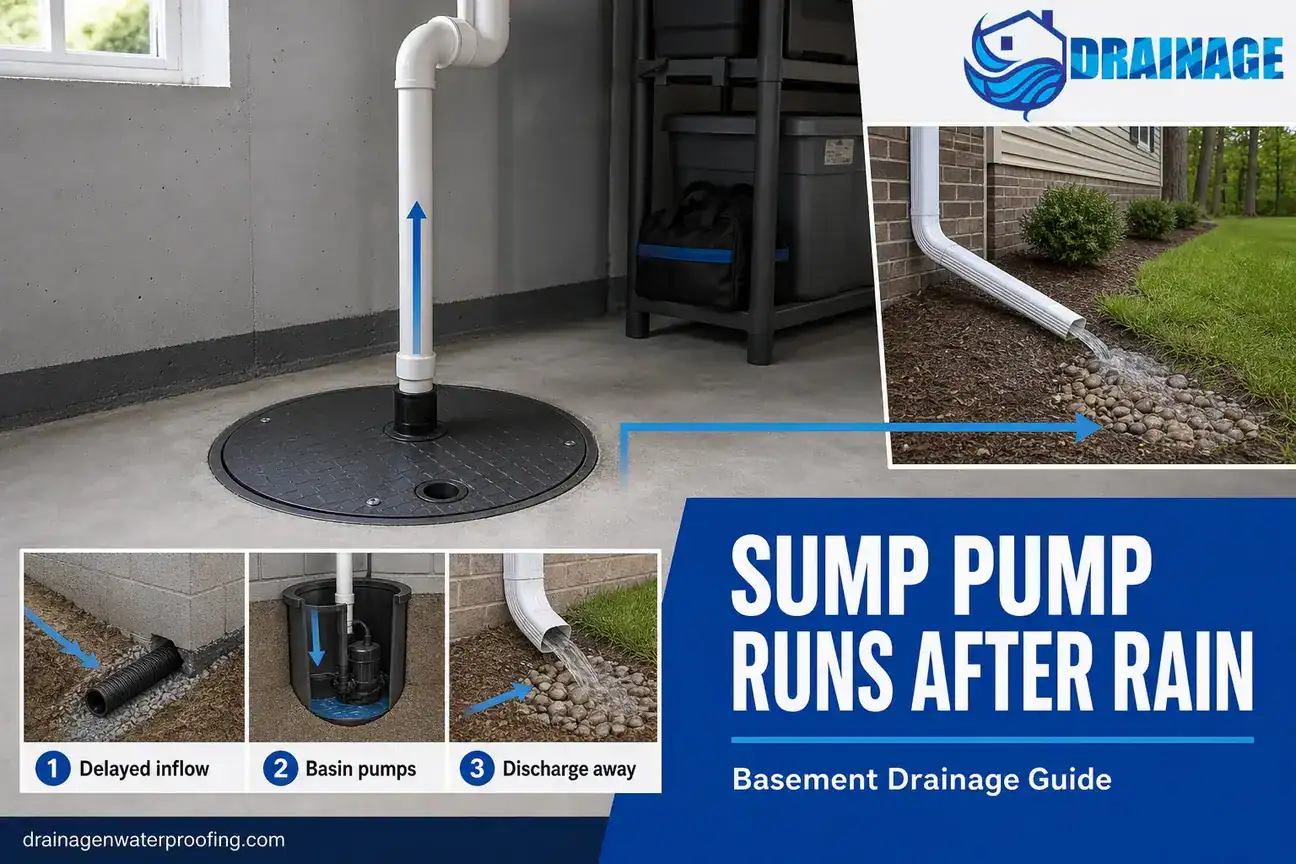
Featured image note: Homeowner observing a covered sump pump basin from a dry, safe location after a storm.
In Garner, Raleigh, and the Triangle, a hard summer storm can leave soil wet long after the rain stops. Piedmont clay soils, roof runoff, low yard areas, and below-grade basement or crawl-space drainage can all keep water moving toward the lowest collection point. The question is whether your pump is simply handling delayed inflow, or whether the system is recycling water, fighting a blockage, or pointing to a broader drainage issue.
This guide walks through a practical post-rain diagnosis: how the pump is cycling, what the discharge line is doing, what check-valve trouble may look like, how to read basin water behavior, and when to stop troubleshooting. Drainage & Waterproofing Solutions, LLC provides drainage and waterproofing services in the Raleigh/Garner area, but an on-site inspection is what determines the right system for a specific property.
Why sump pump runs after rain can point to more than one water source
A sump pump is not just responding to rain that falls at the moment you hear it run. It may be responding to water that has already soaked into the ground and is still moving toward the foundation. In its 2026 guidance, the Building America Solution Center sump pump guidance says to “Install a drain or sump pump in homes with a basement or crawlspace,” and its installation guidance describes collecting drainage water and discharging it away from the building.
That means post-rain operation can be normal in some cases. If water is actively entering the basin and the pump lowers it each time, the pump may simply be keeping up with delayed inflow. There is no universal safe run time because each home has different rainfall exposure, soil, grading, foundation drainage, discharge routing, pump capacity, and groundwater conditions.
The pattern matters more than the clock. A pump running for a while after heavy rain is different from a pump that turns on every minute, runs but fails to lower the water, or shuts off and immediately receives a rush of water back into the basin.
A practical way to think about it is this: the pump is the last part of the water path you can hear. The real problem may be outside in the grading, at the roof-water discharge, in the discharge pipe, around the foundation, or in the basin itself.
How to read a sump pump after storm pattern
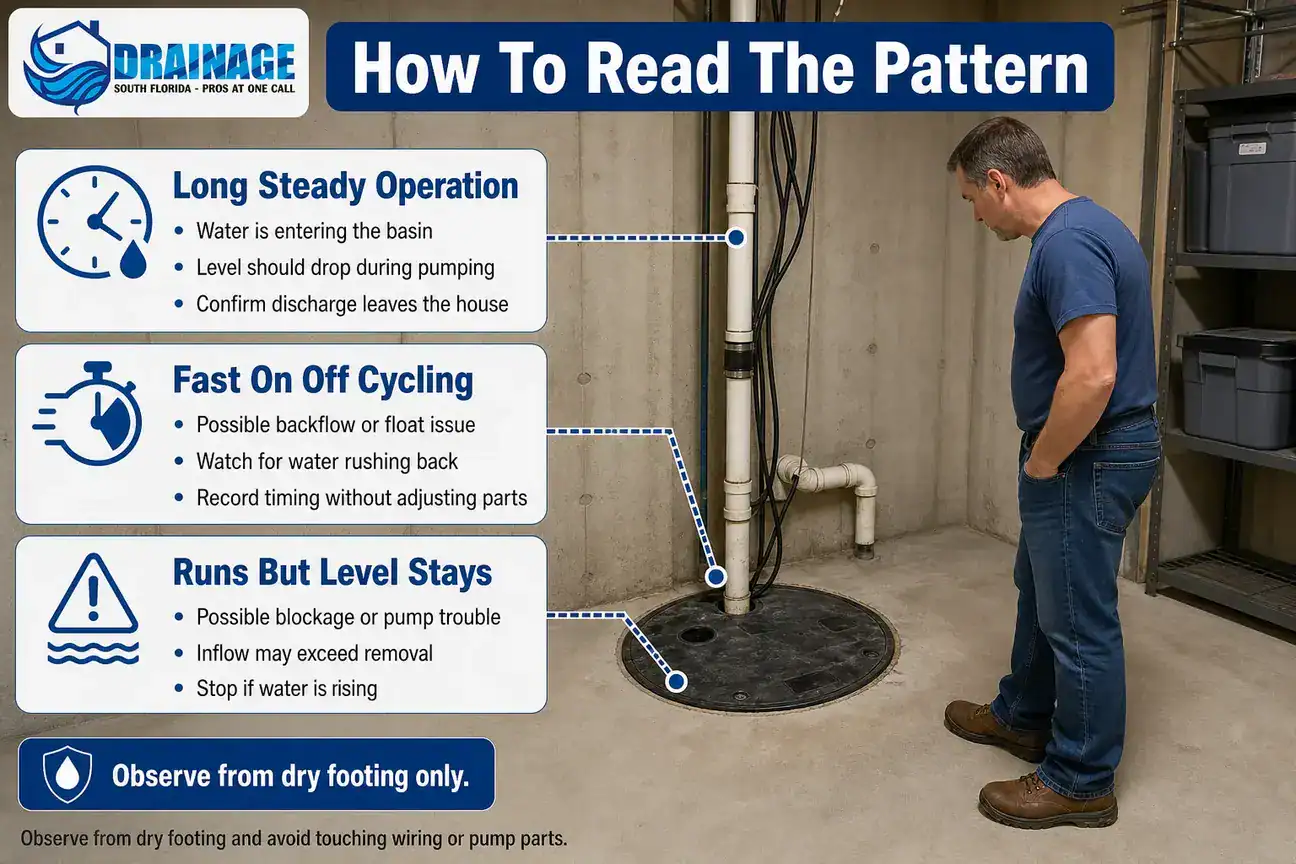
A sump pump after storm pattern gives you clues about where the water is coming from and whether the pump is keeping up. Stand in a dry, safe place and observe the pattern without touching wiring, reaching into the pit, or removing the cover.
| What you notice after rain | What it may mean | What to watch next |
|---|---|---|
| Long, steady operation while water is entering | Delayed groundwater or foundation drainage may still be flowing to the basin | Confirm that the water level drops during pumping and that discharge leaves the house |
| Fast on/off cycling | Possible backflow, float issue, high inflow, small basin, or component problem | Note whether water rushes back right after shutoff |
| Pump runs but basin water does not fall | Possible discharge obstruction, pump issue, or inflow exceeding capacity | Stop DIY work if water keeps rising or electrical hazards are present |
| Basin refills immediately after shutoff | Possible check-valve backflow, very high inflow, or poor discharge routing | Look outside for where discharge water is going |
| Pump runs even when the visible water level appears low | Possible float, switch, basin, or pump issue | Do not open energized equipment; arrange qualified diagnosis |
The phrase sump pump after storm can describe several different behaviors, so avoid jumping straight to “the pump is bad.” A pump can be working correctly while the property still has a water-management issue. It can also be struggling because the discharge line is blocked or because water is returning to the basin after every cycle.
If that post-rain pattern repeats after nearly every rainfall, write down a few details: storm intensity, how soon the pump starts, how often it cycles, whether the outlet is flowing, and whether basement or crawl-space moisture appears afterward. Those observations help narrow the water source during an inspection.
A useful note might be as simple as: “The pump starts about 20 minutes after heavy rain, runs often for several hours, and the discharge outlet is flowing away from the house.” Another useful note might be: “The pump shuts off, then the basin refills right away.” Those two patterns point to different questions.
Could lingering groundwater be normal after heavy rain?
After a soaking rain, water does not disappear from the soil as soon as clouds clear. It can continue moving through the ground toward the lowest path. If your home has foundation drainage that routes water to a sump basin, that drainage may keep delivering water until the surrounding soil conditions ease.
In the Raleigh/Garner area, many homeowners deal with tight clay soils and low areas that hold water. NC State Extension’s soil guidance discusses soil modification around homes, a reminder that soil conditions can affect how water moves and drains around a property. That does not mean clay is automatically the cause at your house, but it is one reason local grading and drainage deserve attention.
A normal-looking cycle usually has a few features. Water enters the basin, the pump turns on, the water level falls, and the pump shuts off. The basin may refill later, but not necessarily instantly. The discharge outlet sends water away from the building rather than toward the foundation.
The same run time becomes more concerning if it comes with warning signs. These include water rising despite pump operation, rapid cycling, a discharge outlet that dumps beside the house, a basin that refills immediately, or unusual sound, odor, heat, or repeated breaker trips.
There is also a difference between “the pump ran for a while after one unusually heavy storm” and “the pump runs hard after every moderate rainfall.” The second pattern often points to a recurring water source such as poor slope, roof-water concentration, a low yard area, hydrostatic pressure, or an interior drainage system receiving more water than expected.
If the sump pump basin water rises slowly and drops each time the pump runs, lingering groundwater may be part of the picture. If it rises instantly after the pump shuts off, the next questions are different: where is that returning water coming from, and is a discharge or backflow issue involved?
Is there a sump pump discharge problem outside?
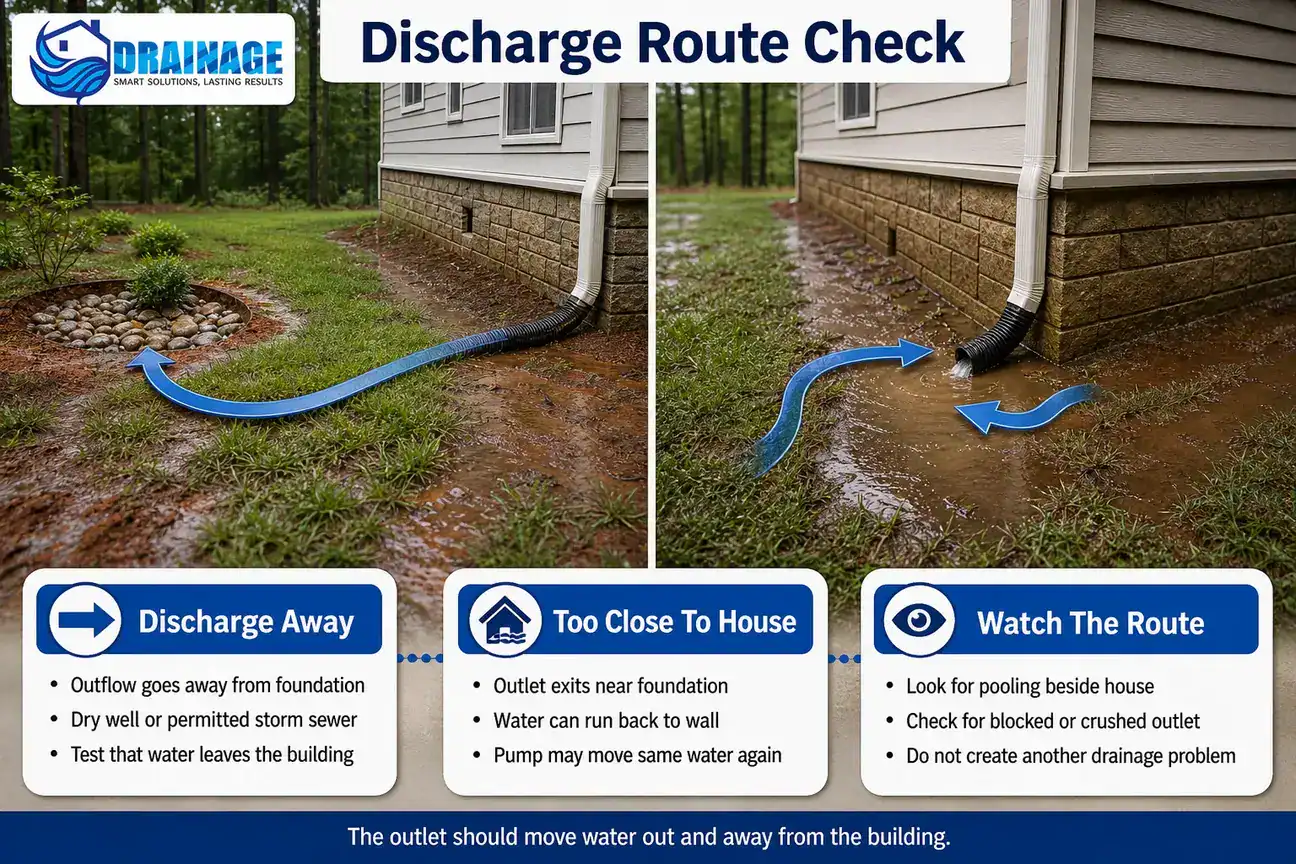
A sump pump discharge problem is one of the first things to consider after rain because the system is supposed to move water away from the building, not simply out of the pit. If discharge water exits too close to the foundation, runs back toward a basement wall, or pools beside the house, the pump may end up moving some of the same water repeatedly.
The 2026 Building America Solution Center sump pump guidance states, “The outflow from the sump pit must be directed to a storm sewer (if permitted by your local municipality) or a dry well away from the foundation.” That source also says to “Test the sump pump system to ensure that water is properly discharged out and away from the building.” Existing homes vary, so treat this as installation guidance and not a promise that every system is currently routed correctly.
Start outside if you can do so safely. Confirm that the discharge outlet is visible and not obviously crushed, disconnected, buried in mulch, blocked by debris, or aimed back toward the house. Look for water pooling at the foundation, at a crawl-space access, near a basement wall, or in a low area that drains back toward the building.
A sump pump discharge problem may also be hidden. A buried pipe can be crushed, clogged, disconnected, or routed to a location that cannot accept water during storms. If the pump sounds like it is working but little or no water appears at the outlet, stop short of digging or rerouting the line yourself.
Repeated discharge trouble can make the pump seem undersized even when the pump is moving water. If water leaves the pipe and then flows right back toward the foundation, the system is not finishing the job. That is a drainage-path issue, not just a pump-cycle issue.
Do not send sump water toward a neighbor’s property or into a sanitary sewer. Local stormwater rules and site conditions matter. Homeowners should check the rules that apply to their property before changing discharge routing, especially when water may reach public drainage systems or nearby properties.
If excavation is being considered, call NC 811 before digging so underground utilities can be marked. This is especially important when discharge lines, French drains, downspout extensions, or other buried drainage features may be involved. A safe drainage plan considers where water starts, where it travels, and where it can be discharged without creating a new problem.
What a sump pump check valve issue can and cannot prove
A sump pump check valve is meant to help prevent water in the discharge pipe from flowing back into the basin after the pump shuts off. The 2026 Building America Solution Center sump pump installation guidance includes “the discharge pipe with the check valve” as part of the described system. If that valve is missing, stuck, installed incorrectly, or no longer holding, water in the vertical or sloped discharge pipe may drain back to the pit.
The classic clue is immediate restart. The pump runs, shuts off, and then you hear or see water rush back into the basin. The basin level rises quickly, the pump turns back on, and the cycle repeats. That can look like a pump problem when the real issue may be backflow in the discharge assembly.
Still, a sump pump check valve symptom is not a diagnosis by itself. High inflow, a float issue, a small basin, discharge restriction, or pump capacity problem can look similar. Do not disassemble the pump, loosen piping, or handle electrical parts while troubleshooting.
Timing is the clue homeowners can safely record. If a check-valve problem is suspected, note whether water returns immediately after shutoff or whether the basin rises gradually over time. Immediate return can suggest backflow; gradual rise may suggest ongoing inflow from the surrounding drainage system.
| Observed symptom | What it may suggest | Appropriate next step |
|---|---|---|
| Water rushes back after shutdown | Possible backflow through the discharge pipe | Have the discharge assembly evaluated by the appropriate professional |
| Immediate restart after shutoff | Possible backflow, high inflow, or cycling issue | Observe safely and arrange an inspection if it repeats |
| Rapid on/off cycling during rain | Possible sump pump check valve, float, basin, pump, or inflow issue | Stop DIY component work and seek qualified diagnosis |
| Pump runs but water level does not fall | Possible obstruction, pump problem, or inflow exceeding removal | Treat as a potential water-entry risk, especially if water is rising |
If you suspect the sump pump check valve is part of the problem, describe the timing rather than trying to repair it while the area is wet. For example: “The pump shuts off, I hear water rush back, and it restarts within seconds.” That kind of observation is more useful and safer than opening the system.
Drainage & Waterproofing Solutions, LLC does not provide plumbing, sewer, or septic repair. If the issue is a pump component, a plumbing connection, or a supply or sewer line, a plumber or other qualified pump professional may be the right call. If the issue is the water source, discharge routing, interior drainage, or basement/crawl-space moisture pattern, a drainage and waterproofing inspection may be appropriate.
How sump pump basin water behavior helps narrow the issue
The way sump pump basin water rises and falls tells you a lot. Watch from a dry, safe spot only. Do not remove a mechanically fastened cover, reach into the basin, handle wiring, or stand in water while observing the pump.
The Building America guidance says “The sump pump should be located in the lowest spot of the floor” and recommends selecting “a sump pump with a tight fitting, gasketed cover that is mechanically fastened.” These are installation recommendations, and existing systems may vary. A displaced or poorly fitted cover, visible debris, sediment, or unusual basin conditions can affect what you observe.
If sump pump basin water falls while the pump runs, the pump is at least moving water out of the pit at that moment. If it falls and then slowly rises again, the system may still be receiving groundwater or foundation-drainage inflow. If it falls and immediately rises with a rush of returning water, backflow or discharge routing should be considered.
If the water level does not fall while the pump is running, stop treating it as a simple “normal after rain” issue. The discharge line may be blocked, the pump may not be moving water effectively, or inflow may be exceeding the system’s ability to remove it. Rising water near electrical equipment is not a DIY troubleshooting situation.
Watch for the relationship between sump pump basin water and pump sound. A pump that hums while the water level does not change is different from a pump that clearly moves water down. A pump that shuts off and then receives a rush of returning water is different again.
Listen as well as look. Grinding, humming without visible water movement, loud vibration, repeated clicking, or a change in normal pump sound can be useful information. Avoid touching the pump to “see if it is hot,” and do not bypass switches, cords, breakers, or safety devices.
7 safe homeowner checks before you call someone
Safe checks should be visual, exterior when possible, and done from dry footing. You are gathering clues, not repairing energized equipment. If the basement or crawl space is wet, dark, or close to outlets, appliances, cords, or electrical equipment, stop and leave the area.
1. Confirm the pump cycle from dry footing
From a dry location, observe whether the pump starts, runs, and shuts off. Do not lean over an open pit, move cords, remove pump parts, or stand in water while watching. Your goal is only to understand the cycle pattern.
2. Watch whether the basin level falls
Note whether the visible water level drops during operation. If the pump runs and the water level does not fall, the issue may involve discharge blockage, pump trouble, or inflow exceeding removal. Do not reach into the basin to test anything.
3. Listen for unusual noise without touching equipment
Listen for grinding, humming, repeated clicking, heavy vibration, or a sound that is different from normal operation. Sound can be useful information, but it is not a reason to touch the pump, wiring, or piping.
4. Note rapid cycling or immediate refill
Watch whether the pump shuts off and restarts within seconds. Immediate refill may point to backflow, heavy inflow, float issues, basin conditions, or discharge restrictions. Record the timing instead of trying to open or adjust components.
5. Look outside for the discharge outlet
If you can safely walk outside, look for the outlet and whether water is actually leaving the house. A visible sump pump discharge problem may include a crushed, disconnected, buried, blocked, or poorly aimed outlet.
6. Check whether discharge water returns toward the home
Look for water pooling near the foundation or flowing back toward basement walls, crawl-space doors, or low foundation areas. Do not reroute water toward a neighbor, sidewalk, driveway, public system, or sanitary sewer.
7. Write down the post-rain pattern
Record whether the sump pump after storm pattern is steady, rapid, or immediate-refill cycling. Also note rainfall intensity, when the pump starts, whether the outlet flows, and whether basement or crawl-space moisture appears afterward.
Safety note: Do not enter a flooded basement or crawl space near energized outlets, appliances, cords, panels, or equipment. Do not open electrical components, remove pump parts, or reach into the basin while standing in water. If water is rising, electrical hazards are present, or you smell burning or see smoke or sparking, leave the area and contact the appropriate qualified professional.
Visible moisture and musty odors should be handled as moisture-control issues, not guessed mold diagnoses. The EPA’s mold and moisture guidance emphasizes fixing moisture problems and cleaning up mold. Drainage & Waterproofing Solutions, LLC does not provide mold testing, mold remediation, or health assessments.
When post-rain pumping points beyond the pump
Sometimes the pump is working, but the property is sending it too much water. In that case, replacing pump parts may not solve the bigger pattern. The question becomes: why is so much water reaching the basin after rain?
Common contributors include grading and slope that send runoff toward the house, roof-water discharge too close to the foundation, low yard areas that hold stormwater, foundation drainage that is receiving sustained inflow, or an interior drain system carrying water to the sump from the wall-floor area.
The Building America site-drainage guidance focuses on drainage practices that help minimize localized flooding around homes. Its site drainage practices resource is a useful reminder that managing water outside the structure matters before water reaches the basement or crawl space.
A recurring post-storm pump pattern may also be tied to hydrostatic pressure. That term simply means water pressure in the soil can push moisture toward below-grade areas. You do not need to diagnose that yourself. What you can note is whether water appears at the wall-floor joint, whether efflorescence or dampness appears after rain, and whether the same spots become wet repeatedly.
A recurring discharge issue may be the outside half of the same story. The pump may remove water from the basin, but the yard, outlet location, or buried discharge route may send that water back into the drainage path. That is why the discharge outlet and the surrounding grade are part of the same inspection.
Do not assume structural failure from seepage, cracks, or wet walls. Drainage and waterproofing professionals can evaluate water-entry patterns, but structural movement, settlement, or major cracking should be evaluated by a structural engineer. Plumbing odors, supply-line leaks, sewer backups, and fixture-related water should be directed to a plumber.
If your basement or crawl space stays damp even when the pump is keeping up, the solution may involve more than the pump. Depending on the actual source, the conversation may include exterior drainage, foundation waterproofing, an interior drain system, moisture control, a vapor barrier, or crawl-space encapsulation assessment.
Which fix fits the cause after a storm?
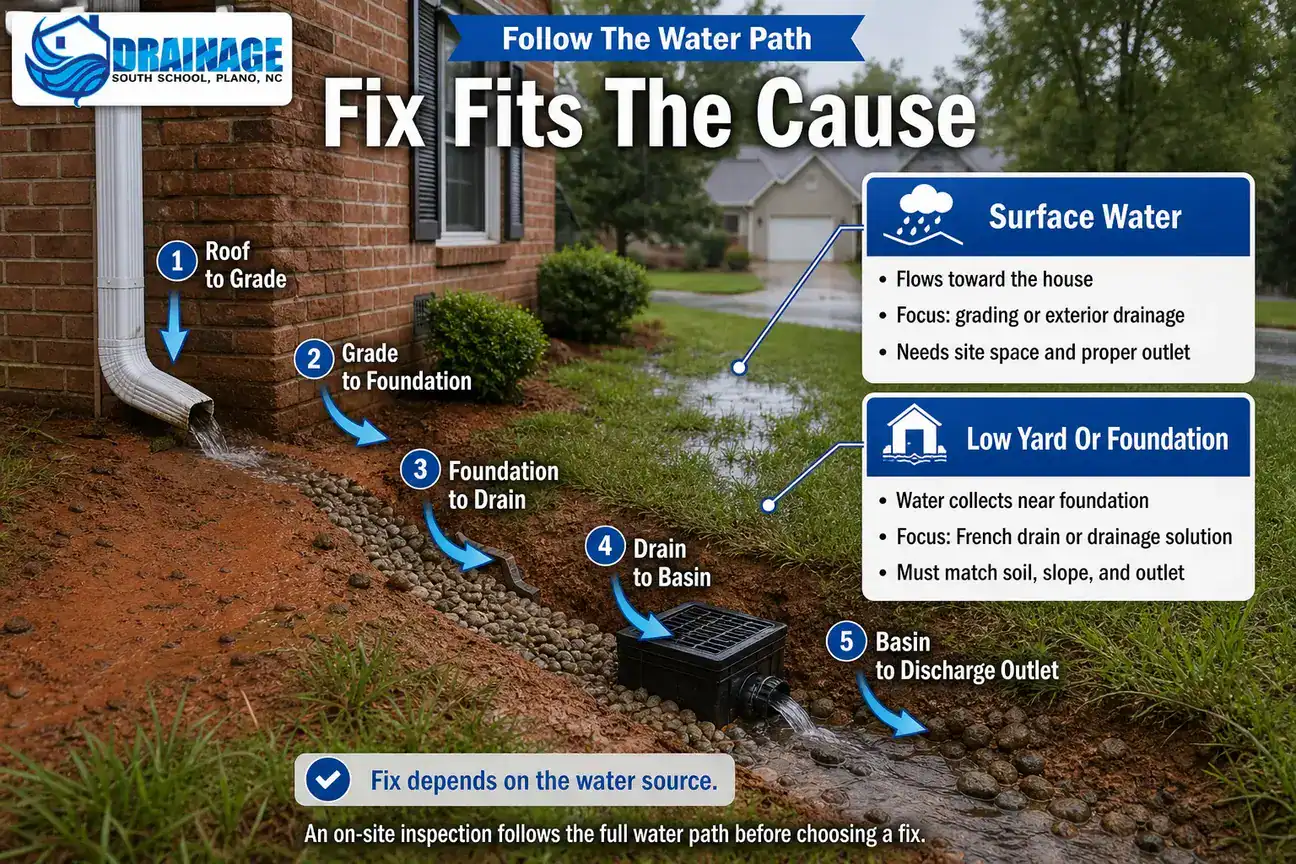
The right fix depends on the water source, not just the symptom. An on-site inspection looks at the full path: roof to grade, grade to foundation, foundation to drain, drain to basin, and basin to discharge outlet.
| Observed problem | Possible system focus | Trade-off or limitation |
|---|---|---|
| Surface water flows toward the house | Grading correction or exterior drainage planning | Requires enough site space and a proper discharge destination |
| Water collects along a foundation or low yard area | French drain installation or another drainage solution | Must match the actual flow path, soil, slope, and outlet conditions |
| Water enters below grade or near the wall-floor joint | crawl space and basement waterproofing or an interior drain system | May manage below-grade water but does not eliminate every exterior source |
| Basement stays humid or damp after storms | basement moisture control | Moisture control still depends on identifying active water entry |
| Crawl space is damp, musty, or has ground moisture | crawl space encapsulation assessment, vapor barrier, or related moisture-control work | Does not replace correction of active drainage or plumbing problems |
| Water appears to enter through foundation walls | foundation waterproofing evaluation | Requires inspection of water source, wall conditions, grade, and drainage |
| Discharge outlet sends water back near the home | Discharge correction or drainage redesign | Local stormwater rules, utilities, and site layout must be considered |
| Supply-line, fixture, sewer, or septic water is suspected | Plumber or appropriate utility professional | Drainage & Waterproofing Solutions, LLC does not provide plumbing, sewer, or septic repair |
A drainage-path issue can sometimes be part of a larger exterior problem. For example, water may leave the sump basin but collect in a low side yard that drains back to the house. In that case, focusing only on the pump misses the larger water route.
A sump pump check valve concern can also be part of a larger pattern. If backflow is happening, the pump may restart quickly even when exterior drainage is otherwise acceptable. If water is still pouring into the basin from the drainage system, the valve may not be the main issue even when cycling is frequent.
Closed or sealed crawl-space work can require a permit in North Carolina. The North Carolina OSFM interpretation on permits for closed crawl spaces is a reason to confirm requirements with the local building department before crawl-space changes are made. Permit needs can vary by scope and jurisdiction.
Drainage & Waterproofing Solutions, LLC is locally owned and family operated, with more than 20 years of experience in drainage and waterproofing work. For homeowners in the Garner/Raleigh area, a free written estimate within 60 miles of Raleigh/Garner includes an on-site inspection, a written plan, and a written quote and estimated timeline. You can request a free estimate or call (919) 508-7503 during business hours.
When to stop troubleshooting a running pump
Post-rain observation is useful only while it is safe. Stop troubleshooting and contact the appropriate professional if any of the following are true:
- Water is rising faster than the pump removes it.
- The pump runs but the basin water level does not fall.
- The breaker trips repeatedly.
- You notice burning odor, smoke, sparking, unusual heat, or severe vibration.
- Floodwater is near outlets, cords, panels, appliances, or other electrical equipment.
- The discharge pipe is broken, buried, inaccessible, or discharging where it may cause another problem.
- You cannot reach a dry, safe viewing point.
- The water may be coming from a supply line, sewer, septic system, or plumbing fixture.
- Cracks, settlement, wall movement, or structural concerns are present.
A check-valve issue, discharge obstruction, float problem, or pump malfunction can involve plumbing or pump-component work. A drainage contractor can evaluate water sources and waterproofing needs, but plumbing repairs should be directed to a plumber. Structural concerns should be directed to a structural engineer.
If a discharge problem is visible outside, avoid quick rerouting that creates a new drainage issue for a neighbor, sidewalk, driveway, or public system. The safe next step is to document what you see and confirm the right path before changes are made.
Do not try to “push through” inspection if the area is unsafe. A wet basement or crawl space with electrical exposure is not worth the risk. A few notes and photos taken from a dry, safe place are enough to help start the conversation later.
What an on-site drainage inspection can determine
An on-site inspection connects the clues. Instead of looking only at the pump, it looks at where water starts, how it reaches the house, how it enters the drainage system, whether the basin receives expected flow, and whether the discharge route moves water out and away from the building.
For post-rain sump complaints, the inspection may consider grading and slope, downspout discharge, low yard areas, foundation drainage, interior drain system behavior, the sump basin location, pump cycling pattern, discharge routing, crawl-space or basement moisture, and signs of recurring seepage. It may also identify when a plumber, electrician, structural engineer, or local building department should be involved.
Drainage & Waterproofing Solutions, LLC provides drainage system inspections. The company also offers 6-month and yearly maintenance inspections for internal drain systems it installed; that maintenance inspection includes the internal drain system, sump pump, and dehumidifier inspection with filter change for $150 per appointment.
That maintenance inspection is different from a free written estimate. For new concerns within 60 miles of Raleigh/Garner, the estimate includes an on-site inspection, written plan, written quote, and estimated timeline. Outside that 60-mile radius, a $200 trip/estimate charge applies.
If sump pump basin water rises every time it rains, if a sump pump discharge problem keeps sending water back toward the foundation, or if the pump runs but the basement or crawl space stays damp, an inspection can help separate pump behavior from the larger drainage pattern.
An inspection can also compare several clues at once: post-storm timing, the discharge location, sump pump check valve symptoms, and whether the basin water level falls during operation. Looking at those details together is more useful than assuming one part is always to blame.
Practical closing note for Garner-area homeowners
A pump that runs after a storm is not automatically failing. It may be responding to lingering inflow. But if your sump pump runs after rain and the pattern includes rapid cycling, immediate refill, ineffective discharge, rising water, or unsafe electrical conditions, stop troubleshooting and get qualified help.
The goal is not to guess at a single part. The goal is to understand the water source, the route it takes to the basin, and whether it is being discharged safely away from the home. That is why the right drainage or waterproofing solution depends on an on-site inspection of your property.
This article is general homeowner information. The right drainage or waterproofing solution depends on an on-site inspection of your property.
If you want help tracing the water path, request a free estimate or call (919) 508-7503. Within 60 miles of Raleigh/Garner, the estimate includes an on-site inspection, a written plan, and a written quote and estimated timeline.
Frequently Asked Questions
How long should a sump pump run after heavy rain?
There is no universal normal run time. It depends on rainfall, soil saturation, grading, foundation drainage, pump capacity, groundwater conditions, and discharge routing. The more important question is whether the pump lowers the water level and discharges water away from the house.
Is it normal for a sump pump to run continuously after a storm?
It can be normal for a pump to run for a while after heavy rain if water is still entering the basin and the pump is removing it. It is more concerning if the pump short-cycles, cannot lower the water, runs with a burning smell or electrical issue, or sends discharge water back toward the foundation.
How can I tell whether the pump discharge is clogged?
From a safe outdoor location, look for little or no water at the outlet while the pump is running, pooling near the foundation, or a visibly crushed, blocked, disconnected, or buried outlet. Do not dig up or reroute buried discharge piping without checking local requirements and calling for utility marking first.
What does a bad sump-pump check valve sound or look like?
Possible clues include water rushing back after shutdown, the basin refilling immediately, or the pump restarting within seconds. Those signs do not prove the valve is bad; high inflow, basin conditions, float problems, or discharge restrictions can look similar.
Why does the sump basin fill again immediately after the pump stops?
Immediate refill may come from backflow through the discharge pipe, a check-valve issue, very heavy inflow, or discharge water returning toward the foundation. Watch safely from a dry location and describe the timing to the appropriate professional instead of opening the pump or piping yourself.
Can a high water table cause the sump pump to run after rain?
Yes, high groundwater or saturated soil can keep water moving toward the sump basin after rain ends. The pump may be working correctly, but recurring post-rain operation can still point to a broader drainage issue that needs an on-site evaluation.
Should I call a plumber or a drainage contractor?
Call a plumber when the problem appears tied to plumbing, sewer, septic, supply lines, fixtures, or pump-component repair. Call a drainage and waterproofing contractor when the concern is where stormwater is coming from, how it reaches the foundation, whether discharge is routed properly, or whether basement or crawl-space waterproofing is needed.
When is a sump-pump problem unsafe to troubleshoot myself?
Stop troubleshooting if water is near electrical outlets, cords, appliances, panels, or energized equipment; if the breaker trips repeatedly; if you smell burning; if water keeps rising; or if you cannot stand in a dry, safe place. Leave the area and contact the appropriate qualified professional.
Sources
- Building America Solution Center: Drain or Sump Pump Installed in Basements or Crawlspaces
- Building America Solution Center: Site Drainage Practices to Minimize Localized Flooding
- EPA: A Brief Guide to Mold, Moisture and Your Home
- NC State Extension: Modifying Soil for Plant Growth Around Your Home
- North Carolina OSFM: Permit Required for Closed Crawl Space