
Quick Answer
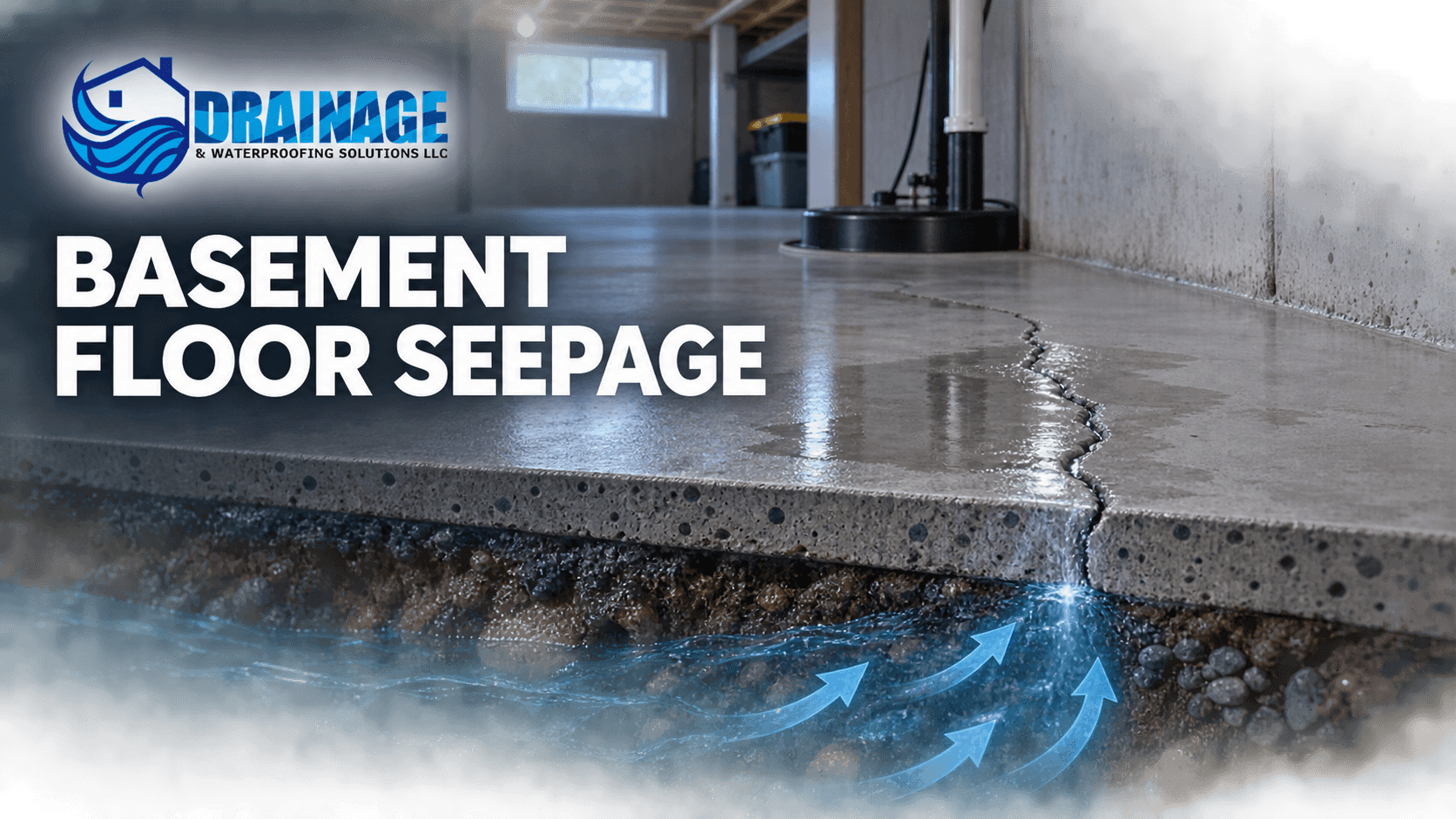
If clear water appears through a basement floor crack during or after rain, subsurface moisture is a leading possibility. Saturated soil can increase water pressure beneath and beside the slab, while capillary action and vapor diffusion can move smaller amounts of moisture through concrete. First rule out plumbing, drain, appliance, and condensation sources. Then inspect roof runoff, grading, exterior pooling, foundation drainage, the sump system, and the exact entry point. Persistent basement floor seepage usually requires water management matched to the verified cause; paint, caulk, or a surface patch alone may simply move the symptom.
Is the Water Actually Coming Through the Basement Floor?
A puddle on the slab does not prove that water rose through it. Water can travel across a nearly level floor, run behind finished walls, follow a pipe, drip from a cold duct, leak from an appliance, or emerge from the joint at the foundation perimeter. Before diagnosing basement floor seepage, dry the area if it is safe, observe where moisture reappears first, and compare the timing with rain and household water use.
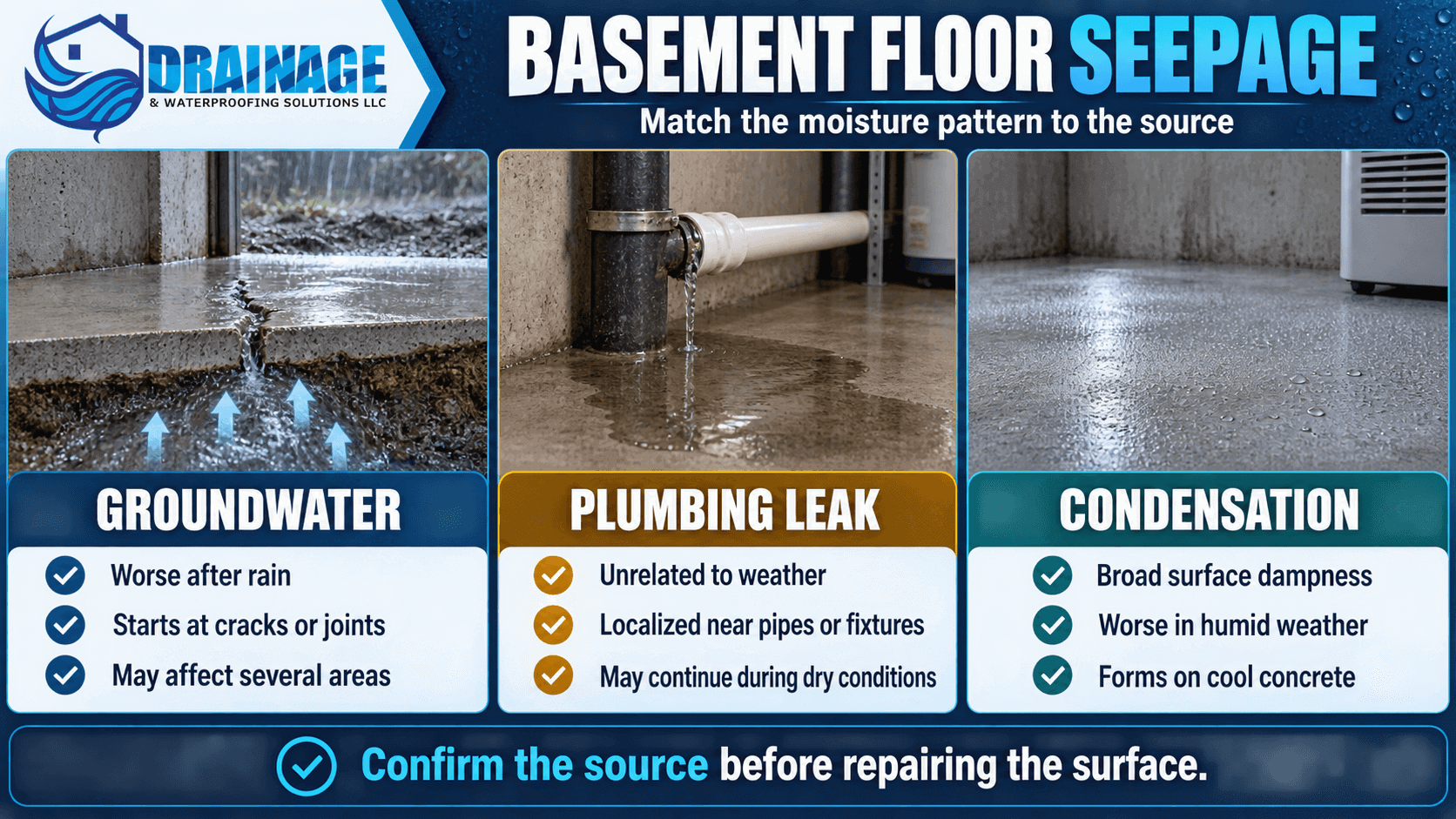
The distinction matters because each source belongs to a different repair path. Groundwater requires drainage and water-management analysis. A pressurized supply-line leak needs a plumber. A wastewater backup requires immediate sanitation precautions and the appropriate drain or sewer professional. Condensation calls for humidity and surface-temperature control. Treating all four as “waterproofing” wastes time and can conceal a more urgent problem.
| What You Observe | Possible Source | Useful Clues | Best Next Step |
|---|---|---|---|
| Wet crack after rain | Subsurface water using a slab opening | Clear water; storm-related; may recur in the same line | Inspect the full exterior-to-interior water path |
| Water begins at the perimeter | Wall-floor joint or wall leakage | First wetness at the cove joint, then flow across slab | Use the separate wall-floor leakage diagnosis |
| One wet spot in dry weather | Plumbing, appliance, or condensate leak | Unrelated to rain; near piping or equipment | Have the appropriate trade isolate the source |
| Moisture on broad cool surfaces | Condensation | Humid weather; pipes or objects may also sweat | Measure humidity and check for hidden seepage |
| Dirty or foul-smelling water at a drain | Drain or sewer backup | Slow fixtures, odor, solids, or rising drain water | Avoid contact and obtain urgent professional help |
How Does Basement Floor Seepage Happen?
Concrete is durable, but an ordinary basement slab is not an unlimited waterproof barrier. Moisture can cross or bypass it in several ways. More than one mechanism may operate at the same house, which is why a damp-looking slab and an active stream of water should not receive the same diagnosis.
Liquid Water Flow
When soil beneath or beside the foundation becomes saturated, liquid water can follow cracks, joints, penetrations, gaps, drainage stone, or other connected openings. The visible exit may be far from the original exterior source.
Water Pressure
If water accumulates faster than it can drain, the pressure against below-grade materials rises. Professionals often call this hydrostatic pressure. It encourages water to use the weakest available pathway rather than proving that the concrete itself failed.
Capillary Movement
Tiny pores in concrete can draw moisture from damp material below. This can create darkening, mineral deposits, or persistent dampness without an obvious puddle or dramatic leak.
Vapor Diffusion
Water vapor can move through porous material when vapor conditions differ from one side to the other. A missing or ineffective sub-slab vapor retarder can matter, especially before moisture-sensitive flooring is installed.
Condensation
Warm, humid air can reach its dew point on a cool slab and leave surface moisture. Condensation forms on top of the floor; it does not rise through it, though both conditions can occur together.
Connected Water Paths
A crack, utility trench, pipe sleeve, abandoned drain, sump opening, and porous fill may form a connected route. The place you see water is an exit point—not necessarily the root cause.
Safety First: Water and Electricity Do Not Mix
Do not enter standing water if outlets, extension cords, appliances, service equipment, pumps, or other electrical components may be energized. Do not touch the electrical panel while standing on a wet floor. Keep children and pets away, and contact the appropriate emergency, electrical, utility, plumbing, or remediation professional when conditions are uncertain.
Treat foul-smelling or visibly contaminated water as a potential sewage exposure. If the slab is lifting, cracking rapidly, or accompanied by bowing or displaced foundation walls, stop cosmetic work and seek qualified structural evaluation.
What Does the Timing and Location Reveal?
Patterns narrow the investigation but do not prove a cause. Photograph the first wet point, mark its boundary with removable tape, and record recent rain, sump activity, plumbing use, indoor humidity, and exterior pooling. The most useful observation is often where the water begins—not where the puddle ends.
| Pattern | What It May Suggest | Inspection Priority |
|---|---|---|
| Only after prolonged or heavy rain | Surface runoff, saturated soil, limited drainage, or elevated groundwater | Roof water, grade, outlets, foundation drainage, sump |
| Continues after rain stops | Stored water in soil is draining slowly toward or beneath the house | Site drainage and subsurface water movement |
| Always at one crack | A preferential route through the slab; pressure source may remain elsewhere | Crack condition plus water beneath the slab |
| Around a pipe penetration | Opening around the sleeve, pipe condensation, or plumbing leak | Determine whether water is outside or inside the pipe |
| Under flooring, not on exposed slab | Vapor movement, trapped seepage, adhesive failure, or another leak | Moisture testing before replacement |
| Unrelated to weather | Plumbing, condensate, appliance, drain, or year-round subsurface source | Rule out active building systems first |
Root-Cause Checklist
Eight Common Causes of Basement Floor Seepage
1. Roof Runoff Concentrated Near the Foundation
A large roof delivers substantial water during a storm. Overflowing gutters, disconnected downspouts, short extensions, eroded outlets, and buried drains that are blocked or broken can release that water beside the foundation. It may then move downward and appear as basement floor seepage.
2. Negative Grade or Exterior Ponding
Settled backfill, low planting beds, patios, walkways, driveways, and landscape edging can direct water toward the house. A visible puddle is not required; slowly infiltrating water can still load the soil beside the footing.
3. Saturated Soil or a Seasonally High Water Table
Long rain events can fill pore spaces in the soil and reduce its ability to accept more water. The resulting pressure and water movement may expose weak points in the slab or existing drainage system. This can affect structurally sound homes as well as homes with cracks.
4. Missing, Clogged, Damaged, or Overwhelmed Foundation Drainage
A footing drain or interior perimeter system must collect water, convey it without obstruction, and reach a working outlet or sump. A failure anywhere in that chain can allow water to build beneath or beside the slab.
5. Slab Cracks, Joints, and Penetrations
Concrete commonly develops shrinkage cracks, and construction creates joints and penetrations. These openings may be harmless when dry yet become water routes when conditions beneath the floor change. Sealing the route without controlling the water may cause a new leak nearby.
6. Sump-Pump or Discharge Problems
A failed pump, stuck switch, power outage, undersized system, blocked inlet, missing backup, frozen or obstructed discharge, or outlet that sends water back toward the foundation can permit the water level beneath the slab to rise.
7. Sub-Slab Plumbing or Drain Failure
A supply, waste, or condensate line beneath or near the slab can leak independently of rain. Location, temperature, odor, meter behavior, fixture use, and professional testing help distinguish plumbing water from groundwater.
8. Vapor Movement or Condensation Misidentified as Seepage
A floor can feel damp or damage a covering without carrying visible liquid through a crack. Moisture testing and humidity observations are important before installing carpet, luxury vinyl, wood, epoxy, or another low-permeance finish.
Safe Checks Homeowners Can Make Before an Inspection
Observation is valuable; destructive testing is not required. If the area is electrically safe and the water is not contaminated, document conditions before moving belongings or changing the surface.
- Find the first wet point. Dry a small observation area and watch the crack, penetration, wall edge, floor drain, pipe, appliance, and ceiling above it.
- Record timing. Note when rain began, when moisture appeared, how long it continued, and whether it repeats after similar storms.
- Inspect from safe exterior ground. Look for gutter overflow, leaking elbows, disconnected pipes, erosion, ponding, low spots, and hard surfaces that tilt toward the house.
- Observe the sump. Without bypassing guards or touching energized equipment, note whether the pump activates, whether the water level falls, and where discharge water goes.
- Check plumbing context. Note nearby bathrooms, laundry, water heaters, HVAC drains, supply lines, and floor drains. A licensed plumber may need to perform isolation or pressure tests.
- Measure relative humidity. A hygrometer can show whether humid indoor air may contribute, though it cannot rule out seepage below the slab.
- Protect evidence. Photograph staining, mineral residue, lifted flooring, crack width, and water lines before cleaning or patching.
- Move vulnerable items. Relocate cardboard, fabric, wood furniture, electronics, and stored contents to a dry area rather than setting them directly on the slab.
What a Professional Basement-Water Inspection Should Evaluate
A useful inspection follows water as a system. It should not begin and end with the wet crack. Site layout, roof discharge, surface flow, foundation type, slab condition, existing drainage, sump performance, outlet elevation, moisture pattern, and possible building-system leaks all affect the recommendation.
Exterior Inputs
Roof area, gutters, downspouts, buried conveyance, grading, patios, walkways, retaining features, neighboring runoff, low areas, erosion, and available outlets.
Foundation Pathways
Slab cracks, control joints, penetrations, perimeter joints, wall cracks, masonry conditions, patches, coatings, previous repairs, and locations concealed by finishes.
Drainage Performance
Presence and apparent condition of foundation drains, accessible cleanouts, sump pit, pump, check valve, alarms, backup provisions, discharge routing, and evidence of recirculation.
Competing Sources
Plumbing, wastewater, condensate, appliances, humid air, roof leaks, wall seepage, window wells, and water traveling behind finished assemblies.
Which Solutions Actually Address Basement Floor Seepage?
The right plan controls the verified source, creates a reliable path for water, protects the structure and interior, and reaches a suitable discharge point. It may combine low-cost exterior corrections with subsurface drainage. It should also distinguish liquid entry from vapor transmission before floor finishes are selected.
| Verified Condition | Potential Response | Important Limitation |
|---|---|---|
| Roof water released at foundation | Repair conveyance and route discharge to a suitable location | Do not send water toward neighbors, septic areas, or back toward the house |
| Negative grading or ponding | Correct surface flow, settlement, swales, or site drainage as appropriate | Utilities, siding clearance, entrances, and outlet elevation constrain work |
| Persistent water beneath slab | Evaluate interior or exterior foundation drainage connected to reliable discharge | System design depends on foundation, soil, layout, and destination |
| Sump cannot keep up or discharge | Correct pump, inlet, power, backup, pipe, outlet, or capacity issue | A larger pump alone does not fix blocked drainage or recirculation |
| Isolated nonmoving crack with controlled water | A compatible crack-repair system may be part of the plan | Repair material cannot relieve ongoing water pressure or structural movement |
| Vapor transmission through slab | Professional moisture testing and a compatible flooring/vapor-control assembly | A vapor product is not a solution for active liquid leakage |
| Plumbing or drain failure | Repair and test the affected building system; dry and remediate materials | Drainage work cannot substitute for plumbing or sewer repair |
Why Paint, Caulk, and Quick Patches Often Fail
A surface product may be useful only after the cause, substrate condition, moisture load, and repair objective are understood. If water continues accumulating below the floor, plugging one opening can increase pressure at the patch or redirect water to another crack, joint, or penetration. A coating can also trap visible evidence until adhesion fails.
Likewise, a dehumidifier manages water vapor in the air; it does not intercept liquid water below the slab. It can support a dry-basement plan after leaks are controlled, but it should not be presented as a cure for basement floor seepage.
A durable repair answers four questions: Where is the water coming from? How does it reach the slab? Where will it be collected? Where can it discharge safely?
Why Raleigh-Area Homes Need a Whole-Property Diagnosis
Central North Carolina properties vary widely in elevation, grading, soil behavior, lot drainage, foundation design, additions, landscaping, and stormwater outlets. Intense rainfall can expose a weak link that remains invisible during dry weather. Water may arrive from the roof, an uphill yard, a hard surface, a neighboring drainage pattern, saturated soil, or a building-system leak.
That is why basement floor seepage should be assessed in context. A crack may be the visible exit, while the actual cause is a disconnected downspout, settled grade, failed footing drain, underperforming sump, obstructed discharge line, or water redirected by later landscaping. Conversely, a wet spot that appears without rain may have nothing to do with exterior drainage.
Drainage & Waterproofing Solutions can connect drainage-system inspection, basement moisture control, and foundation waterproofing when the evidence shows those services belong in the same plan.
Evidence and Limits
What Does a Wet Basement Floor Prove?
A wet floor proves that water reached the visible surface. It does not, by itself, prove groundwater, hydrostatic pressure, structural failure, a plumbing leak, or the need for a particular system. Even water sitting directly on a crack may have traveled across the surface from the wall or from above.
Responsible diagnosis combines the first wet location with weather history, exterior drainage, plumbing context, sump behavior, material condition, moisture measurements, and repeat observations. Some concealed conditions cannot be confirmed without specialized testing or limited access.
It Does Not Prove Foundation Failure
Many water-entry problems occur in foundations without structural failure. Floor heaving, displacement, widening cracks, bowing walls, or other movement are separate signs that may require an engineer.
It Does Not Select One System
Exterior water management, foundation drainage, sump work, crack repair, vapor control, plumbing repair, and humidity control solve different problems. The visible puddle cannot choose among them.
It Does Not Justify Covering the Floor
Installing flooring over unresolved moisture can trap water, damage adhesives and finishes, and conceal recurrence. Diagnose and control moisture before finishing the basement.
How Can You Reduce the Chance of Basement Floor Seepage Returning?
Maintain Roof-Water Conveyance
Inspect gutters, downspouts, connections, and outlets during rain. A pipe that looks intact in dry weather may leak, overflow, or discharge beside the house under storm flow.
Protect Positive Surface Drainage
Watch for settled soil, mulch dams, eroded swales, sunken pavers, new planting beds, and hard surfaces that change the route of runoff toward the foundation.
Test Installed Equipment
Follow manufacturer and professional guidance for sump pumps, alarms, backup power, check valves, drains, and discharge lines. Observe the complete cycle and outlet, not just motor noise.
Keep the Slab Observable
Do not permanently cover a recurring wet area before diagnosis. Use raised, moisture-resistant storage practices and retain access to cracks, drains, sumps, and perimeter conditions.
Control Humidity After Leakage Is Addressed
Monitor relative humidity and operate correctly sized equipment as needed. Humidity control protects materials but does not replace liquid-water management.
Recheck After Major Storms
Inspect the same locations after heavy or long-duration rain. Early staining, mineral residue, pump changes, or damp edges may reveal a developing problem before a large puddle forms.
When Should You Call for Help?
Request prompt help for standing water near electrical equipment, sewage or drain backup, rapid inflow, a pump that cannot lower the water, suspected active plumbing leakage, or slab and wall movement. Schedule a drainage and waterproofing evaluation when basement floor seepage repeats after rain, spreads to multiple cracks, damages finishes, continues after exterior maintenance, or returns after a surface patch.
Bring photographs and a simple timeline. Knowing the rain conditions, first wet point, duration, sump behavior, and recent property changes can make the inspection more productive.
People Also Ask
Frequently Asked Questions
Why is water coming up through my basement floor after rain?
Rain can saturate soil around and beneath the foundation faster than the property’s surface and subsurface drainage can carry it away. Water then follows available cracks, joints, penetrations, or porous material. Check roof discharge, grading, exterior pooling, foundation drainage, sump performance, and the exact first wet point.
Can water really pass through solid concrete?
Concrete contains pores and often has cracks, joints, and penetrations. Liquid water can use connected openings, while smaller amounts of moisture can move by capillary action or vapor diffusion. The mechanism matters because active liquid entry and vapor transmission require different responses.
Does basement floor seepage mean my foundation is failing?
Not by itself. Many basement water problems are drainage or moisture-management issues rather than structural failures. However, floor heaving, offset slab sections, widening cracks, bowing walls, or other movement should be evaluated by an appropriately qualified structural professional.
Will sealing a floor crack stop the water?
It may seal one route if the crack is suitable and the underlying water condition is controlled. If water remains beneath the slab, pressure can challenge the repair or move the leak to another opening. Diagnose and manage the water source before treating the crack as an isolated defect.
Will waterproof paint stop water coming through a basement floor?
A coating may reduce limited surface moisture when the substrate and product are appropriate, but it is not a substitute for managing active water beneath the slab. Pressure, poor adhesion, salts, or ongoing wetting can make coatings blister, peel, or redirect the visible leak.
Can a dehumidifier fix basement floor seepage?
No. A dehumidifier removes water vapor from indoor air. It can help control humidity after liquid entry is corrected, but it cannot intercept groundwater, repair plumbing, clear a drain, restore grading, or provide a path for water below the slab.
How can I tell groundwater from a plumbing leak?
Groundwater-related leakage commonly tracks rain or seasonal wet conditions and may affect cracks, joints, or several areas. Plumbing water may appear regardless of weather and relate to fixture use, equipment, pressure, temperature, odor, or meter behavior. Do not rely on one clue; a plumber may need to isolate and test the system.
Is water at the wall-floor joint the same problem?
Not necessarily. Water may enter at the cove joint where the wall and floor meet, then spread across the slab and resemble floor seepage. Observe where wetness begins. See the dedicated guide to water leaking where the basement wall meets the floor for that specific pathway.
Can I install flooring after the basement looks dry?
A dry appearance on one day is not enough. Moisture can be seasonal, storm-dependent, or present as vapor without a visible puddle. Resolve known leakage and use appropriate professional moisture testing and flooring specifications before installing moisture-sensitive finishes.
Who should inspect basement floor seepage in Raleigh, NC?
A drainage and waterproofing professional can evaluate runoff, grading, foundation pathways, drainage, sump equipment, and discharge. Use a licensed plumber for suspected supply, waste, or appliance leaks, and an engineer when heaving, displacement, or significant structural movement is present.
Find the Water Path
Request a Basement Drainage and Moisture Evaluation
If water returns through a floor crack, appears after storms, overwhelms the sump, or damages basement finishes, diagnose the full route before covering or patching the evidence.
Drainage & Waterproofing Solutions, LLC serves Raleigh and surrounding Central North Carolina communities with drainage inspection, basement moisture control, foundation waterproofing, and related water-management services.
Related Drainage and Basement Resources
Authoritative References
This guide uses established building-moisture principles and is educational, not a site-specific diagnosis.