
French Drain Installation in Raleigh, NC
Standing water, soggy lawn areas, and water collecting near a foundation can have different causes. At Drainage & Waterproofing Solutions, we inspect the property, identify how water is moving, and prepare a written plan for the drainage work that fits the site.
We serve Raleigh, Garner, and nearby Triangle communities with on-site inspections and written estimates for residential drainage projects.
Find out why water is collecting before choosing a drain
A French drain is an underground drainage system designed to collect and move water away from a problem area. It may help when water is traveling through saturated soil or repeatedly collecting in a low area. The right design depends on where the water comes from, the property’s slope and soil, and whether a suitable outlet is available.
A French drain is not the right answer for every leak or puddle. Roof runoff, a blocked surface drain, grading, foundation seepage, and groundwater can require different or combined solutions. Our on-site evaluation helps distinguish among them.
A French drain typically uses a gravel-filled trench and a perforated drainage pipe to collect subsurface water and convey it toward a planned outlet. Its performance depends on the water source, layout, soil conditions, and outlet path—not simply the amount of gravel or pipe used.
Signs you may need a French drain evaluation
Consider a drainage assessment when the same water problem returns after rain or water repeatedly gathers in a particular part of the property. These signs point to a drainage concern, but they do not prove that a French drain is the correct solution.
Recurring standing water
Puddles remain in the same lawn area after rainfall or take unusually long to disappear.
Soggy ground near the house
Soil stays saturated near a foundation, crawl-space access, or basement wall.
Water following a predictable route
Runoff moves across a walkway, driveway edge, or yard toward a low spot.
Erosion or washed-out mulch
Repeated flow leaves channels, exposes roots, or moves soil and landscape material.
Moisture inside a basement or crawl space
Water at a wall-floor joint or persistent dampness may require drainage and waterproofing to be evaluated together.
An existing drain that no longer performs
A blocked outlet, sediment buildup, or a changed site condition can affect an older drainage system.
How a French drain collects and redirects water
A French drain is a subsurface drainage assembly. In a typical design, water moves through the surrounding soil toward a gravel-filled trench. A perforated pipe within the trench collects that water and carries it toward a planned outlet. Filter materials may be used as part of the design to limit soil and sediment entering the drainage system.
The exact materials, pipe placement, trench dimensions, and outlet depend on the conditions at the property. A yard drainage run is not automatically the same as a foundation perimeter drain, and a drain that works on one lot may not work the same way on another.
The water must have a route into the drain and a suitable path out. If the source, trench location, pipe route, or outlet is wrong for the property, adding more gravel or extending the pipe alone may not correct the problem.
French drain design depends on the whole water path
A French drain is more than a trench with stone. A sound design accounts for the area contributing water, how water reaches the drain, the route the pipe can follow, and where collected water can discharge. A system can underperform if any part of that path is overlooked.

This illustration explains common design considerations. The system recommended for your property depends on an on-site evaluation.
Water source
Roof runoff, surface flow, and water moving through soil behave differently. Identifying the source helps determine whether water should be collected at the surface, below ground, or at a specific entry point.
Site and soil conditions
Available slope, low areas, soil layers, existing landscaping, and nearby structures influence where a system can go and how it can function. North Carolina State Extension notes that restrictive soil layers can impair subsurface drainage.
Drain route
The trench and pipe route need to connect the collection area to the outlet. Existing walkways, driveways, foundations, trees, utilities, and property boundaries can affect the available route.
Outlet and discharge
Collected water needs a practical destination. We consider the outlet location, elevation, route, and site conditions during planning.
Existing drainage features
Gutters, downspouts, surface drains, catch basins, and older underground pipes can contribute to or affect a drainage problem. Their condition and layout may be relevant to the proposed work.
Property use and restoration
Access, landscaping, hardscape, and the area’s intended use help shape the work plan. The estimate should identify the proposed scope and any restoration included.
Problems a French drain may help address
A French drain may be considered when water moves through saturated soil or repeatedly collects below the surface. It can be part of a drainage plan for a wet yard or for certain foundation drainage conditions. The inspection should first confirm the source and determine whether there is a suitable place for the water to go.
Situations worth evaluating
- Waterlogged areas that recur after rain.
- Water moving through soil toward a low section of the yard.
- Persistent wet ground near a foundation.
- Drainage concerns near a basement or crawl space.
- An older drainage system that may be blocked or no longer suited to the site.
When another measure may be needed
A French drain does not repair a leaking pipe, correct every grading problem, or seal a foundation by itself. Roof runoff may need downspout routing. Surface water at a defined low point may need a catch basin or surface drain. Basement water can require interior drainage, a sump pump, foundation waterproofing, or a combination.
French drain, surface drain, or another solution?
The visible symptom does not always reveal the underlying cause. We evaluate whether the problem is mainly surface runoff, subsurface water, roof discharge, or water entering the foundation before recommending a drainage approach.
| Drainage approach | May be considered when | Important planning question |
|---|---|---|
| French drain | Water is moving through saturated soil or repeatedly collecting below the surface. | Can the system collect water and reach a suitable outlet? |
| Catch basin or surface drain | Runoff collects at a defined surface low point, such as beside a paved area. | Can surface water enter the drain without creating a blockage or discharge issue? |
| Gutter and downspout routing | Roof water is being released too close to the foundation or into a problem area. | Can roof runoff be conveyed away safely and separately from other drainage? |
| Grading or surface-flow correction | Water is flowing across the ground toward the house or remaining in a shallow low spot. | Can the surface be adjusted without directing water toward neighboring property? |
| Foundation or interior waterproofing | Water is entering a basement or crawl space through or beneath the structure. | Is the problem caused by exterior water pressure, an entry point, or interior collection needs? |
Some properties need more than one measure. Learn about our foundation waterproofing, crawl-space and basement waterproofing, and drainage system inspection services.
What to expect from a French drain evaluation
We begin by learning where water appears, when it occurs, and how it affects your property. During an on-site inspection, we assess the drainage conditions and prepare a written estimate with a proposed resolution, cost, and estimated timeline.
Tell us what is happening
Describe where water collects, when you notice it, and whether the problem affects your yard, foundation, basement, or crawl space.
We inspect the property
We review water patterns and site conditions before recommending a drainage approach. The inspection helps distinguish between surface runoff, subsurface water, and water entering the home.
Review the written scope
Your estimate outlines the proposed resolution, price, and expected project timeline. Review the work area, outlet plan, and any restoration details before approving the work.
Plan before excavation
We coordinate the work area, outlet plan, access needs, and utility-marking arrangements before digging begins.
North Carolina 811 advises excavators to request utility marking and wait for responses before digging. Public utility locating may not include privately owned lines such as irrigation, lighting, or other customer-owned services. Review NC 811’s homeowner FAQs and ask what additional private-line locating may be needed.
Drainage systems installed for residential properties
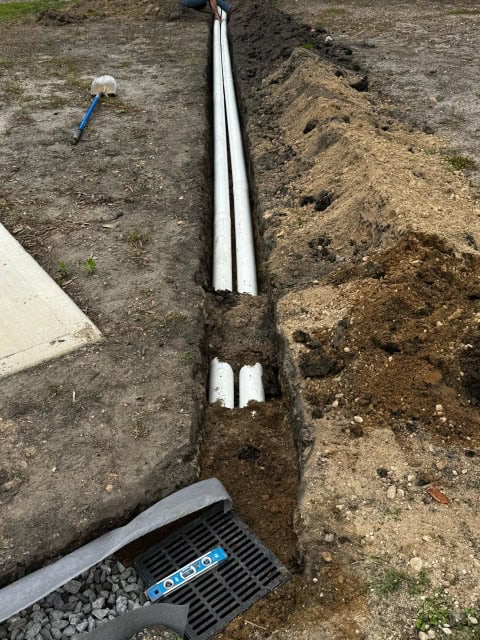
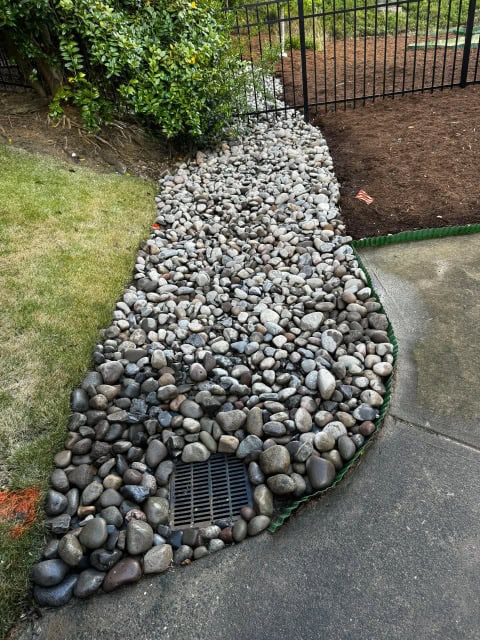
Every property has its own water-flow patterns and site conditions. Our drainage work may include underground piping, surface collection points, and rock-lined channels, depending on the problem and the layout of the property.
The project photos below show examples of residential drainage features, including underground pipe routing and a rock-lined collection channel. The system recommended for your home will depend on the source of the water and the conditions at your property.
See more completed drainage work
Visit our project gallery to see additional drainage and waterproofing work.
If water is entering a basement or crawl space, the solution may involve more than a yard drain. We can also evaluate related foundation waterproofing needs.
French drain estimates in Raleigh, Garner, and the Triangle
We serve Raleigh, Garner, and nearby communities, including Cary, Apex, Durham, Holly Springs, Clayton, and Wake Forest. Our contact page lists free estimates within a 60-mile radius of Raleigh and Garner. For locations outside that radius, a $200 trip and estimate charge applies. Contact us to confirm service availability and the estimate policy for your address.
Learn more about our work in the area on our Raleigh service page. If runoff is coming from a public street or public property, the City of Raleigh describes a separate Drainage Assistance Program. That situation may need to be evaluated before choosing private-property drainage work.
French drain installation FAQs
What is a French drain, and how does it work?
A French drain is a subsurface drainage system that typically uses a gravel-filled trench and perforated pipe to collect water moving through saturated soil. The collected water travels toward a planned outlet. The design must account for the water source, site conditions, route, and discharge location; a generic trench depth or layout does not fit every property.
How do I know if I need a French drain?
Recurring soggy ground, standing water, erosion, or moisture near a foundation can justify a drainage evaluation. These symptoms can also come from roof runoff, surface grading, a blocked drain, or water entering through the foundation. We inspect the source before deciding whether a French drain, a surface drain, downspout routing, or another measure is appropriate.
Will a French drain solve water in my basement or crawl space?
A French drain may help when exterior water contributes to the problem, but it is not a guaranteed fix for every basement or crawl-space leak. Water can enter through wall or floor joints, cracks, or beneath the structure. The evaluation should identify the entry path and determine whether exterior drainage, interior drainage, waterproofing, or a combination is needed.
Does clay soil make a French drain ineffective?
Clay is one site factor, but the soil layer, location, water source, and outlet also matter. North Carolina State Extension notes that restrictive layers, such as clay that reduces water movement, can impair subsurface drainage. A property-specific assessment is more useful than assuming every clay-soil yard needs the same drain design.
How deep should a French drain be?
There is no single depth that is right for every French drain. A yard drain and a foundation drainage system serve different conditions and may require different placements. The appropriate depth depends on where water is moving, the area being protected, existing structures and utilities, and how the system can reach its outlet.
Where does a French drain send the water?
The outlet must be selected during planning. Depending on the property, a design may use a suitable lower area or an approved drainage connection. The route should not create a new problem by directing water toward a foundation, neighboring property, or an unsuitable discharge point. Ask us to explain the proposed outlet in the written scope.
Is a French drain different from a catch basin or yard drain?
Yes. A French drain generally collects subsurface water through gravel and perforated pipe. A catch basin or surface drain collects runoff at a visible low point through a grate or inlet. Some properties need one type, and others need both. The water source and path determine which system is suitable.
How much does French drain installation cost in Raleigh?
Cost depends on the length and depth of the system, excavation access, soil and landscape conditions, materials, and outlet requirements. We provide a written estimate after an on-site inspection. Estimates are free within 60 miles of Raleigh/Garner; a $200 trip and estimate charge applies outside that radius.
How long does French drain installation take?
Project time depends on the amount of excavation, access, system length, site conditions, and restoration work. We include an estimated completion timeline in the written estimate. Before approving the project, ask about the expected start date, work duration, property access, and any landscape-restoration details included in the scope.
How do I maintain a French drain?
Keep the outlet visible and clear of leaves, sediment, and other obstructions. After major storms, look for new pooling, erosion, or changes in discharge. If the system has cleanouts or surface inlets, keep them accessible. Inspection needs depend on the property and system; persistent problems should be evaluated instead of treated with repeated surface clearing alone.
Do you install French drains in Raleigh and nearby Triangle towns?
Yes. We serve Raleigh, Garner, and nearby communities, including Cary, Apex, Durham, Holly Springs, Clayton, and Wake Forest. Estimates are free within 60 miles of Raleigh/Garner. Call (919) 508-7503 to confirm availability and the estimate policy for your address.
Helpful North Carolina drainage resources
- North Carolina 811 homeowner FAQs — utility marking information before excavation.
- NC State Extension: Drainage and North Carolina soils — background on soil layers and subsurface drainage.
- City of Raleigh Drainage Assistance Program — information for qualifying public-property runoff concerns.
Get a written plan for your drainage problem
Tell us where water is collecting and how it affects your property. We’ll inspect the site and provide a written plan, estimate, and expected timeline for work within our service area.
Estimates are free within 60 miles of Raleigh/Garner. A $200 trip and estimate charge applies outside that radius.